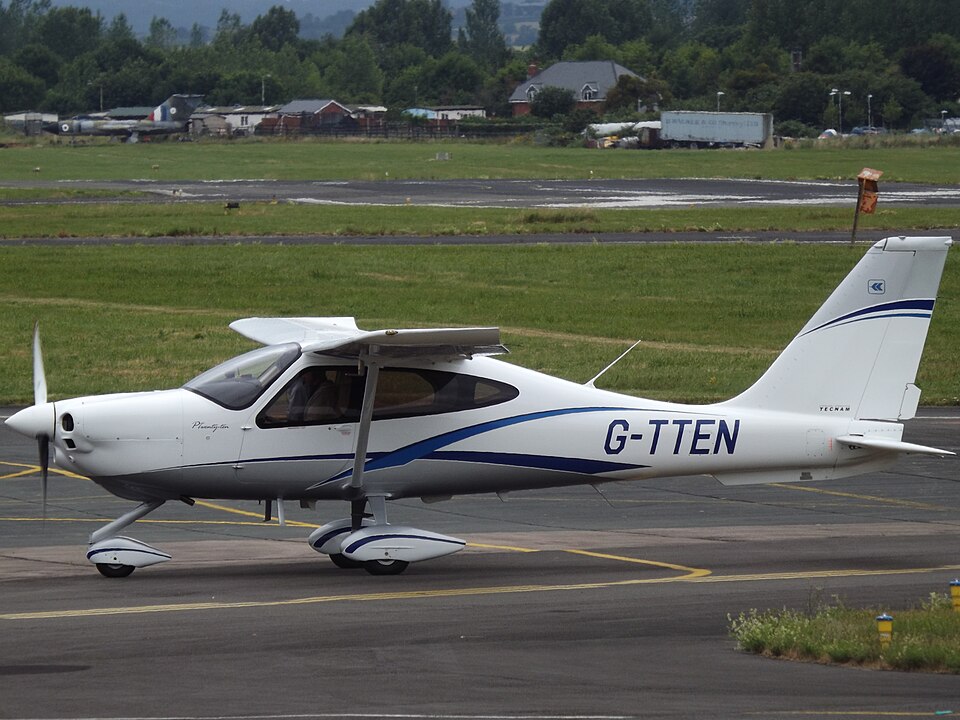
If you have ever stood on the ramp and done a double take at an unfamiliar high-wing airplane, there is a good chance it was a Tecnam P2010. It looks just enough like a Cessna 172 Skyhawk to fool you from a distance. But get closer, and you will quickly notice the sleek composite lines, the extra rear door, and a cockpit that feels more like a luxury car than a traditional trainer.
Both aircraft carry four people. Both use a Lycoming engine. Both sit high-winged and proud on a tricycle gear. After that, the comparison gets interesting fast. One is a legend with decades of proven history. The other is a modern Italian design with serious performance credentials.
This guide digs into the Tecnam P2010 vs Cessna 172 comparison from every angle: speed, cabin comfort, avionics, price, maintenance, and the kind of flying each plane does best. By the end, you will have a clear sense of which one fits your mission.
Key Takeaways
The Tecnam P2010 and Cessna 172 are both four-seat, high-wing singles powered by Lycoming engines, but they are very different airplanes in practice. The P2010 is faster, has a wider cabin, and comes loaded with modern avionics as standard, while the 172 wins on parts availability, a larger support network, and its unmatched track record as a trainer. For pilots who want modern performance and style, the P2010 is a compelling choice. For those who prioritize familiarity, resale value, and low-risk ownership, the 172 remains a tough aircraft to beat.
| Category | Tecnam P2010 | Cessna 172 Skyhawk |
| Cruise Speed | ~137–146 knots (variant dependent) | ~124 knots |
| Engine | Lycoming IO-360 (180 hp) or IO-390 (215 hp) | Lycoming IO-360 (180 hp) |
| Useful Load (standard) | ~992 lbs (book); ~910 lbs (actual tested) | ~918 lbs |
| Cabin Width | Wider composite fuselage | Narrower aluminum fuselage |
| Doors | 3 passenger doors + 1 baggage door | 2 doors |
| Standard Avionics | Garmin G1000 NXi | Garmin G1000 NXi (current models) |
| New Price (approx.) | ~$420,000–$700,000+ (used market) | ~$369,000+ new |
| Support Network | Growing in the US; stronger in Europe | Extensive worldwide |
| Best For | Cross-country travel, modern ownership | Training, first ownership, resale |
Flying411 is a great resource for pilots navigating the aircraft ownership and buying process — with guides, comparisons, and expert insight all in one place.
A Tale of Two Manufacturers
The Cessna 172 Skyhawk needs no introduction. Cessna began producing it in the 1950s, and by most accounts it has become the most produced aircraft in general aviation history. Hundreds of thousands of pilots have trained in one. The 172 is the starting point for so many flying careers that it has become something of a cultural institution in American aviation.
The Tecnam P2010 is a very different story. Tecnam is an Italian aircraft manufacturer based near Naples, and the company has been building light aircraft for decades. The P2010 was first unveiled at AERO Friedrichshafen in 2011 and made its maiden flight in April 2012. It received European Aviation Safety Agency (EASA) certification in September 2014 and FAA certification in December 2015.
Fun Fact: The Tecnam P2010 is said to be the first all-new high-wing, four-seat single certified under FAA Part 23 since the Cessna 177 Cardinal in 1968. That is a gap of nearly half a century between new entrants in this specific category.
The P2010 was designed specifically to challenge legacy products like the 172. And in several meaningful ways, it does exactly that.
How They Are Built: Materials and Construction
This is one of the clearest differences between the two aircraft.
The Cessna 172 uses a conventional riveted aluminum construction throughout. It is a tried-and-true method that has produced rugged, repairable, and maintainable airframes for decades. Any A&P mechanic in America can work on aluminum sheet metal with confidence, and that matters a great deal when something needs fixing in a small town.
The Tecnam P2010 takes a hybrid approach. Its fuselage is made of carbon fiber composite, which is lighter and more aerodynamically smooth. The wings and tail surfaces are all-metal aluminum. This combination gives the P2010 a slippery, low-drag profile that contributes directly to its speed advantage.
Good to Know: The P2010's carbon fiber fuselage allows for a wider cabin than aluminum construction of similar weight would typically allow. This is one reason the P2010 feels more spacious inside despite having a similar external footprint to the 172.
The 172's aluminum construction is something most pilots view as a maintenance advantage. Parts are plentiful, repairs are well-understood, and the airframe has a well-documented history of how it ages. Composite repair, by contrast, requires more specialized skills and equipment.
Performance: Where the P2010 Pulls Ahead
This is the section where the P2010 makes a strong case for itself.
Cruise Speed
The standard 180-horsepower P2010 cruises at around 137 knots. The MkII version with the 215-horsepower Lycoming IO-390 pushes that up to roughly 146 knots. The Cessna 172 Skyhawk, by comparison, cruises at around 124 knots.
That gap of 13 to 22 knots might not sound huge in everyday terms. But on a 500-nautical-mile cross-country flight, that kind of speed difference translates into a meaningful saving in time and fuel stops.
Why It Matters: Tecnam's own team described the P2010 as carrying four 200-pound passengers, two and a half hours of fuel, and luggage while staying within legal weight limits. That is a real-world useful load capability that many pilots struggle to achieve in a fully loaded 172.
Takeoff Performance
Here is where the 172 has an advantage. The P2010's aerodynamically clean design that helps it cruise fast also means it does not want to stop flying. Its takeoff roll is longer than the 172's, and during landing it tends to float farther down the runway than pilots expect. Pilots transitioning from the 172 often note that the P2010 requires a deliberate slip on final approach to bleed off extra energy.
The 172 gets off the ground more quickly and lands in a shorter distance. For pilots who regularly use shorter strips, that is a practical consideration worth taking seriously.
Range
The standard gasoline P2010 has a range of roughly 720 nautical miles. The diesel TDI variant stretches that to around 1,050 nautical miles thanks to its much lower fuel burn of about 5.2 gallons per hour. The standard 172 has a range of roughly 640 nautical miles.
Cabin and Comfort: A Clear Win for Tecnam
Step inside a Tecnam P2010, and the difference is immediately obvious. The composite fuselage allows for a wider, more car-like interior. The seats are ergonomically designed with quality materials that reflect the aircraft's Italian heritage.
The P2010 also has three passenger doors plus a separate baggage door. Front-seat passengers each get their own door. Rear passengers have a large dedicated door on the port side. For anyone who has watched a full-grown adult contort themselves into the back of a 172, this feature alone is worth paying attention to.
Pro Tip: The P2010's rear door is not just a convenience feature. For flight schools and charter operators, it makes boarding and deplaning much faster and more dignified for passengers, which matters if you are trying to impress a skeptical non-pilot.
The Cessna 172 has two doors, one on each side for the front seats. Rear passengers climb in and shuffle across. The cabin is narrower, and the interior quality on older 172s can vary widely depending on age and how well the previous owner maintained it.
For pilots focused on the passenger experience, and especially those who fly with people who are not pilots themselves, the P2010's cabin is a genuine advantage.
The Tecnam P2010 vs Cessna 172: A Direct Comparison of Key Factors
Here is a side-by-side look at the areas that matter most to buyers.
Engine Options
Both aircraft share the well-known Lycoming IO-360 as their base engine at 180 horsepower. This is genuinely good news for P2010 buyers, because it means the engine itself is not a mystery. Lycoming IO-360 parts, service shops, and mechanics are widely available across the United States.
The P2010 MkII adds the Lycoming IO-390 at 215 horsepower, giving pilots a meaningful performance boost. The 172 does not offer this option in its standard lineup.
Tecnam also offers the TDI variant with a Continental CD-170 diesel engine running on Jet-A fuel. This is a significant advantage internationally where avgas can be scarce, and it dramatically improves range and reduces fuel costs per hour.
Keep in Mind: The P2010 TDI's diesel engine has a manufacturer-specified time between overhaul of 1,200 hours, which is shorter than what many pilots are used to with traditional Lycoming engines. Factor that into your long-term ownership cost calculations.
Avionics
Current production P2010s come standard with the Garmin G1000 NXi glass cockpit, the GFC700 autopilot, synthetic vision, ADS-B in and out, and active traffic. The avionics package is genuinely impressive and compares favorably with aircraft costing significantly more.
The current Cessna 172 also comes with the G1000 NXi in new models. However, the huge fleet of older used 172s still on the market runs the gamut from steam gauges to various generations of glass panels. If avionics are important to you, be specific about which variant of the 172 you are comparing.
Price
New Cessna 172s have listed at roughly $369,000 in recent years. New P2010 models have varied based on configuration, with used examples listed between roughly $420,000 and $700,000 depending on variant, hours, and equipment.
This pricing reflects the premium nature of the P2010. It is not a budget airplane. But when you factor in what you get for the money: speed, cabin, avionics, and modernity, the value proposition becomes clearer.
If you are weighing your options in the used aircraft market, Flying411 offers detailed aircraft guides and comparisons to help you find the right fit for your budget and flying style.
Heads Up: The P2010's smaller production numbers compared to the 172 mean fewer used examples on the market at any given time. Patience may be required when shopping for the right one.
Maintenance and Support
This is arguably the 172's strongest long-term advantage. The sheer number of Cessna 172s flying worldwide means that parts availability is excellent, mechanics are experienced with the type, and annual inspection costs are predictable.
The P2010 is still a relatively new aircraft in the US fleet. Service centers are available but concentrated. Europe has a larger network of Tecnam-approved shops. As P2010 ownership grows in the US, this situation is gradually improving, but it is a real consideration today.
The composite fuselage, while strong and aerodynamically efficient, requires different repair techniques than aluminum. Not every shop will be comfortable working on it, and finding one that is may mean more travel to reach a qualified facility.
Insurance
Insurance costs for the P2010 will generally be higher than for a comparable 172. The aircraft is newer, less common, and the limited community of pilots with type-specific time means insurers may require more experience or higher premiums, especially for new owners.
Who Each Aircraft Is Built For
The Cessna 172 Is the Right Choice If...
You are a student pilot or recently certificated pilot building hours. The 172's forgiving nature and wide support network make it ideal for the early stages of a flying career. For a deep look at what the 172 offers new pilots, this guide to why student pilots prefer training in the Cessna 172 covers it thoroughly.
You want predictable resale value. The 172 holds its value well because demand is consistently high. If you are not sure how long you will own the aircraft, that matters.
You fly from shorter strips or rural airports. The 172's shorter takeoff and landing performance gives it an edge in places where runway length is limited.
You want the widest possible maintenance network. Anywhere in the United States, you can likely find a shop familiar with the 172. That peace of mind has real value.
You are shopping used with a limited budget. There are far more used 172s available than P2010s, and they span a very wide price range. A well-maintained used 172 can be found for significantly less than any P2010 on the market. To understand what to look for in a used purchase, reading a Cessna 172 buyer's guide is a smart starting point.
The Tecnam P2010 Is the Right Choice If...
You do longer cross-country trips regularly and speed actually matters to your schedule.
You fly with non-pilot passengers who care about comfort. The wider cabin, ergonomic seats, and rear door make a real difference.
You want modern avionics as a standard feature rather than a costly retrofit.
You are comparing the P2010 to something like a Cessna 182 Skylane but prefer a lower purchase price. The P2010 performs closer to a 182 in several key areas while costing less than a comparable new Skylane.
You have access to a Tecnam-approved service facility within reasonable distance and have the experience level (or are willing to build it) to satisfy insurance requirements.
How the 172 Compares to Other Alternatives
Before settling on either the 172 or the P2010, it helps to understand where each sits in the broader market. The 172 is often compared to a wide range of alternatives, and many pilots explore several options before deciding.
For pilots interested in how the 172 stacks up against other popular singles, comparisons like Cirrus SR22 vs Cessna 172 and Grumman Tiger vs Cessna 172 offer useful context. Those looking at older Cessna models can also explore how the Cessna 170 vs 172 and Cessna 175 vs 172 differ in design and performance.
For utility-focused buyers, the Cessna 185 vs 172 comparison shows what a more capable, backcountry-focused Cessna looks like. And if you want to go back to the basics, the Piper Tri-Pacer vs Cessna 172 comparison is a fun look at how the 172 compares to another classic from the same era.
Understanding what the 172 offers across different model generations also helps. A look at the different models of the Cessna 172 can clarify which year and configuration best fits your needs, while a review of Cessna 172 characteristics and specifications gives you the technical foundation to make a solid comparison.
Fun Fact: The Cessna 172 has appeared in more flight training syllabi than arguably any other aircraft in history. Its stability and predictability are said to have helped introduce more people to private aviation than any other single design.
Thinking about a specific Cessna for your private pilot license? Flying411's guide on what is the best Cessna for a private pilot breaks it down in plain language.
Real-World Ownership Considerations
Fuel Costs
The 172's IO-360 burns around 8 to 9 gallons of avgas per hour at cruise. The P2010 with the same engine burns similarly, around 10 to 12 gallons per hour at typical cruise power settings. The P2010 TDI, running on Jet-A, burns approximately 5.2 gallons per hour, making it dramatically cheaper to fuel up.
If you fly 200 hours per year and avgas costs around $6 per gallon in your area, the fuel cost difference between the gasoline P2010 and the TDI version can be significant over time.
Common Issues to Watch
Every aircraft type has its quirks. The 172 has a well-documented list of common issues that experienced mechanics know how to spot during a pre-purchase inspection. For buyers doing their homework, reviewing common problems with a Cessna 172 before inspecting any specific aircraft is time well spent.
The P2010 is newer, so its long-term wear patterns are less documented. Early production aircraft in any new design can surface issues that later models address. Buyers of early P2010s should review service bulletins and talk to other owners through Tecnam forums before committing.
One specific item worth noting: reports from pilots suggest that vortex generators on the P2010's vertical stabilizer must be installed correctly to avoid potential airworthiness concerns. This is the kind of detail a thorough pre-buy inspection with a knowledgeable shop should catch.
Winter Flying
The 172's aluminum airframe and proven engine make it a reliable choice in cold-weather operations, and there is solid guidance available on flying a Cessna in winter. The P2010's composite fuselage behaves differently in temperature changes, and pilots in cold climates should confirm how the aircraft handles winter preheating and cold-soaking with owners who have direct experience in similar conditions.
Quick Tip: If you are buying any aircraft for year-round flying in northern states, ask specifically how previous owners managed cold-weather operations. The answers can tell you a lot about real-world ownership experience.
The Verdict: Which One Wins?
Neither aircraft is objectively better. They are built for different buyers with different priorities.
The Tecnam P2010 wins on performance, cabin quality, and modern design. If you want the most airplane for your money in terms of speed and comfort, and you are comfortable with a smaller support network and higher insurance costs, the P2010 makes a compelling case. It performs closer to a Cessna 182 than a 172 in many areas, yet it has historically been priced competitively against both.
The Cessna 172 wins on familiarity, support infrastructure, and low-risk ownership. Its massive installed fleet, predictable maintenance, and proven resale value make it the safe choice in the best sense of that word. For students, recent graduates, and pilots who do not need maximum speed or a luxury interior, the 172 delivers everything that matters most.
If cost is a deciding factor and you are open to the used market, the 172 offers far more options across a much wider price range. If you are ready to spend more for something modern and fast, the P2010 rewards the investment.
Conclusion
Comparing the Tecnam P2010 vs Cessna 172 reveals two excellent aircraft that simply serve different missions. The 172 is the reliable, well-supported classic that has earned its place at the center of American general aviation. The P2010 is the modern challenger that proves you can have Italian style, genuine performance, and a glass cockpit without breaking the bank relative to what comparable performance costs in other aircraft.
The best choice is the one that fits how you actually fly, not just how you imagine you will fly. Think honestly about your typical mission, your maintenance access, your experience level, and your budget before deciding.
If you are ready to take the next step, Flying411 has the resources, aircraft guides, and expert comparisons to help you make a confident, well-informed decision on your next aircraft.
FAQs
Is the Tecnam P2010 good for flight training?
Yes, the P2010 has been adopted by several flight academies in Europe and some in the US, particularly for instrument and commercial training. Its stability and G1000 NXi avionics make it a solid IFR training platform, though its longer takeoff roll and floating tendencies on landing mean it requires more careful technique than the 172.
How many Tecnam P2010s are currently flying?
Tecnam has delivered over 245 P2010s since production began, with the majority of them initially operating in Europe. US deliveries began after FAA certification in December 2015, and the domestic fleet has grown steadily since then.
Can you fly the Tecnam P2010 on a private pilot certificate?
Yes. The P2010 is certified under FAR Part 23 and can be flown with a standard private pilot certificate. Pilots transitioning from the 172 should plan for some differences in handling, particularly during landing, and may want to get a few hours of dual instruction from someone familiar with the type.
Does the Tecnam P2010 hold its value as well as the Cessna 172?
The 172 generally has stronger resale value due to its enormous demand and widespread recognition. The P2010 is a newer type with a smaller production run, which means the used market is thinner. This can make pricing less predictable, though well-maintained examples with low time have held value reasonably well.
What is the crosswind limit on the Tecnam P2010?
The P2010 has a maximum demonstrated crosswind of 12 knots. This is lower than many pilots are used to in the 172, which has a demonstrated crosswind limit of around 15 knots. Pilots flying in areas with frequent gusty crosswind conditions should factor this into their planning.