If you have ever stood between two great aircraft and wondered which one to choose, you know the feeling. The Cessna 185 Skywagon and the Cessna 172 Skyhawk are two of the most beloved single-engine piston planes ever built. Both come from the same Cessna family. Both have long track records of reliability. But they were built for very different jobs.
The Cessna 172 is the world's most produced aircraft and the go-to trainer for generations of pilots. The Cessna 185 is a rugged workhorse with serious power and payload that bush pilots and backcountry fliers have trusted for decades. When it comes to the Cessna 185 vs 172, the right choice depends entirely on how and where you plan to fly.
This comparison breaks down both aircraft across every important category so you can make a confident decision.
Key Takeaways
The Cessna 172 is the better choice for flight training, everyday personal flying, and pilots who want simplicity and lower operating costs. The Cessna 185 is the better choice for heavy loads, rough backcountry strips, float operations, and pilots who need serious power in a compact airframe. The 172 uses tricycle gear and is far more forgiving for low-time pilots, while the 185 uses conventional tailwheel gear that demands more skill. The 185 carries more, climbs faster, and goes farther, but costs more to buy, fuel, and maintain.
| Category | Cessna 172 | Cessna 185 |
| Engine Power | 150–180 HP (depending on model) | 260–300 HP |
| Gear Type | Tricycle (nosewheel) | Conventional (tailwheel) |
| Useful Load | Around 900–950 lbs | Around 1,400–1,500 lbs |
| Cruise Speed | Around 120–124 knots | Around 140–150 knots |
| Best For | Training, personal flying | Bush flying, heavy hauling, floats |
| Skill Level | Beginner-friendly | Intermediate to advanced |
| Operating Cost | Lower | Higher |
| Float Compatible | Limited | Yes, widely used |
Flying411 is an aviation resource for pilots at every level. Whether you are shopping for your first aircraft or comparing options for your next upgrade, Flying411 has the guidance you need.
A Brief History of Both Aircraft
The Cessna 172 Skyhawk
The Cessna 172 first flew in 1955 and entered production in 1956. It was an immediate success. Cessna sold thousands in the first few years alone, and the aircraft quickly became the standard training platform across the United States and around the world. More than 44,000 have been built, making it the most produced aircraft in aviation history by a wide margin.
The 172 started with a Continental O-300 engine producing 145 horsepower. Over the decades, it went through many variants and engine changes, eventually settling on the Lycoming IO-360 producing 180 horsepower in later models. You can learn more about how the aircraft evolved across its many variants in this overview of the different Cessna 172 models.
Fun Fact: It is said that more than half of all pilots in the world began their flight training in a Cessna 172. That statistic, often cited across the aviation community, speaks to how deeply this aircraft shaped pilot education.
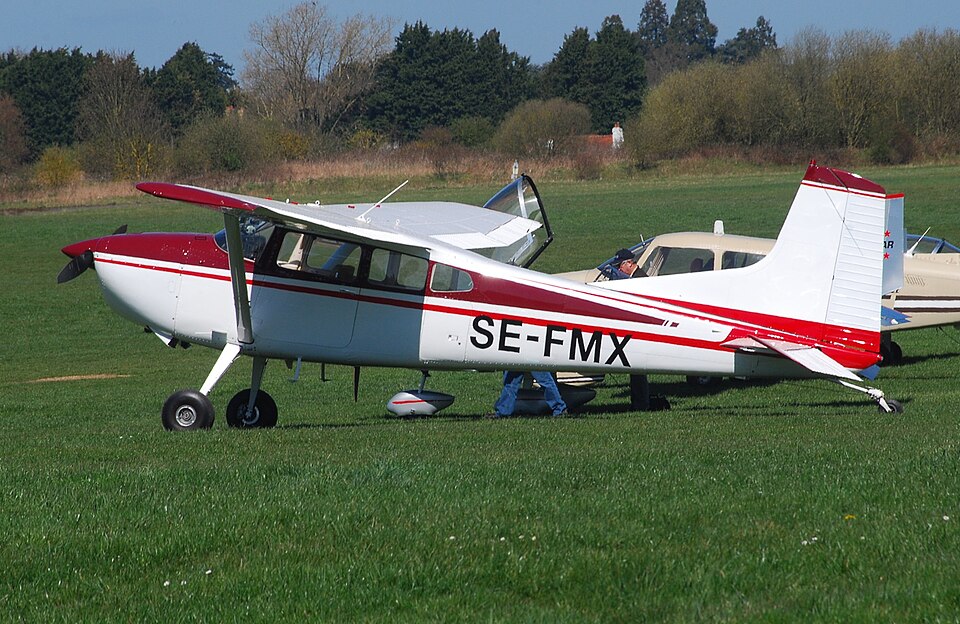
The Cessna 185 Skywagon
The Cessna 185 Skywagon arrived in 1961 as a more powerful follow-on to the already capable Cessna 180. Cessna took the proven Cessna 180 airframe, strengthened the fuselage, added a larger vertical fin, and bolted on a significantly bigger engine. The result was an aircraft that could haul more, climb harder, and handle rougher conditions than almost anything in its class.
Early models used a 260-horsepower Continental IO-470. By 1966, Cessna offered the 300-horsepower Continental IO-520 as an option, and it quickly became the standard. The 185 was produced until 1985, with just over 4,000 airframes built total. It was never designed to compete with the 172 for training volume. It was built to work.
Good to Know: The Cessna 185 was also used by the U.S. military. Designated the U-17, it was supplied to allied nations as part of the Military Assistance Program. A special version built between 1967 and 1973 was even modified to carry rockets under the wings.
Cessna 185 vs 172: Head-to-Head Comparison
This is where things get interesting. These two aircraft share a family name, but they were engineered for very different missions. Here is a full breakdown across the categories that matter most to buyers and pilots.
Engine and Power
The engine difference between these two aircraft is dramatic.
The Cessna 172 typically runs a Lycoming O-320 or O-360 series engine producing between 150 and 180 horsepower. These are simple, dependable engines with a solid reputation for going well past their time between overhaul (TBO) with proper care.
The Cessna 185 runs a Continental IO-520, a fuel-injected engine producing 300 horsepower in its most common configuration. That is roughly twice the horsepower of a typical 172. The IO-520 is a bigger, heavier, more complex engine. It burns more fuel and costs more to overhaul, but it delivers performance the 172 simply cannot match.
Pro Tip: If you are considering a 185, budget for a full engine overhaul at TBO. The IO-520 is a capable engine, but rebuilds cost significantly more than overhauling a Lycoming O-320 or O-360.
Landing Gear: Tricycle vs. Tailwheel
This is one of the biggest practical differences between the two aircraft, and it affects who should fly each one.
The Cessna 172 uses tricycle gear, meaning it has a nosewheel in the front and two main wheels under the wings. This setup is very stable on the ground. The aircraft naturally wants to track straight. Low-time pilots find it intuitive and forgiving.
The Cessna 185 uses conventional gear, more commonly called a tailwheel or "taildragger" configuration. The two main wheels sit ahead of the center of gravity, and a small tailwheel supports the back of the aircraft. This setup requires more precise footwork and attention during takeoff and landing. Crosswind landings demand real skill.
The payoff is that tailwheel aircraft can handle rougher ground. Gravel strips, grass fields, and unimproved backcountry runways are all within the 185's comfort zone in ways that would give a 172 pilot pause.
Heads Up: You need a tailwheel endorsement to fly the Cessna 185 legally. If you are coming from a 172 background, plan on dedicated training time before flying the 185 solo. The aircraft rewards skilled pilots but punishes inattention on the ground.
Useful Load and Payload
This is where the Cessna 185 truly separates itself.
The Cessna 185 became famous for something remarkable: its useful load is often greater than its empty weight. That means the aircraft can carry a payload roughly equal to its own weight. In practical terms, you can fill the tanks, load four adults, and still have room for gear without sweating the weight and balance numbers.
The Cessna 172S, by comparison, has a useful load of around 917 pounds in factory configuration. That sounds workable until you account for full fuel, four adults, and any luggage. With 53 gallons of fuel aboard (roughly 318 pounds), you have less than 600 pounds left for people and bags. That limits you to two or three adults with modest gear in real-world flying.
| Configuration | Cessna 172S | Cessna 185 (IO-520) |
| Gross Weight | ~2,550 lbs | ~3,350 lbs |
| Typical Empty Weight | ~1,635 lbs | ~1,520 lbs |
| Useful Load | ~915 lbs | ~1,400–1,500 lbs |
| Fuel (usable) | 53 gal / ~318 lbs | 84 gal / ~504 lbs |
| Full Fuel Payload | ~597 lbs | ~900–1,000 lbs |
Why It Matters: For a pilot flying solo on a weekend trip, the 172's useful load is perfectly fine. For an operator hauling cargo to a remote Alaskan strip or loading up for a family camping trip with full fuel, the 185's extra capacity is not just convenient. It is essential.
Cruise Speed and Performance
The Cessna 172 cruises at around 120 to 124 knots at 75 percent power, depending on the model. That is a comfortable speed for cross-country flights, and the fuel burn stays manageable at around 8 to 9 gallons per hour.
The Cessna 185 cruises at around 140 to 150 knots depending on the engine, conditions, and altitude. One owner writing in AOPA's resources regularly reported seeing around 150 knots true airspeed at 75 percent power, though the book numbers at 70 percent power at 8,000 feet suggest closer to 141 knots. Either way, the 185 is noticeably faster.
The climb rate also tells a clear story. The 172S climbs at around 730 feet per minute at sea level. The 185, with 300 horsepower swinging a big propeller, climbs at well over 1,000 feet per minute. That margin matters a lot when you are operating from a short strip surrounded by terrain.
Range and Fuel Capacity
Both aircraft have decent range, but the 185 carries more fuel and goes farther.
The Cessna 172S holds 53 usable gallons and achieves a maximum range of around 640 nautical miles under favorable conditions. Real-world range with reserves is typically shorter.
The Cessna 185 holds 84 usable gallons (wet wings). One AOPA article noted that an owner regularly planned on six hours to dry tanks, yielding roughly 600 to 700 nautical miles of real-world range with reserves. The 185 burns more fuel per hour, but its larger tanks keep the range competitive.
Handling and Stability
The Cessna 172 is famous for being forgiving. It is stable in all axes, recovers predictably from unusual attitudes, and gives pilots time to think and correct mistakes. That is exactly why it became the world's primary trainer. If you are working on your private pilot certificate or instrument rating, the 172 is designed to teach without punishing.
The Cessna 185 is also described as stable in pitch and yaw, but pilots note it is more neutral laterally than a 172. That means it does not self-correct as aggressively in roll. Add the tailwheel configuration and the big engine torque on takeoff, and you have an aircraft that demands active, precise flying. It is not difficult once you know it, but it does not tolerate inattention.
Keep in Mind: The 185's tailplane is actually the same size as the one on a Cessna 172, even though the 185 carries far more payload. This means pilots need to watch center of gravity carefully, especially on long flights where fuel burn shifts the balance aft.
Float and Amphibious Operations
The Cessna 185 is one of the most popular float-equipped aircraft in the world. Bush operators in Alaska, Canada, and throughout remote areas of the Pacific Northwest have relied on the 185 on floats for decades. Its power, payload, and rugged construction make it a natural fit for water operations.
The Cessna 172 can be put on floats, but it is generally considered marginal in that configuration. With only 150 to 180 horsepower and a modest useful load, the 172 on floats works best with light loads and favorable conditions. It is not the preferred choice for serious seaplane work.
If float operations are part of your mission, the 185 is the far stronger platform.
Winter and Rough Conditions
Both aircraft can handle cold weather with proper preparation, but the 185's power reserves give it an edge in demanding conditions. You can read about general cold weather considerations for Cessna flying here.
The 185's higher power output helps it perform better at high-density altitude airports and in winter conditions where air density drops and engine output suffers. A fully loaded 172 in summer heat at a high-elevation airport can feel sluggish. A 185 in the same conditions still has reserve power.
Flying411 specializes in helping pilots navigate the aircraft market. If you are weighing options like the 185 or 172 for purchase, this Cessna 172 Buyer's Guide is a great place to start your research.
Cost of Ownership: What You Will Actually Pay
This is where the 172 wins clearly for most private pilots.
Purchase Price
Used Cessna 172s are among the most accessible aircraft on the market. Older models from the 1970s can be found for well under six figures in many cases, while well-equipped later models command more. The sheer volume of 172s in the fleet means there is always inventory to choose from.
Used Cessna 185s are priced higher. Demand for capable tailwheel aircraft keeps values strong, and well-maintained examples with good engines command premium prices. The A185F, which is by far the most common variant, tends to hold its value well.
Operating Costs
| Cost Category | Cessna 172 | Cessna 185 |
| Fuel Burn | ~8–9 gal/hr | ~16–18 gal/hr |
| Engine TBO Cost | Lower (Lycoming O-360) | Higher (Continental IO-520) |
| Annual Inspection | Moderate | Moderate to higher |
| Insurance | Lower | Higher |
| Tailwheel Training | Not required | Required |
The 185's IO-520 is a reliable engine, but overhauls cost more than a Lycoming O-360. Fuel costs at 16 to 18 gallons per hour add up quickly compared to the 172's 8 to 9 gallons per hour. For pilots flying 100 to 150 hours per year, that difference in fuel alone runs into thousands of dollars annually.
Quick Tip: If you are primarily flying for fun, local trips, or keeping currency, the 172 delivers a very satisfying experience at a much lower per-hour cost. The 185 starts to justify its higher operating costs when you actually need what it offers: heavy loads, short strips, or float operations.
Which Cessna Should You Buy?
Here is a simple decision framework based on your actual flying needs.
Choose the Cessna 172 if:
- You are learning to fly or building hours
- You want lower operating costs and more affordable entry price
- Your typical flights involve one to three passengers with modest gear
- You want something reliable and easy to resell
- You are not interested in backcountry or float operations
- You value forgiving handling and easy ground operations
Choose the Cessna 185 if:
- You need to carry heavy loads or haul cargo regularly
- You operate from short, rough, or unimproved strips
- You want to operate on floats or amphibious gear
- You are based in Alaska, the Pacific Northwest, or similar backcountry regions
- You already have tailwheel experience or are committed to getting it
- You need genuine performance at high-density altitudes
The 172 is the better aircraft for most recreational pilots in the lower 48. The 185 is the better aircraft when the mission demands it.
If you are still exploring which Cessna fits your flying profile, this guide on what is the best Cessna for a private pilot breaks it down by mission type.
How the 185 and 172 Compare to Other Cessna Models
The Cessna family is broad, and both the 185 and 172 have useful context when placed alongside their siblings.
The Cessna 177 Cardinal shares the 172's nosewheel configuration but features a cantilever wing and roomier cabin. The Cessna 170 is the 172's tailwheel ancestor, offering a similar airframe with conventional gear. The Cessna 175 sits between the 172 and 182 in power but has a complicated engine history.
For pilots who want more than the 172 but are not ready for the 185's complexity, the Cessna 210 vs 172 comparison is worth reading. The 210 offers retractable gear and higher performance while staying in the nosewheel world.
The Cessna 162 SkyCatcher sits at the opposite end of the spectrum: a lightweight sport aircraft ideal for basic training at very low cost. And for a non-Cessna perspective, the Grumman Tiger vs Cessna 172 comparison shows how the 172 stacks up against one of its most popular four-seat competitors.
Ready to find your next aircraft? Flying411 connects pilots with the resources, listings, and expert guidance they need to make smart aircraft decisions. Start your search today.
Conclusion
When you put the Cessna 185 vs 172 side by side, there is no universal winner. There is only the right tool for the job.
The Cessna 172 Skyhawk earns its reputation every day as the world's most practical training aircraft and personal plane. It is approachable, economical, and available in abundance. For the vast majority of general aviation pilots, it delivers everything they need.
The Cessna 185 Skywagon earns its reputation in a different way. It goes where other aircraft cannot, carries what others cannot, and performs when the conditions would ground lesser planes. It is the right choice when the mission actually demands it.
Neither aircraft is the wrong answer. They just answer different questions. Figure out your question first, then choose your plane.
When you are ready to take the next step, let Flying411 help you navigate the market with confidence. Whether you are buying your first Cessna or trading up, Flying411 has the tools and knowledge to help you land the right deal.
Frequently Asked Questions
Is the Cessna 185 harder to fly than the 172?
Yes, the 185 is more demanding, primarily because of its tailwheel landing gear and significantly more powerful engine. The tailwheel configuration requires more precise footwork during takeoff and landing, and the 300 horsepower engine creates more torque to manage. Pilots coming from the 172 should plan for dedicated tailwheel training before flying the 185.
Can a low-time pilot fly the Cessna 185?
A low-time pilot can legally fly the 185 with the appropriate tailwheel endorsement, but it is generally not recommended without significant dual instruction first. Most experienced aviators suggest building solid tailwheel time in a lighter, more forgiving aircraft before transitioning to the 185.
Is the Cessna 185 a good float plane?
Yes, the Cessna 185 is widely regarded as one of the best float planes in the light single-engine category. Its powerful engine, high useful load, and rugged construction make it a natural fit for water operations. It has been a staple of bush flying on floats in Alaska and Canada for many decades.
How does the Cessna 185 compare to the Cessna 182?
The Cessna 182 Skylane uses tricycle gear and a 230-horsepower engine, making it far easier to fly than the 185 while still offering better performance than the 172. The 185 has more power and greater payload than the 182, but it demands more skill and costs more to operate. Pilots who want a step up from the 172 without committing to a tailwheel often find the 182 to be a natural middle ground.
What are the most common issues with the Cessna 172?
The Cessna 172 is generally reliable, but it does have some known issues depending on the model and engine variant. Some common concerns include carburetor icing on carbureted models, avionics that may need updating on older aircraft, and engine-specific issues depending on which powerplant is installed. A thorough pre-purchase inspection is always recommended. You can read more about common problems with the Cessna 172 before making a purchase decision.