When a wildfire starts, the first hour can decide everything. Big air tankers grab the headlines, but the planes that often reach the flames first are much smaller. These small firefighting planes are quick, nimble, and built to hit a fire while it is still young.
Many of them started life as crop dusters. With a few changes, they trade seed and fertilizer for water and fire retardant. They take off from short, rough strips close to the fire. They drop their load, turn around, reload, and come right back.
Some can even scoop water straight off a lake without landing. A single-engine plane about the size of a farm tractor can do work that once needed a converted bomber. The way these little aircraft slow a wall of flame is smarter than most people watching from the ground ever guess.
Key Takeaways
The best small firefighting planes are mostly single-engine air tankers, often shortened to SEATs, plus a few small command and scout planes. Top picks include the Air Tractor AT-802F, the amphibious AT-802 Fire Boss, the Thrush 510G, the PZL M-18 Dromader, the Air Tractor AT-602, the OV-10 Bronco, the Beechcraft King Air, and the Cessna O-2 Skymaster. Most carry around 500 to 800 gallons of water or retardant, fly from short runways, and reach new fires faster than large tankers can.
| Aircraft | Main Role | Approx. Load | Known For |
| Air Tractor AT-802F | Land-based air tanker | ~800 gallons | Workhorse of the SEAT world |
| AT-802 Fire Boss | Water-scooping tanker | ~800 gallons | Scoops water off lakes and rivers |
| Thrush 510G | Convertible air tanker | ~500 gallons | Switches from spraying to firefighting fast |
| PZL M-18 Dromader | Rugged air tanker | ~660 gallons | Tough radial engine, simple build |
| Air Tractor AT-602 | Mid-size air tanker | ~630 gallons | Nimble on short farm strips |
| OV-10 Bronco | Air attack command | No drop tank | Directs the whole air show |
| Beechcraft King Air | Lead plane | No drop tank | Guides tankers to the target |
| Cessna O-2 Skymaster | Scout and spotter | No drop tank | The original eyes in the sky |
Flying411 is an online aviation marketplace where pilots, operators, and buyers come together around aircraft, engines, parts, and aviation services, all in one place.
What Makes a Firefighting Plane "Small"
Not every plane that fights fire is a giant. Aircraft used in aerial firefighting come in a few size classes, and the smallest ones do a huge share of the early work.
In the United States, the smallest tanker is called a single engine air tanker, or SEAT. A SEAT has one engine, one pilot, and a tank that usually holds about 800 gallons or less. That sounds modest next to a large tanker that carries thousands of gallons. The trade-off is speed and reach. A small plane can land on a short dirt strip near a fire, reload, and be back over the flames in minutes.
Here are the main jobs small firefighting planes do:
- Air tankers (SEATs): drop water, foam, gel, or retardant straight onto the fire.
- Water scoopers: skim across a lake to fill their tanks, then drop and repeat.
- Lead planes: fly ahead of the tankers to mark the safe drop path.
- Air attack and scout planes: circle above the fire and direct every other aircraft.
So "small" covers two big groups. One group carries the load and drops it. The other group carries eyes and brains, guiding the whole operation from above. Both matter. A tanker without a spotter is like a fire truck with no one reading the map.
If you want a wider view of the little aircraft behind these missions, the different types of small planes used in farming, scouting, and rescue share a lot of the same roots.
Good to Know: Most SEATs are farm planes at heart. The same airframe that sprays a cotton field in spring can battle a grass fire in summer. That double duty keeps these aircraft busy and affordable year-round.
How Small Firefighting Planes Actually Fight Fire
Small planes rarely put a fire all the way out. Their real job is to slow it down and box it in so ground crews can finish the work. They do this in a few simple ways.
First, they drop water. Water cools the flames and soaks the fuel. Plain water works well on small, fresh fires and on hot spots that could flare up again.
Second, they drop fire retardant. Retardant is a thick, often reddish mix of water, a salt compound, a thickener, and coloring. It weighs around nine pounds per gallon. Crews lay it down in long lines ahead of the fire. The treated ground burns much slower, which gives the fire fewer places to spread. The color helps pilots see where the last drop landed.
Third, some planes drop foam or gel. These cling to brush and trees and hold moisture longer than plain water.
The real magic is the turnaround. A small plane working from a strip a few miles away can drop, land, reload, and launch again very quickly. Stacked up over a long afternoon, those fast trips add up to a lot of water on the fire. Heavier knowledge of useful load helps explain why every gallon and every pound counts so much on these aircraft.
Fun Fact: Water scoopers can refill in seconds. Some skim a lake at low speed and gulp water through scoops in the floats. A single pass can top off the tank in well under a minute, so the plane never even has to land to reload.
Small Firefighting Planes Worth Knowing, From SEATs to Spotters
Now for the lineup. These eight aircraft show the full range of small firefighting planes, from the tankers that drop the water to the scout planes that run the show. Loads and numbers below are approximate, since tanks, engines, and gear vary from one operator to the next.
1. Air Tractor AT-802F
The Air Tractor AT-802F is the heavy hitter of the small tanker world. It is widely considered the largest single-engine air tanker in production, and it has become the face of modern SEAT firefighting.
The AT-802F carries around 800 gallons of water or retardant in a belly tank. A powerful Pratt and Whitney PT6A turboprop pulls it off short strips with a full load. A computerized fire gate lets the pilot control the drop pattern, from a quick salvo to a long, even line.
You can spot these planes at work in the United States, Canada, Australia, Spain, Portugal, and across Eastern Europe and the Middle East. Operators like them because they cost far less to run than large tankers, so agencies can afford to field more of them.
A typical patrol sends two AT-802F planes out together, loaded and ready, watching high-risk areas. The moment smoke appears, they can be over the fire in minutes. That speed is the whole point. These single-engine workhorses prove that one engine and one pilot can carry a serious punch.
2. Air Tractor AT-802 Fire Boss
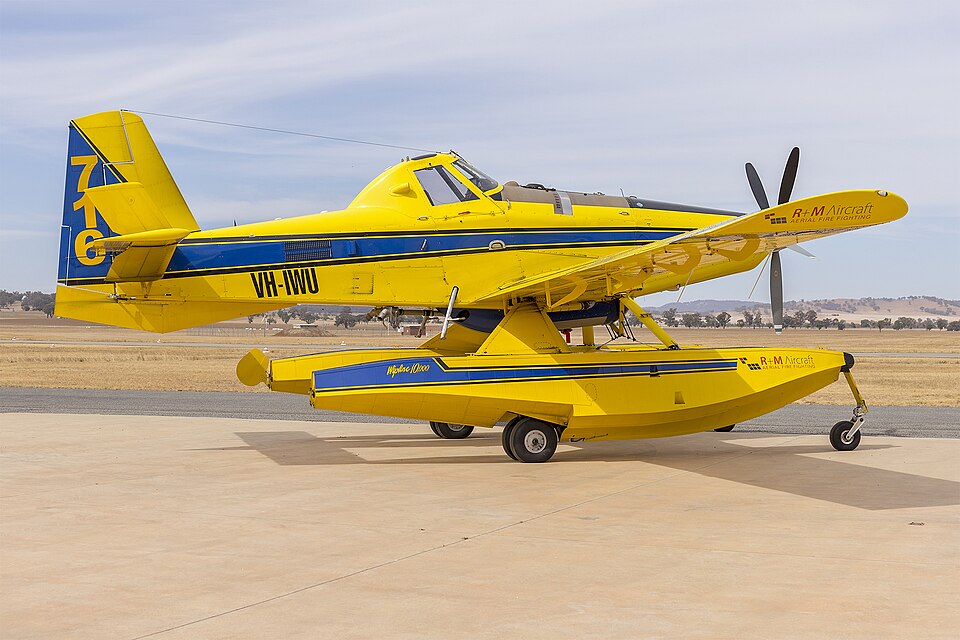
The Fire Boss is the AT-802 with a clever twist. Instead of wheels, it rides on big amphibious floats. That means it can take off from a runway, land on water, and scoop a fresh load straight from a lake or river.
This makes the Fire Boss a true water scooper. Near a good water source, it can scoop and drop again and again for hours without returning to base. One leading operator notes its planes can run continuous scoop-and-drop cycles for several hours at a stretch.
The floats can even hold small foam tanks to boost each drop. For regions full of lakes, the Fire Boss is a dream tool. It turns nearby water into an endless supply line.
The skills here overlap with water-landing seaplanes, since landing and skimming on water takes its own kind of training and nerve.
3. Thrush 510G Switchback
The Thrush 510G is a smaller, lighter tanker built for tight, tricky spots. It carries about 500 gallons and runs on a GE H80 turboprop. It earned its firefighting certification in 2018.
The "Switchback" name points to its best trick. A pilot can flip it between crop spraying and firefighting in a matter of minutes. That flexibility lets one plane earn its keep all year, then jump into action when a fire breaks out.
It is light on its feet, too. Once empty, a 510G can land in as little as 350 feet using reverse thrust. That lets it work from short grass strips right next to a wildfire.
Keep in Mind: The firefighting world keeps shifting. In 2026, Air Tractor acquired Thrush Aircraft, bringing two of the best-known SEAT builders under one roof. Moves like this can shape which models stay in production for years to come.
4. PZL M-18 Dromader
The Dromader is the rugged outsider on this list. Built in Poland, it uses a big radial piston engine and carries around 660 gallons in a forward hopper. It is simple, tough, and built to take a beating.
Crews around the world have used the Dromader as a light air tanker. You can find it fighting fires in places like Greece and Turkey, and it has flown in many countries as both a sprayer and a firefighter.
It is heavy and not the fastest plane here, but it hauls a solid load and keeps going in rough conditions. Pilots who fly it tend to respect its honest, no-nonsense nature.
Fun Fact: The Dromader was designed in the 1970s with help from an American maker, and it shares part of its wing and fuselage with an early Thrush crop duster. Two of the planes on this list are cousins under the skin.
5. Air Tractor AT-602
The AT-602 fills the gap between the smaller AT-500 series and the larger AT-802. It carries about 630 gallons and runs on a Pratt and Whitney turboprop of around 1,050 horsepower.
Many AT-602 planes spend most of the year as crop dusters. During fire season, operators fit them with tanks and gates and turn them into part-time tankers. Being smaller and lighter than the AT-802, the 602 is easy to handle on short farm strips.
It is a great example of how the farming world and the firefighting world overlap. The same plane that feeds a field can help save a forest. These crossover aircraft show why turboprop power has become the standard for serious small tankers.
6. North American OV-10 Bronco
The OV-10 Bronco does not drop water at all. It runs the show. This twin-turboprop plane serves as an air attack platform, a flying command post that circles above the fire.
Inside, an air tactical officer watches the whole scene. That officer talks to the ground crews, decides where tankers should drop, and keeps every aircraft safely apart. The Bronco can stay aloft for five hours or more, which lets the crew manage a long, shifting battle.
The Bronco started as a military observation and light attack plane. A major California agency picked up a fleet in 1993 to replace older scout planes, and the type has guided wildfire operations ever since. Its twin booms and big greenhouse canopy make it easy to spot overhead.
Its roots show up in our look at small military aircraft, where rugged, mission-built designs often find second lives in civilian work.
7. Beechcraft King Air 90 and 200
The Beechcraft King Air is a trusted lead plane. Agencies use the King Air 90 and King Air 200 to guide tankers along the right path over a fire.
A lead plane flies the drop run first. It checks the terrain, the smoke, and the wind. Then it marks the line, often with a puff of smoke, so the tanker pilot knows exactly where to release. This teamwork keeps drops accurate and keeps pilots safe near rough ground.
The King Air also makes a fine intelligence and mapping platform. With its twin turboprops and roomy cabin, it can carry gear and crew for hours. As far as twin-engine prop planes go, the King Air family is among the most respected in any role.
8. Cessna O-2 Skymaster
The Cessna O-2 Skymaster is the elder statesman here. With one engine in front and one in back, this push-pull twin served as an early scout and air attack plane before bigger command ships took over.
It is light, simple, and easy to fly. For decades it gave fire bosses a steady set of eyes over the flames. While newer planes have replaced it in many fleets, the O-2 and its civilian Skymaster cousins still fly as spotters and patrol aircraft in some areas.
It earns its spot on this list for what it started. Long before fancy command planes, a small twin like the Skymaster proved how much a calm pilot with a good view could change the outcome of a fire.
Looking to study real listings of turboprops, twins, and former mission aircraft like these? Flying411's aircraft marketplace lets you compare models, engines, and prices side by side.
Single Engine Air Tankers vs Water Scoopers
Two of the most common small firefighting planes are land-based SEATs and amphibious scoopers. They look similar, but they work in different ways. Picking the right one depends on the land, the water nearby, and the kind of fire.
| Feature | Land-Based SEAT | Water Scooper |
| Reload method | Lands at a base to refill | Skims water from a lake or river |
| Best drop material | Water or fire retardant | Mostly water |
| Ideal setting | Dry areas with airstrips | Regions with many lakes nearby |
| Turnaround speed | Fast, if a base is close | Very fast near good water |
| Example | Air Tractor AT-802F | AT-802 Fire Boss |
A land-based SEAT shines when crews need retardant lines, since retardant is usually loaded at a base. A scooper shines when a lake sits close to the fire, since it never has to stop for water. Many agencies use both and mix them based on the day.
Pro Tip: When you watch fire coverage, look at what the plane drops. A long reddish line usually means retardant from a land-based tanker laying down a fire break. A clear splash often means water, which may come from a scooper working a nearby lake.
What Small Firefighting Planes Cost
Cost is a big reason small planes are so popular. They are far cheaper to buy and run than large tankers, so agencies can field more of them and cover more ground.
Exact prices change with age, engine, hours, and gear. As a general guide, used examples of these turboprop SEATs can run from a few hundred thousand dollars up into the low millions. Brand-new, purpose-built firefighting tankers sit at the higher end of that range. The piston-engine Dromader and older scout planes tend to fall on the lower side.
Running costs matter just as much as the sticker price. One engine means less fuel, fewer parts, and simpler upkeep than a multi-engine tanker. Short-strip operations also cut down on ferry time and base costs. For buyers comparing options, our breakdown of what small planes cost and a look at more affordable options both help set realistic expectations.
Heads Up: A firefighting price tag is about more than the airframe. Tanks, fire gates, floats, avionics, and special radios all add cost. Two planes of the same model can be priced very differently based on their firefighting kit.
Why These Small Planes Matter More Than Ever
Fire seasons have grown longer and harsher in many parts of the world. That has pushed demand for fast, flexible aircraft. Small firefighting planes fit that need almost perfectly.
The key idea is rapid initial attack. The plan is simple: launch the moment smoke appears and hit the fire while it is still tiny. A small fire is far easier to stop than a large one. As one operator likes to say, it is easier to spit on a match than to fight a bonfire later.
This approach works. Some regions that station SEATs for quick response report that the large majority of their fires get caught early and stay small. When fires stay small, fewer homes burn, fewer crews are at risk, and budgets stretch further.
Demand has spread far beyond North America. These planes now work fire seasons in Europe, South America, and Australia. As the calendar fills with overlapping seasons, builders have been turning out record numbers of small tankers to keep up.
Why It Matters: Catching a fire in its first minutes can be the difference between a quick knockdown and a week-long disaster. Small planes are often the only aircraft close enough and quick enough to make that early hit.
The Upsides and Trade-Offs of Small Firefighting Planes
No aircraft is perfect for every job. Small firefighting planes bring real strengths and a few honest limits. Knowing both helps explain why agencies still use a mix of sizes.
The upsides:
- Fast response. They reach new fires quickly and reload in minutes.
- Short-strip ability. They work from rough, small runways close to the action.
- Lower cost. Cheaper to buy and run, so more can be deployed.
- Flexibility. Many switch between farm work and firefighting.
- Maneuverability. They turn tight in rugged canyons and hills.
The trade-offs:
- Smaller loads. Each drop is modest compared with a large tanker.
- More trips. Covering a big fire takes many runs.
- Weather limits. Smoke, wind, and terrain can ground small planes fast.
- Single pilot. One person handles a demanding, low-level job alone.
Safety is always part of the conversation, since these planes fly low and slow over fire and rough ground. If that topic interests you, our look at the safety record of small planes adds useful context for any low-level mission.
Quick Tip: When comparing tankers, do not judge by tank size alone. A small plane that drops 800 gallons six times in an hour can put more water on a fire than a big tanker that makes one slow trip. Speed and turnaround often beat raw capacity on fast-moving fires.
Ready to see what is on the market? Browse current aircraft, engine, and parts listings on Flying411 and connect with certified aviation pros in one place.
Conclusion
Small firefighting planes prove that size is not the only thing that wins a fight. The Air Tractor AT-802F and its Fire Boss cousin, the Thrush 510G, the PZL M-18 Dromader, and the nimble AT-602 carry the water and retardant. The OV-10 Bronco, the Beechcraft King Air, and the Cessna O-2 Skymaster carry the eyes and the plan. Together they form a fast, flexible team that hits fires early and keeps them small.
These planes are quick, affordable, and tough, and demand for them keeps climbing as fire seasons stretch longer each year. For anyone drawn to the aircraft, engines, or services behind this work, the right marketplace makes the whole world of small aviation easier to navigate.
Pilot, operator, or simply a fan of these hard-working planes, you will find your next aircraft, part, or service at Flying411, the place that keeps aviation flying.
Frequently Asked Questions
Are firefighting planes the same as the helicopters used on wildfires?
No, they are different tools that work together. Planes cover ground fast and lay long lines of water or retardant, while helicopters hover, make pinpoint drops, and can carry crews and gear into tight spots.
Can one person fly a single-engine air tanker?
Yes. SEATs like the Air Tractor AT-802F and the Thrush 510G are flown by a single pilot, who handles flying, navigation, and the drop all at once during low-level runs over the fire.
What is the colored material dropped from firefighting planes?
That reddish material is fire retardant, a mix of water, a salt compound, a thickener, and coloring. The color helps pilots and crews see exactly where the last line was laid down.
Do small firefighting planes fly at night?
Most firefighting flights happen in daylight for safety, since pilots fly low over rough, smoky terrain. Some operators are adding night-capable gear, but daytime remains the norm for small tankers.
Who owns and operates these small firefighting planes?
Many are privately owned and flown by contract operators who work under agreements with government fire agencies. Some agencies, such as state forestry and fire departments, also own and run their own fleets directly.