Picture a worker leaning out of a hovering helicopter, reaching toward a power line that carries enough electricity to light up a small town. That worker looks calm. They are also getting paid very well for that calm.
So how much do helicopter lineman make when their office is a few hundred feet in the air, right next to a wire humming with hundreds of thousands of volts?
The short answer is a lot more than most people guess. The longer answer has very little to do with the helicopter and almost everything to do with what the worker is willing to touch.
The number on that paycheck is really a price tag on risk, and that price tells a story most people never hear.
Key Takeaways
Helicopter linemen usually earn well above the pay of a regular electrician or a ground-level utility worker. Most reports put their yearly pay somewhere between roughly $50,000 and $100,000, and skilled workers who travel or chase storms can earn even more than that. The pay sits high because the job is rare, heavily trained, and genuinely dangerous.
| Question | Quick Answer |
| Typical yearly pay | Roughly $50,000 to $100,000 for most workers, with room above that |
| Top earners | Many aerial specialists report well over $120,000 in strong years |
| Why it pays so well | A rare skill, heavy training, and serious danger |
| The core skill | Live-line "barehand" work on energized wires |
| Pilot or lineman? | The pilot flies the aircraft. The lineman works the wire. Two jobs, two paychecks |
| How to get in | Finish a lineman apprenticeship first, then earn barehand certification |
Flying411 is an online aviation marketplace and community where pilots, mechanics, and curious readers come to learn about the machines and careers that keep the sky busy.
What Does a Helicopter Lineman Actually Do?
A helicopter lineman is a highly trained electrical worker who fixes and maintains high-voltage power lines while a helicopter holds them in place near the wire. These are the giant lines you see marching across hills and valleys on huge steel towers. They carry power across long distances, often through places no truck can reach.
Most of the time, a lineman climbs a pole or rides up in a bucket truck. A helicopter lineman skips all of that. The aircraft flies them straight to the wire and holds steady while they work. In some cases, the helicopter drops them onto a tower. In other cases, the worker leans out and handles the line directly from the aircraft.
Here is the part that sounds impossible. They often do this while the line is still live. The power is never turned off.
This style of work is called live-line work, and it exists for a good reason. On many parts of the grid, demand is so high that the power simply cannot be shut down. A blackout to fix one wire could leave entire regions in the dark. So the work happens hot, with the electricity still flowing.
Good to Know: People often mix up the helicopter lineman with the helicopter pilot. They are two separate roles on the same crew. The pilot flies the aircraft and keeps it rock steady. The lineman handles the wires and the repairs. They train differently, they get paid differently, and they rely on each other completely.
Lineman or Pilot? They Are Not the Same Job
This mix-up matters because the pay looks different for each role. The pilot is a licensed aviator with serious flight hours. The lineman is a licensed electrical worker with serious line hours. One controls the machine. The other controls the repair.
If flying itself is what pulls at you, the path runs through pilot training rather than line work. You can read up on becoming a helicopter pilot and what it takes to actually fly a helicopter to see how different that road is. The lineman, by contrast, learned electricity first and flying second.
How Barehand Work Lets a Lineman Touch a Live Wire
This is the trick that makes the whole job possible. It is called barehand or bonded work, and it follows the same rule that lets a bird sit on a power line without getting hurt.
Electricity wants to move from high energy to low energy, like water flowing downhill. A bird on a single wire is safe because it never gives the current a path to anywhere lower. Both of the bird's feet sit at the same voltage. Nothing flows through it.
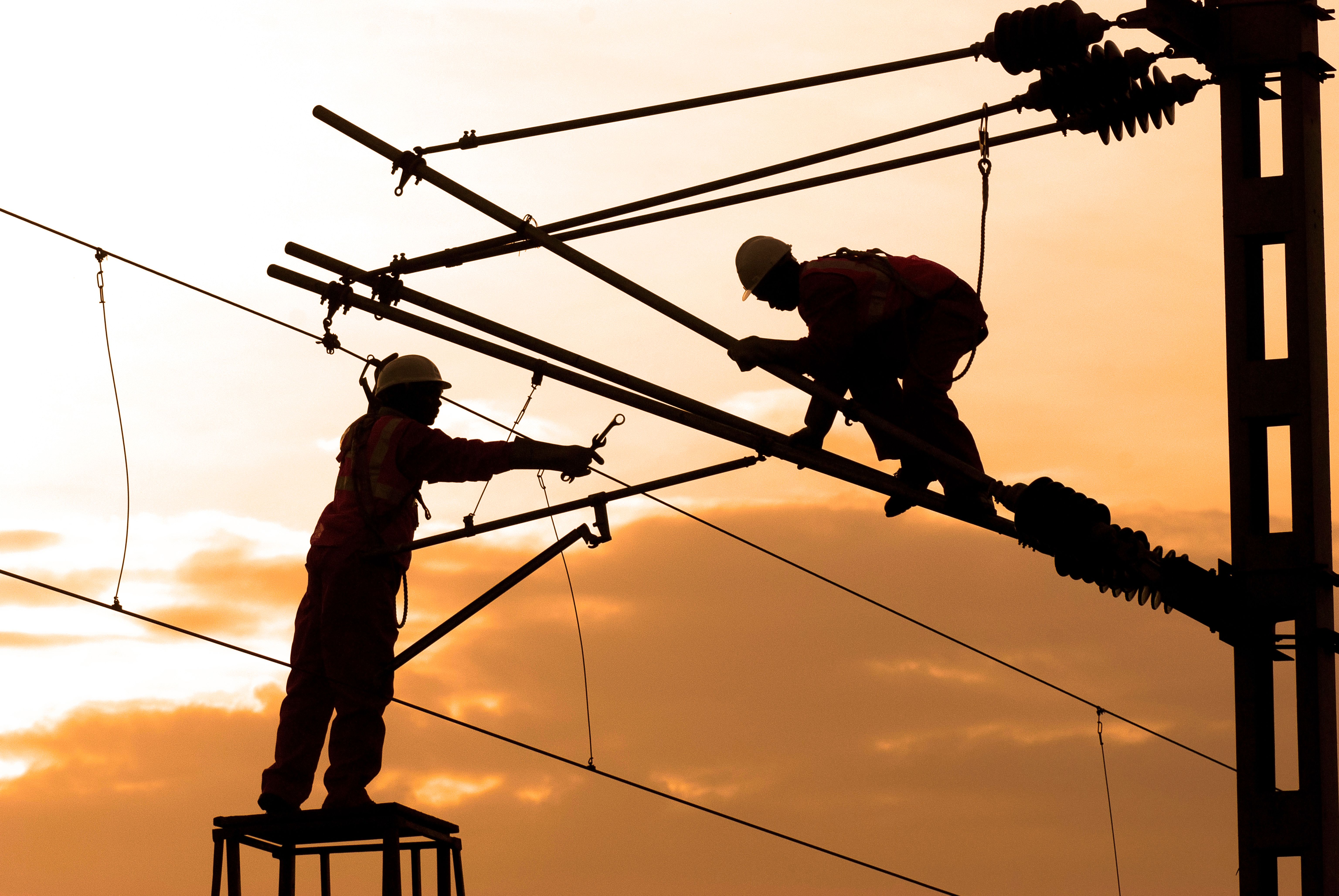
A barehand lineman uses that exact idea. Before touching the line, the worker raises their own body to the same voltage as the wire. They wear a special conductive suit, sometimes called a Faraday suit, woven with metal fibers. The crew bonds the suit and the aircraft to the line first. Once everyone sits at the same voltage, the lineman can grab the wire with gloved hands and feel no shock at all.
As the lineman first reaches toward the line, a small arc can jump across the gap. The worker bonds to the wire right away to stop it. After that, they are riding the same electrical wave as the line itself.
Fun Fact: The first barehand techniques are widely credited to a high-voltage engineer back in 1960, who helped prove that a person could safely work on a live line as long as they matched its voltage. The method has been used on some of the highest-voltage lines in the world ever since.
How Much Do Helicopter Linemen Make at Each Stage of the Career
Now to the heart of it. The pay does not land on a single number. It climbs as a worker moves from raw beginner to trusted specialist. It also swings based on a handful of factors that can add tens of thousands of dollars to a year's total.
Here is a rough picture of how the pay tends to build across a career. Treat these as reported ranges, not promises, because real pay shifts by company, region, and the number of hours a person is willing to work.
| Stage | What They Do | Reported Pay Range |
| Apprentice | Learns the trade, does ground and climbing work | Often starts in the low-to-mid $60,000s and rises step by step |
| Journeyman lineman | Fully qualified, handles transmission and distribution work | Commonly lands in the $70,000 to $100,000 range |
| Barehand / aerial specialist | Live-line work from helicopters and towers | Often $90,000 and up, with top earners reported well above $120,000 |
| Power line helicopter pilot | Flies the aircraft, does not touch the wire | Averages around $100,000 in some salary trackers |
So what moves a helicopter lineman's paycheck up or down? Several things stack together. Here are the big ones:
- Experience level. An apprentice earns less than a seasoned journeyman. Pay rises with every step of training and every year on the wire.
- Certifications. Barehand and live-line certification is the golden ticket. It opens the highest-paying aerial work and sets a worker apart.
- Region. Pay shifts by state and even by city. Areas with rugged terrain or heavy grid demand often pay more.
- Employer type. Traveling contractors often out-earn workers tied to a single local utility, since they chase the best-paying projects.
- Overtime hours. Storm season and emergency repairs pile on overtime, and overtime can balloon a yearly total fast.
- Height and hazard premiums. Some utilities add a percentage of pay for work above a certain height. One example often cited is around an extra 7 percent for work above roughly 80 feet.
- Storm and travel work. Workers willing to leave home and chase outages after hurricanes or ice storms can earn far more than those who stay local.
- The specific line voltage. Higher-voltage transmission work tends to pay better than lower-voltage distribution work, because the stakes and skill demands climb with the voltage.
When you add these together, you start to see why the helicopter lineman salary has such a wide spread. A local worker who clocks steady hours might land near the middle of the range. A traveling specialist who chases storms and works at height might push toward the very top.
Heads Up: Salary numbers for this job vary a lot from one source to the next. Some trackers report averages near the high five figures, while others show six-figure averages for aerial and barehand specialists. The honest takeaway is that the range is wide, and your own number depends heavily on skill, location, and hours.
Apprentice and Entry-Level Pay
Nobody starts at the top. Every helicopter lineman begins as an apprentice, learning the basics of line work on the ground and on poles. Apprentice pay often starts in the low-to-mid $60,000s at larger utilities and rises with each step of the program. It is solid money for someone still in training, and it climbs steadily as skills grow.
Journeyman and Barehand-Certified Pay
Once a worker finishes the apprenticeship, they become a journeyman lineman. This is the fully qualified level. Journeyman pay commonly lands somewhere in the $70,000 to $100,000 range, depending on region and hours.
Adding barehand certification on top of that is where the aerial lineman pay really takes off. Specialists who do live-line work from helicopters are reported to earn well into six figures in strong years. Some sources note experienced workers grossing well above $120,000, and a few who travel widely report even higher totals.
Keep in Mind: A big chunk of a top earner's pay often comes from overtime, travel pay, and hazard premiums rather than the base rate alone. Two workers with the same job title can earn very different yearly totals based on how many tough hours they are willing to take on.
What the Helicopter Pilot Earns
The pilot on the crew earns on a different scale, tied to flying rather than line work. Some salary trackers put the average for a power line helicopter pilot near the $100,000 mark, with experienced pilots in busy regions reported higher. The pilot's pay reflects flight skill, flight hours, and the steady-hands precision the job demands.
A Quick Word on the Machine Doing the Flying
The helicopter is the quiet hero of this whole operation. Line work uses small, nimble civilian helicopters that can hover with incredible precision. That is a very different animal from the heavy military machines most people picture. It helps to know the difference between a chopper and a helicopter before going further, since the words get tossed around loosely.
Helicopters come in a huge range of shapes and jobs. On the military side alone, matchups like the Viper and the Apache, the Apache and the Comanche, the Chinook and the Black Hawk, and the Huey and the Black Hawk show how much these aircraft differ in size, speed, and purpose. The civilian side keeps growing too, with newer eVTOL designs, small helicopter and quadcopter drones, and even oddball winged ornithopter concepts testing the edges of what counts as a flying machine. People even love wild matchups, like a helicopter against a tank. For line work, though, the winning trait is simple. The pilot needs a steady hover, exactly where it is wanted, and the ability to reach lines high above the ground. If you have ever wondered how high these machines climb, the answer is part of why aerial line work reaches places trucks never could.
Why Helicopter Lineman Pay Runs So High
A fair question sits behind all these numbers. Why does this job pay so much better than many other skilled trades? The answer comes down to a few simple truths.
The skill is rare. Becoming a regular lineman already takes years. Adding barehand certification narrows the pool to a small, elite group. When few people can do a job, the pay tends to rise.
The training is heavy. This is not a job you pick up over a weekend. It takes years of apprenticeship, then more training to earn the live-line and barehand qualifications. Every hour of that training is built into the value of the worker.
The danger is real. Line work is regularly ranked among the more dangerous trades in the country. The fatality rate for line workers is often cited as several times higher than the average across all jobs. Electrocution, falls from height, and vehicle accidents are the main risks. Add a hovering helicopter and a live wire, and the stakes climb even higher.
Why It Matters: High pay in this field is not a bonus. It is the trade for accepting a level of risk that most workers would never take on. The paycheck reflects the danger, the rare skill, and the long road of training behind it.
The work cannot wait. Power keeps the modern world running. When a major transmission lineman crew is needed after a storm, the work happens fast, often around the clock, and often in brutal weather. Companies pay a premium to get skilled hands on those lines quickly.
Helicopters save serious money. Using aircraft for line work can cut both cost and time on hard-to-reach projects. One utility study reported large savings in cost and a huge reduction in time when crews used aerial methods instead of ground access. When a method saves a company that much, the company is willing to pay the specialists who can pull it off.
Flying411 connects readers with flight schools, certified mechanics, and aviation training providers, so the first real step toward a career around helicopters is easier to find.
How to Become a Helicopter Lineman
If the pay and the thrill both appeal to you, here is the honest road map. It is a long one, and that length is part of why the job pays well.
The Apprenticeship Path
Almost everyone starts the same way, by learning the broad trade of line work first.
- Finish high school or earn an equivalent. A diploma or GED is the basic starting point.
- Get your commercial driver's license (CDL). Linemen operate big trucks and equipment, so a CDL is usually required early.
- Pass the entry tests. Many employers use a standard skills and aptitude test to screen new applicants.
- Start as a groundman or apprentice. This is where the real learning begins, assisting journeymen and handling tools and materials.
- Work through the apprenticeship. A lineman apprenticeship usually runs about four years and roughly 7,000 to 7,500 hours of paid, on-the-job training. It is broken into steps, and pay rises after each one.
- Earn your journeyman ticket. After passing the final written and field tests, you become a journeyman lineman, qualified to work on your own.
Pro Tip: Treat the apprenticeship as a paid education. You earn a real wage the entire time, and your pay climbs with every step you complete. By the time you finish, you have both a skilled trade and zero student debt from it.
Earning Your Barehand Certification
Becoming a journeyman is the doorway, not the destination. To do helicopter and live-line work, a lineman needs extra barehand training on top of the journeyman ticket.
This often means spending time getting familiar with the transmission system, then completing classroom training plus a stretch of supervised in-field hours on energized lines. Some programs ask for a week of classroom work followed by dozens of hours of hands-on field training. After that, a worker usually has to keep a minimum number of live-line hours each year to stay certified.
Quick Tip: Once you earn barehand certification, protect it. Many programs require a set number of hours on the wire each year to keep the qualification active. Staying current keeps you eligible for the highest-paying aerial jobs.
The Trade-Offs Before You Chase the Paycheck
A big number on a job listing is exciting. Before you set your heart on it, weigh both sides honestly. This job asks a lot in return for what it pays.
The upsides are real:
- Strong pay, often well above other trades at the same experience level.
- A rare, respected skill that keeps you in demand.
- Steady work, since the power grid always needs upkeep.
- No college degree required, and you earn while you train.
- A genuine sense of adventure, with a workplace few people ever see.
The trade-offs are just as real:
- Serious physical danger, every single shift.
- Long hours, including nights, weekends, and storm call-outs.
- Heavy travel, with many nights away from home for contract and storm work.
- Tough weather, from freezing cold to blazing heat.
- A long training road before the big pay arrives.
The people who thrive in this job tend to share a few traits. They stay calm under pressure. They respect danger without freezing up around it. They do not mind heights, travel, or hard weather. For the right person, the mix of risk, skill, and reward is exactly the point.
Browse helicopters, parts, and aviation services on Flying411 today, and start picturing what it would take to put a rotor over your own head.
Conclusion
So, how much do helicopter lineman make? The honest answer is a wide range, usually from around $50,000 on the lower end up past $100,000 for skilled specialists, with the biggest earners stacking overtime, travel, and hazard pay on top. The number is high for a clear reason. It pays for rare skill, years of training, and a level of danger most people would never accept.
This is one of those jobs where the paycheck and the courage behind it are tied together. The wire does not care how brave you are. It only respects whether you matched its voltage. For the small group of workers who master that calm, the reward shows up in both the work and the wallet.
Whether you dream of flying the aircraft or simply love the machines that make this work possible, Flying411 is your runway into the world of aviation, careers, and the helicopters that keep the grid alive.
Frequently Asked Questions
Do helicopter linemen need a pilot's license?
No. The lineman works the wire while a separate, licensed pilot flies the helicopter. The two roles are trained and certified differently, so a lineman does not need to know how to fly.
What states or regions pay helicopter linemen the most?
Pay tends to run higher in areas with rugged terrain, heavy grid demand, or frequent storm work. Traveling contractors often earn the most overall, since they can chase the best-paying projects across different regions.
Is being a helicopter lineman harder than being a ground lineman?
In most ways, yes. It requires everything a ground lineman knows, plus extra barehand certification, comfort working from a hovering aircraft, and the nerve to handle energized wires. That added difficulty is a big part of why it pays more.
Do helicopter linemen work year-round?
Yes, though the workload often spikes during and after major storms. Routine maintenance happens throughout the year, while emergency repairs can create long stretches of overtime when bad weather strikes.
What tools do helicopter linemen use on live wires?
They rely on a conductive bonding suit, insulated gloves, line hoses, blankets, and a range of specialized hot-line tools. The suit and bonding gear keep them at the same voltage as the line, which is what makes the work safe.