Spinning rotors, hovering flight, vertical takeoff -- helicopters and quadcopters share a lot of the same basic tricks. But spend five minutes with each one and you'll realize they are very different machines built for very different jobs. One is a mechanical marvel with decades of proven history.
The other is a modern tech-driven flier that fits in a backpack. So when it comes to helicopter vs quadcopter, which one actually comes out on top? That depends a lot on what you need it to do.
The two aircraft serve overlapping but distinct roles, and understanding those differences can save you a lot of money, frustration, and wasted flight time.
Key Takeaways
Helicopters and quadcopters both achieve vertical flight but do it in fundamentally different ways. Helicopters use a single large main rotor with variable pitch blades for control, making them far more efficient at carrying heavy loads over long distances. Quadcopters use four fixed-pitch rotors controlled by varying motor speed, making them simpler to build, easier to fly, and ideal for short-range tasks like photography and inspection. Neither is universally better -- the right choice comes down to payload, range, budget, and purpose.
| Feature | Helicopter | Quadcopter |
| Number of rotors | 1 main + 1 tail | 4 |
| Control method | Cyclic and collective pitch | Variable motor speed |
| Flight efficiency | Higher | Lower |
| Payload capacity | High | Low to moderate |
| Mechanical complexity | High | Low |
| Ease of flying | Harder | Easier |
| Wind stability | Very stable | Moderately stable |
| Best use | Long range, heavy lift, manned flight | Aerial photography, inspection, recreation |
| Typical cost range | Thousands to millions (manned) | Under $100 to several thousand (UAV) |
| Flight time | Longer | Shorter |
Flying411 covers everything aviation -- from rotorcraft comparisons to full pilot guides. If you are trying to make sense of the aircraft world, it is a solid place to start.
How Each Aircraft Actually Works
Before getting into a side-by-side comparison, it helps to understand what is going on under the hood -- or rather, above the fuselage -- for each type of aircraft.
The Helicopter: One Big Rotor, a Lot of Moving Parts
A helicopter generates lift using a single large main rotor. The blades on that rotor have a variable pitch, meaning their angle can change as they spin. This is called cyclic pitch control, and it is how the pilot steers the helicopter in any direction. A second, smaller tail rotor spins to counteract the rotational torque of the main rotor and keep the body from spinning out of control.
This design is mechanically complex. The swashplate, pitch links, rotor mast, and transmission are all working together at high speed to give the pilot precise control. But that complexity pays off in a big way -- the helicopter can fly faster, farther, and with heavier loads than almost any comparable rotorcraft.
Fun Fact: The first recorded helicopter-like aircraft that achieved vertical flight is said to date back to the early 1900s, with the modern helicopter design being refined and widely adopted in the mid-20th century.
The Quadcopter: Four Rotors, Pure Electronics
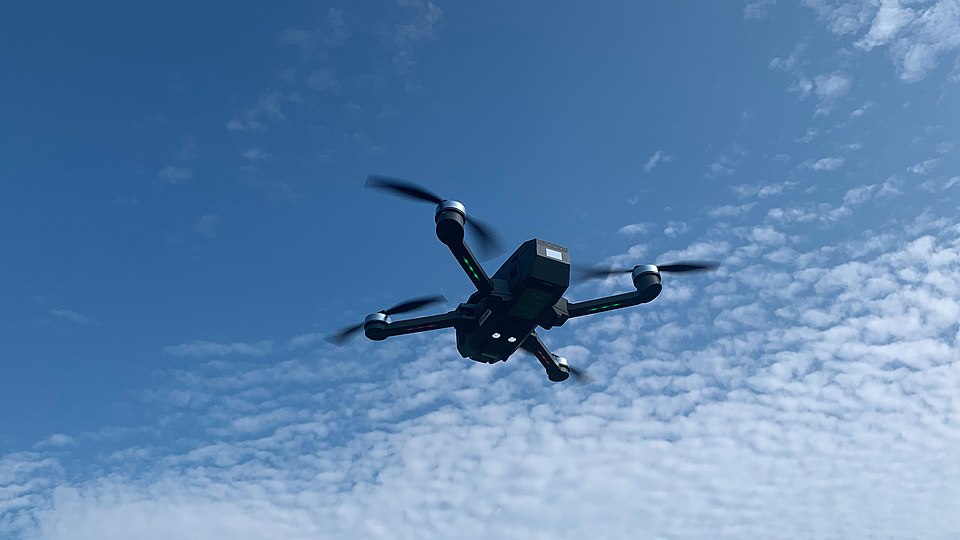
A quadcopter uses four rotors arranged in a square or X-shaped pattern. Each rotor spins at a fixed pitch, meaning the blade angle does not change. Instead, the aircraft controls its movement by speeding up or slowing down individual motors. Two rotors spin clockwise and two spin counterclockwise, which cancels out the torque effect and eliminates the need for a tail rotor entirely.
All of this is managed by an onboard flight controller -- a small computer that reads sensor data dozens of times per second and adjusts motor speeds automatically. This is why quadcopters feel so stable and easy to fly. The computer is doing most of the hard work.
Good to Know: Without a flight controller, a quadcopter would be nearly impossible to fly by hand. The stability you see is electronic, not natural.
A Brief History of Both Aircraft
Where Helicopters Came From
Helicopters have been around in some useful form since the mid-20th century. Early experimental designs appeared as far back as the early 1900s, but practical, controllable helicopters did not come until later decades. They were quickly adopted by military and civil operators for their ability to hover, land almost anywhere, and fly at low altitudes in ways fixed-wing aircraft simply could not.
Today, helicopters are used in search and rescue, medical transport, law enforcement, firefighting, military operations, and private aviation. They are proven, reliable, and trusted with missions where failure is not an option.
You can read more about how helicopters are used in specialized military roles in this comparison of the Apache helicopter and fighter jets.
Where Quadcopters Came From
Quadcopters have an interesting history that not many people know. Early multi-rotor designs actually appeared in the 1920s, but they were difficult to control and never caught on. The concept sat largely dormant for decades until advances in electronics, microcontrollers, and battery technology made small, stabilized quadcopters practical.
The modern quadcopter boom is generally traced to the mid-2000s and accelerated rapidly in the 2010s when consumer drones from companies like DJI became widely available. What started as a hobbyist gadget quickly found serious applications in photography, surveying, agriculture, and public safety.
Pro Tip: If you are comparing rotorcraft categories more broadly, the difference between a chopper and a helicopter is a surprisingly interesting topic with some nuance worth knowing about.
Helicopter vs Quadcopter: The 8 Key Differences That Matter Most
1. Rotor Configuration and Control
The most visible difference between a helicopter and a quadcopter is how many rotors they have and how those rotors work.
Helicopters rely on one main rotor with variable pitch blades. The pilot physically changes the pitch of those blades mid-flight to steer, climb, and descend. This system is highly responsive and precise, especially in experienced hands.
Quadcopters rely on four fixed-pitch rotors. They cannot change blade angle. Instead, they control flight by changing how fast each motor spins. This is simpler from a mechanical standpoint but requires rapid, constant electronic adjustments to stay stable.
| Control Method | Helicopter | Quadcopter |
| Pitch control | Variable (cyclic/collective) | Fixed |
| Yaw control | Tail rotor | Differential rotor speed |
| Stability source | Mechanical design | Electronic flight controller |
| Pilot input processing | Direct | Computer-mediated |
2. Flight Efficiency
Efficiency is one area where helicopters hold a clear advantage. A single large rotor moves a greater mass of air at a lower velocity to produce the same lift. This is more energy-efficient than four smaller rotors working at higher speeds.
Rules of aerodynamics generally dictate that a larger rotor blade spinning more slowly is more efficient than a smaller blade spinning faster. That is why a helicopter is more efficient than a quadcopter -- and why a quadcopter is more efficient than a six or eight-rotor drone.
Why It Matters: If you are flying long missions or carrying heavy payloads, efficiency directly affects how long your aircraft stays in the air and how much fuel or battery it burns doing it.
3. Payload Capacity
Helicopters win by a wide margin when it comes to carrying things. Their large rotor systems can generate substantial lift, and manned helicopters routinely carry passengers, cargo, equipment, and external loads that would be impossible for any quadcopter to handle.
Quadcopters are generally suited for lighter payloads. Consumer models might carry a small camera. Professional models can carry heavier sensors or equipment, but they still fall far short of what even a light helicopter can manage. For demanding missions like search and rescue, heavy equipment delivery, or aerial firefighting, a helicopter is the only realistic option.
4. Speed and Range
Helicopters are faster over distance and cover far more ground per flight. A typical light helicopter can cruise at speeds well exceeding 100 miles per hour and cover hundreds of miles on a single tank of fuel.
Most consumer and professional quadcopters have a top speed in the range of a few dozen miles per hour, and their battery-based flight time is typically measured in minutes rather than hours. Even extended-range professional drones are generally limited to a range of a few miles under normal operating conditions.
Keep in Mind: Flight time for quadcopters is constrained by battery capacity, which is still a major limiting factor compared to fuel-powered helicopters.
5. Wind Stability
This one might surprise you. Helicopters are generally more stable in windy conditions than quadcopters of similar size.
The reason is blade pitch control. Because helicopter rotor blades can constantly change their angle of attack, they can immediately respond to gusts and shifting winds, compensating for external forces in real time. Quadcopters, using fixed-pitch blades and motor speed adjustments, are slower to respond and more affected by wind, especially at small sizes.
Larger quadcopters handle wind better than small ones, but a helicopter's pitch-based control system gives it a natural advantage in rough air.
6. Mechanical Complexity and Maintenance
Here is where quadcopters shine. Their design is dramatically simpler. No swashplate, no pitch links, no tail rotor gearbox. Just motors, propellers, a frame, and electronics. This simplicity translates to lower manufacturing costs, easier repairs, and fewer points of failure.
Helicopters require regular inspection and maintenance of their complex mechanical systems. A worn pitch link or damaged swashplate can ground a helicopter and require skilled technicians to fix. A broken quadcopter prop can be swapped out in seconds for a few dollars.
Heads Up: Simplicity of repair does not mean quadcopters are more reliable in critical missions. A single rotor failure on a quadcopter can cause a crash, while a helicopter can often execute a safe autorotation landing even with engine failure.
7. Ease of Flying
Quadcopters are far easier to learn. The onboard flight controller handles stabilization automatically, and many consumer models include GPS hold, obstacle avoidance, and one-touch return-to-home features. A beginner can be flying a quadcopter safely within minutes of unboxing it.
Helicopters -- especially manned ones -- require extensive training. The coordination of cyclic, collective, and anti-torque pedals while managing engine power is genuinely difficult. RC helicopters are also harder to fly than RC quadcopters because they have fewer electronic assists.
If you are curious about what it takes to get licensed to fly a real helicopter, the requirements are quite different from a standard fixed-wing pilot license. A full breakdown of helicopter license vs pilot license requirements is worth reading before committing to training.
Speaking of training and aircraft knowledge, Flying411 is a great resource for understanding what different aircraft certifications involve and what they mean for your aviation goals.
8. Cost
Cost differences between helicopters and quadcopters vary enormously depending on whether you are comparing manned or unmanned versions.
For consumer and hobbyist use, a basic quadcopter can cost as little as $50 to $100. A quality camera drone from a reputable brand typically runs a few hundred to a few thousand dollars. Entry-level RC helicopters can be similarly priced, but they are harder to fly and less feature-rich at the same price point.
For manned aircraft, the gap widens dramatically. A light manned helicopter costs hundreds of thousands of dollars, while operating costs per hour run into the hundreds or more. Quadcopters used commercially still cost significantly less to operate per hour compared to their manned counterparts.
| Cost Category | Quadcopter | Helicopter (UAV) | Helicopter (Manned) |
| Entry-level purchase | $50 - $500 | $500 - $5,000 | N/A |
| Professional/commercial | $1,000 - $10,000+ | $5,000 - $50,000+ | $200,000 - $3M+ |
| Operating cost (per hour) | Very low | Low to moderate | High |
| Repair cost | Very low | Low to moderate | High |
Real-World Uses: Where Each Aircraft Belongs
Best Uses for Helicopters
- Search and rescue in remote or disaster-stricken areas
- Medical evacuation and air ambulance services
- Military operations, troop transport, and reconnaissance
- Firefighting and aerial water drops
- Long-range cargo and supply delivery
- Offshore oil platform crew transfers
- Private and VIP charter transportation
- Law enforcement patrol and pursuit
Best Uses for Quadcopters
- Aerial photography and videography
- Real estate marketing and inspection
- Agricultural surveying and crop monitoring
- Infrastructure inspection (bridges, power lines, towers)
- Recreational flying and racing
- Search and rescue support in accessible areas
- Wildlife monitoring and conservation research
- Delivery testing and logistics in controlled environments
Fun Fact: Quadcopters have been used in some of the most dramatic film and television productions in recent years, capturing shots that would have required far more expensive helicopter operations just a decade ago.
Can Quadcopters Replace Helicopters?
This is one of the most common questions in aviation and drone technology circles, and the honest answer is: not entirely.
Quadcopters have taken over a huge portion of the low-altitude aerial work that helicopters used to dominate, especially in aerial photography and inspection. For many of those tasks, they are cheaper, faster to deploy, and safer to operate. But they cannot match a helicopter's range, payload, endurance, or reliability for serious missions.
The idea of scaling up a quadcopter to carry passengers has been explored extensively. Several companies have built large multi-rotor air taxis, and some have even flown with passengers aboard. But the efficiency challenges and safety limitations of fixed-pitch multi-rotor designs make them fundamentally less practical than traditional helicopter configurations at larger scales.
Good to Know: If a single rotor fails on a quadcopter, the aircraft becomes extremely difficult or impossible to control. Helicopters can perform an autorotation maneuver that allows a safe landing even with a complete engine failure.
For those interested in how the aviation industry is approaching this challenge with next-generation designs, the ongoing development of eVTOL aircraft represents an entirely new category that blends elements of both aircraft types. The comparison between eVTOL and helicopter technology is an evolving and fascinating topic.
Similarly, if you are curious about the line between drone and helicopter more broadly, a detailed look at drone vs helicopter differences covers how the two categories relate and where they diverge.
Helicopter vs Quadcopter: Which Should You Choose?
The right choice depends entirely on what you want to do.
If your goal is aerial photography, inspection, or recreational flying, a quadcopter is the clear winner. It is affordable, easy to learn, and purpose-built for those tasks. A quality consumer drone gets you in the air quickly and delivers results that used to require a full helicopter crew.
If your goal is long-range transport, heavy lifting, emergency services, or manned flight, a helicopter is the only real option. No quadcopter can match a helicopter's payload, range, endurance, or safety record for serious operations.
For those interested in RC aviation and hobby flying, both types offer their own rewards. RC helicopters appeal to pilots who enjoy the challenge of mastering a complex machine. RC quadcopters appeal to those who want a stable, feature-rich platform right out of the box.
And if you are thinking about more specialized comparisons within the helicopter world -- like how attack helicopters differ from one another in terms of capability and design -- there are some interesting side-by-side analyses worth exploring, such as the comparison of the Viper helicopter vs Apache.
For guidance on aircraft types, certifications, training paths, and aviation decisions, check out Flying411 -- it is built for anyone who wants clear, honest answers about the world of flight.
Conclusion
The helicopter vs quadcopter debate does not have a single winner -- it has two very different tools built for very different jobs. Helicopters are powerful, efficient, and irreplaceable for serious missions that demand range, payload, and reliability. Quadcopters are accessible, affordable, and perfectly suited for the growing world of drone-based work and recreation. Understanding the real differences between them helps you make smarter decisions, whether you are buying your first drone, planning a commercial operation, or just getting curious about how these machines actually work.
For more guidance on aircraft, flight, and everything in between, Flying411 is the place to go.
FAQs
Is a quadcopter considered a helicopter?
Technically, a quadcopter is a type of rotorcraft, and some definitions classify it as a type of helicopter since it uses rotating blades for lift. In common usage, however, the two terms refer to distinct aircraft with different designs and capabilities.
Which is safer to fly, a helicopter or a quadcopter?
For manned flight, helicopters are subject to rigorous safety standards and certification requirements that make them among the safest aircraft in the world. For unmanned hobbyist use, quadcopters are generally safer to operate near people because of their smaller size, slower speeds, and electronic safety features.
Why don't we use giant quadcopters for passenger transport?
Scaling up a quadcopter introduces serious efficiency and safety challenges. Fixed-pitch rotors become less efficient at large sizes, and losing even one rotor in a four-rotor system can be catastrophic. Traditional helicopter designs handle these challenges more effectively, which is why manned rotorcraft still use conventional configurations.
How long can a quadcopter fly compared to a helicopter?
Most consumer quadcopters have a flight time of roughly 20 to 40 minutes per battery charge. Professional models may extend that somewhat. Manned helicopters can fly for several hours depending on fuel capacity, giving them a major endurance advantage.
Do quadcopters need FAA registration in the United States?
Yes. In the United States, most drones weighing more than 0.55 pounds require registration with the Federal Aviation Administration. Operators may also need to pass a knowledge test and follow specific airspace rules depending on where and how they fly.