When people hear "Apache helicopter" and "fighter jet" in the same sentence, the first question is usually: which one wins? It is a fair question, and the honest answer is — it depends on what you mean by "win." These two aircraft could not be more different in design, mission, and purpose. One hugs the ground and hunts tanks. The other screams through the sky at twice the speed of sound. Yet both are deadly, both are impressive, and both are essential to modern warfare.
The apache helicopter vs fighter jet debate is less about one being better than the other and more about what each machine was built to do. Understanding that difference is what makes the comparison so fascinating. Strap in — this one goes deep.
Key Takeaways
The Apache helicopter and the fighter jet serve very different roles on the battlefield. The Apache is a low-flying attack helicopter designed to destroy tanks, support ground troops, and operate in tight terrain. Fighter jets like the F-16 or F-35 fly at extreme speed and altitude, engage aerial threats, and strike targets from long range. In a head-to-head clash at low altitude, the Apache can hold its own in surprising ways. But in open-sky, high-speed combat, the fighter jet's range, speed, and firepower give it a decisive edge. Each aircraft is the best in the world at what it was specifically designed to do.
| Feature | AH-64 Apache | Fighter Jet (e.g., F-16 / F-35) |
| Primary Role | Ground attack, anti-armor | Air superiority, multi-role strike |
| Max Speed | Around 182 mph (293 km/h) | Mach 1.6 to Mach 2+ (1,200-1,500+ mph) |
| Crew | 2 (pilot + gunner) | 1-2 (depending on variant) |
| Main Weapons | 30mm chain gun, Hellfire missiles, rockets | Air-to-air missiles, bombs, cannons |
| Stealth | Low radar profile via terrain masking | F-35 has built-in stealth technology |
| Operating Altitude | Very low (nap-of-the-earth flight) | High altitude (40,000+ feet typical) |
| Runway Needed | None (vertical takeoff) | Yes (standard airstrip required) |
| Best Environment | Urban, mountainous, close-quarters | Open sky, contested airspace |
| Cost (approx.) | Around $35-50 million per unit | $35 million (F-16) to $110 million (F-35) |
Flying411 covers military aviation topics like this and much more, helping enthusiasts and professionals stay informed about the aircraft shaping modern skies.
A Quick Introduction to Both Aircraft
Before comparing them directly, it helps to know a bit of background on each platform.
The AH-64 Apache: The Army's Tank Killer
The AH-64 Apache is the U.S. Army's primary attack helicopter. It has been in service since 1984 and has gone through several major upgrades, leading to the current AH-64E Guardian — the most advanced version yet. The Apache was purpose-built as a "tank killer," designed to find, track, and destroy armored vehicles at low altitudes using terrain for cover.
It carries a crew of two in a tandem cockpit: one pilot and one gunner. Its signature weapon is the AGM-114 Hellfire missile, a laser- or radar-guided missile designed to punch through heavy armor. It also carries a 30mm M230 chain gun under its fuselage, capable of firing around 625 rounds per minute.
Fun Fact: The Apache's helmet-mounted display allows the pilot or gunner to aim the 30mm chain gun simply by turning their head. Wherever they look, the gun follows.
One of the Apache's most unique abilities is nap-of-the-earth (NOE) flight — flying just a few feet above the ground, using hills, trees, and valleys to stay hidden from enemy radar. This makes it extraordinarily hard to detect and intercept.
Fighter Jets: Speed, Altitude, and Long-Range Lethality
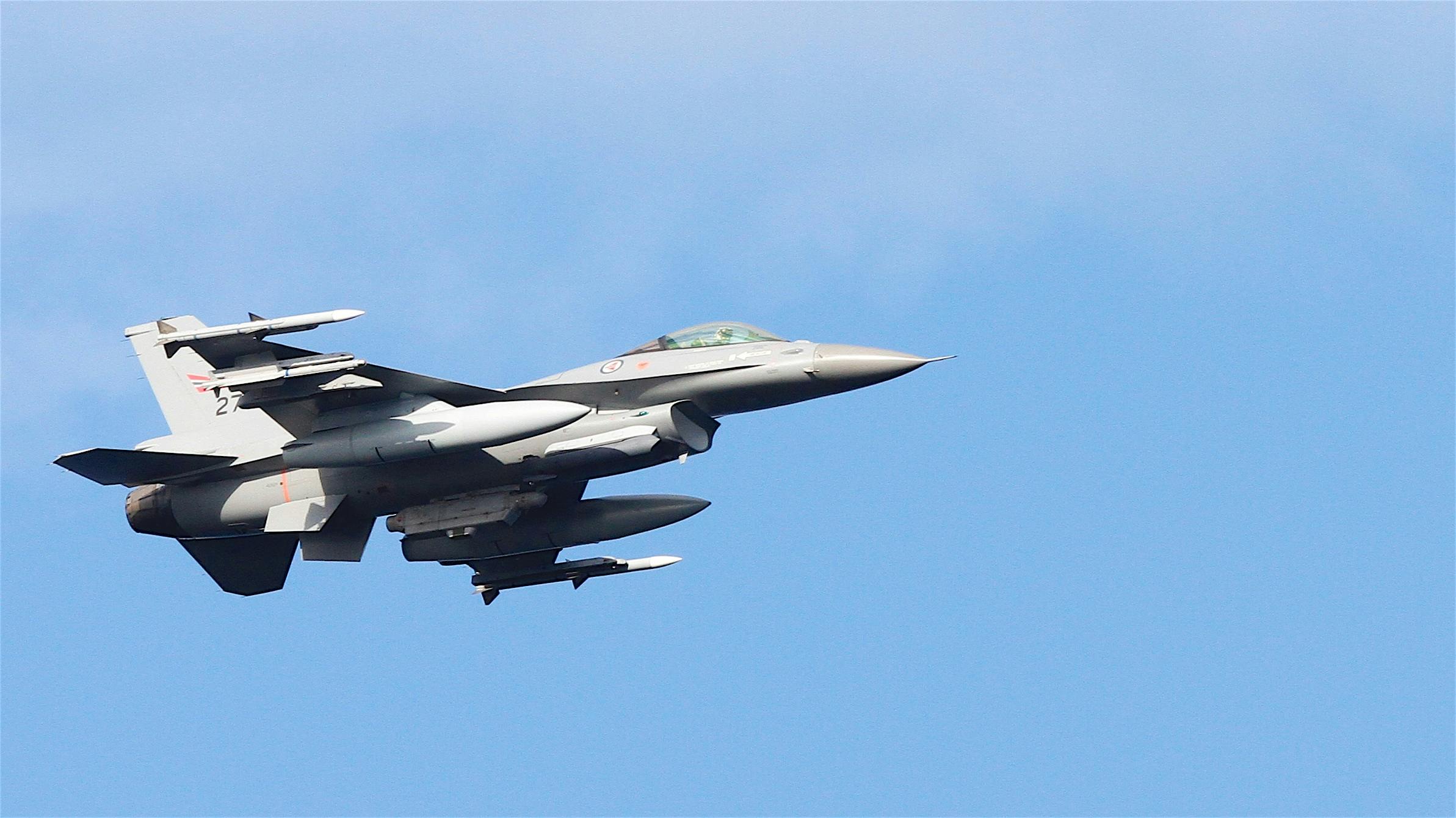
Fighter jets like the F-16 Fighting Falcon and the F-35 Lightning II operate in a completely different part of the sky. They are fast, high-altitude aircraft built for air-to-air combat, long-range strikes, and power projection.
The F-16, introduced in the late 1970s, can reach speeds around Mach 2 and carries a diverse weapons load including air-to-air missiles and precision-guided bombs. The F-35, the newest U.S. fifth-generation fighter, trades some raw speed (capping around Mach 1.6) for advanced stealth, sensor fusion, and networked warfare capabilities.
Where the Apache is a close-in brawler using terrain for protection, the fighter jet is a long-range predator that often engages targets before the enemy even knows it is there.
Apache Helicopter vs Fighter Jet: 8 Key Differences That Actually Matter
Both aircraft carry serious firepower and represent the best of what military aviation can produce. But they were designed for completely different battlefields, and those differences show up in almost every aspect of their design.
Here are eight areas where the Apache and the fighter jet part ways in ways that actually change the outcome of a mission.
1. Speed and Altitude
This is the most obvious gap between the two platforms, and it is enormous.
The Apache has a top speed of around 182 mph (293 km/h). It cruises even slower, typically around 165 mph. For comparison, the F-16 reaches speeds around Mach 2 — roughly 1,500 mph. The F-35 tops out at about Mach 1.6, or around 1,200 mph.
Even in fighter jet terms, the Apache is barely moving. But that speed difference cuts both ways. A fast-moving jet streaking through a low-altitude combat zone has far less time to identify and engage targets. The Apache, moving slowly and close to the ground, can take its time.
Good to Know: A fighter jet flying at Mach 1 or higher at low altitude is fighting physics as much as it is fighting the enemy. The slow, deliberate Apache can often react faster in a close-range, terrain-cluttered environment.
2. Primary Mission
The Apache's mission is close air support (CAS) and anti-armor warfare. It supports ground troops by hunting tanks, fortified positions, and vehicles at very close range. It loiters. It waits. It stalks.
Fighter jets are built for air superiority and long-range strike missions. The F-35 in particular is designed to be a "first-in" aircraft — entering hostile airspace before anyone else, disabling enemy radar and air defenses, and clearing the way for other platforms.
These missions rarely overlap, which is exactly why both aircraft exist in the same air force.
3. Weapons Systems
Both platforms are heavily armed, but their weapons are designed for very different targets.
Apache weapons:
- 30mm M230 chain gun (anti-personnel, light vehicles)
- Up to 16 AGM-114 Hellfire missiles (anti-armor, precision strike)
- Hydra 70 rocket pods (area suppression)
- AIM-92 Stinger air-to-air missiles (self-defense against aircraft)
Fighter jet weapons (F-16/F-35):
- AIM-120 AMRAAM beyond-visual-range air-to-air missiles
- AIM-9 Sidewinder short-range missiles
- JDAMs and laser-guided bombs (precision ground attack)
- Internal 20mm Vulcan cannon (F-16) or 25mm GAU-22/A (F-35)
Pro Tip: The Apache can actually carry air-to-air missiles for self-defense. This matters in the hypothetical "can an Apache shoot down a jet" debate — and the short answer is: under the right conditions, yes.
4. Survivability and Armor
The Apache was built to take a hit. Its airframe, rotor blades, and critical systems are designed to survive hits from small arms and light cannon fire. The AH-64E's composite rotor blades are engineered to withstand hits from 23mm anti-aircraft rounds. Redundant hydraulic and electrical systems mean the crew can often limp home after damage that would down other aircraft.
Fighter jets rely on speed and altitude for survivability. They are not armored in the same way — they avoid getting hit by not being seen or by moving too fast to target.
Keep in Mind: The Apache's armor is a key advantage in low-altitude, high-threat environments. But no amount of armor protects against a beyond-visual-range missile fired from 20 miles away at 40,000 feet.
5. Terrain and Environment
The Apache thrives in complex terrain. Mountains, valleys, forests, and urban canyons all work in its favor. It can pop up from behind a ridgeline, fire its Hellfire missiles, and drop back into cover before the enemy can respond. This tactic — called "pop-up attack" — is a hallmark of Apache operations.
Fighter jets need open sky. They are designed for operations at medium to high altitude, where their sensors, speed, and weapons are most effective. Flying low and slow in a confined valley is not where a fighter jet wants to be.
You can learn more about how different helicopters compare in various environments in this breakdown of the Apache vs Blackhawk — two helicopters with very different strengths.
6. Loiter Time and Flexibility
The Apache can hover. It can loiter over a target area for extended periods, waiting for the right moment to strike or providing persistent overwatch for ground forces. It can land almost anywhere without a runway.
Fighter jets are the opposite. They move fast and burn fuel quickly. Even with drop tanks, their time over a target area is limited. They need prepared runways or aircraft carriers to operate.
Flying411 has a growing library of aviation comparisons and guides — whether you fly, study, or simply love aircraft, it is worth bookmarking.
7. Stealth and Detection
The Apache relies on terrain masking for stealth — staying so low and using the landscape so cleverly that radar systems cannot get a clean look at it. The AH-64E also incorporates a low radar profile and advanced electronic countermeasures.
The F-35, on the other hand, uses true radar-absorbing stealth technology built into its airframe, coatings, and internal weapons bays. It can penetrate advanced air defense systems that would detect and engage conventional aircraft. Its Distributed Aperture System (DAS) gives the pilot 360-degree infrared vision in all directions simultaneously.
Why It Matters: The F-35's stealth is so effective that it is often described as a "networked intelligence node that carries weapons" rather than a traditional fighter. It changes the rules of engagement entirely.
8. Cost and Logistics
Both aircraft are expensive to buy and maintain, but in different ways.
The AH-64E Apache costs roughly $35-50 million per unit, though operating costs and support contracts add significantly to lifetime expenses. It can operate from forward bases, cleared fields, or ship decks — no runway required.
The F-16 Fighting Falcon in modern configurations runs around $35-40 million per unit. The F-35 Lightning II is considerably more expensive, with per-unit costs generally cited in the range of $80-110 million depending on the variant and contract.
Fighter jets also require significant airfield infrastructure — long runways, maintenance hangars, and ground support equipment.
Can an Apache Helicopter Shoot Down a Fighter Jet?
This is the question everyone really wants answered.
The short answer is: yes, under specific conditions — and it has been demonstrated in training exercises.
Heads Up: This is a nuanced topic that depends heavily on environment, altitude, and pilot skill. Real combat outcomes are never as clean as spec-sheet comparisons suggest.
Here is the key insight from actual pilot accounts: fighter jets are dangerous to helicopters at high altitude and long range. But if a fighter pilot drops down to low altitude to engage an Apache, the dynamic shifts dramatically.
Helicopter turn rates can reach 30 to 40 degrees per second — roughly three times faster than a fighter jet pulling hard at high g-force. At low altitude, the Apache can use terrain to mask its position and make the fighter's targeting systems work overtime. The Apache's weapons are always pointing toward the threat while the fighter has to maneuver into firing position — and in a low-speed, low-altitude knife fight, that is a serious disadvantage for the jet.
The Apache can also carry AIM-92 Stinger air-to-air missiles and has a 30mm chain gun optimized for anti-aircraft use. An Apache crew that spots a low-flying jet before the jet spots them has a real fighting chance.
That said, if the fighter stays at altitude and uses beyond-visual-range missiles, the Apache has very limited options. The fighter's speed and missile range are overwhelming advantages in open sky.
The conclusion most experts reach: neither aircraft should ever be in a position to fight the other in the first place. Their missions are designed to be complementary, not competitive.
For a broader look at how helicopters match up in various combat scenarios, this article on Cobra helicopter vs Apache offers helpful context on the evolution of attack helicopter design.
Real-World Combat Performance
Apache in Combat
The Apache's combat record is extensive. It saw action in Operation Desert Storm, the 2003 invasion of Iraq, Afghanistan, and numerous smaller engagements across the Middle East. Its ability to destroy armor, support infantry, and operate in demanding terrain has made it one of the most battle-tested attack helicopters in history.
It has not been without challenges. Early in Operation Iraqi Freedom, a large formation of Apaches flew into a well-prepared ambush and suffered significant damage from small-arms fire and rocket-propelled grenades. The lesson learned: the Apache is devastating when used with proper tactics, and vulnerable when those tactics are ignored.
Fun Fact: The AH-64E Guardian can command unmanned aerial vehicles (UAVs) directly from the cockpit, extending its sensor reach far beyond line-of-sight. This makes it a force-multiplier, not just a gunship.
Fighter Jets in Combat
Modern fighter jets, particularly the F-35, have transformed how air power is used. The F-35's ability to penetrate defended airspace, gather intelligence, disable enemy radars, and coordinate other aircraft makes it far more than a dogfighter.
The F-16 has amassed a remarkable combat record since entering service, racking up air-to-air victories across multiple conflicts while also performing close air support, interdiction, and suppression of enemy air defense missions. Its versatility and sheer numbers make it a cornerstone of U.S. and allied air power.
You can explore more about how rotor-wing and fixed-wing aircraft compare in this overview of helicopter vs jet performance differences.
Which Platform Is More Versatile?
This depends entirely on what you define as versatile.
The Apache is extraordinarily specialized. It does close air support and anti-armor warfare better than almost anything else in the world, but it cannot intercept enemy aircraft at altitude, cannot conduct long-range strikes, and cannot fly faster than a sports car's top speed.
The fighter jet — especially the F-35 — is a true multi-role platform. It can fight other aircraft, strike ground targets, suppress air defenses, conduct reconnaissance, and share battlefield data with allied forces simultaneously.
If versatility means doing many different things well, the modern fighter jet wins. If it means doing one thing at a truly elite level in a specific environment, the Apache holds its own.
What About Safety and Accident Rates?
Military helicopter operations carry inherent risk, and the Apache is no exception. For those curious about how helicopter safety statistics compare to other forms of transportation, this analysis of helicopter death rate vs car accidents provides useful context.
Fighter jets face their own risks — high-speed, high-altitude flight in contested airspace is one of the most demanding environments a pilot can face. Both aircraft depend on extensive training, maintenance, and crew coordination to operate safely.
If you are passionate about military aviation, general aviation, or anything in between, Flying411 is a great place to explore aircraft comparisons, safety data, and more.
How They Work Together
It is worth emphasizing that these two aircraft are designed to work together, not compete. In a modern combined-arms operation, fighter jets might first clear the skies of enemy aircraft and neutralize surface-to-air missile systems. Once air superiority is established, Apaches move in to support ground forces, hunt armor, and provide persistent fire support in ways jets simply cannot.
This layered approach — where each platform handles what it does best — is the foundation of modern U.S. military air doctrine.
For more fascinating helicopter comparisons that put design tradeoffs in sharp relief, check out these related reads on the Seahawk vs Blackhawk and the gyrocopter vs helicopter debates.
Conclusion
The Apache helicopter vs fighter jet comparison ultimately reveals two very different answers to the same basic question: how do you project lethal force from the air? The Apache answers with patience, terrain mastery, and devastating close-range firepower. The fighter jet answers with speed, altitude, stealth, and reach.
Neither is "better." Both are irreplaceable. One hunts tanks in the valleys. The other rules the sky above. Together, they form the backbone of modern air combat power.
If you want to keep learning about the aircraft that shape the world — from military machines to general aviation — Flying411 is where the conversation never runs out of altitude.
Frequently Asked Questions
What is the main difference between an Apache helicopter and a fighter jet?
The Apache is a low-flying attack helicopter built for close air support and destroying ground targets like tanks and fortified positions. A fighter jet operates at high speed and altitude, primarily for air-to-air combat and long-range precision strikes.
Can an Apache helicopter win in a fight against a fighter jet?
Under certain conditions — particularly at low altitude in complex terrain — an Apache can pose a serious threat to a fighter jet using air-to-air missiles and its chain gun. However, if the jet stays at altitude and uses beyond-visual-range missiles, the Apache has very limited ability to fight back.
How fast is the Apache helicopter compared to a fighter jet?
The Apache reaches a maximum speed of around 182 mph. Fighter jets are dramatically faster — the F-16 reaches around Mach 2 (approximately 1,500 mph), while the F-35 tops out near Mach 1.6 (around 1,200 mph).
Do Apache helicopters need a runway to take off?
No. The Apache is a rotary-wing aircraft that takes off and lands vertically. It can operate from unprepared fields, forward operating bases, and even ship decks — no runway required.
Which aircraft is more expensive, an Apache or an F-35?
The F-35 Lightning II is generally far more expensive, with per-unit costs often cited in the range of $80-110 million. The AH-64E Apache typically runs in the range of $35-50 million per unit, though both aircraft carry significant lifetime operating and maintenance costs on top of purchase price.