If you've ever looked up at a military helicopter and wondered which one it is, you're not alone. The Seahawk and the Black Hawk look remarkably similar at first glance. They share the same DNA, after all. But once you dig a little deeper, these two helicopters are built for very different worlds -- one rules the open ocean, and the other owns the battlefield on land.
Both helicopters trace their roots to Sikorsky's legendary S-70 design. The UH-60 Black Hawk was introduced to the U.S. Army in the late 1970s, and the SH-60 Seahawk followed in the mid-1980s as a Navy-specific adaptation. Think of the Seahawk as the Black Hawk's more specialized cousin -- one who traded combat boots for sea legs. Understanding the seahawk helicopter vs Black Hawk comparison helps aviation fans, military enthusiasts, and curious minds appreciate just how much engineering goes into tailoring one platform for two completely different environments.
Key Takeaways
The Seahawk helicopter and the Black Hawk are both part of the Sikorsky H-60 family and share a common airframe, but they serve very different roles. The Black Hawk is the U.S. Army's primary utility and assault helicopter, designed for troop transport, medical evacuation, and combat support on land. The Seahawk is the U.S. Navy's maritime multi-mission helicopter, modified to operate from ship decks at sea. Key differences include folding rotor blades, corrosion-resistant coatings, more powerful engines, and a triple-redundant electrical system on the Seahawk -- all features designed specifically for naval operations.
| Feature | UH-60 Black Hawk | SH-60 / MH-60 Seahawk |
| Operator | U.S. Army (primary) | U.S. Navy (primary) |
| Introduced | Late 1970s | Mid-1980s |
| Primary Role | Troop transport, assault | Anti-submarine, multi-mission naval ops |
| Rotor Blades | Fixed | Folding (for shipboard storage) |
| Tail Boom | Fixed | Hinged and foldable |
| Tail Wheel Position | End of tail boom | Near fuselage (forward position) |
| Engine Variant | T700-GE-700 / 701 series | T700-GE-401C / 401D |
| Corrosion Protection | Standard | Enhanced for saltwater exposure |
| Electrical System | Dual main generators | Triple-redundant system |
| Crew Capacity | 3 crew + up to 14 troops | Varies by variant |
If you're passionate about aviation and want to stay informed on the latest in military and general aviation topics, Flying411 is a great resource to bookmark for reliable, easy-to-understand aircraft coverage.
A Shared Origin: The Sikorsky S-70 Family
Before comparing the two helicopters, it helps to understand where both came from. In the late 1960s and early 1970s, the U.S. Army began looking for a new utility helicopter to replace the aging UH-1 Iroquois -- better known as the "Huey" -- that had served so prominently during the Vietnam War. The Army needed something faster, tougher, and more capable of surviving modern battlefield threats.
The result was the Sikorsky S-70 design, which became the UH-60 Black Hawk. It first flew in 1974 and entered Army service in the late 1970s. The design was so successful that the U.S. Navy took notice. Rather than develop an entirely new airframe, the Navy worked with Sikorsky to adapt the Black Hawk platform for shipboard operations. That adaptation became the SH-60 Seahawk.
Fun Fact: The Black Hawk takes its name from Black Hawk, a Sauk warrior and leader from the early 19th century. The U.S. military has a long tradition of naming helicopters after Native American leaders and tribes, including the Chinook, Apache, Iroquois, and Lakota.
Why the Navy Needed Its Own Version
The Navy's requirements were quite different from the Army's. Ships have limited deck space. Salt air and ocean spray corrode metal quickly. Missions like hunting submarines, inserting special operations forces into coastal areas, and rescuing downed pilots at sea require very different tools than moving troops across a battlefield.
The Navy's version needed to fit into tighter spaces aboard destroyers, frigates, and aircraft carriers. It needed electronics for tracking submarines. And it needed to handle the constant punishment that comes from operating in a saltwater environment.
Good to Know: The Seahawk can deploy from virtually any air-capable U.S. Navy vessel, including destroyers, frigates, cruisers, littoral combat ships, and aircraft carriers -- making it one of the most versatile naval helicopters in the world.
This is what led Sikorsky to develop the S-70B design in the late 1970s, officially selected by the Navy in 1978 and designated the SH-60B Seahawk. It was more than just a Black Hawk with a Navy paint job. It was a fundamentally reworked aircraft built around the demands of maritime warfare.
Seahawk Helicopter vs Black Hawk: 9 Key Differences
These two helicopters share a family resemblance, but the list of differences is longer than most people expect. Here is a breakdown of what sets them apart.
1. Folding Rotor Blades and Tail
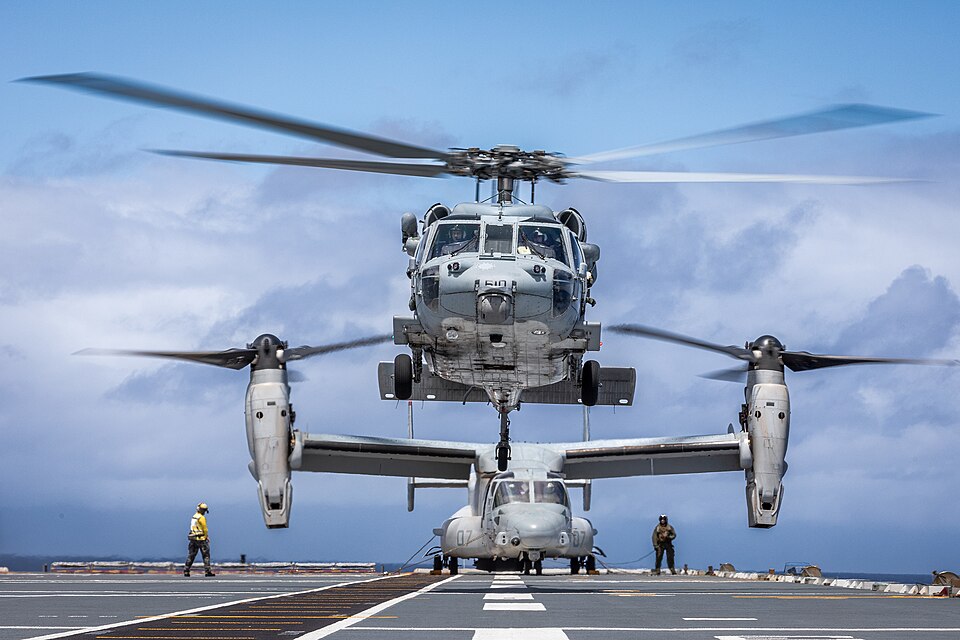
This is the most visually obvious difference. The Seahawk is equipped with folding main rotor blades and a hinged, foldable tail boom. This is not a minor tweak -- it is a core design feature that allows the helicopter to fit into the tight hangar spaces aboard naval vessels.
The Black Hawk has no such folding system. It operates from land bases with far more room to spare, so there is simply no need for it.
2. Tail Wheel Position
Look closely at the two helicopters from the side and you will notice something subtle but important. On the Black Hawk, the tail wheel is located at the very end of the tail boom. On the Seahawk, the tail wheel is moved forward, closer to the fuselage.
This repositioning shortens the wheelbase and improves deck handling stability, especially in rough seas. It also makes it easier to maneuver the helicopter on a ship's deck without the tail swinging into obstacles.
Pro Tip: The tail wheel position is one of the fastest ways to visually tell a Seahawk and a Black Hawk apart when you see them on the ground or deck.
3. Engines and Power Output
Both helicopters use variants of the General Electric T700 turboshaft engine, but the specific versions differ. The Seahawk's MH-60R and MH-60S variants typically use the T700-GE-401C or 401D engines, which are tuned to produce around 1,940 shaft horsepower each and are optimized to resist the corrosion and erosion that come with maritime operations.
The Black Hawk's base variants use the T700-GE-700 or 701 series. The UH-60M, the current Army standard, uses the upgraded T700-GE-701D, which delivers improved performance and efficiency over earlier versions.
4. Corrosion Protection
Operating over the open ocean is hard on any aircraft. Salt air, spray, and high humidity can eat through metal and electronics quickly. The Seahawk features specialized anti-corrosion coatings on its airframe and components that the land-based Black Hawk simply does not need in the same way.
Every part of the Seahawk exposed to the maritime environment is engineered or treated with this in mind, from its fuselage panels to its engine internals.
Why It Matters: Without dedicated anti-corrosion treatment, a helicopter operating from a naval vessel could suffer accelerated structural wear, increasing maintenance costs and reducing service life significantly.
5. Electrical System
The Seahawk features a triple-redundant electrical system: two main generators driven by the engines, plus a dedicated auxiliary power unit. This setup ensures that advanced sensors, the dipping sonar, folding mechanisms, and other critical equipment remain powered even if the main engines are shut down.
The Black Hawk uses a more conventional dual-generator electrical setup, which is more than sufficient for its land-based mission profile.
6. Mission Equipment and Sensors
This is where the two helicopters diverge most dramatically in function. The Black Hawk is primarily set up for troop transport, cargo lift, medical evacuation, and combat support. It can mount door guns, carry Hellfire missiles and rockets via its External Stores Support System, and transport up to 11 to 14 fully equipped combat troops.
The Seahawk carries a completely different suite of mission equipment depending on the variant. The SH-60B, for example, carries a towed Magnetic Anomaly Detector (MAD) for submarine hunting, air-launched sonobuoys, torpedoes, the APS-124 search radar, and the ALQ-142 electronic support measures system. Some versions also include a nose-mounted Forward Looking Infrared (FLIR) turret.
The Navy's MH-60R "Romeo" -- the current primary combat Seahawk variant -- is equipped for anti-submarine warfare, anti-surface warfare, and electromagnetic operations. The MH-60S "Sierra" focuses more on combat search and rescue, vertical replenishment, and special operations support.
Fun Fact: The Seahawk's dipping sonar system allows it to hover above the ocean surface and lower a sonar transducer into the water to detect submerged submarines -- a mission the land-based Black Hawk was never designed to perform.
7. Crew and Troop Capacity
The Black Hawk is designed with a crew of three -- pilot, co-pilot, and crew chief -- and can carry 11 to 14 fully armed combat troops depending on configuration. In the MEDEVAC role, it can accommodate up to six litter patients.
The Seahawk's crew size and passenger capacity vary significantly by variant and mission. Anti-submarine warfare missions typically involve a smaller specialized crew focused on operating the complex sensor suite rather than carrying large numbers of troops.
8. Shipboard Compatibility
The Seahawk was purpose-built to operate from naval vessels. Its folding features, forward tail wheel, corrosion protection, and reinforced landing gear all serve this goal. It can land on, secure to, and launch from the rolling and pitching decks of ships at sea in conditions that would ground most helicopters.
The Black Hawk has no such adaptations. It is designed for airfield and forward operating base operations on land.
9. Landing Gear Design
Both helicopters use a conventional wheeled tricycle landing gear layout, but the engineering details differ. The Seahawk's gear is reinforced and specifically configured for shipboard operations, where the deck may be wet, angled, or moving. Some Seahawk variants also include systems that help lock the helicopter to the deck to prevent it from sliding during rough seas.
You can read more about how helicopter landing gear design choices -- wheels versus skids -- affect different operational environments in this comparison of helicopters with wheels vs skids.
Speaking of powerful aviation platforms, Flying411 covers a wide range of helicopter and fixed-wing topics designed to keep aviation enthusiasts well-informed and up to date.
Performance Comparison: How Do the Numbers Stack Up?
Both helicopters are capable performers, but their specifications reflect their different roles.
| Spec | UH-60 Black Hawk (UH-60M) | MH-60R Seahawk |
| Length (overall) | Approx. 64 ft 10 in | Approx. 64 ft 10 in |
| Main Rotor Diameter | Approx. 53 ft 8 in | Approx. 53 ft 8 in |
| Max Speed | Approx. 173 mph | Similar range |
| Combat Range | Approx. 370 miles | Varies by mission load |
| Max Gross Weight | Approx. 22,000 lb | Similar |
| Service Ceiling | Approx. 19,000-20,000 ft | Similar |
| Engines | 2x T700-GE-701D | 2x T700-GE-401C/D |
The two helicopters share nearly identical external dimensions because the Seahawk was built on the same S-70 airframe. The performance differences that do exist come mainly from engine tuning, mission equipment weight, and operational requirements rather than fundamental airframe differences.
Keep in Mind: The Seahawk's mission equipment -- sonar, radar, torpedoes, and other naval systems -- adds significant weight compared to a lightly configured Black Hawk, which can affect its available payload and range in any given mission.
Combat History and Real-World Use
Both helicopters have long and distinguished service records.
Black Hawk in Combat
The Black Hawk has seen action in nearly every major U.S. military conflict since the 1980s. It played a central role in Operation Desert Storm, where it supported the largest air assault in U.S. Army history involving hundreds of helicopters. It became internationally known after the 1993 Battle of Mogadishu, which inspired the book and film "Black Hawk Down." It has continued to serve in operations across the Middle East, Central Asia, and in humanitarian and disaster relief missions worldwide.
Modified special operations versions, including the MH-60 variants used by the 160th Special Operations Aviation Regiment -- known as the "Night Stalkers" -- have carried out some of the most sensitive missions in U.S. military history.
Seahawk in Service
The Seahawk has been equally active at sea. It has served in anti-submarine warfare patrols, special operations insertions, search and rescue missions, and logistics support for naval task forces around the world. It is currently operated by the U.S. Navy and a growing number of allied nations, including Australia, Denmark, Norway, and others.
The best turboshaft engine technology available has played a key role in keeping both platforms reliable across decades of demanding service, and you can learn more about how turboshaft engines power top military and commercial helicopters in this overview of the best turboshaft engine helicopters.
Good to Know: The Seahawk has been procured by allied navies worldwide, making it one of the most widely exported naval helicopters in history. This international adoption reflects just how capable and adaptable the platform has proven to be.
Variants: How Many Versions Are There?
Both platforms have spawned numerous variants tailored to specific missions.
Black Hawk Variants
- UH-60A -- The original Army utility transport version
- UH-60L -- Updated version with more powerful engines and improved performance
- UH-60M -- Current production model with digital avionics, wide-chord rotor blades, and T700-GE-701D engines
- HH-60M -- Dedicated medical evacuation version
- MH-60K / MH-60L -- Special operations variants for the 160th SOAR
- HH-60G Pave Hawk -- Air Force combat search and rescue version
- VH-60N White Hawk -- VIP and presidential transport version
Seahawk Variants
- SH-60B -- Original ship-based anti-submarine warfare variant
- SH-60F -- Carrier-based inner-zone anti-submarine warfare
- HH-60H -- Combat search and rescue and special operations support
- MH-60R "Romeo" -- Current primary multi-mission combat variant
- MH-60S "Sierra" -- Multi-mission support variant for logistics and rescue
The sheer number of variants on both sides shows how versatile the underlying S-70 platform has proven to be over decades of service.
How Does the Black Hawk Compare to Other Military Helicopters?
If you are curious how the Black Hawk stacks up against other famous military rotorcraft, the comparisons are fascinating. The Apache helicopter vs Black Hawk comparison highlights how an attack helicopter and a utility helicopter serve fundamentally different battlefield roles despite both being Army standards. Similarly, the Cobra helicopter vs Apache comparison traces the evolution of dedicated attack helicopter design across generations.
For those interested in less conventional rotor designs, synchropter advantages and disadvantages explores a completely different approach to helicopter engineering that stands in sharp contrast to the tandem and single-main-rotor designs of both the Black Hawk and Seahawk.
Heads Up: The Black Hawk and Seahawk are sometimes confused with the Coast Guard's HH-60J Jayhawk, which is yet another variant of the same H-60 family adapted for maritime search and rescue. Each branch of the U.S. military has tailored the basic design to its own specific needs.
Safety and Reliability
Both platforms have built strong reputations for reliability and survivability over decades of service. The H-60 family's design includes self-sealing crash-capable fuel tanks, dual-stage impact-absorbing landing gear, impact-absorbing crew seats, armor protection around the cockpit, and rotor blades made from ballistically resilient materials capable of withstanding hits from small-arms fire and certain artillery.
For context on how military helicopter safety compares across different platforms and to other forms of transport, this article on helicopter death rate vs car offers some useful perspective.
The Seahawk adds to this foundation with its triple-redundant electrical system and dual-redundant flight controls, making it one of the most reliably powered helicopters in its class.
Ready to learn more about the aircraft that shape military and general aviation? Flying411 is your go-to source for clear, approachable coverage of everything from military rotorcraft to general aviation buying guides -- bookmark it today.
Conclusion
The Seahawk helicopter vs Black Hawk comparison comes down to one core idea: same roots, very different missions. The Black Hawk is the Army's dependable workhorse -- fast, tough, versatile, and built for the battlefield. The Seahawk takes that same proven foundation and transforms it into a maritime specialist, folding its rotors, hardening itself against saltwater, loading up with submarine-hunting sensors, and making itself at home on the rolling decks of Navy warships.
Both helicopters represent some of the finest rotorcraft engineering in the world, and both have earned their reputations through decades of real-world service. Understanding what separates them makes you appreciate how much thought goes into designing a helicopter for its specific environment.
If you want to keep exploring the world of military and general aviation, Flying411 has you covered.
FAQs
Are the Seahawk and Black Hawk the same helicopter?
They share the same base airframe from Sikorsky's S-70 design, but they are not the same helicopter. The Seahawk has been extensively modified for naval operations, including folding rotor blades, enhanced corrosion protection, and specialized maritime mission equipment that the Black Hawk does not carry.
Can a Black Hawk operate from a Navy ship?
The standard Black Hawk is not designed for shipboard operations. It lacks the folding rotor blades, reinforced deck landing gear, and other naval adaptations that make the Seahawk capable of operating safely from a ship's deck in rough sea conditions.
What does the Seahawk use to hunt submarines?
The Seahawk is equipped with a suite of anti-submarine warfare tools, including a towed Magnetic Anomaly Detector, air-launched sonobuoys, and torpedoes. Some variants can also lower a dipping sonar transducer into the water while hovering above the ocean surface.
How many countries operate the Seahawk?
The Seahawk has been adopted by a growing number of allied nations, including Australia, Denmark, Norway, Greece, and others. Its versatility and proven performance record have made it one of the most sought-after naval helicopter platforms in the world.
Is the Black Hawk still being produced?
Yes. As of the time of writing, Sikorsky continues to produce and deliver UH-60M Black Hawks to the U.S. Army and international customers. The platform has undergone continuous upgrades over the decades and remains in active production and service.