If you have ever seen a helicopter with two rotors spinning side by side in opposite directions, you have seen a synchropter. It is one of aviation's most distinctive designs, and it comes with a set of strengths and weaknesses that set it apart from conventional helicopters.
Whether you are curious about how it works, what it is used for, or whether it could ever be the right aircraft for a particular mission, understanding the synchropter's advantages and disadvantages is the best place to start.
Synchropters have a surprisingly long history and have served in roles ranging from naval operations to heavy-lift cargo work. They are not the most common aircraft you will see at your local airfield, but the engineering behind them is fascinating and worth understanding in depth.
Key Takeaways
The synchropter design offers real advantages in stability, compact footprint, and mechanical simplicity compared to conventional single-rotor helicopters, but it also comes with notable trade-offs in speed and complexity of the intermeshing rotor system. This article covers everything you need to know about how synchropters work, what makes them useful, and where their limitations show up in the real world.
| Takeaway | Detail |
| Design type | Twin intermeshing rotors on angled masts, no tail rotor |
| Key advantage | High lift efficiency, compact footprint, stable hover |
| Key disadvantage | Lower top speed, complex synchronization system |
| Best-known use | U.S. Navy utility and rescue operations (Kaman K-MAX, HH-43 Huskie) |
| Modern relevance | Heavy-lift cargo, firefighting, remote logging operations |
At Flying411, we cover everything from unconventional rotor designs to the full spectrum of helicopter knowledge. Whether you are just getting into rotorcraft or expanding what you already know, Flying411 is a resource built for curious aviation minds.
What Is a Synchropter?
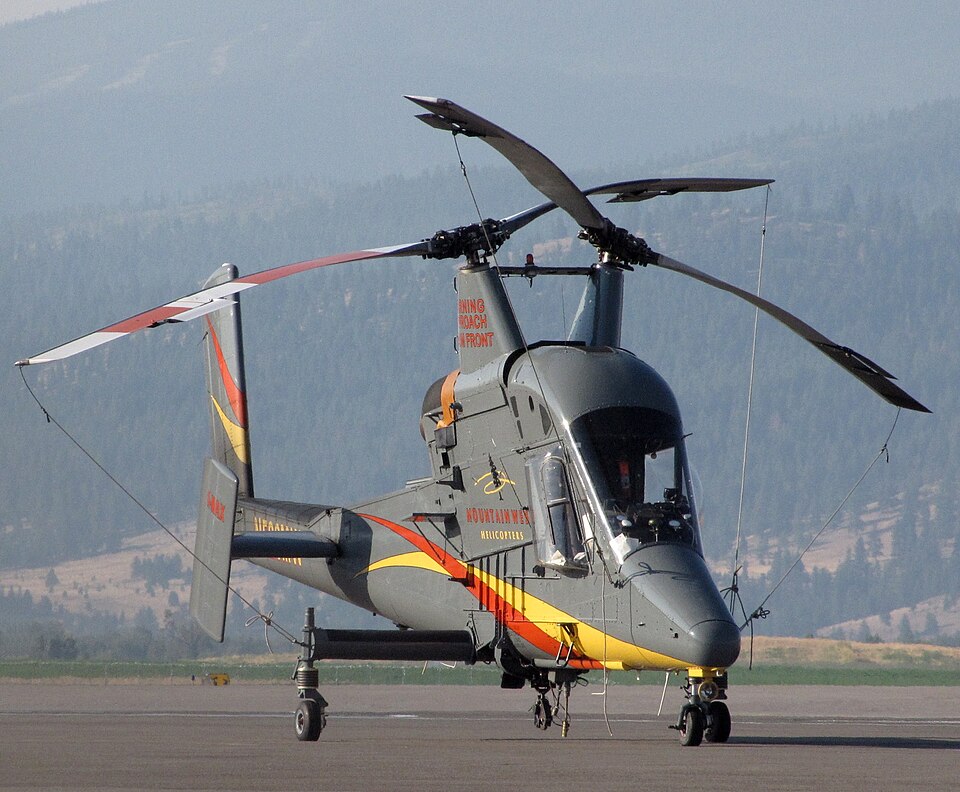
A synchropter is a type of helicopter that uses two rotors mounted side by side on slightly angled masts. The rotors spin in opposite directions and are timed so precisely that their blades intermesh without touching each other. This intermeshing is what gives the design its other common name: the intermeshing rotor helicopter.
The key distinction from other multi-rotor designs is that the rotor discs overlap. In a tandem rotor helicopter, the rotors are spaced far apart, front to back. In a synchropter, they sit close together and their blades pass through the same shared airspace in a carefully synchronized pattern.
How the Intermeshing System Works
The two masts are angled outward slightly, typically somewhere around 12 to 24 degrees from vertical, depending on the specific design. A mechanical gear system called a synchronizer links the two rotor shafts together. This synchronizer ensures that as one rotor turns, the other turns in perfect coordination, with blades timed to pass each other without colliding.
Because the rotors turn in opposite directions, the torque forces they generate cancel each other out. This is the same problem that a tail rotor solves on a conventional helicopter, but in a synchropter the solution is built directly into the main rotor system.
Good to Know: The term "synchropter" was coined by American engineer Anton Flettner, who pioneered the design in the 1940s. His Flettner Fl 265 and the later Fl 282 Kolibri were among the earliest practical synchropters ever built.
A Brief History of the Design
The synchropter concept traces back to Germany during World War II. Flettner's Fl 282 Kolibri is said to have been one of the first mass-produced helicopters in history, built in meaningful numbers for the German Navy. After the war, Kaman Aircraft in the United States acquired the concept and developed it further. The Kaman HH-43 Huskie became a well-known synchropter in U.S. military service, used primarily for crash rescue and utility work. The Kaman K-MAX, developed for heavy-lift external cargo operations, brought the design into the modern era and remains one of the most capable aerial lift platforms available today.
How Synchropters Compare to Other Rotor Configurations
To fully understand synchropter advantages and disadvantages, it helps to see how they stack up against other common rotor designs.
| Configuration | Rotor Setup | Torque Solution | Key Strength |
| Single-rotor (conventional) | One main rotor, one tail rotor | Tail rotor counteracts torque | Simplicity, speed |
| Tandem rotor | Two rotors, front and rear | Counter-rotation cancels torque | High payload, forward CG range |
| Coaxial rotor | Two rotors stacked on same shaft | Counter-rotation cancels torque | Compact footprint, high hover efficiency |
| Synchropter | Two rotors, side by side, intermeshing | Counter-rotation cancels torque | Compact, stable hover, no tail rotor drag |
Fun Fact: The Kaman K-MAX was originally designed to carry external loads heavier than the aircraft itself. Its lift-to-weight ratio is considered one of the best among production helicopters of any rotor type.
Each configuration has a niche it fits well. The synchropter's niche is a combination of compact footprint, strong hover performance, and the elimination of the tail rotor, which makes it particularly well-suited to confined spaces and heavy-lift external work.
Synchropter Advantages and Disadvantages: A Complete Breakdown
Here is a thorough look at the full range of synchropter advantages and disadvantages, covering both what makes this design excel and where it struggles.
Advantage 1: No Tail Rotor Required
The single biggest mechanical advantage of the synchropter is the complete elimination of the tail rotor. In a conventional helicopter, the tail rotor consumes a meaningful share of engine power, sometimes estimated in the range of ten percent or more, just to counteract torque and keep the aircraft pointed in the right direction.
Removing the tail rotor means that power is redistributed directly to the main lifting rotors. This improves overall efficiency, particularly during hover, which is the phase of flight that demands the most from a rotorcraft. It also removes a major point of vulnerability. Tail rotors are exposed components that can strike obstacles, especially during operations in tight spaces, trees, or structures.
Why It Matters: In confined-area operations like logging, wildfire response, or urban rescue, the absence of a tail rotor dramatically reduces the risk of a catastrophic strike against surrounding obstacles.
Advantage 2: High Hover Efficiency
Synchropters are known for exceptional hover performance. Because both rotors contribute directly to lift and neither power source is diverted to a tail rotor, the lifting system operates at a higher efficiency than a comparable single-rotor aircraft.
The intermeshing disc arrangement also creates a favorable pattern of induced airflow. The overlapping rotor discs generate a combined column of downwash that is more concentrated and organized than what two widely separated rotors would produce. This is part of why aircraft like the K-MAX can lift external loads that are surprisingly heavy relative to the aircraft's own weight.
Advantage 3: Compact Rotor Footprint
Although synchropters have two main rotors, the intermeshing design keeps both rotors positioned close together above the fuselage. The overall rotor footprint is significantly smaller than a tandem-rotor helicopter of comparable lift capacity.
This matters enormously for ships and confined spaces. A synchropter can be operated from a smaller deck area than a tandem design, and it can maneuver in tighter quarters than a single-rotor helicopter with a long tail boom and exposed tail rotor.
Pro Tip: If you are researching helicopters for shipboard or confined-area utility roles, the synchropter's compact rotor span combined with its no-tail-rotor design makes it one of the most space-efficient lifting configurations available.
Advantage 4: Mechanically Simpler in the Anti-Torque System
Conventional helicopters require a complete tail rotor drive system, including a tail rotor gearbox, a long tail rotor driveshaft running the length of the tail boom, and the tail rotor hub, blades, and pitch control system. Every one of those components adds weight, complexity, and potential failure points.
The synchropter replaces all of that with the synchronizer gear system connecting the two main rotor shafts. The synchronizer is a precision piece of engineering, but it is compact and located close to the main transmission. From a mechanical standpoint, the elimination of the entire tail rotor drivetrain is a genuine simplification.
Advantage 5: Stable and Predictable Hover
Pilots who have flown synchropters frequently note that they have a planted, stable feel in the hover. Because the two counter-rotating rotors are in such close proximity and their gyroscopic forces are balanced against each other, the aircraft has a natural tendency to resist uncommanded yaw and pitch.
This stability is valuable in precision operations, such as placing a load in a specific location or holding a hover above a moving vessel. For those curious about learning to fly rotorcraft, an overview of the best helicopter flight schools in the U.S. can help narrow down the right training path.
Advantage 6: Reduced Vulnerability in Combat and Rugged Environments
A tail rotor that takes damage can be catastrophic. The synchropter, with no tail rotor to strike or be struck, has a meaningful survivability advantage in combat environments or during operations in rough terrain with vegetation and obstacles. The German Navy valued this characteristic in the Fl 282 Kolibri, and U.S. forces found it useful in the HH-43 Huskie's crash rescue role.
Keep in Mind: While the synchropter's rotor system has fewer exposed vulnerability points, the close-set intermeshing blades do require very precise maintenance. Any deviation in blade tracking or pitch can create serious problems.
Advantage 7: Excellent Power-to-Lift Ratio for External Loads
The synchropter's lifting efficiency translates directly into an impressive power-to-lift ratio when carrying external sling loads. The K-MAX is specifically optimized for this role, and it has been used in unmanned cargo delivery trials by the U.S. Marine Corps. For aerial work like firefighting helicopter operations or logging in remote terrain, this efficiency means more payload per gallon of fuel.
If aerial work and specialized helicopter operations interest you, Flying411 has in-depth coverage of the different types and roles of rotorcraft used in demanding real-world missions.
Disadvantage 1: Limited Forward Speed
The synchropter's intermeshing rotor configuration creates aerodynamic constraints that limit its top speed. As the aircraft accelerates in forward flight, the overlapping rotor discs encounter asymmetric airflow conditions that become increasingly challenging to manage at higher airspeeds.
Conventional single-rotor helicopters and especially compound or coaxial designs can reach higher cruise speeds. The synchropter is built for lift efficiency in the hover and low-speed regime, not for cross-country speed. For most of its intended missions, such as external lift and utility work, this is an acceptable trade-off.
Disadvantage 2: Complex Synchronization Requirement
The synchronizer gear system that keeps the two rotor shafts perfectly timed is a critical and precisely engineered component. If synchronization fails, the blades will collide, which is a catastrophic event. This means the synchronizer must be maintained to exacting standards and inspected regularly.
While the elimination of the tail rotor drivetrain is a simplification, the synchronization system adds its own layer of mechanical complexity. Mechanics working on synchropters need specialized training and familiarity with this unique system.
Heads Up: The precision required to maintain a synchropter's intermeshing rotor system means that maintenance costs and the demand for experienced technicians can be higher than for conventional helicopters of similar size.
Disadvantage 3: Limited Production and Parts Availability
Synchropters have never been produced in large numbers. There are a small number of manufacturers and a relatively small population of aircraft in operation worldwide. This limited production base means that spare parts can be harder to source, lead times for components may be longer, and the pool of mechanics with direct experience on the type is smaller than for common helicopter designs.
For fleet operators planning long-term availability, this is a meaningful logistical consideration.
Disadvantage 4: Restricted Autorotation Performance
In a conventional helicopter, autorotation, which is the process of using rotor inertia to land safely after an engine failure, is a well-understood and practiced procedure. The synchropter's rotor system and its mechanical coupling between the two shafts creates a different set of autorotation characteristics that pilots must understand specifically for that aircraft type.
While autorotation is possible in a synchropter, the coupled rotor system behaves differently from a single-main-rotor helicopter, and pilot training must address this difference explicitly.
Disadvantage 5: Narrow Speed Envelope for Efficient Operation
Synchropters perform best in a relatively specific speed range. They are highly efficient in the hover and at low airspeeds, but their efficiency advantage narrows as airspeed increases. For missions that require transit at moderate or high cruise speeds between work sites, the synchropter may not be the most efficient tool compared to faster rotorcraft options.
Quick Tip: If your mission involves a mix of low-speed work and long-distance transit, it may be worth comparing the synchropter against other configurations, including the tandem rotor design, which offers different trade-offs between payload and speed.
Real-World Applications of Synchropters
Understanding the advantages and disadvantages of synchropter helicopters becomes most useful when you look at where the design has actually been deployed.
External Cargo and Logging
The Kaman K-MAX was purpose-built for vertical reference external lift operations, primarily logging and construction material delivery. It carries its load entirely on a single hook below the fuselage and is flown with the pilot looking down and back to watch the load. The design's hover stability and lift efficiency make it exceptionally capable in this role.
Military Utility and Rescue
The Kaman HH-43 Huskie served U.S. military branches for decades, primarily in crash rescue and base fire suppression roles. Its compact footprint and hover stability made it useful in confined areas around airfields. Some versions were also configured for local base rescue operations in Vietnam.
Unmanned Cargo Delivery
The K-MAX has been converted to an unmanned configuration and tested for autonomous cargo delivery to forward operating bases. Its hover efficiency and mechanical reliability in the load-carrying role made it an attractive platform for this experimental mission.
Firefighting and Aerial Application
The synchropter's ability to carry heavy external loads and hold a precise hover makes it a capable platform for aerial firefighting and agricultural spray operations. For those interested in the full range of rotorcraft used in emergency response, the variety of platforms in this role is broader than most people realize.
Are Synchropters Able to Perform Unusual Maneuvers?
One question that sometimes comes up about synchropters relates to their flight envelope and whether the intermeshing rotor design imposes unique limitations. Unlike conventional helicopters, the synchropter is not typically associated with the kind of inverted or aerobatic maneuvers that some rotorcraft enthusiasts wonder about. The coupled rotor dynamics and the precision required for blade synchronization make extreme attitude maneuvers impractical. Those curious about the specific limits of helicopter aerobatics can read more about helicopters that can fly upside down and how different rotor systems handle unusual flight attitudes.
Who Should Consider a Synchropter?
Given all of the synchropter advantages and disadvantages above, the design is best matched to operators with a very specific mission profile.
Ideal candidates include:
- Aerial logging companies needing maximum external lift efficiency
- Organizations doing heavy construction material placement in remote terrain
- Military and government agencies with confined-area utility requirements
- Operators engaged in firefighting or disaster response where hover precision matters
- Research and development programs exploring unmanned heavy-lift platforms
For general utility, passenger transport, or operations where transit speed is a priority, the synchropter is typically not the best choice. Operators in those categories will usually find a conventional single-rotor or tandem-rotor helicopter better suited to their needs.
Interestingly, some of the heaviest lift requirements in aviation are met not by synchropters but by large conventional and tandem-rotor heavy-lifters. For a sense of what machines handle the biggest loads, a look at helicopters that can carry a tank gives a useful perspective on the upper end of rotorcraft capability.
Ready to explore more of what the rotorcraft world has to offer? Flying411 covers the full range of helicopter types, flight training resources, and aviation knowledge in one place. Visit Flying411 to keep learning.
Conclusion
The synchropter is one of aviation's most distinctive engineering solutions, and once you understand synchropter advantages and disadvantages, it is clear that this is a design optimized for a specific and demanding set of missions. Its hover efficiency, compact rotor footprint, and elimination of the tail rotor give it real strengths in the external lift and confined-area utility roles. Its limited top speed, precision maintenance demands, and narrow parts availability are genuine trade-offs that operators must weigh carefully.
For the missions it was built for, the synchropter is a remarkable machine. For everything else, there are better options.
Knowing which category your mission falls into is exactly the kind of aviation knowledge that Flying411 is built to help you develop.
FAQs
What is the difference between a synchropter and a tandem rotor helicopter?
A synchropter has two rotors mounted side by side on angled masts with blades that intermesh in the same shared disc space, while a tandem rotor helicopter has its two rotors spaced far apart, one at the front and one at the rear of the fuselage. The two designs cancel torque in the same way but have very different physical footprints and flight characteristics.
Why do synchropters not need a tail rotor?
Because the two main rotors spin in opposite directions, the torque each rotor generates is balanced against the other. The net torque acting on the fuselage is canceled out, so no tail rotor is needed to prevent the aircraft from spinning.
How many synchropters are currently in operation?
The total number of synchropters in active service worldwide is relatively small compared to other helicopter types. The Kaman K-MAX is among the most active production synchropters, used primarily in external lift operations and some unmanned cargo trials.
Is the synchropter design safe in an engine failure situation?
Like all helicopters, synchropters can perform autorotation after an engine failure, but the coupled rotor dynamics require pilots to train specifically on this procedure for the synchropter type. The aircraft can be landed safely by a trained pilot in the event of power loss.
Can synchropters be flown without a license?
All synchropters currently in production or common operation are certificated aircraft that require appropriate pilot ratings to operate. They are not in the category of ultralight or experimental aircraft that might fall under simplified licensing rules.