Picture a helicopter spinning through a perfect loop, going completely inverted for a few breathtaking seconds before pulling back upright. For most people, that sounds impossible. Helicopters hover, they carry people, they rescue lives — they do not fly upside down. Except, sometimes, they do.
A small number of helicopters that can fly upside down actually exist, and the engineering that makes it possible is as fascinating as the spectacle itself. Most standard helicopters cannot safely go inverted. Their rotor blades flex, their oil systems rely on gravity, and their fuel supply would simply fail the moment they flipped belly-up. But a few very special machines have been built or modified to pull off this jaw-dropping maneuver — at least for a few thrilling seconds at a time.
This article breaks down exactly which helicopters can do it, how they pull it off, and what separates them from every other chopper in the sky.
Key Takeaways
Helicopters that can fly upside down are extremely rare because standard rotorcraft are not designed for inverted flight. Only a handful of specially engineered or modified helicopters — primarily those with rigid or semi-rigid rotor systems — can briefly go inverted during aerobatic maneuvers like loops and rolls. The most well-known examples include the MBB Bo 105, the Westland Lynx, the Eurocopter AS350, the Eurocopter EC120 Colibri, and the Boeing AH-64 Apache. None of these can sustain fully inverted level flight for more than a few seconds, but they can pass through an inverted position during controlled aerobatic sequences performed by highly trained pilots.
| Helicopter | Rotor Type | Inverted Capability | Best Known For |
| MBB Bo 105 | Rigid (hingeless) | Loops, rolls, inverted passes | Red Bull aerobatic displays; Bond film Spectre |
| Westland Lynx | Semi-rigid | Loops and rolls | World helicopter speed record holder |
| Eurocopter AS350 | Semi-rigid | Inverted passes, short loops | High-altitude performance |
| Eurocopter EC120 Colibri | Rigid (Fenestron tail) | Aerobatic display routines | Spanish Air Force display team |
| Boeing AH-64 Apache | Fully articulated | Brief inverted during rolls | Military aerobatic demonstrations |
If you want to learn more about remarkable helicopters and the world of rotorcraft, Flying411 is your go-to resource for aviation guides, aircraft comparisons, and pilot insights.
Why Most Helicopters Cannot Fly Upside Down
Before getting to the machines that can do it, it helps to understand why most helicopters cannot.
A helicopter stays in the air because its rotor blades generate lift by spinning and creating vertical thrust. In normal flight, the blades are angled slightly upward to push air downward, which lifts the helicopter. Simple enough. But the moment you flip that helicopter over, everything works against it.
The rotor blade problem is the most immediate issue. Standard rotor blades are designed to flex upward during flight. When inverted, those same blades would flex toward the fuselage and could strike the tail boom — a catastrophic event with a name in aviation: a boom strike. These have caused fatal accidents even in normal operations during hard landings.
The oil system problem comes next. Helicopter engines and gearboxes depend on oil sumps that use gravity to collect and recirculate lubricant. Invert the helicopter and oil pools in the wrong places. Bearings spinning at tens of thousands of revolutions per minute would be starved of lubrication within seconds.
The fuel system problem is similar. Without pressurized fuel delivery, the fuel supply becomes unreliable the instant the aircraft goes inverted.
The control problem adds another layer. To maintain lift while inverted, the pilot would need to reverse rotor blade pitch to generate thrust in the opposite direction. Most helicopters simply cannot do this.
Good to Know: Military and aerobatic pilots do occasionally pass through an inverted attitude during loops and barrel rolls. During those brief moments, the rotor still generates thrust in the normal direction — the helicopter relies on momentum and altitude rather than sustained inverted lift to complete the maneuver safely.
What Makes an Aerobatic Helicopter Different
For a helicopter to safely pass through an inverted attitude, several key modifications must be in place.
The Rotor Head
The single most important factor is a rigid or semi-rigid rotor head. Unlike standard articulated rotor systems with flapping and lead-lag hinges, a rigid rotor head is machined from a single piece of material — often titanium — and does not rely on hinges to manage blade movement. The blades flex naturally through material properties rather than mechanical joints. This prevents the dangerous blade droop that can cause a boom strike during inverted flight.
The Oil System
Aerobatic helicopters require a pressurized dry-sump oil system so that lubricant continues flowing to all moving components regardless of the aircraft's orientation. Without this modification, engine failure during inverted flight is almost guaranteed.
The Fuel System
Similarly, the fuel system must be pressurized or otherwise designed to deliver fuel reliably when the helicopter is belly-up. Standard gravity-fed systems fail almost immediately under negative-G conditions.
Structural Reinforcement
The airframe must be strengthened to handle the loads imposed by aerobatic maneuvering. Negative-G forces during inverted flight stress the structure in ways normal helicopters are never designed to experience.
Fun Fact: The rotor head on the MBB Bo 105 is machined from a single solid billet of titanium. It has no hinges at all — the blades flex through the natural properties of their composite construction. According to historical records, this rotor system accumulated millions of flight hours with zero structural failures as of the early 1990s.
Pilot Certification
Even with the right aircraft, performing aerobatics in a helicopter is extraordinarily rare from a certification standpoint. In the United States, only a handful of pilots have ever held FAA waivers permitting aerobatic helicopter flight. Chuck Aaron, the American pilot famous for flying an MBB Bo 105 for Red Bull, is widely recognized as one of the very few pilots in the world to have held such a certification and performed these maneuvers publicly at air shows.
Flying411 covers the fastest helicopters in the world, the most impressive luxury machines in the sky, and everything in between — a great place to explore rotorcraft performance across the board.
5 Helicopters That Can Fly Upside Down
Each of the helicopters below earned its place on this list through a combination of purpose-built engineering and real-world aerobatic performance. Some were designed from the ground up with inverted flight in mind, while others were modified or pushed to their limits by exceptionally skilled pilots.
All of them share the key traits that make brief inverted flight possible: rigid or semi-rigid rotor systems, reinforced airframes, and modified oil and fuel delivery.
Here is what sets each one apart.
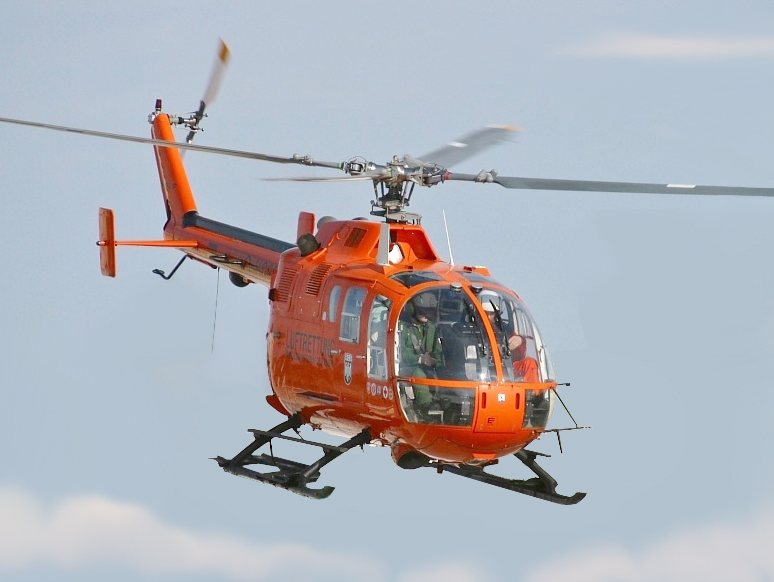
1. MBB Bo 105 — The Original Aerobatic Helicopter
The Messerschmitt-Bolkow-Blohm Bo 105 is widely considered the benchmark for helicopter aerobatics. It holds the distinction of being the first rotorcraft ever certified capable of performing aerobatic maneuvers including inverted loops, a milestone that had never been achieved before its introduction in 1970.
The secret is its revolutionary hingeless rotor system. The rotor head is a single titanium block with no flapping or lead-lag hinges. Four composite glass-fiber rotor blades bolt directly to that hub. The blades flex through their own material properties to absorb the forces that would normally require mechanical hinges. The result is a rotor system with exceptional stiffness, precision, and agility that no competing helicopter of its era could match.
The Bo 105 is cleared for up to approximately 3.5 positive G and at least 1 negative G — remarkable figures for a rotorcraft. Its twin-engine configuration, dual hydraulics, and dual electrical supply also contributed to making aerobatics survivable and repeatable.
Chuck Aaron, flying a specially modified Bo 105 for Red Bull, became perhaps the most famous face of helicopter aerobatics in the United States. His routine included vertical climbs, rolls, loops, a Cuban Eight, an Immelman turn, a Split S, and his signature self-invented maneuver known as the "Chuckcevak." He performed most of these routines at air shows across the country until his retirement from the air show circuit in 2015.
The Bo 105 also starred in the James Bond film Spectre, where one was seen performing loops and rolls in a dramatic action sequence — flown by a skilled aerobatic pilot rather than a stuntman on a wire.
Why It Matters: The Bo 105 is more than an aerobatic curiosity. It was also one of the most successful utility helicopters of its era, serving in military, search and rescue, law enforcement, and offshore roles across dozens of countries. More than 1,400 were produced between its introduction and the end of production in 2001.
Quick specs:
- Configuration: Light twin-engine utility helicopter
- Rotor system: Rigid, hingeless titanium hub
- G-load envelope: Up to approximately 3.5 positive G, 1 negative G
- Notable operator: Red Bull (aerobatic displays)
- Fame: First helicopter certified for aerobatic maneuvers
2. Westland Lynx — The Speed Record Holder That Also Loops
The Westland Lynx is a British military helicopter that wears two very different crowns. On one hand, it holds what is widely recognized as the official Fédération Aéronautique Internationale (FAI) airspeed record for conventional helicopters — set in 1986 at approximately 400.87 km/h (about 249 mph) by a specially modified example using advanced British Experimental Rotor Programme (BERP) rotor blades. That record is said to remain unbroken as of the time of writing.
On the other hand, the Lynx is a fully aerobatic helicopter. It can perform loops and rolls, and display teams including the British Army's Blue Eagles and the Royal Navy's Black Cats have used Lynx helicopters in their air show routines for decades.
The Lynx uses a semi-rigid rotor head with composite rotor blades, giving it the structural integrity to handle the loads that aerobatic maneuvering imposes. Like the Bo 105, it can briefly pass through an inverted attitude during a loop — but sustained inverted level flight is not within its design envelope.
Its airframe is built from lightweight materials chosen specifically for strength without compromising agility. That combination of a stiff rotor system and a strong, responsive airframe is what lets display pilots push the Lynx through maneuvers that would be catastrophic in a standard helicopter.
Pro Tip: If you want to see the Westland Lynx in action, British military air shows like the Royal International Air Tattoo (RIAT) at RAF Fairford have historically been a great place to watch display teams fly these helicopters through their aerobatic routines.
The Lynx has served the British Army, Royal Navy, and numerous allied nations in roles ranging from anti-submarine warfare to troop transport to anti-tank operations. It is one of the few helicopters in history that was built to be fast, capable in combat, and able to perform a loop.
For more on impressive military and performance rotorcraft, the guide to helicopters that can carry a tank offers a fascinating look at what large helicopters can haul.
3. Eurocopter AS350 (Airbus H125) — High-Altitude Aerobatics
The Eurocopter AS350, now marketed as the Airbus H125, is a light single-engine utility helicopter that has earned a reputation for exceptional performance at high altitudes. It is widely used for mountain rescue, aerial survey, and utility missions in terrain where most helicopters struggle — including operations on high Himalayan peaks.
That high-altitude capability comes with a structurally capable airframe designed to handle significant load variations. The AS350's semi-rigid rotor system and robust construction have made it one of the rotorcraft most frequently documented performing brief inverted flight during aerobatic passes.
The AS350 does not have a purpose-built aerobatic certification like the Bo 105. However, it has appeared in aerobatic demonstrations and has been shown capable of brief negative-G maneuvering including short inverted passes and loop-type maneuvers — primarily in demonstration contexts with specially prepared aircraft and expert pilots.
Its frame is known to withstand the elevated negative-G loads experienced during inverted flight, which distinguishes it from most standard utility helicopters. This capability is tied directly to how the helicopter was engineered to cope with demanding environmental conditions at altitude.
Keep in Mind: The AS350/H125 in standard configuration is not cleared for aerobatics. Any inverted flight performed in this type has involved purpose-modified aircraft or carefully controlled demonstration conditions. Do not attempt aerobatic flight in a standard AS350.
The AS350 family has been extraordinarily popular worldwide, with many hundreds of examples in service across civil and military operators in numerous countries. For many helicopter enthusiasts, it sits in an interesting middle ground — a practical workhorse that has proven it can do surprising things when pushed by the right pilot in the right conditions.
4. Eurocopter EC120 Colibri (Airbus H120) — The Display Team Specialist
The Eurocopter EC120 Colibri — the name means "hummingbird" in French — is a light, five-seat, single-engine utility helicopter that has found a notable niche in aerobatic display flying.
The Spanish Air and Space Force formed an aerobatic display team called the Patrulla ASPA in 2003, flying EC120s in coordinated formation displays involving complex maneuvers. This makes the EC120 one of the very few helicopter types to have an entire dedicated national aerobatic display team built around it.
The EC120's design includes a Fenestron shrouded tail rotor — a distinctive fan-in-fin system rather than a conventional exposed tail rotor — along with a rigid main rotor system. These design choices contribute to the helicopter's agility and its ability to handle aerobatic loads that would stress a less capable machine.
According to aviation sources, the EC120 is among the helicopter types specifically noted as capable of aerobatics, alongside the Bo 105 and the Westland Lynx. While it does not have the same legendary status as the Bo 105 in inverted flight circles, its use in organized national aerobatic display programs puts it firmly on this list.
Fun Fact: The Fenestron tail rotor design used on the EC120 Colibri is said to be significantly quieter than a conventional exposed tail rotor, which made the helicopter popular for operations in noise-sensitive areas. Quiet and capable of aerobatics — a rare combination.
The EC120 program ended in 2017, but many examples remain active in training and light utility roles worldwide. The French Army selected it as a lead-in rotary-wing trainer, a role where the aircraft's responsive handling and agility — traits that also contribute to its aerobatic capability — proved particularly valuable.
5. Boeing AH-64 Apache — Military Power Meets Aerobatic Agility
The Boeing AH-64 Apache is one of the most recognizable attack helicopters in the world. It is a heavy, heavily armed military machine designed for anti-tank warfare and close air support — not exactly what most people picture when they think of aerobatics.
Yet in 1999, Boeing publicly demonstrated an AH-64D Apache Longbow performing a series of dramatic aerobatic maneuvers, including rolls that briefly took the aircraft through an inverted attitude. The demonstration was intended to highlight the Apache's performance and agility to potential customers, and it drew significant attention in aviation circles.
The Apache uses a fully articulated four-blade main rotor system. In display flying, pilots from military demonstration teams and Boeing test pilots have performed rolls and other maneuvers in the Apache that involve momentary inverted flight. Like the other helicopters on this list, this is brief — the Apache does not sustain inverted level flight, and its standard flight envelope does not include aerobatics.
What makes the Apache relevant here is its rotor system's structural strength and the aircraft's powerful twin-engine configuration, which gives it enough performance margin to pass through an inverted attitude during a roll without losing control — provided the pilot has the skill and the aircraft has the altitude and speed to complete the maneuver safely.
Heads Up: The AH-64 Apache is strictly a military aircraft and is not available for civilian ownership or operation. Its aerobatic demonstrations have been performed exclusively by highly trained military and manufacturer test pilots in controlled settings.
The Apache's aerobatic capability speaks to something broader about what rigid and semi-rigid rotor systems can enable in terms of flight performance. The more rigid and responsive the rotor system, the more agile the helicopter — and agility, taken far enough, opens the door to aerobatics.
For a broader look at helicopter capabilities and categories, the overview of helicopter facts and history is worth reading.
Comparing the 5 Aerobatic Helicopters
| Feature | MBB Bo 105 | Westland Lynx | Eurocopter AS350 | EC120 Colibri | AH-64 Apache |
| Rotor Type | Rigid (hingeless) | Semi-rigid | Semi-rigid | Rigid | Fully articulated |
| Engines | Twin turboshaft | Twin turboshaft | Single turboshaft | Single turboshaft | Twin turboshaft |
| Primary Role | Utility / military | Military | Utility | Training / light utility | Attack |
| Aerobatic Certification | Yes (modified) | Display use | No (demonstrated) | Display use | No (demonstrated) |
| Famous For | Red Bull displays, Spectre | Speed record | High-altitude performance | Spanish Air Force display | Military aerobatic demos |
| Sustained Inverted Flight | No | No | No | No | No |
Quick Tip: Notice that none of these helicopters can maintain sustained inverted level flight. The passes through inverted attitude during loops and rolls are brief — typically just a few seconds at most. This is a fundamental limitation of current helicopter design and engineering, not a matter of pilot skill.
The Role of Pilot Skill and Certification
Even in the right aircraft, flying upside down in a helicopter is extraordinarily demanding. In the United States, performing aerobatics in a helicopter requires a specific FAA waiver. Only a small number of pilots worldwide have ever held one.
Chuck Aaron is the most well-known example in the U.S. He built his career over decades as a test pilot, military contractor, and eventually the most prominent helicopter aerobatic performer in the country. His work with Red Bull required building the first-ever FAA-certified aerobatic helicopter — a process that involved inventing the modifications himself, certifying the aircraft, and then convincing the FAA he could do it repeatedly and safely. He was granted his FAA statement of aerobatic competency in 2006.
Training for helicopter aerobatics involves understanding the physics of every maneuver, calculating performance against altitude and temperature, and knowing precisely when to recover. Getting any of those calculations wrong can be fatal. Aaron himself has spoken publicly about adjusting routines when conditions such as altitude and heat density affected aircraft performance.
Pro Tip: If helicopter aerobatics interest you professionally, the first step is building a strong foundation of rotary-wing hours and obtaining all standard helicopter ratings. Programs like those featured in guides to the best helicopter flight schools in the US are a great starting point for building that foundation.
Aerobatic Maneuvers Helicopters Can Perform
Beyond inverted flight, the aerobatic helicopters on this list can perform a range of impressive maneuvers. Here is a quick overview of the most commonly seen in display flying:
- Loop: The helicopter climbs, arcs over the top while briefly inverted, then pulls through and exits level. Requires entering with enough speed and altitude to complete the arc.
- Barrel roll: A combination of roll and loop that traces a corkscrew path through the air. Generally considered somewhat easier on the rotor system than a pure loop.
- Cuban Eight: A figure-eight maneuver combining two half-loops with rolls. Chuck Aaron performed this regularly in his Bo 105 routine.
- Immelman turn: A half-loop at the top of which the pilot rolls the aircraft upright, reversing direction while gaining altitude.
- Split S: The reverse of an Immelman — the pilot rolls inverted, then pulls through a half-loop to exit heading in the opposite direction.
- Tic-Toc: A pendulum-like maneuver where the helicopter cycles between nose-up and nose-down positions. Considered one of the most distinctive helicopter-specific aerobatic figures.
- Vertical climb and roll: The helicopter climbs straight up before rolling at the apex — a crowd favorite that showcases raw power and control.
Flying411 also covers some fascinating edge cases in rotorcraft, including a look at helicopters that don't require a license — worth a read if you're curious about where the boundaries of rotary-wing aviation sit.
Why No Helicopter Can Sustain True Inverted Flight
It is worth being direct about one thing: no production helicopter can sustain true inverted level flight. The five helicopters on this list can pass through an inverted attitude during a loop or roll. That is categorically different from flying along in a stable, sustained upside-down cruise.
The engineering barriers are significant. A pressurized dry-sump oil system can handle brief inverted periods, but designing one that functions indefinitely upside down while maintaining engine and gearbox health is a different challenge entirely. Rotor blade pitch reversal — needed to generate sustained lift while inverted — requires control system redesigns that have never been certified in any full-scale production helicopter.
There is also very little commercial or military motivation to build such a machine. The cost of development would be enormous and the practical applications essentially nonexistent. So for now, the brief inverted pass during a loop remains the ceiling of what any real helicopter can do.
Good to Know: Model radio-controlled helicopters are a different story. Small RC helicopters with symmetrical rotor blades and pressurized systems scaled to their size can and do hover inverted with relative ease. This is one reason aerobatic RC helicopter flying has become such a popular hobby — the physics scale differently at small sizes.
If the world of high-performance and luxury helicopters interests you, Flying411 covers some of the most impressive rotorcraft available today, from utilitarian workhorses to executive cabin flying machines.
Conclusion
Helicopters that can fly upside down occupy a genuinely remarkable corner of aviation history. The MBB Bo 105, Westland Lynx, Eurocopter AS350, EC120 Colibri, and Boeing AH-64 Apache all represent machines where engineering and piloting skill combine to push rotorcraft far beyond what most people think possible. None of them can fly upside down indefinitely — but the few seconds they spend inverted during a loop or roll are enough to stop a crowd cold.
The key ingredients are always the same: a rigid or semi-rigid rotor system, a pressurized oil and fuel supply, a reinforced airframe, and a pilot with the training, certification, and nerve to execute the maneuver safely. Strip away any one of those elements and the attempt becomes catastrophically dangerous.
For anyone fascinated by what helicopters can really do — from aerobatics to heavy lifting to high-altitude utility — there is far more to explore.
Head over to Flying411 for in-depth guides, aircraft comparisons, and aviation insights that go well beyond what the textbooks cover.
Frequently Asked Questions
Can any helicopter fly upside down for an extended period?
No. No current production helicopter is capable of sustained inverted level flight. The helicopters on this list can briefly pass through an inverted attitude during aerobatic maneuvers like loops and rolls, but this typically lasts only a few seconds before the pilot recovers to normal flight.
What is the most important modification needed for a helicopter to fly inverted?
The single most critical factor is a rigid or semi-rigid rotor system. Without it, rotor blades can droop during inverted flight and strike the tail boom — a potentially fatal event. Beyond the rotor, pressurized oil and fuel systems are also essential for safe inverted maneuvering.
Has anyone been killed performing helicopter aerobatics?
Aerobatic helicopter flying is considered extremely dangerous, and incidents have occurred historically. Professional aerobatic helicopter performances are conducted only by certified pilots at safe altitudes with purpose-built or specially modified aircraft. Standard helicopter aerobatics are prohibited in most flight manuals.
What does "rigid rotor" mean and why does it matter for inverted flight?
A rigid rotor system uses a rotor head machined from a single solid piece of material — often titanium — with no mechanical flapping or lead-lag hinges. The blades flex through their own material properties rather than hinges. This makes the rotor much stiffer and more resistant to the drooping that can cause boom strikes during inverted flight.
Do military helicopter pilots train for inverted flight?
Military pilots in certain specialized roles do train for unusual attitude recovery, including brief inverted passes during aerobatic sequences. However, full aerobatic training in helicopters is not a standard part of most military rotary-wing programs. Display team pilots and test pilots are the most common exceptions, and even they require specialized training and certification before performing these maneuvers.