Helicopters are the Swiss Army knives of aviation. They can hover, land in tight spots, fly sideways, and take off without a runway. But if there's one thing people rarely associate them with, it's raw, heart-pounding speed. That image is changing fast.
Engineers and test pilots around the world have spent decades pushing rotorcraft to their absolute limits, shattering records and rethinking what a helicopter can be. The result? A growing class of aircraft that blur the line between chopper and jet.
If you've ever wondered which machines sit at the very top of that speed ladder, this list of the fastest helicopters in the world has your answer.
Key Takeaways
The fastest helicopters in the world are mostly experimental or military aircraft designed with specialized rotor systems, pusher propellers, or tiltrotor configurations that overcome the natural speed limits of conventional helicopter design. The Eurocopter X3 and Sikorsky X2 are widely cited as the fastest rotor-based aircraft ever tested, reaching speeds well above 250 mph in controlled flight conditions. Production military helicopters like the Westland Lynx hold the official FAI speed record, while next-generation designs like the Bell V-280 Valor and Sikorsky Raider X are pushing toward 300 mph and beyond.
| Helicopter | Type | Approximate Top Speed |
| Eurocopter X3 | Experimental hybrid | ~293 mph (472 km/h) |
| Sikorsky X2 | Experimental demonstrator | ~299 mph (481 km/h) |
| Sikorsky Raider X | Next-gen military | ~288 mph (463 km/h) |
| Bell V-280 Valor | Tiltrotor military | ~322 mph cruising (518 km/h) |
| Westland Lynx (modified) | Military record-holder | ~249 mph (400 km/h) FAI record |
| CH-47 Chinook | Military heavy-lift | ~196 mph (315 km/h) |
| Mil Mi-24 Hind | Military attack | ~208 mph (335 km/h) |
| AH-64 Apache | Military attack | ~186 mph (299 km/h) |
| UH-60 Black Hawk | Military utility | ~183 mph (295 km/h) |
| Kamov Ka-52 Alligator | Military attack | ~217 mph (349 km/h) |
| Airbus H155 | Civilian | ~200 mph (322 km/h) |
| AgustaWestland AW139 | Civilian/military | ~193 mph (310 km/h) |
| NH Industries NH90 | Military utility | ~186 mph (300 km/h) |
Flying411 covers everything of aviation, from military machines to civilian aircraft. Whether you're a first-time buyer or a seasoned pilot, it's a go-to resource for everything flight-related.
Why Speed Is So Hard to Achieve in a Helicopter
Before jumping into the list, it helps to understand why helicopters struggle with speed in the first place. The physics are fascinating — and a little tricky.
A helicopter's main rotor spins constantly. One side of that rotor (called the advancing blade) moves in the same direction as the aircraft. The other side (the retreating blade) moves backward relative to the aircraft. As the helicopter speeds up, the advancing blade gets faster and faster. Eventually, the tip of that blade approaches the speed of sound. When that happens, aerodynamic shock waves form and control becomes nearly impossible.
At the same time, the retreating blade begins to lose lift because it's moving too slowly relative to the air around it. This imbalance — known as retreating blade stall — is the primary reason conventional helicopters top out at around 200 mph in normal conditions.
Fun Fact: The average speed of a standard helicopter falls somewhere between 95 and 160 mph. The machines on this list are in an entirely different league.
Engineers have found several clever ways around this problem. Some use compound designs with additional wings or pusher propellers. Others use coaxial rotors spinning in opposite directions to cancel out the imbalance. Tiltrotor aircraft take a different approach altogether. Each solution has its own trade-offs — but all of them have produced some extraordinary aircraft.
How Helicopter Speed Records Are Officially Tracked
The Fédération Aéronautique Internationale (FAI), based in Switzerland, is the organization responsible for certifying official aviation speed records. For a helicopter speed record to count, the flight must meet strict criteria, including a specific course distance, independent timing, and detailed documentation.
The FAI's official speed record for a helicopter has been held since 1986 by a specially modified Westland Lynx. That record stands at approximately 249 mph (around 400 km/h). Several experimental aircraft have flown faster since then, but not all of those flights have been submitted or certified by the FAI, so they exist in an unofficial category.
Good to Know: When you see claims about "the fastest helicopter," it's worth noting the difference between officially certified FAI records and unofficial test flight results. Both are impressive — they just live in different categories.
The 13 Fastest Helicopters in the World
Here is a closer look at each machine that earns a spot on this list, ranked roughly from the fastest experimental aircraft down to the fastest production models currently in service.
1. Sikorsky X2 Technology Demonstrator
The Sikorsky X2 is widely considered one of the fastest rotor-based aircraft ever built. In August 2010, it reportedly reached a top speed of around 299 mph (approximately 481 km/h) during a test flight, significantly surpassing the existing helicopter speed record at the time.
The X2 used a coaxial rotor system — two sets of rotors stacked on the same shaft, spinning in opposite directions. This design cancels out the torque effect and eliminates the retreating blade stall problem. A pusher propeller at the rear provided additional forward thrust. The combination was revolutionary for rotorcraft engineering.
While the X2 itself was never intended for commercial or military service, its technologies live on in the aircraft that followed it. It laid the engineering foundation for the Sikorsky S-97 Raider and later the Raider X.
Why It Matters: The X2's test flights proved that compound rotorcraft could safely reach speeds that were once thought impossible. That changed the direction of helicopter development worldwide.
2. Eurocopter X3
If the X2 is the fastest American helicopter demonstrator, the Eurocopter X3 (pronounced "X-cube") is its European rival. On June 7, 2013, the X3 reached an unofficial top speed of around 293 mph (approximately 472 km/h) during a level flight test at altitude, after reportedly exceeding that figure briefly in a descent phase.
Unlike the X2's coaxial approach, the X3 used a more traditional single main rotor paired with two propellers mounted on small wings on each side of the fuselage. This gave it strong forward thrust without the complexity of stacked rotors. Airbus described the aircraft as a "girodyne" — a hybrid that operates like a helicopter at low speeds but more like a fixed-wing aircraft in forward flight.
The X3 completed around 200 test flights before the program concluded. Its legacy lives on in the Airbus RACER (Rapid and Cost-Effective Rotorcraft), a successor demonstrator that made its first flights in 2024 and has been reported to reach cruising speeds of around 250 mph.
3. Sikorsky Raider X
The Raider X is the evolution of the X2 concept, designed for real-world military use. Built on the same coaxial pusher-propeller platform as its predecessor, it has been reported to reach speeds of around 288 mph (approximately 463 km/h). It was developed as part of the U.S. Army's Future Attack Reconnaissance Aircraft (FARA) program.
The Raider X uses the same core X2 technology but in a form designed for combat: a tandem cockpit, weapon hardpoints, and advanced sensor systems. It is significantly more refined than the original demonstrator and represents the practical application of all those early test flights.
Pro Tip: If you want to understand how military helicopter development works, the progression from X2 to S-97 Raider to Raider X is a textbook case study in how experimental aircraft feed into future combat machines.
Curious about how some of the military's most unconventional rotorcraft came to be? There's a fascinating history behind some of the most unusual military helicopter designs ever produced.
4. Bell V-280 Valor
The Bell V-280 Valor is a tiltrotor aircraft — meaning its engines and rotors can rotate from a vertical position (for helicopter-style takeoff) to a horizontal position (for airplane-style forward flight). The U.S. Army selected the V-280 in 2022 as part of its Future Long-Range Assault Aircraft (FLRAA) program to eventually replace the UH-60 Black Hawk.
In combat configuration, the V-280 has been reported to reach a cruising speed of around 322 mph (approximately 518 km/h), which puts it in a category that far exceeds any conventional helicopter. In transport mode, it operates at lower speeds over much longer ranges.
The V-280 is not purely a helicopter by traditional definition — but tiltrotors occupy a recognized category in aviation, and their speeds are often included in discussions of the fastest rotor-based aircraft in the world.
5. Westland Lynx (Modified Record Holder)
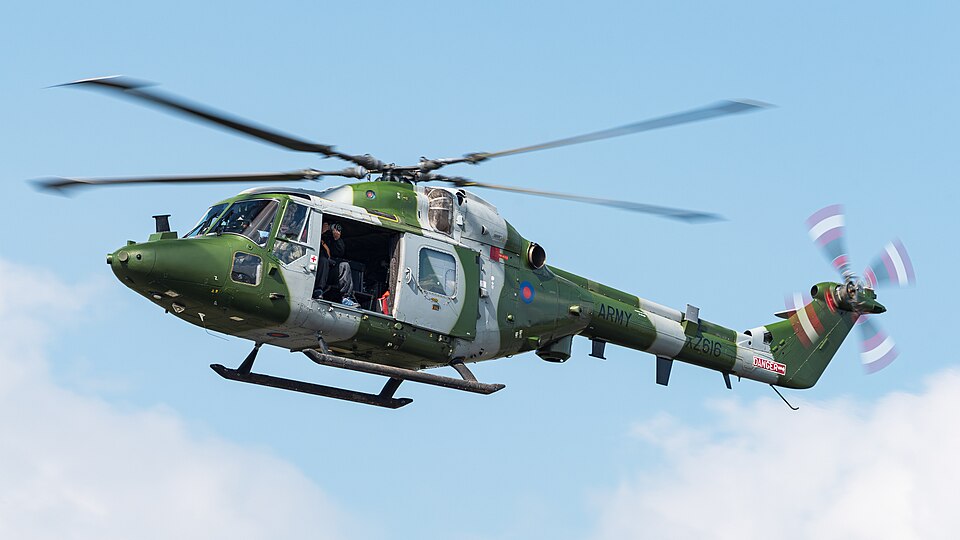
The Westland Lynx holds the FAI's official world speed record for helicopters. On August 11, 1986, a specially modified Lynx flew over a measured 9.32-mile course in southwest England and reached a recorded speed of approximately 249 mph (about 400 km/h). That record has never been officially broken in FAI competition.
The record-setting aircraft was no ordinary Lynx. It had been stripped of non-essential weight, fitted with experimental main rotor blades, upgraded Rolls-Royce Gem 60 turboshaft engines, and a digital electronic fuel control system. The result was a machine purpose-built for speed.
The Lynx family went on to serve many nations and has since been replaced in many fleets by the AgustaWestland AW159 Wildcat. But its record-setting flight remains one of the most celebrated moments in aviation history.
Fun Fact: The Westland Lynx that set the record was reportedly so modified that it was closer to a racing aircraft than a standard military helicopter by the time it took to that final run.
Want to know more about which helicopters are considered the most formidable on the battlefield today? A deeper look at what makes a helicopter truly feared in combat reveals some surprising answers.
6. Kamov Ka-52 Alligator
The Ka-52 Alligator is a Russian attack helicopter produced by the Kamov design bureau. It features a side-by-side cockpit, advanced avionics, and a coaxial rotor system — no tail rotor required. With two TV3-117 turboshaft engines generating around 2,000 horsepower each, it can reportedly reach a top speed of approximately 217 mph (around 350 km/h).
The Ka-52 is used for armed reconnaissance, close air support, and anti-armor missions. Its coaxial design gives it impressive maneuverability, especially at lower speeds, while still allowing it to move fast when needed. It has been widely observed and analyzed in various conflicts over recent years.
Flying411 is a great resource for anyone curious about military and civilian aircraft performance — from speed records to aircraft ownership, they cover the full picture.
7. Mil Mi-24 Hind
Few helicopters in history carry the same visual impact as the Mil Mi-24 Hind. This Soviet-era gunship is a massive machine — wide enough to carry up to eight combat troops inside while also bristling with weapons on its stub wings. It has been called a "flying infantry fighting vehicle," and for good reason.
In its standard variants, the Mi-24 can reach approximately 208 mph (around 335 km/h). A modified Mi-24 set a world speed record in 1975 at around 228 mph — a record that stood until the Westland Lynx bested it in 1986. The Hind has seen service in dozens of countries and numerous conflicts since its introduction in the 1970s.
Keep in Mind: The Mi-24's speed is particularly impressive given how much it can carry. Most helicopters this large fly significantly slower. The Hind was built to combine troop transport with gunship firepower — an unusual combination.
8. Boeing CH-47F Chinook
The CH-47 Chinook is the definition of a workhorse. It's a massive tandem-rotor helicopter that has been in continuous service since the early 1960s, and the latest CH-47F variant can still reach approximately 196 mph (around 315 km/h) — making it one of the faster heavy-lift helicopters ever built.
The Chinook's speed comes from its twin-rotor configuration, which eliminates the tail rotor entirely and allows both rotors to contribute to forward thrust. Powered by two Lycoming T55 turboshaft engines delivering combined output of over 9,000 horsepower, the Chinook can carry enormous loads while still moving quickly.
The U.S. Army has been flying the Chinook for over six decades. The Army reportedly aims to keep the platform in service into the 2060s, which would make it one of the longest-serving military aircraft in history.
Want to know which heavy-hitters the U.S. military relies on most? A closer look at the strongest U.S. military helicopters puts the Chinook and its peers in perspective.
9. Airbus H155
The H155 is one of the fastest civilian helicopters available from a major manufacturer. It can reach a top speed of around 200 mph (approximately 322 km/h), and its twin-engine design supports up to 12 passengers in a soundproofed, climate-controlled cabin.
The H155 is a popular choice for VIP transport, offshore energy operations, and medical evacuation missions. It features advanced autopilot systems, vibration-reduction technology, and a fenestron (enclosed tail rotor) that makes it noticeably quieter than many competitors. For civilians who need to travel quickly without the cost or logistics of a private jet, the H155 sits near the top of the market.
Quick Tip: If you're evaluating fast civilian helicopters for charter or ownership, twin-engine models like the H155 typically offer a better combination of speed, range, and safety margin than single-engine alternatives.
10. AgustaWestland AW139
The AW139 is a medium-size twin-engine helicopter used across an impressive range of roles — offshore oil and gas transport, search and rescue, VIP travel, law enforcement, and military utility. It can reach a top speed of approximately 193 mph (around 310 km/h).
The AW139 is produced by Leonardo (formerly AgustaWestland) and is operated by governments, energy companies, and private charter services around the world. Its combination of speed, range, cabin space, and reliability has made it one of the most commercially successful helicopters of the past two decades.
11. Mil Mi-26
The Mi-26 is the world's largest and heaviest production helicopter. It was designed by the Soviet Union to carry payloads that no other helicopter could manage, and it remains the heavy-lift champion decades after its introduction. Despite its enormous size, it can reach speeds of around 183 mph (approximately 295 km/h) — a remarkable figure for an aircraft this large.
The Mi-26 uses eight main rotor blades driven by two Lotarev D-136 turboshaft engines, each generating well over 10,000 horsepower. It has been used for disaster relief, military logistics, and even the recovery of other aircraft. Stories of the Mi-26 carrying other helicopters as sling loads are well documented.
Fun Fact: The Mi-26 has reportedly been used to move other helicopters — including military transport helicopters — as external cargo. That's a level of lifting capability that has no rival in the production helicopter world.
The Mi-26 belongs in any conversation about the most famous helicopters in the world, and its sheer scale makes it one of the most recognizable aircraft ever built.
12. Sikorsky UH-60 Black Hawk
The UH-60 Black Hawk is the backbone of U.S. Army aviation and one of the most widely operated military helicopters in the world. It can reach a top speed of approximately 183 mph (around 295 km/h) and has a combat range of around 370 miles in standard configuration.
The Black Hawk entered service in 1979 and has since been deployed in virtually every major U.S. military operation since. It performs troop transport, medical evacuation, special operations, and search-and-rescue missions. Special variants like the MH-60 are optimized for covert missions, and a stealth-modified version reportedly participated in the 2011 raid that killed Osama bin Laden.
With around 5,000 units produced across multiple variants, the Black Hawk is one of the most produced military helicopters of the modern era.
Good to Know: The UH-60's top speed of around 183 mph might seem modest compared to experimental aircraft on this list. But that speed, combined with its payload capacity, reliability, and survivability, is why it has remained in service for nearly 50 years.
If you're passionate about aviation — military or civilian — Flying411 is the resource worth bookmarking. From aircraft specs to ownership guides, it's all there.
13. NH Industries NH90
The NH90 is a medium-size military helicopter developed jointly by France, Germany, Italy, and the Netherlands through a consortium called NHIndustries. It can reach a top speed of approximately 186 mph (around 300 km/h) and is used for both tactical transport and naval missions across NATO member nations.
The NH90 came in two primary variants: the TTH (Tactical Transport Helicopter) for land-based operations and the NFH (NATO Frigate Helicopter) for naval use. Its fly-by-wire flight control system was a technological milestone for European military rotorcraft at the time of its introduction in the early 2000s.
For those interested in helicopters designed to avoid detection while operating in sensitive environments, a deeper look at the stealthiest helicopters in the world reveals some fascinating engineering behind modern military rotorcraft.
What Separates the Fastest Helicopters from the Rest
Speed in a helicopter doesn't come from just one factor. It's a combination of design choices, each one affecting performance in a different way.
Rotor System Design
The rotor system is the single biggest factor in helicopter speed. Conventional single main rotors face the retreating blade stall limit. Coaxial rotors (like those on the X2 and Ka-52) solve this by balancing lift on both sides simultaneously. Tandem rotors (like the Chinook) eliminate the tail rotor and let both rotors contribute to lift and forward motion.
Pusher or Puller Propellers
Adding a separate propeller for forward thrust — independent of the main rotor — lets the rotor focus on providing lift while the propeller handles speed. This is the core principle behind the X2, X3, and S-97 Raider. It's one of the most effective ways to push a helicopter past its conventional speed ceiling.
Engine Power and Efficiency
Raw horsepower matters, but so does how efficiently that power is converted into thrust and lift. Modern turboshaft engines have become lighter and more powerful, enabling faster aircraft without the weight penalties of older designs.
Airframe Weight and Aerodynamics
Composite materials have transformed helicopter construction. Lighter airframes mean more of the engine's power goes toward speed rather than simply lifting the aircraft itself. Aerodynamic fairings and streamlined fuselages reduce drag significantly at higher speeds.
Pro Tip: When comparing helicopter speeds, always check the difference between "never-exceed speed" (VNE) and "maximum cruise speed." The VNE is the absolute ceiling — exceeding it risks structural damage. Cruise speed is what the aircraft can sustain comfortably on a typical mission.
A Quick Comparison: Experimental vs. Production Speeds
| Category | Representative Aircraft | Approx. Top Speed |
| Experimental demonstrators | Sikorsky X2, Eurocopter X3 | 290-300+ mph |
| Next-gen military (near production) | Raider X, Bell V-280 | 280-320+ mph |
| Official FAI record holder | Westland Lynx (modified) | ~249 mph |
| Fast production military | Ka-52, Mi-24 Hind | 205-220 mph |
| Standard production military/civilian | Apache, Black Hawk, H155 | 183-200 mph |
The gap between experimental and production aircraft is significant. Building a helicopter that can reach 299 mph in a controlled test is one thing. Building one that can do it reliably, safely, with weapons and troops on board, is another challenge entirely.
What the Future Holds for Helicopter Speed
The next generation of military and civilian rotorcraft is already taking shape. The U.S. Army's Future Vertical Lift program is driving development of aircraft that can cruise significantly faster than any helicopter currently in service. Both the Bell V-280 Valor and Sikorsky Raider X were contenders in this program.
On the civilian side, companies are exploring hybrid-electric and hydrogen-powered designs for urban air mobility. These are typically optimized for efficiency and noise reduction rather than outright speed — but the technology being developed will likely feed into faster designs over time.
One thing is clear: the ceiling for helicopter speed is higher than anyone imagined 30 years ago. With coaxial rotors, pusher propellers, tiltrotor designs, and advanced materials all improving simultaneously, the records on this list may look modest in another decade.
Want to understand what makes a helicopter genuinely survivable in the world's toughest conditions? Exploring the safest helicopter designs ever built offers a revealing look at how engineering choices affect durability and survivability.
Conclusion
The fastest helicopters in the world are a remarkable collection of experimental aircraft, combat-proven military machines, and advanced civilian transports. From the record-setting Westland Lynx of 1986 to the coaxial speed demons of Sikorsky and the tiltrotor ambitions of Bell, this field has never stood still. Engineers keep finding new ways to solve old aerodynamic problems, and the results keep getting faster. Whether you're drawn to the raw speed of the X2 and X3, the practical power of the Apache or Black Hawk, or the civilian elegance of the H155, each of these aircraft represents a genuine achievement in rotorcraft design.
For more aviation insights, buyer guides, and aircraft deep-dives, Flying411 is the resource that helps you stay informed and fly smarter.
Frequently Asked Questions
What is the officially recognized fastest helicopter in the world?
The Westland Lynx holds the FAI's official world speed record for helicopters, set in 1986 at approximately 249 mph (around 400 km/h). While several experimental aircraft have reportedly flown faster in test conditions, that official FAI record has not been formally surpassed in certified competition as of this writing.
How fast can a military attack helicopter like the Apache fly?
The AH-64E Apache, the most current production variant, has a reported top speed of around 186 mph. Its speed is sufficient for combat ingress and egress, though it is not among the fastest military helicopters available.
What is the difference between a helicopter's VNE and its cruise speed?
VNE stands for "never-exceed speed" — the absolute maximum speed beyond which the aircraft risks structural failure. Cruise speed is the speed at which the helicopter is designed to operate efficiently on a standard mission. Cruise speed is always lower than VNE, often by a considerable margin.
Are tiltrotor aircraft like the V-22 Osprey considered helicopters?
Tiltrotors occupy their own category in aviation, distinct from pure helicopters. They take off and land like helicopters but fly like fixed-wing aircraft at cruise altitude. They are sometimes included in discussions of "fast helicopters" because they fall under the broader rotorcraft category, but they are not helicopters in the traditional sense.
Why do experimental helicopters fly so much faster than production models?
Experimental demonstrators are stripped of mission equipment, weapons, armor, and passenger systems. They are built purely to test new technologies at the edge of performance. Production aircraft must balance speed with safety margins, payload capacity, reliability, and survivability — all of which add weight and limit top speed.