Few things on a battlefield inspire fear quite like the thump of rotor blades overhead — especially when those blades belong to an attack helicopter built to destroy everything in its path.
From armored gunships to precision killing machines, military helicopters have shaped the outcome of wars for decades. But one question keeps coming up among aviation enthusiasts, history buffs, and military watchers alike: what is the most feared helicopter ever built?
The answer depends on who you ask and what era you're talking about. Some point to raw firepower. Others look at combat reputation built across real wars. A few consider the technology edge, the psychological impact, or sheer survivability.
No matter how you measure it, a short list of rotary-wing aircraft stands clearly above the rest — and the stories behind them are equal parts fascinating and sobering.
Key Takeaways
What is the most feared helicopter? The Boeing AH-64 Apache is widely considered the most feared helicopter in the world today, thanks to its advanced targeting systems, heavy weapons load, and extensive combat record spanning several decades. The Soviet-era Mil Mi-24 Hind holds a powerful second claim, having earned its terrifying reputation as the "flying tank" during the Soviet-Afghan War of the 1980s. Both aircraft represent a pinnacle of attack helicopter design from their respective eras, and both changed the nature of modern warfare.
| Helicopter | Country of Origin | Nickname | Key Weapon | Combat Experience |
| AH-64 Apache | United States | The Apache | AGM-114 Hellfire missile | Panama, Gulf War, Iraq, Afghanistan |
| Mi-24 Hind | Soviet Union / Russia | Satan's Chariot / Flying Tank | AT-6 Spiral missile | Afghanistan, Africa, Middle East, Ukraine |
| AH-1Z Viper | United States | The Viper | AGM-114, Sidewinder | Middle East, ongoing service |
| Ka-52 Alligator | Russia | Alligator | Vikhr anti-tank missile | Syria, Ukraine |
| Mi-28 Havoc | Russia | Havoc | AT-16 Scallion | Syria, Ukraine |
At Flying411, we cover the full world of aviation — from the most powerful military aircraft ever built to the helicopters you can actually learn to fly. If you're curious about what makes these machines tick, you're in the right place.
What Makes a Helicopter "Feared"?
Before jumping straight to the answer, it helps to understand how a helicopter earns a fearsome reputation in the first place. A feared helicopter is not just heavily armed. It is a combination of several qualities working together.
Firepower and Weapons Systems
A helicopter needs serious weapons to be a genuine threat. Modern attack helicopters carry anti-tank missiles, rockets, autocannons, and in some cases even air-to-air missiles. The ability to engage multiple targets quickly, and at long range, is what separates a feared gunship from a glorified scout.
Survivability and Armor
The most fearsome attack helicopters are built to take a hit and keep flying. Thick armor plating around crew compartments, redundant systems, and crash-resistant airframes allow these aircraft to operate in the most hostile environments. A helicopter that can shrug off ground fire is far more terrifying than one that can be brought down by a rifle.
Advanced Targeting and Electronics
Modern attack helicopters can see and strike targets at night, in bad weather, and at ranges where the enemy cannot effectively fight back. Forward-looking infrared (FLIR) systems, fire-control radar, and data-linked battlefield networks give crews a massive advantage over anything on the ground.
Combat Record and Reputation
Perhaps the most powerful source of fear is a real combat record. When soldiers on the ground know from experience what a certain helicopter can do, the sound of its rotors alone can change behavior. The aircraft on this list have all earned their reputations the hard way.
Good to Know: Attack helicopters are classified separately from utility or transport helicopters. Their primary role is to destroy ground targets, support infantry, and defeat enemy armor.
The AH-64 Apache: The Most Feared Helicopter in the World
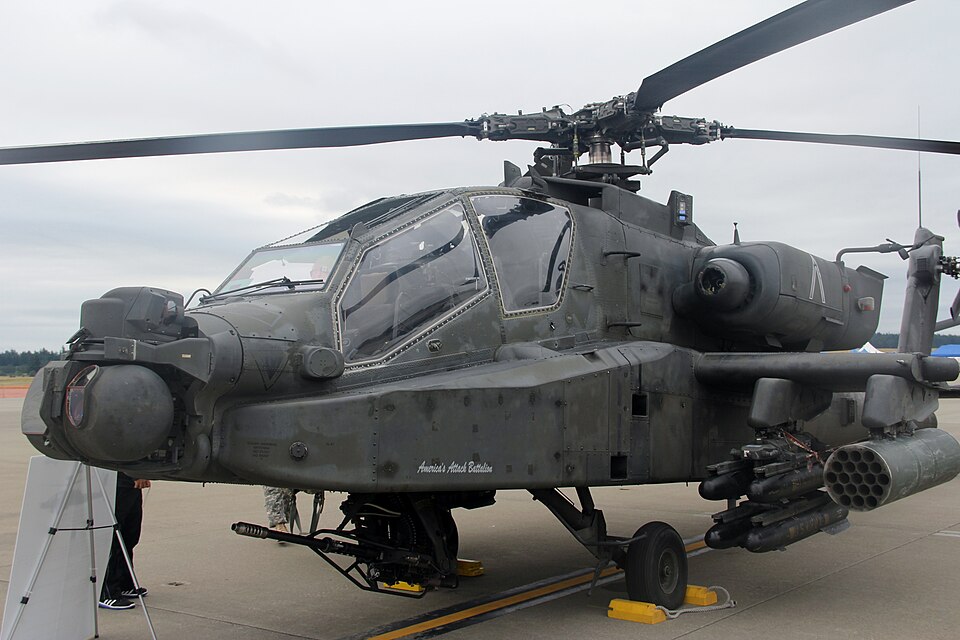
The Boeing AH-64 Apache is the helicopter most consistently called the most feared attack helicopter on the planet. Among the many helicopters in service with the United States military, none have inspired as much fear as the AH-64 Apache, thanks to its powerful armament, versatility, and advanced targeting system.
That reputation was not handed to the Apache. It was earned through decades of combat operations, continuous upgrades, and a weapons suite that ground forces around the world have learned to respect.
A Brief History of the Apache
The AH-64 Apache entered service in 1986, replacing the AH-1 Cobra, which many consider the world's first true attack helicopter. The development program that produced it was one of the most rigorous in U.S. military history.
The military sought an attack helicopter with better range, a higher flight ceiling, and improved weapons and armor capabilities compared to the Cobra. In the early 1970s, it issued a Request for Proposals for the aircraft, known as the Advanced Attack Helicopter program. Several major defense companies competed. Hughes ultimately won, and its design became the Apache. The AH-64 was officially given the name Apache in late 1981, following the Army tradition of naming helicopters after Native American tribes or leaders.
Fun Fact: The AGM-114 Hellfire missile's name is said to stand for "Helicopter Launched, Fire and Forget" missile — a fitting name for a weapon designed to lock onto a target and destroy it with minimal pilot input after launch.
Apache Weapons: What It Carries Into Battle
The Apache's weapons load is one of the most impressive of any attack helicopter ever built.
It carries a 30 mm M230 chain gun under its forward fuselage and four hardpoints on stub-wing pylons for armament and stores, typically AGM-114 Hellfire missiles and Hydra 70 rocket pods.
- M230 Chain Gun: Fires 30mm rounds at a high rate of fire, capable of destroying light vehicles and suppressing infantry
- AGM-114 Hellfire Missiles: Laser-guided anti-tank missiles with a range of several kilometers; can be carried in loads of up to 16
- Hydra 70 Rockets: Unguided 70mm rockets that can be fitted with a range of warheads for different targets
- Air-to-Air Missiles: Some variants can carry Stinger or Sidewinder missiles, making the Apache one of the few helicopters capable of engaging enemy aircraft
The Apache can carry up to 16 Hellfire missiles on four wing-mounted pylons. These fire-and-forget weapons became famous during the Gulf War, where AH-64 helicopters played a pivotal role in decimating Iraqi armored columns.
The Longbow Radar: Seeing Everything at Once
One of the most feared features of the modern Apache is not a weapon at all. It is a radar system.
The Longbow radar is capable of tracking up to 128 hostile targets at once, and the system can engage up to 16 simultaneously. The integrated radio internet system incorporated into the Apache's sensor suite also allows the data from one helicopter to be shared among ground units and other aircraft, allowing multiple teams and aircraft to fire at targets detected by a single Apache.
That means a single Apache crew can effectively direct an entire attack on multiple targets at the same time. Few ground forces in the world have a reliable answer to that kind of overhead intelligence and firepower combination.
Why It Matters: The Longbow radar sits above the main rotor, allowing the Apache to peek over a hill, scan for targets, and drop back behind cover — all without exposing the aircraft to ground fire.
Apache Combat Record
Since its introduction in the mid-1980s, the Apache has seen action in nearly every major U.S. and allied conflict, proving itself in both high-intensity warfare and counterinsurgency missions. The Apache helicopter made its combat debut during Operation Just Cause in Panama in 1989, but it was the 1991 Gulf War where it truly made history.
AH-64 fleet totals exceed 5.3 million flight-hours and 1.3 million combat hours, underscoring long-term reliability and operational relevance.
That combat record is nearly unmatched by any other attack helicopter in Western service. The Apache has been put to work across wildly different environments — jungle, desert, mountain, and urban — and has consistently performed.
Pro Tip: If you're interested in the physics behind how these powerful machines stay in the air, check out this deep dive on how a helicopter flies — it covers the science in a way that makes it easy to understand.
Apache Variants: From A to E Model
The Apache has not stood still. It has evolved significantly since its introduction.
| Variant | Key Upgrade | Notes |
| AH-64A | Original production model | First entered service in 1986 |
| AH-64D Longbow | Longbow millimeter-wave fire-control radar | Major leap in targeting capability |
| AH-64E Apache Guardian | Upgraded engines, open systems architecture | Most advanced version; planned through 2060s |
With the AH-64E in production into the 2030s, the Apache will serve the U.S. Army and its partner nations as the world's primary attack helicopter into the 2060s.
Curious about the most intense flying machines ever designed? Flying411 explores everything from bleeding-edge military aircraft to the weirdest helicopters ever built — worth a read if you enjoy the unusual side of aviation.
Why the Apache Is the Most Feared Helicopter in Modern Combat
Now that we have covered the basics, here is a detailed breakdown of why the AH-64 Apache has earned its place as the most feared helicopter in the world. These are the factors that set it apart.
1. Night and All-Weather Strike Capability
The Apache was designed from the start to fight at night. Its forward-looking infrared system and night-vision sensors allow crews to operate effectively in complete darkness. Enemy forces have no warning. There is no noise reduction or flare system that fully protects against an Apache hunting in the dark.
2. Fire-and-Forget Precision Targeting
A key feature of the Apache's deadly effectiveness is the Longbow's available "fire and forget" mode. Using this option, the targeting radar can identify and track a target, and then guide a missile to it, without requiring the pilot to maintain a continuous lock. This frees the crew to engage additional targets while missiles are still in flight.
3. Exceptional Range and Endurance
The Apache's combat range is approximately 260 nautical miles. With a full combat load, a fully fueled Apache can remain airborne and on station for around 2.5 hours. That is a long time to be a persistent threat over a battlefield.
4. Crew Survivability and Armor
The cockpit is armored with boron-carbide and Kevlar, capable of withstanding direct hits from small arms and shrapnel, ensuring crew survivability during intense combat operations. The Apache was built on the assumption that it would regularly take hits. Redundant hydraulic lines, dual engines, and crash-attenuating landing gear all contribute to keeping crews alive when things go wrong.
5. Massive Weapons Payload
Few helicopter platforms in any country's inventory can match the sheer volume of firepower the Apache brings to a fight. With 16 Hellfire missiles, multiple rocket pods, and a 30mm cannon, a single Apache has enough ammunition to destroy an entire armored column in a single mission.
6. Deployability and Air Transport
A useful feature of the AH-64 is its folding, 4-bladed, composite main propeller, which allows Apaches to be loaded and transported in a C-17 Globemaster, C-5 Galaxy, or other military transport aircraft without the need for disassembly. This means Apaches can be rapidly deployed anywhere in the world within hours of a crisis.
7. Networked Battlefield Integration
Modern Apaches are deeply integrated into the broader military communications network. Sensor data can be shared instantly with ground forces, other aircraft, and command centers. The Apache does not just destroy targets — it helps the entire force understand and control the battlefield.
8. Global Combat Proven Status
The Apache has seen action in every major American and NATO conflict since its introduction. That depth of real-world experience is something you simply cannot replicate in a training environment. The Apache's crews and tactics have been tested repeatedly under fire.
9. Continuous Modernization
Unlike many weapons systems that grow outdated, the Apache has received regular upgrades that keep it competitive with newer designs. The future of the AH-64 Apache will see it integrating with emerging technologies like AI, unmanned systems, and hypersonic weapons, ensuring its continued dominance in aerial combat for decades to come.
10. Widespread Adoption by Allied Nations
Primarily operated by the U.S. Army, the AH-64 has also become the primary attack helicopter of multiple nations, including Greece, Japan, Israel, the Netherlands, Singapore, and the United Arab Emirates. When this many professional militaries independently choose the same platform, it says something significant about its capabilities.
Keep in Mind: Flying an Apache is not like flying any other helicopter. The cockpit controls, sensor systems, and weapons management systems require extensive, specialized training. Apache pilots often complete years of training before their first combat deployment.
The Mi-24 Hind: The Helicopter That Started the Fear
No discussion of the most feared helicopters in the world is complete without talking about the Mil Mi-24 Hind. While the Apache claims the modern title, the Hind arguably did more to establish the idea of the feared military helicopter than any other aircraft in history.
What Is the Mi-24 Hind?
The Mil Mi-24 is a large helicopter gunship, attack helicopter, and low-capacity troop transport with room for eight passengers. It was introduced by the Soviet Air Force in 1972. Nothing quite like it existed anywhere in the world at the time.
It was an attempt to combine the firepower of a heavily armed and armored helicopter gunship with the troop-carrying capability of a light assault helicopter. The design was audacious and, for a time, almost unstoppable.
"Satan's Chariot" in Afghanistan
The Hind built its fearsome reputation primarily in Afghanistan during the Soviet-Afghan War of 1979 to 1989. The Mujahideen came to call the Mi-24 Hind "Satan's Chariot," because of the destruction and fear it imposed upon the fighters on the ground.
Bristling with guns, cannons, rocket pods, and guided missiles, Mi-24s famously flew search-and-destroy missions across the country's rugged landscape. When not ferrying troops into combat, the Hinds, which were virtually impervious to small arms and heavy machine gun fire, often swooped down on the enemy from high altitudes or pounced on unsuspecting insurgents while flying high-speed, ground-hugging patrols.
The Hind's heavy armor could withstand small arms fire and even shrapnel, earning its nickname among Soviet forces as the "flying tank."
Fun Fact: The U.S. military was so eager to study the Mi-24 Hind that it launched a top-secret mission called Operation Mount Hope III in 1988, sending special operations helicopters deep into Chad to recover an abandoned Hind and bring it back to the United States for analysis.
How the Stinger Changed Everything
The Hind appeared nearly invincible for much of the early Soviet-Afghan War. That changed in 1986 when the CIA began supplying the Mujahideen with FIM-92 Stinger shoulder-fired surface-to-air missiles.
The Stingers were highly lethal, highly accurate, lightweight, fire-and-forget shoulder-launched missiles — a cutting-edge technology that proved to be the perfect counter to the Hind.
In response, Hind pilots would operate at higher altitudes, but this reduced effectiveness because the unguided rockets and powerful guns needed to be at lower altitudes for accuracy. The Soviets tried to adapt by installing countermeasures including infrared jammers and flare systems, but the adaptations largely failed.
Despite this vulnerability, the Hind's legacy as one of the most feared helicopters ever built remains firmly intact. It served in dozens of conflicts across multiple continents, and more than 2,600 Mi-24 Hinds have been built, serving in over 50 countries — a testament to its versatility and enduring relevance.
Other Helicopters That Demand Respect
While the Apache and the Hind are the two most consistently named as the most feared, several other attack helicopters have earned serious reputations on the modern battlefield.
If you're curious about the stranger side of military rotary aviation, this look at weird military helicopters is worth a read — some of the experimental designs that never made it to production are fascinating in their own right.
Ka-52 Alligator
Russia's Kamov Ka-52 uses a distinctive coaxial rotor design — two sets of rotors spinning in opposite directions rather than the standard main-and-tail rotor layout. This gives it exceptional agility. It has seen combat in Syria and Ukraine. Some analysts consider it the most capable Russian attack helicopter currently in service.
AH-1Z Viper
The American Viper is a third-generation descendant of the Bell AH-1 Cobra, the grandfather of all modern attack helicopters. The AH-1Z Viper is heavily armed, with a total of six hardpoints capable of carrying more than 5,700 lbs of armaments, including up to 76 unguided Hydra rockets or 38 guided rockets, as well as Sidewinder, Hellfire, or JAGM missiles.
Mi-28 Havoc
Russia's Mi-28 Havoc is a dedicated attack helicopter with no troop-carrying role — a direct response to the Apache. It carries a powerful 30mm cannon and a range of anti-tank missiles. Unlike the Mi-24, it was designed purely to destroy things, and it shows.
Heads Up: Many attack helicopters that look similar on paper perform very differently in real-world conditions. Terrain, weather, maintenance, and crew training all play enormous roles in how effective any of these aircraft actually are in combat. Understanding what conditions a helicopter cannot fly in is an important part of understanding their operational limits.
Why Helicopters Are So Hard to Fly — Especially Attack Helicopters
One thing that makes attack helicopters even more impressive is the difficulty of flying them in the first place. Flying a standard helicopter is already a significant challenge. Helicopters are notoriously hard to fly because of the complex interplay between collective pitch, cyclic input, pedals, and engine management — all of which must be coordinated simultaneously.
Attack helicopters add another layer of complexity. Crews must manage weapons systems, sensor suites, threat detection, navigation, and communications — often while maneuvering aggressively under fire. Apache crews, for example, complete hundreds of hours of simulation and flight training before they ever fly a combat mission. The demands on crew coordination, especially between the pilot and the gunner in the front seat, are significant.
If you want to explore the more accessible side of helicopter flight, this guide on the easiest helicopters to pilot and fly offers a great starting point.
Ready to dive deeper into the world of aviation? Flying411 is your go-to resource for everything from military aviation history to practical flying guides. Visit Flying411 to keep exploring.
The Psychological Power of the Attack Helicopter
There is one dimension of the "most feared" question that pure performance specs cannot capture: the psychological effect.
When an Apache or a Hind appears on a battlefield, the fear it generates goes beyond what it can actually do in that single moment. Combatants who have seen or heard reports of what these machines can do often change their behavior in anticipation. Troops move at night instead of day. Vehicles disperse instead of traveling in columns. Supply routes shift. Decision-making degrades.
The Mujahideen learned to move mostly at night to avoid the gunships, and in response the Soviets trained their Mi-24 crews in night-fighting. This kind of back-and-forth — where one side changes behavior to survive and the other adapts its tactics in response — shows just how deeply a feared aircraft can shape an entire campaign.
The Apache has had a similar effect. The sound of an AH-64 in the airspace above a battlefield is, by many accounts, one of the most effective deterrents a ground force can deploy.
Conclusion
So what is the most feared helicopter in the world? By almost any measure, the answer is the Boeing AH-64 Apache. Its combination of advanced sensors, massive firepower, survivability, and a combat record that spans multiple wars and decades places it at the top. The Soviet Mi-24 Hind holds an equally legitimate claim based on reputation and historical impact — and the fear it produced in Afghanistan was both real and profound.
Both aircraft changed the course of conflicts. Both forced enemies to adapt their tactics, their movements, and their decision-making just to survive. That is the truest test of what it means to be feared.
If helicopters have sparked your curiosity — and they should — Flying411 is the place to keep learning. From the most fearsome military gunships to the basics of rotorcraft flight, the world of aviation has no shortage of incredible stories waiting to be discovered.
Frequently Asked Questions
What is the most feared helicopter in the world?
The Boeing AH-64 Apache is widely regarded as the most feared attack helicopter in the world today. Its advanced targeting systems, Hellfire missiles, and extensive combat record across multiple conflicts have established its dominant reputation.
Is the Mi-24 Hind still in use?
Yes. The Mil Mi-24 Hind and its variants remain in service with dozens of countries. Both Russian and Ukrainian forces have used versions of the Mi-24 in recent conflicts, and many nations in Africa, the Middle East, and Asia continue to operate the type.
How fast can an AH-64 Apache fly?
The Apache can reach a top speed of roughly 180 mph, depending on the variant, payload, and conditions. Its cruise speed during combat operations is typically lower, especially when conducting low-altitude strike runs or loitering over a target area.
What replaced the Mi-24 Hind in Russian service?
Russia developed the Mi-28 Havoc and the Ka-52 Alligator as more specialized successors to the Hind. While both are formidable attack helicopters in their own right, the Hind remains in service alongside them rather than having been fully retired.
Can civilians ever see these military helicopters up close?
Several Mi-24 Hinds are on display in museums in the United States and Europe. The Southern Museum of Flight in Birmingham, Alabama, has a genuine Mi-25 Hind on display with a notable history. AH-64 Apaches are occasionally displayed at airshows, though they are active military aircraft not permanently on display in museums.