Military engineers are problem solvers. Sometimes they solve problems in ways that look completely insane. The history of military aviation is full of helicopters that look like they were designed by someone who had never seen a helicopter before. Bent fuselages. Rotors spinning into each other. Pilots standing on top of the engine. Fire shooting from the blade tips.
These are not failures. Most of these weird military helicopters flew successfully, served their country, and pushed the limits of what rotorcraft could do. A few even changed the course of helicopter design forever.
If you thought all military choppers looked the same, buckle up. These seven machines will make you rethink everything.
Key Takeaways
Weird military helicopters are not just oddities. They are proof that military aviation demands creative, unconventional thinking. Some of the strangest helicopters ever built were also among the most effective, influencing modern designs we still fly today. From the bent-bodied Piasecki H-21 to the Soviet Mil V-12 with rotors mounted on its wingtips, every aircraft on this list tackled a real military need in the most unexpected way possible.
| Helicopter | Nickname | Why It Is Weird | Era |
| Piasecki H-21 | Flying Banana | Curved fuselage, tandem rotors | 1950s |
| Hughes XH-17 | Flying Crane / Monster | 134-foot rotor, fire-tipped blades | Early 1950s |
| Kaman HH-43 Huskie | Huskie | Intermeshing rotors, no tail rotor | 1950s–1970s |
| Mil V-12 (V-12 Homer) | Homer | Rotors on wingtips, size of a 737 | Late 1960s |
| de Lackner HZ-1 Aerocycle | Aerocycle | Pilot stood on top of the rotors | 1950s |
| Sikorsky CH-37 Mojave | Mojave | Engines in pods, front-loading hatches | 1950s–1960s |
| de Bothezat Helicopter | Flying Octopus | Four giant rotors, no tail | 1920s |
Flying411 is a go-to resource for aviation enthusiasts who want straight talk about helicopters, fixed-wing aircraft, and the world of flying. Whether you are just curious or ready to start your journey, it is a great place to start.
Why Do Military Helicopters Get So Weird?
Before diving in, it helps to understand why military aircraft end up looking so strange in the first place.
Civilian helicopters are designed with comfort, efficiency, and cost in mind. Military helicopters are designed to do something very specific under very extreme conditions. That specific task might be lifting a 40-ton ballistic missile in Siberia. It might be carrying a lone soldier over enemy territory without any flight training. It might be extinguishing a jet fuel fire at a military airbase.
Why It Matters: When the mission is strange enough, the helicopter will be strange too. Military engineers are not trying to win a beauty contest. They are trying to solve an impossible problem on a deadline, often with whatever parts are available.
Those unusual requirements lead to unusual designs. A helicopter that needs two rotors instead of one because the fuselage is too long. A helicopter where the engines cannot fit inside the body. A helicopter so enormous it needs four engines and wingtip-mounted rotors just to get off the ground.
Each aircraft below represents an engineering team that looked at an impossible problem and said, "We can build that."
If you want to understand how today's capable rotorcraft evolved from these strange early designs, take a look at the different military helicopter types and names that came out of this era.
The 7 Weirdest Military Helicopters Ever Built
Military engineers have tackled some truly outrageous design challenges over the decades, and the helicopters below are the proof. Each one earned its place on this list by being genuinely strange, not just unusual on paper, but weird in ways that made people stop and stare.
Some flew for years. Some barely made it off the ground. All of them left a mark on aviation history.
1. Piasecki H-21 Workhorse, a.k.a. "The Flying Banana"
There is no helicopter in history with a more accurate nickname. The Piasecki H-21 Workhorse looks exactly like a banana. Its fuselage curves upward in the middle, with rotors mounted at both ends and the rear rotor sitting noticeably higher than the front one.
The reason for the bend is purely practical. The H-21 uses a tandem rotor configuration, meaning two rotors spinning in opposite directions at opposite ends of the aircraft. Without the upward curve of the fuselage, those massive spinning blades would collide in flight. The kink keeps them apart.
Frank Piasecki designed the H-21 in the early 1950s as an Arctic rescue helicopter for the U.S. Air Force. It was built to operate in temperatures as low as negative 65 degrees Fahrenheit. The Army later adopted it as a troop carrier, and the H-21 saw service in the early years of the Vietnam War before being replaced by the Bell UH-1 Huey and the Boeing CH-47 Chinook.
Key specs at a glance:
- First flight: April 1952
- Crew: 2, plus up to 20 troops
- Powerplant: Wright R-1820 radial engine
- Notable feat: First helicopter to cross the United States nonstop, in August 1954
Fun Fact: The H-21 completed the first nonstop transcontinental helicopter flight in 1954. A single aircraft nicknamed "Amblin' Annie" made the crossing with the help of in-flight refueling from a fixed-wing aircraft.
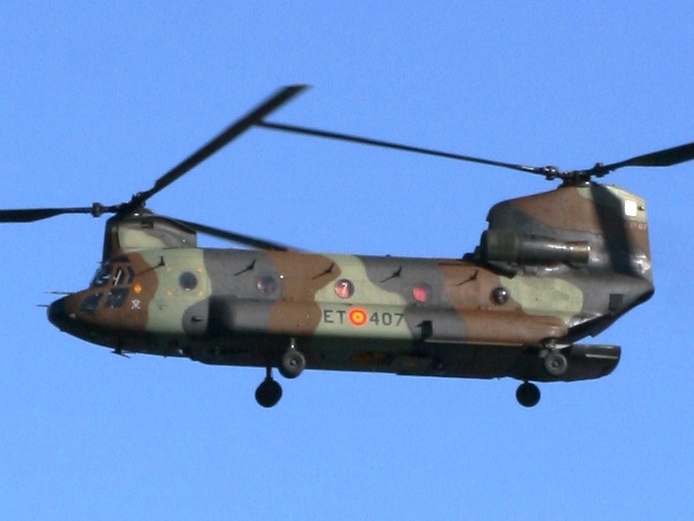
The H-21 is considered a direct ancestor of the CH-47 Chinook, the iconic tandem-rotor workhorse still flying today. The "flying banana" shape was refined rather than replaced, which says a lot about how well it actually worked.
If you are curious about the full range of civilian rotorcraft that followed in the wake of these early designs, check out this overview of civilian helicopters with the longest range to see how far the technology has come.
2. Hughes XH-17, a.k.a. "The Flying Crane" and "The Monster"
In the early 1950s, the U.S. Air Force had a big problem. It needed to lift heavy military vehicles across rivers, canyons, and rough terrain that ground forces could not cross. The solution it commissioned was one of the most extraordinary aircraft ever built.
The Hughes XH-17 had a two-bladed main rotor with a diameter of roughly 134 feet. That is still the record for the largest rotor system ever to fly. To put that in perspective, a modern Boeing 747 has a wingspan of around 200 feet. The XH-17's rotor was nearly three-quarters of that, spinning in a circle underneath a relatively small fuselage.
The way those blades spun was just as strange as their size. The XH-17 did not use a traditional engine-to-rotor drive shaft. Instead, two General Electric J35 turbojet engines bled compressed air up through the hollow rotor blades and out through tip jets at the ends. The rotor spun from the thrust of that escaping air. When those tip jets fired up, flames shot from the ends of the rotating blades like a Catherine wheel the size of a house.
Good to Know: Because the rotor was driven by tip jets rather than a mechanical shaft, the main rotor did not create the usual torque problem. The small tail rotor from a Sikorsky H-19 Chickasaw was added only for directional control, not torque compensation.
The XH-17 was so loud it could reportedly be heard from around eight miles away, which caused a wave of noise complaints against Hughes Aircraft Company. The rotor blades were so large and stressed during operation that each blade had a fatigue life of only around 10 hours before replacement was needed.
Despite flying successfully and lifting loads exceeding 50,000 pounds during testing, the XH-17 was too fuel-hungry, too noisy, and too expensive to operate. Its range was limited to roughly 40 miles. Only one prototype was ever built. It was eventually scrapped.
But its legacy lives on. The concept of a heavy-lift helicopter crane influenced the later Sikorsky S-64 Skycrane, which proved far more practical and is still used today for firefighting and construction.
The XH-17's "Frankenstein" Parts List:
- Cockpit: Waco CG-15 military glider
- Front wheels: North American B-25 Mitchell bomber
- Rear wheels: Douglas C-54 Skymaster
- Fuel tank: Boeing B-29 Superfortress bomb bay unit
- Tail rotor: Sikorsky H-19 Chickasaw
Pro Tip: If you ever want to appreciate how far helicopter design has come, compare the XH-17's 40-mile range to a modern long-range civilian helicopter. The difference is staggering.
3. Kaman HH-43 Huskie
At first glance, the Kaman HH-43 Huskie looks like a fairly normal helicopter from the 1950s. Boxy shape, no-nonsense color scheme. Then you notice the rotors.
The Huskie uses an intermeshing rotor system, sometimes called a synchropter. Two rotors are mounted side by side on separate angled shafts, and they spin in opposite directions. Because they are angled and timed precisely, the blades interlock and pass through the same space without hitting each other. It looks like they should destroy each other on startup, but they do not.
This design, developed with significant influence from German aeronautical engineer Anton Flettner (who was brought to the United States after World War II as part of Operation Paperclip), eliminates the need for a tail rotor entirely. Without a tail rotor, the helicopter can focus all of its engine power on lift. It also creates an unusually stable hover, which turned out to be extremely valuable.
The Huskie entered service with the U.S. Air Force in the late 1950s and became the primary search and rescue and base firefighting helicopter for years. During the Vietnam War, the HH-43 is said to have flown more rescue missions than all other rotorcraft combined. Its precise hover made it ideal for lowering rescue personnel into tight spaces.
Keep in Mind: The intermeshing rotor concept did not die with the Huskie. Kaman still uses it today in the K-MAX, a single-seat helicopter specifically designed for unmanned cargo operations. The U.S. Marine Corps tested the K-MAX as an unmanned resupply helicopter in Afghanistan.
HH-43 Huskie at a Glance:
| Feature | Detail |
| Rotor type | Intermeshing synchropter |
| No tail rotor | Yes, not needed |
| Primary role | Search and rescue, firefighting |
| Service period | Late 1950s to early 1970s |
| Notable record | Said to be first twin-turbine helicopter |
4. Mil V-12 "Homer," the World's Largest Helicopter
In the late 1960s, the Soviet Union had a problem that only a truly enormous helicopter could solve. It needed to transport heavy intercontinental ballistic missiles to launch sites across remote, roadless terrain. The result was the Mil V-12, which remains, to this day, the largest helicopter ever built.
The V-12 was not just big. It was conceived differently from almost every other helicopter in existence. Instead of mounting rotors on top of the fuselage, the V-12 mounted two Mi-6 rotor systems at the tips of its broad, fixed wings. The wings spanned roughly 220 feet. The helicopter's length was close to 120 feet. For comparison, that is approximately the same length as a Boeing 737.
Four Soloviev D-25VF turboshaft engines powered the aircraft, two driving each rotor. The rotors turned in opposite directions to cancel out torque, eliminating the need for a tail rotor altogether.
Fun Fact: In 1969, the V-12 set a payload record that still stands: lifting a load of over 88,000 pounds to an altitude of around 7,400 feet. No helicopter has beaten that record since.
Despite its extraordinary capability, the V-12 never entered production. The strategic mission it was designed for, the rapid mobile deployment of Soviet ICBMs, became obsolete as missile basing strategies changed. Only two prototypes were ever completed. One appeared at the 1971 Paris Air Show, where it stunned Western observers who had only just learned of its existence. The program was quietly cancelled in the mid-1970s.
Flying411 covers not just the famous aircraft but also the forgotten ones that reshaped aviation. If you are thinking about getting into the cockpit yourself, Flying411 can help you find the right path.
5. de Lackner HZ-1 Aerocycle
Every helicopter on this list has some engineering logic behind its strangeness. The de Lackner HZ-1 Aerocycle, however, takes strangeness to a different level entirely.
The concept was simple: build a one-person helicopter that could be piloted by a soldier with no flight training at all. The Army believed in the early 1950s that this kind of vehicle could replace the horse cavalry. A scout could supposedly learn to fly it in under 20 minutes.
The design? The pilot stood on a small platform directly above two large contra-rotating rotors. No cockpit. No seat. No enclosure. The pilot controlled the aircraft by shifting their body weight, using motorcycle-style handlebars for additional input. The rotors spun just below their feet.
Heads Up: The Aerocycle required a specially developed emergency parachute called the "Ultra-Fast Opening Personnel Parachute Type XMP-2." Testing later revealed the parachute was unreliable. That fact alone gives a pretty clear picture of how well the program went.
Initial tethered tests in 1954 showed some promise. The Army ordered a dozen examples and named them the HZ-1. But when proper testing began at Fort Eustis, Virginia, in 1956, serious problems emerged. The aircraft was much harder to control than expected. The rotors kicked up dangerous debris from the ground. Two crashes during the test program were the final verdict. The Aerocycle was abandoned.
The Army's cavalry replacement never happened. But the HZ-1 remains one of the boldest, strangest, and most dangerous ideas in aviation history.
6. Sikorsky CH-37 Mojave
The Sikorsky CH-37 Mojave was a heavy-lift helicopter built in the 1950s that managed to be strange in multiple ways at once.
First, its engines. The CH-37 used two massive Pratt and Whitney R-2800 radial piston engines, but those engines were too large to fit inside the fuselage. So Sikorsky mounted them in external pods on either side of the nose, sticking out like bulging eyes. The pods gave the helicopter a goggle-eyed, slightly startled expression.
Second, its loading system. Most large helicopters load cargo through a ramp at the rear. The Mojave loaded from the front through a pair of large clamshell doors that swung outward. To make this possible, the nose was designed to hinge upward, giving full access to the cabin. The effect was somewhat like watching a cartoon character open its enormous mouth.
Good to Know: Despite its odd appearance, the CH-37 was a genuine workhorse. It could carry a loaded Jeep inside its fuselage. When the later and more capable Sikorsky CH-54 Tarhe Skycrane came along, the Mojave was retired, but it had served well through the early 1960s.
The CH-37 is a reminder that form does not always follow function in the cleanest way. Sometimes function requires engines on the outside of the nose and a face that opens like a giant clam.
7. de Bothezat Helicopter, a.k.a. "The Flying Octopus"
This one predates most people's idea of when helicopters even existed.
In 1921, the U.S. Army Air Service contracted Russian-born engineer George de Bothezat to build a helicopter based on his "theory of lifting screws." The result, first flown in 1922 at McCook Field in Ohio, was unlike anything before or since.
The de Bothezat helicopter used four enormous six-bladed rotors arranged in an X shape at the ends of long outrigger beams. A small additional rotor was mounted in the center for additional control. The whole contraption looked less like a vehicle and more like an enormous spider doing its best impression of a helicopter.
Fun Fact: The de Bothezat helicopter is generally considered the first rotorcraft designed and built specifically for the U.S. military. It managed to lift off the ground with multiple passengers and completed hundreds of test flights before the Army cancelled the program in 1924.
The aircraft was capable of controlled flight, which was more than most people expected. But it was also underpowered, difficult to control, and too slow for practical military use. The Army shut down the project and moved on.
George de Bothezat continued refining his theories, and elements of his multi-rotor thinking can be seen in modern quadcopter drone designs. If you have ever flown a consumer drone, you owe a small debt to the Flying Octopus of 1922.
What These Weird Designs Taught Us
Every strange aircraft in this list taught engineers something they needed to know. That is not a coincidence. Military aviation has always moved faster than civilian aviation because the stakes are higher and the funding is more flexible. Weird ideas get tried. Some fail. Some succeed. Most teach something valuable either way.
Here is what the aviation world gained from these bizarre machines:
- Tandem rotors (pioneered by Piasecki) became the foundation of the CH-47 Chinook, still the U.S. Army's primary heavy-lift helicopter.
- Intermeshing synchropters (refined by Kaman with Flettner's work) are now used in advanced unmanned cargo systems.
- Heavy-lift crane concepts (explored by the XH-17) led directly to the Sikorsky S-64, still widely used for firefighting and construction lifts.
- Side-by-side rotor systems (demonstrated by the V-12) remain a valid engineering approach for extremely heavy loads.
- Multi-rotor stability (demonstrated by de Bothezat) is the entire basis for modern drone technology.
Pro Tip: If you are thinking about learning to fly helicopters, understanding the basic mechanics of different rotor systems can make training feel a lot less mysterious. Take a look at some of the best helicopters to learn to fly to see how much simpler modern training aircraft are compared to these experimental machines.
None of these helicopters were built to be weird. They were built to solve problems. The weirdness was just a side effect of thinking differently.
How Hard Is It to Fly a Weird Helicopter?
This is a fair question, and the answer depends on the design.
Standard helicopters are famously difficult to fly even without unusual rotor configurations. The controls require simultaneous coordination of both hands and both feet in ways that go against natural instinct. If you want a deeper look at why helicopters are so hard to fly, the physics are genuinely fascinating.
Synchropters like the Huskie are generally considered to hover more stably than standard helicopters, which is one reason they were favored for rescue operations. Tandem rotor designs like the H-21 are known for their load-carrying stability but require additional training to manage two rotor systems. The de Lackner Aerocycle was supposed to be easy to fly by design, but real-world testing proved that assumption wrong in a hurry.
If you are curious about where to begin your own flying education, understanding the easiest helicopters to pilot and fly can help you figure out the right starting point. Modern training helicopters are dramatically simpler than any of the machines on this list.
It is also worth knowing that even the most capable helicopter has limitations. Extreme cold, high altitude, high winds, and other factors can ground any rotorcraft. The conditions a helicopter cannot fly in matter just as much as the aircraft's design when it comes to real-world operations.
If aviation has caught your interest and you want to take the next step, Flying411 is a resource worth bookmarking. From helicopter types to pilot training basics, it covers the stuff you actually want to know.
Conclusion
The weirdest military helicopters in history were not mistakes. They were bold answers to difficult questions, designed by engineers who refused to accept that the conventional approach was the only approach. The Piasecki H-21 bent itself into a banana shape so its rotors could coexist. The Hughes XH-17 shot flames from its blade tips to stay airborne. The Mil V-12 grew to the size of a passenger jet because nothing smaller would do the job.
Every one of these aircraft contributed something to the helicopters flying today. The strangeness was the point. Without it, we would not have the Chinook, the Skycrane, or the drone sitting in your closet.
If you want to keep exploring the world of rotorcraft, military aviation, and the history of flight, Flying411 is the place to go. The stories are just as strange, and the knowledge is a lot more useful.
Frequently Asked Questions
What makes a military helicopter "weird"?
A military helicopter is generally considered weird when its design departs significantly from the conventional single-main-rotor layout, such as having intermeshing rotors, tandem rotors, wingtip-mounted rotor systems, or a pilot standing on top of the engine.
Did any of these strange helicopters actually work well in combat?
Yes. The Kaman HH-43 Huskie is said to have flown more rescue missions than all other rotorcraft combined during the Vietnam War. The Piasecki H-21 was an effective troop carrier in the early stages of that same conflict. Strange design did not mean poor performance.
Why did the Soviet Mil V-12 never enter production despite setting records?
The V-12's primary mission, rapidly deploying heavy ballistic missiles to remote launch sites, became unnecessary as Soviet missile deployment strategies shifted. Without a clear ongoing military need, the enormous cost of producing and operating the aircraft could not be justified.
Are any of these weird helicopter designs still in use today?
The intermeshing rotor concept used by the Kaman HH-43 Huskie is still active in the Kaman K-MAX, which has been tested as an unmanned cargo helicopter. The tandem rotor layout from the Piasecki H-21 lives on in the Boeing CH-47 Chinook, which remains in active military service.
Could an untrained soldier really fly the de Lackner HZ-1 Aerocycle?
That was the original idea, but testing showed it was far more difficult than anticipated. Army testers found the aircraft hard to control and prone to kicking up dangerous rotor wash debris. Two crashes during the test program ended the project before any real-world military deployment could occur.