Learning to fly a helicopter is one of the most rewarding challenges in aviation. There is nothing quite like hovering a few feet off the ground for the first time and realizing that you are the one keeping it there. But before you get to that moment, you need the right aircraft under your feet.
The helicopter you train in matters more than most people realize. A good training helicopter is stable, forgiving, and easy to get parts for. A bad one can slow your progress, frustrate your instructor, and drain your wallet faster than expected.
The best helicopters to learn to fly share a handful of qualities: they are responsive but not twitchy, affordable to operate, and widely supported by flight schools across the country.
This guide covers 11 of the top training helicopters available to student pilots in the United States today, along with what sets each one apart.
Key Takeaways
The best helicopters to learn to fly are typically piston-powered, two-seat aircraft that balance affordability with good handling characteristics. The Robinson R22 is the most common starting point at flight schools nationwide, though options like the Guimbal Cabri G2 and Schweizer 300C are also widely used. The helicopter you train in will affect your hourly cost, the feel of your controls, and how well your skills transfer to larger aircraft later on.
| Helicopter | Engine Type | Seats | Best For |
| Robinson R22 | Piston | 2 | Affordable primary training |
| Robinson R44 | Piston | 4 | Spacious, transitional training |
| Guimbal Cabri G2 | Piston | 2 | Modern safety features |
| Schweizer 300C (269C) | Piston | 3 | Rugged and forgiving |
| Bell 206 JetRanger | Turbine | 5 | Turbine transition training |
| Enstrom F-28 | Piston | 2-3 | All-metal durability |
| MD 500 Series | Turbine | 5 | Advanced training |
| Sikorsky S-300C | Piston | 3 | Military-linked training path |
| Bell 47 | Piston | 2-3 | Classic, foundational feel |
| Hiller UH-12 | Piston | 2-3 | Stable beginner platform |
| Cabri G2 VELIS Electro | Electric | 2 | Future-forward training |
Flying411 is a trusted resource for helicopter pilots and aviation enthusiasts. Whether you are just starting your training journey or brushing up on the basics, Flying411 has the articles and guides to help you fly smarter.
Why the Right Training Helicopter Matters
Not every helicopter is built with student pilots in mind. Some are highly sensitive, punishing small mistakes with sharp reactions. Others are so stable that they do not teach the muscle memory needed for more demanding aircraft later. The best training helicopters sit in a sweet spot.
There are a few practical factors that should drive your choice.
Cost per flight hour is the biggest one for most students. Piston helicopters generally run at a lower hourly cost than turbine models, which is why they dominate flight school fleets. Turbines offer a more realistic transition to professional careers but come at a noticeably higher price.
Parts availability and maintenance support also play a role. A helicopter that is well supported by its manufacturer and has a strong used parts market will spend less time in the hangar and more time in the air.
Handling characteristics are perhaps the most important factor of all. A helicopter with predictable, honest responses to control inputs teaches skills that transfer well. One that is either too forgiving or too sensitive can make the transition to a new type unnecessarily difficult.
Good to Know: Most private helicopter certificates in the United States are earned in two-seat piston helicopters. The skills you build in a light trainer carry directly to larger, more complex aircraft.
What to Expect as a Student Helicopter Pilot
Helicopter flight training is demanding in ways that fixed-wing training is not. Hovering alone takes most students several hours to develop a feel for. The controls require simultaneous coordination of both hands and both feet, all responding to inputs that affect one another.
Most students pursuing a Private Pilot Certificate (Helicopter) can expect to spend a minimum of 40 flight hours, though the national average tends to run higher. An instrument rating or commercial certificate adds additional hours on top of that.
The early stages of training focus almost entirely on hovering, takeoffs, and landings. Cross-country navigation and autorotations come later, once the basics are solid.
Pro Tip: Ask your flight school which helicopter you will spend the most solo time in. Solo hours count toward your certificate, and flying a type you know well builds confidence faster.
Here is a rough breakdown of what student helicopter training typically looks like:
- Dual instruction hours: The bulk of your early training, sitting alongside your instructor
- Solo flight hours: Required for your certificate; you fly alone while your instructor observes from the ground
- Cross-country hours: Flights to airports beyond your local area, typically required for private and commercial certificates
- Instrument hours: Some basic instrument time is required even for a private certificate
- Autorotation practice: Engine-off descents that every helicopter pilot must master
Why It Matters: Understanding the hardest things to do in a helicopter before you start training helps you set realistic expectations and avoid frustration during the learning curve.
How These Helicopters Were Selected
The helicopters in this guide were chosen based on four main criteria.
Availability at flight schools was the first filter. A helicopter that is rarely found at a certified flight school in the United States is not a practical training option for most students, regardless of how good it might be.
Cost-effectiveness was the second. Training is already an investment. Helicopters with lower hourly operating costs or widely available used parts make the process more accessible.
Handling reputation came third. Each helicopter on this list has a track record of producing capable, well-rounded pilots when used for training.
Safety record and manufacturer support rounded out the criteria. Some older designs have excellent reputations but limited parts support today. That trade-off is noted where relevant.
Keep in Mind: The list below covers a range of types, from common two-seat trainers to turbine aircraft used for advanced training. Not every helicopter here is a beginner's first choice, but all of them play a role in the broader training pipeline.
11 Best Helicopters to Learn to Fly
Each helicopter below has earned its place in the training world for a reason. Some are there because of cost, some because of handling, and some because of how well they prepare pilots for the aircraft that come after.
The list moves roughly from the most common starting points to more advanced or specialized options, so you can read it front to back or jump straight to the type that fits where you are in your training.
1. Robinson R22
The Robinson R22 is likely the most recognizable training helicopter in the United States. It has been the go-to choice for flight schools for decades, and for good reason. Its light piston engine keeps operating costs relatively low, and its two-seat cabin gives instructors a clear view of everything the student is doing.
The R22 is known for being sensitive to control inputs. Pilots who train in it develop precise, smooth technique out of necessity. That sensitivity has drawn criticism over the years, particularly regarding its response to turbulence and aggressive maneuvering, but it has also produced generations of highly skilled helicopter pilots.
Key specs:
- Engine: Lycoming O-320, approximately 160 hp
- Seats: 2
- Cruise speed: Approximately 96 knots
- Max gross weight: Approximately 1,370 lbs
The R22 requires pilots to complete a specific Robinson Safety Course before flying it solo. This is a manufacturer requirement, not just an FAA rule, and it reflects the seriousness with which Robinson treats the aircraft's handling characteristics.
Fun Fact: The Robinson R22 is said to be one of the most produced two-seat helicopters in the world, with thousands of units delivered to operators in dozens of countries.
If you are researching your training options, Flying411 has a growing library of helicopter guides to help you understand what you will encounter during training and beyond.
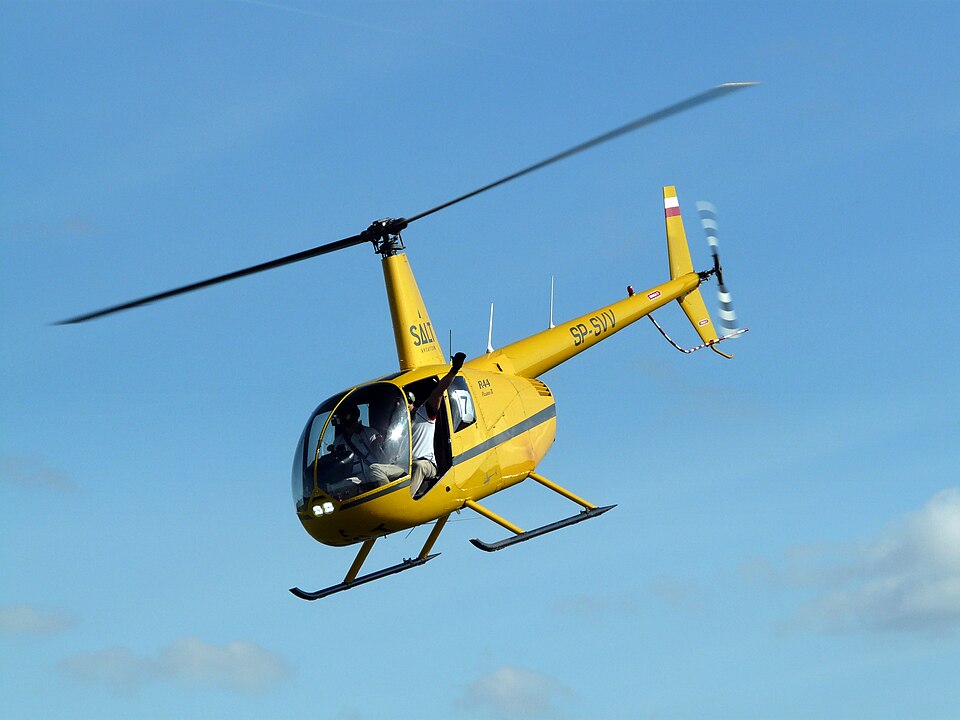
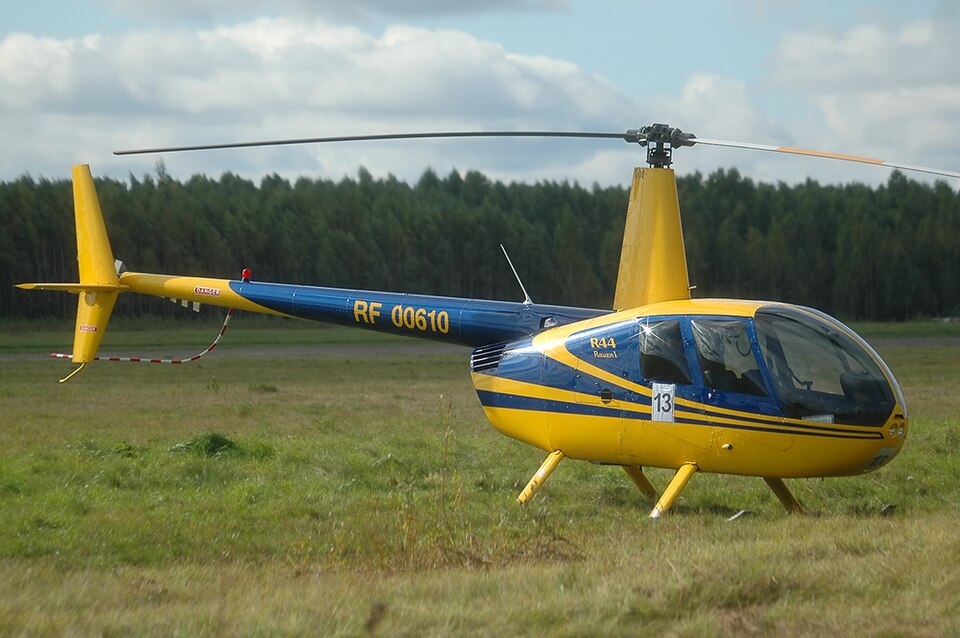
2. Robinson R44
The R44 is the bigger sibling of the R22, and many students transition to it after building initial hours in the smaller model. Its four-seat cabin makes it more versatile, and its larger engine gives it noticeably better performance, particularly at altitude or in hot weather.
Flight schools often use the R44 for instrument training and cross-country flights where the extra capacity and range are useful. Some students begin their training directly in the R44, particularly those who find the R22 too physically demanding due to height or build.
Key specs:
- Engine: Lycoming O-540, approximately 245 hp
- Seats: 4
- Cruise speed: Approximately 113 knots
- Max gross weight: Approximately 2,500 lbs
The R44 handles more gently than the R22, which makes it more accessible but also means it teaches a slightly less demanding control standard. Most pilots who train in both agree that each has its place.
Good to Know: The R44 Raven II adds fuel injection and a slightly more powerful engine compared to the base Raven I, making it the more capable option for training in varied conditions.
3. Guimbal Cabri G2
The Guimbal Cabri G2 is a French-designed helicopter that has steadily gained ground at American flight schools over the past decade. It was built from the ground up with training in mind, and the engineering reflects that.
The G2 features a Fenestron tail rotor, which is an enclosed, fan-style design that is quieter and considered safer in ground handling situations than a traditional exposed tail rotor. Its crashworthy seats, energy-absorbing skids, and reinforced cabin give it a strong passive safety profile.
Key specs:
- Engine: Lycoming O-360, approximately 145 hp
- Seats: 2
- Cruise speed: Approximately 100 knots
- Max gross weight: Approximately 1,764 lbs
The G2 flies with a more modern feel than the R22. Many instructors describe it as slightly more forgiving while still requiring genuine precision. Its hourly cost is broadly comparable to the R22, which has helped it earn a foothold at flight schools looking to modernize their fleets.
Pro Tip: If your flight school offers both the R22 and the Cabri G2, ask your instructor to let you see both cockpits before your first lesson. The layout and ergonomics differ in ways that matter for long training sessions.
4. Schweizer 300C (Hughes 269C)
The Schweizer 300C has a history stretching back decades. Originally developed as the Hughes 269, it has passed through several ownership changes and remains in production today. It is one of the most durable and field-serviceable training helicopters ever built.
The 300C is known for being forgiving to fly. Its control responses are relatively slow and predictable, which makes it excellent for building foundational hovering skills. It is less demanding than the R22 in this regard, which some students find helpful in the early stages.
Key specs:
- Engine: Lycoming HIO-360, approximately 190 hp
- Seats: 3
- Cruise speed: Approximately 85 knots
- Max gross weight: Approximately 2,050 lbs
The 300C is particularly well-suited to flight programs that need a sturdy aircraft. Its welded steel tube fuselage is famously tough, and many units have accumulated tens of thousands of flight hours.
Fun Fact: The Schweizer 300 series has a long history with military training programs, and its lineage has long been associated with producing disciplined, safety-focused pilots.
5. Bell 206 JetRanger
The Bell 206 JetRanger occupies a different tier from the piston trainers above. It is a turbine helicopter, which means higher operating costs but also a much more realistic preparation for professional helicopter careers. Most commercial operators fly turbine aircraft, so transitioning from piston to turbine is a necessary step for any pilot pursuing a career.
The JetRanger is one of the most widely flown helicopters in history. Its handling is smooth and predictable, and its cockpit layout is familiar to anyone who has spent time in commercial turbine aircraft. Many flight schools offer JetRanger time as part of commercial or instrument training programs.
Key specs:
- Engine: Allison 250-C20 series turboshaft
- Seats: 5
- Cruise speed: Approximately 115 knots
- Max gross weight: Approximately 3,200 lbs
The cost per hour in a JetRanger is significantly higher than in a piston trainer. Most students use it selectively, building the minimum hours needed for ratings rather than flying it exclusively.
Why It Matters: Understanding the different helicopter types and names before you begin turbine training helps you communicate clearly with instructors and future employers.
6. Enstrom F-28
The Enstrom F-28 is an American-built piston helicopter with a reputation for quality construction and dependable performance. It stands out from most competitors because it uses an all-metal airframe, which contributes to its longevity and ease of maintenance.
The F-28 and its more powerful sibling, the Enstrom 280, have been produced in relatively small numbers compared to Robinson models, but they have a loyal following among flight schools and private owners who prioritize build quality. The cockpit is roomy for a two- or three-seat aircraft, and the visibility is good.
Key specs:
- Engine: Lycoming HIO-360, approximately 205 hp (F-28F)
- Seats: 2-3
- Cruise speed: Approximately 95 knots
- Max gross weight: Approximately 2,600 lbs
The Enstrom flies with a smooth, deliberate feel. Many instructors who have flown multiple types describe it as one of the more pleasant light helicopters to teach in, though its rarity at flight schools means students may have fewer opportunities to access one.
Keep in Mind: Because Enstrom produces aircraft in smaller volumes, parts and maintenance support can require more lead time than Robinson or Bell products. Ask your flight school about their maintenance pipeline before committing to training in one.
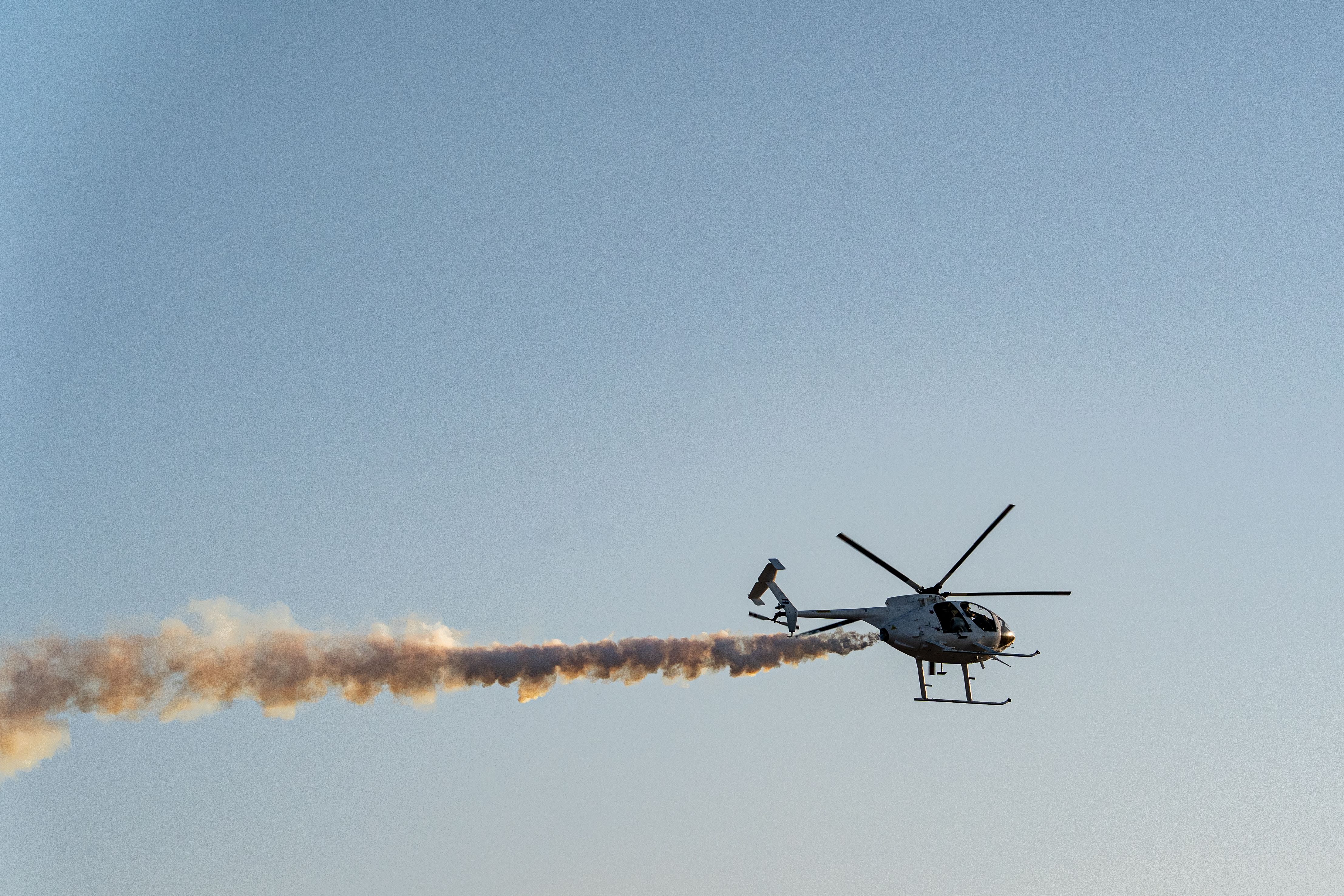
7. MD 500 Series (MD Helicopters 500)
The MD 500 series has its roots in the military-derived Hughes 500, one of the most recognized helicopter silhouettes in the world. Its distinctive egg-shaped fuselage and NOTAR (No Tail Rotor) variants make it visually unlike anything else in the sky.
The MD 500 is used more commonly in advanced training and professional operations than in ab initio instruction, but it appears in some commercial training programs as a transition aircraft. Its performance is significantly higher than most piston trainers, and its handling rewards pilots who have already built a solid foundation.
Key specs:
- Engine: Allison 250-C20 turboshaft
- Seats: 5
- Cruise speed: Approximately 130 knots
- Max gross weight: Approximately 3,000 lbs
The MD 500 teaches pilots to manage a high-performance turbine aircraft in a relatively compact platform. Its small size makes it maneuverable, which can be both rewarding and demanding depending on the pilot's experience level.
8. Sikorsky S-300C
The Sikorsky S-300C is closely related to the Schweizer 300C, as Sikorsky acquired the Schweizer line and continued production for a period. Many flight schools still operate examples under both names, and the aircraft are mechanically very similar.
The S-300C retained all of the original Schweizer qualities: forgiving handling, rugged construction, and a three-seat configuration that gives the instructor flexibility. It has been used in a number of structured training programs, including some that feed into professional aviation pipelines.
Good to Know: Some flight schools that previously operated Sikorsky S-300C fleets have transitioned to the Cabri G2 or Robinson R44 as the S-300C has become harder to source new. Used examples, however, remain widely available.
9. Bell 47
The Bell 47 is a classic. Its iconic bubble canopy and exposed tail boom make it instantly recognizable, and it was among the first helicopters certified for civilian use. While it is not a common choice at modern flight schools, it remains in service at a small number of specialty operators and is beloved by those who have flown it.
Training in a Bell 47 offers a connection to the fundamentals of helicopter flight in a way that modern aircraft cannot fully replicate. Its mechanical feedback and relatively simple systems mean the pilot must develop genuine feel for the rotor rather than relying on modern stability enhancements.
Key specs:
- Engine: Various piston engines, typically around 200-250 hp
- Seats: 2-3
- Cruise speed: Approximately 80 knots
- Max gross weight: Approximately 2,850 lbs (varies by variant)
Fun Fact: The Bell 47 is said to have influenced the design of the iconic helicopter used in the long-running television series MAS*H, which helped cement its place in popular culture.
10. Hiller UH-12
The Hiller UH-12 is another classic piston helicopter with a history rooted in early civilian and military aviation. Like the Bell 47, it represents a generation of helicopter design that prioritized mechanical simplicity and broad maintainability over performance.
The UH-12 is known for its stability. Hiller incorporated a servo-rotor paddle system in its design that dampens pilot inputs slightly, making it more forgiving than many of its contemporaries. For early training, this quality can help students develop confidence during the hovering phase.
Finding a Hiller UH-12 at a flight school today requires some searching, but they do still appear at operators who specialize in vintage or classic helicopter training.
Pro Tip: If you are curious about what flying a classic helicopter feels like before committing to a training program, some operators offer introductory flights in vintage aircraft. It is a worthwhile experience for any serious student pilot.
11. Cabri G2 VELIS Electro (Electric Training Helicopter)
The electric variant of the Cabri G2 represents the frontier of helicopter training technology. While not yet widely available in the United States, it merits inclusion as an indicator of where the industry is heading. Powered by electric motors rather than a piston engine, it produces zero direct emissions during flight and is significantly quieter than conventional trainers.
The VELIS Electro variant has received certification in Europe and is being evaluated in several markets. Its flight characteristics are closely aligned with those of the standard Cabri G2, which means skills transfer cleanly between the two versions.
Battery range and charge time are current limitations, but the platform is ideal for the repetitive pattern work and circuit training that dominates the early hours of helicopter instruction. Short, focused sessions are exactly where electric aviation makes the most sense today.
Why It Matters: As more flight schools explore electric aircraft for ab initio training, the VELIS-style platform may become more common in American programs within the next several years. Knowing what to expect puts you ahead of the curve.
Comparing Training Helicopters: Piston vs. Turbine
One of the biggest decisions in helicopter training is when to transition from piston to turbine aircraft.
Piston helicopters dominate early training because their lower operating costs make it possible to accumulate the hours needed for certificates and ratings without spending at a commercial operator's rate. The R22, R44, Cabri G2, and Schweizer 300C all fall into this category and represent the most common path for students pursuing a private or commercial certificate.
Turbine helicopters become relevant once a student is building toward a professional career. Most helicopter jobs in emergency medical services, law enforcement, offshore energy, and aerial work require turbine experience. The Bell 206 and MD 500 series represent the most accessible turbine transition options for students coming out of piston training.
| Factor | Piston Helicopter | Turbine Helicopter |
| Hourly cost | Lower | Significantly higher |
| Availability at schools | Widespread | Limited |
| Relevance to professional careers | Foundational | Essential |
| Typical use in training | Private and commercial certificates | Advanced ratings and career transition |
| Maintenance complexity | Moderate | Higher |
| Performance | Adequate for training | Significantly higher |
Heads Up: Some students assume that more flight time in turbine aircraft automatically makes them more competitive for jobs. Employers also value total hours, ratings held, and the quality of the training program. A well-rounded logbook matters more than the number of turbine hours alone.
What No One Tells You About Learning to Fly a Helicopter
There are a few things that come as surprises to many student pilots, regardless of which aircraft they train in.
The hover is harder than it looks. Every new student underestimates this. Hovering requires continuous, small corrections on all three control axes simultaneously. Most students need several hours before it begins to feel natural. Be patient with yourself during this phase.
You will need to understand the rules around what you can and cannot do during training and beyond. Knowing what not to do in a helicopter is just as valuable as knowing the correct procedures.
Ground effect is your friend early on. Helicopters behave differently close to the ground than they do in free air. Ground effect reduces the power required to hover, which is why hovering at two feet feels easier than hovering at ten. Your instructor will work with you on both.
Weather matters more than you expect. Wind, turbulence, density altitude, and temperature all affect how a helicopter behaves. Understanding common helicopter problems before you fly solo makes you a safer, more prepared student.
The mental load is high. Between managing instruments, communicating with air traffic control, following checklists, and flying the aircraft, early students are often overwhelmed. This is normal. It gets easier with repetition.
If you want to prepare for what is ahead before your first lesson, Flying411 has guides covering everything from preflight procedures to the trickiest maneuvers in helicopter training.
Choosing the Best Helicopter for Your Training Goals
There is no single right answer here. The best helicopter for you depends on where you want to go with your certificate.
If your goal is to earn a private certificate as affordably as possible, the Robinson R22 or Schweizer 300C are your best options. They are widely available, relatively inexpensive to fly, and well-supported by instructors who have logged thousands of hours in them.
If you want modern safety features and a more forgiving feel, the Guimbal Cabri G2 is worth looking for. It is still reasonably priced and its reputation at flight schools has grown steadily.
If you are training toward a commercial certificate or a career, you will likely start in one of the piston trainers above and eventually add time in a Bell 206 or similar turbine aircraft. The transition is a significant step up in cost but also in career relevance.
If cost is your primary constraint, ask flight schools in your area about block-rate pricing. Many schools offer discounted rates for students who purchase a set number of hours in advance. This can reduce your effective hourly cost and lock in your rate if fuel prices rise.
Quick Tip: Before choosing a flight school, ask to sit in the training helicopter on the ground. The cockpit ergonomics matter more than most students expect, especially during the long hovering sessions of early training. You will be spending a lot of time in that seat.
Understanding the broader range of helicopter types available can also help you think ahead to what you might fly once your training is complete.
Things to Know Before Your First Lesson
A few practical points that will make your early training sessions more productive.
Know what you cannot bring. There are specific items that are prohibited on a helicopter, and knowing them ahead of time saves an awkward conversation at the helipad.
Dress appropriately. Helicopter cockpits can be warm in summer and drafty in older aircraft. Layers work better than a single heavy jacket. Avoid loose scarves or anything that could become a hazard near controls.
Do not eat a heavy meal before flying. Motion sensitivity is common in early training, particularly during hovering practice. A light meal two hours before your lesson is a reasonable approach.
Ask questions before you are in the air. Ground briefings are the time to clarify anything you are uncertain about. Your instructor would much rather answer a question on the ground than deal with confusion in the cockpit.
Expect to feel behind the aircraft for a while. Every new helicopter student feels like the aircraft is ahead of them for the first several hours. This is the normal experience of building muscle memory. Trust the process.
Long-Distance Capability: How Training Helicopters Compare
Most training helicopters are not optimized for long-distance flight, but understanding their range matters for cross-country training and practical operations.
The Robinson R44 has notably better range than the R22 due to its larger fuel capacity, making it more useful for the cross-country hours required for commercial certificates. The Bell 206 extends that range further and is more commonly seen in ferry flights and operational cross-country missions.
For students interested in how training aircraft compare to longer-range models, a review of the best helicopters for long distances provides useful context on where training aircraft sit in the broader performance spectrum.
Conclusion
Choosing where to start your helicopter training is one of the most important decisions in your aviation journey. The aircraft you learn in will shape your habits, your technique, and your confidence for everything that follows. The best helicopters to learn to fly are not just tools for logging hours; they are the platforms that build the instincts and skills you will carry throughout your flying career.
Whether you start in an R22, a Cabri G2, or a Schweizer 300C, the fundamentals you develop in those early hours are what matter most. Pick a helicopter that your chosen flight school maintains well, that fits your budget for the number of hours you plan to fly, and that your instructor has genuine experience teaching in.
When you are ready to take the next step, Flying411 has the resources to help you make sense of every stage of your training journey.
Frequently Asked Questions
What is the easiest helicopter to learn to fly?
The Schweizer 300C and Guimbal Cabri G2 are often cited as among the more forgiving helicopters for student pilots, thanks to their relatively stable handling and predictable control responses. The Robinson R22 is the most commonly used trainer but is considered more demanding due to its sensitive controls.
How long does it take to get a helicopter pilot license?
Most students pursuing a private helicopter certificate in the United States complete their training somewhere between 50 and 70 flight hours, though individual timelines vary considerably based on frequency of lessons, weather, and aptitude.
Is it harder to learn to fly a helicopter than a plane?
Most pilots and instructors agree that helicopter training, particularly the hovering phase, requires more simultaneous coordination than fixed-wing training. However, difficulty is relative. Both require genuine commitment, and many pilots successfully train in both types.
What is the cheapest helicopter to learn to fly in?
The Robinson R22 typically has one of the lowest hourly costs among certified training helicopters, which is a major reason it dominates flight school fleets. Some Schweizer 300C operators offer competitive rates as well, particularly for students who purchase hours in advance.
Can I start helicopter training with no prior flight experience?
Yes. No prior flying experience is required to begin helicopter flight training. Your first lessons will focus on basic orientation, controls familiarization, and introductory hovering. Most flight schools welcome complete beginners.