The United States military operates one of the most advanced and powerful helicopter fleets on the planet. From heavily armed attack helicopters that can engage targets miles away to massive heavy-lift machines capable of carrying armored vehicles, these aircraft represent decades of engineering, combat experience, and relentless improvement.
Some of these helicopters have been flying for more than fifty years — and they are still going strong. Others are brand new and just beginning to earn their reputations on the battlefield and at sea. What they all share is raw capability, and the role each one plays in keeping U.S. forces ready for anything.
Whether you are curious about what these machines can actually do or you simply want to understand the backbone of American air power, learning about the strongest U.S. military helicopters gives you a front-row seat to some of the most impressive aviation engineering in history.
Here is a look at nine of the most powerful rotary-wing aircraft in the U.S. arsenal today, and what makes each one so formidable.
Key Takeaways
The strongest U.S. military helicopters cover a wide range of missions — attack, heavy lift, maritime operations, and special forces insertion. The AH-64 Apache is widely considered the premier attack helicopter in the U.S. Army, while the CH-53K King Stallion holds the title of the most powerful helicopter in the entire Department of Defense. Together, these aircraft form a layered force that can operate in virtually any environment, day or night, under fire or in hostile weather.
| Helicopter | Primary Role | Branch | Notable Strength |
| AH-64 Apache | Attack | Army | Hellfire missiles, 30mm cannon |
| CH-47 Chinook | Heavy lift / transport | Army | Largest and fastest Army helicopter |
| UH-60 Black Hawk | Utility / transport | Army, Air Force, Navy | Versatility across all branches |
| CH-53K King Stallion | Heavy lift | Marine Corps | Most powerful DoD helicopter |
| AH-1Z Viper | Attack | Marine Corps | Marine Corps primary attack aircraft |
| MH-60R Seahawk | Maritime operations | Navy | Dominant anti-submarine platform |
| MH-6 Little Bird | Special operations | Army (160th SOAR) | Elite insertion and extraction |
| V-22 Osprey | Tiltrotor transport | Marine Corps, Air Force, Navy | Fixed-wing speed with rotary lift |
| UH-1Y Venom | Utility / light attack | Marine Corps | Upgraded workhorse with modern avionics |
Flying411 is a trusted resource for aviation enthusiasts who want to understand how aircraft work, what makes them special, and where the world of flight is heading.
Why Military Helicopters Matter So Much
Helicopters give militaries something no other aircraft can offer — the ability to hover, land almost anywhere, and move troops or supplies in and out of tight spaces. A fighter jet is incredibly fast, but it cannot stop and wait above a city street. A cargo plane can carry enormous loads, but it needs a runway.
Military helicopters fill the gaps. They can insert a small special operations team onto a rooftop in the middle of the night. They can extract a wounded soldier from a mountain pass that no vehicle can reach. They can provide close-air support to troops on the ground while a ground vehicle is still an hour away.
Why It Matters: The U.S. Army does not operate traditional combat fighter jets. Its helicopters carry the entire burden of rotary-wing combat, reconnaissance, and close support. That is why the Army's helicopter fleet is so large and so diverse.
To really understand what makes these machines tick, it helps to understand the physics of how a helicopter flies — the principles of lift, torque, and rotor design that allow these aircraft to do things no fixed-wing plane can manage.
The U.S. military divides its helicopter needs into several categories: attack, utility and transport, heavy lift, maritime, and special operations. Each category calls for a different design approach, a different set of capabilities, and a different kind of strength.
The 9 Strongest U.S. Military Helicopters in Service Today
These nine helicopters cover the full range of what military rotary-wing aviation can do. Some are built to destroy — fast, precise, and bristling with weapons. Others are built to carry massive loads, insert elite forces, or hunt submarines in the open ocean.
Together, they represent the core of U.S. military helicopter power, and each one earns its place on this list for a different reason.
1. Boeing AH-64 Apache — The Army's Premier Attack Helicopter
The AH-64 Apache is, by most measures, the most capable attack helicopter in the U.S. Army's inventory. It was designed from the start to hunt and destroy enemy armor — tanks, armored vehicles, fortified positions — and it does that job with ruthless efficiency.
The Apache carries a nose-mounted 30mm M230 chain gun and up to four hardpoints for weapons stores. Its typical loadout includes AGM-114 Hellfire anti-tank missiles and Hydra 70 rocket pods. The latest variant, the AH-64E Apache Guardian, adds improved sensors, a more powerful engine, and the ability to work alongside unmanned aerial systems.
- Crew: Two (pilot and co-pilot/gunner in tandem)
- Primary weapons: 30mm chain gun, Hellfire missiles, Hydra rocket pods
- Key feature: Longbow radar for target acquisition in adverse conditions
- In service since: 1986
Fun Fact: The AH-64 Apache is said to have effective systems redundancy built throughout the airframe, meaning it is designed to keep flying even after sustaining significant combat damage.
The Army has operated Apaches for several decades, and the aircraft has seen action in Panama, the Gulf War, Kosovo, Afghanistan, Iraq, and beyond. As of recent fleet data, the Army operates several hundred Apaches actively, making it the most widely deployed dedicated attack helicopter in the U.S. fleet.
It is also worth noting that it is widely regarded as one of the most feared helicopters in the world, and that reputation has been earned through decades of real-world combat performance.
2. Boeing CH-47 Chinook — The Heavy-Lift Workhorse
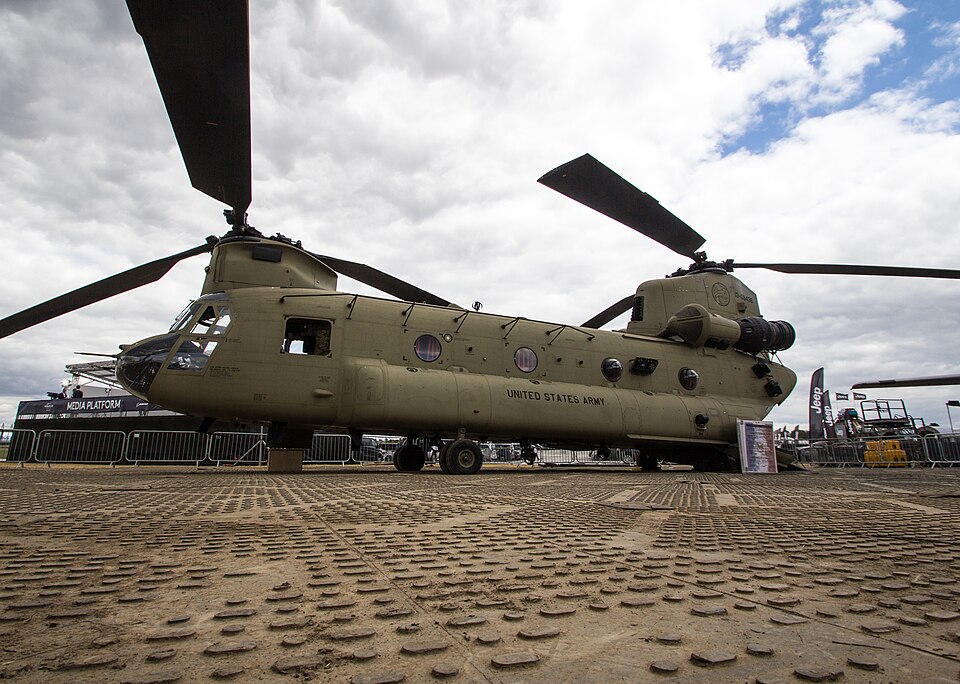
The CH-47 Chinook is one of the most recognizable helicopters ever built. Its distinctive tandem-rotor design — two large rotors, one at the front and one at the rear — makes it impossible to confuse with anything else in the sky.
First introduced in 1962, the Chinook has been upgraded repeatedly over the decades to remain one of the most capable heavy-lift helicopters in the world. It can carry a payload of roughly 25,000 pounds via sling load, transport a full platoon of soldiers internally, and move artillery pieces that would otherwise require ground transport.
- Top speed: Among the fastest in the Army's inventory, reaching speeds around 196 mph
- Lift capacity: Can sling-load approximately 25,000 pounds
- Powerplant: Honeywell T-55 turboshaft engines
- In service since: 1962
Good to Know: Despite being the largest helicopter in the U.S. Army, the Chinook is also among the fastest in the Army's fleet. Its twin-rotor design eliminates the need for a tail rotor, which frees up power for forward speed.
The Chinook is powered by the Honeywell T-55 engine, and the current variant uses a configuration that delivers significantly more power while also being more fuel-efficient than earlier versions. The counter-rotating rotors also make the helicopter less sensitive to changes in center of gravity — a very useful feature when you are carrying all kinds of different cargo loads.
The Chinook has served in Vietnam, the Falklands (with allied forces), the Gulf War, Afghanistan, and dozens of humanitarian missions around the world. The Army has no current plans to retire it.
3. Sikorsky UH-60 Black Hawk — The Military's True Workhorse
If any helicopter deserves the title of "workhorse of the U.S. military," it is the UH-60 Black Hawk. With thousands of units in service across the Army, Air Force, Navy, and even the Coast Guard, it is the most widely operated helicopter in the American military.
The Black Hawk is a medium-lift utility helicopter at its core. It can carry up to eleven fully equipped soldiers, transport roughly 9,000 pounds of cargo via sling load, or be configured for medevac, command and control, or light attack roles.
- Crew: Two pilots plus two crew chiefs
- Troop capacity: Up to 11 fully equipped soldiers
- External load: Approximately 9,000 pounds
- Top speed: Around 183 mph
Pro Tip: The Black Hawk's versatility is its greatest strength. The same airframe can be converted for troop transport, medical evacuation, electronic warfare, or even special operations missions — making it one of the most cost-effective investments in the entire fleet.
The Black Hawk gained worldwide recognition after the 1993 Battle of Mogadishu in Somalia — the event that inspired the film Black Hawk Down. It has since served in virtually every major U.S. military operation, and it continues to be upgraded and improved. According to Congressional Budget Office data, the Army operates roughly 2,100 H-60 Black Hawks, making it by far the largest single type in the Army fleet.
It is also worth noting that a modified stealth version of the Black Hawk is said to have been used in the operation that resulted in the death of Osama bin Laden in 2011 — making it one of the most consequential helicopter designs in modern history.
4. Sikorsky CH-53K King Stallion — The Most Powerful Helicopter in the DoD
The CH-53K King Stallion is officially described by the U.S. Navy as the most powerful helicopter in the Department of Defense. That is not a marketing claim — it is a technical fact backed by the aircraft's specifications.
Designed by Sikorsky for the U.S. Marine Corps, the King Stallion is built to move heavy equipment, vehicles, and supplies from ships to shore during amphibious assault operations. It can carry an external load of around 27,000 pounds at a mission radius of 110 nautical miles in high heat and high altitude conditions — nearly triple the baseline performance of its predecessor, the CH-53E Super Stallion.
- External lift capacity: Approximately 27,000 pounds at mission radius; maximum around 36,000 pounds
- Engines: Three General Electric T408 turboshaft engines, each producing approximately 7,500 shaft horsepower
- Cabin: 12 inches wider than the CH-53E, large enough to carry a Humvee internally
- Troop capacity: Up to 55 troops in high-density configuration
- In service: Deliveries to the Marine Corps began in 2018
Fun Fact: The CH-53K features a fully digital fly-by-wire flight control system with haptic feedback — technology borrowed from modern commercial aviation — that makes it significantly easier to fly than its predecessor.
The King Stallion is not just powerful; it is smart. Its modern avionics, composite rotor blades, and glass cockpit represent a generational leap beyond the helicopters it is replacing. The Marine Corps has a procurement objective of around 200 of these aircraft.
5. Bell AH-1Z Viper — The Marine Corps' Attack Backbone
While the Army relies on the Apache, the Marine Corps flies the AH-1Z Viper as its primary attack helicopter. The Viper traces its lineage all the way back to the AH-1 Cobra — which holds the distinction of being the world's first purpose-built attack helicopter when it entered service in the late 1960s.
The AH-1Z is a thoroughly modern aircraft, however. It shares approximately 84 percent of its parts with the UH-1Y Venom utility helicopter, which dramatically simplifies logistics and maintenance. It features a four-blade bearingless main rotor system, a powerful targeting system, and an impressive weapons loadout.
- Primary weapons: 20mm three-barrel cannon, AIM-9 Sidewinder air-to-air missiles, AGM-114 Hellfires, Hydra rocket pods
- Key feature: Target sight system with forward-looking infrared (FLIR) and TV sensors
- Rotor system: Four-blade bearingless composite rotor
- In service since: 2010
Good to Know: The AH-1Z Viper can engage both ground targets and air threats, thanks to its AIM-9 Sidewinder capability. Very few attack helicopters in the world can make that claim.
The Viper is optimized for the Marine Corps' specific needs — operations from amphibious ships, close air support for ground troops, and the ability to work in tight coordination with ground forces in complex environments.
6. Sikorsky MH-60R Seahawk — Ruler of the Seas
The MH-60R Seahawk is the U.S. Navy's primary combat helicopter and one of the most capable maritime rotary-wing aircraft in the world. Based on the same H-60 Black Hawk airframe, it is specially adapted for naval operations — smaller footprint for ship operations, folding rotor blades, and a sophisticated mission system designed for the ocean environment.
The Seahawk's primary missions include anti-submarine warfare, anti-surface warfare, search and rescue, and support for naval special operations. It carries an impressive package of sensors and weapons optimized for hunting submarines and surface threats.
- Primary weapons: Torpedoes (Mark 54), AGM-114 Hellfire missiles, rockets, crew-operated guns
- Key sensor: Active and passive sonar systems, plus dipping sonar
- Fleet size: The MH-60R makes up the vast majority of the Navy's non-training combat helicopter fleet
- In service since: 2005
Pro Tip: The MH-60R's integrated mission system processes sensor data from multiple sources simultaneously to build what the Navy describes as a complete situational picture of both the ocean surface and the sub-surface domain.
According to recent fleet data, the MH-60R accounts for close to 90 percent of the Navy's active non-training combat helicopter fleet. That makes it as dominant in naval aviation as the Black Hawk is in Army aviation.
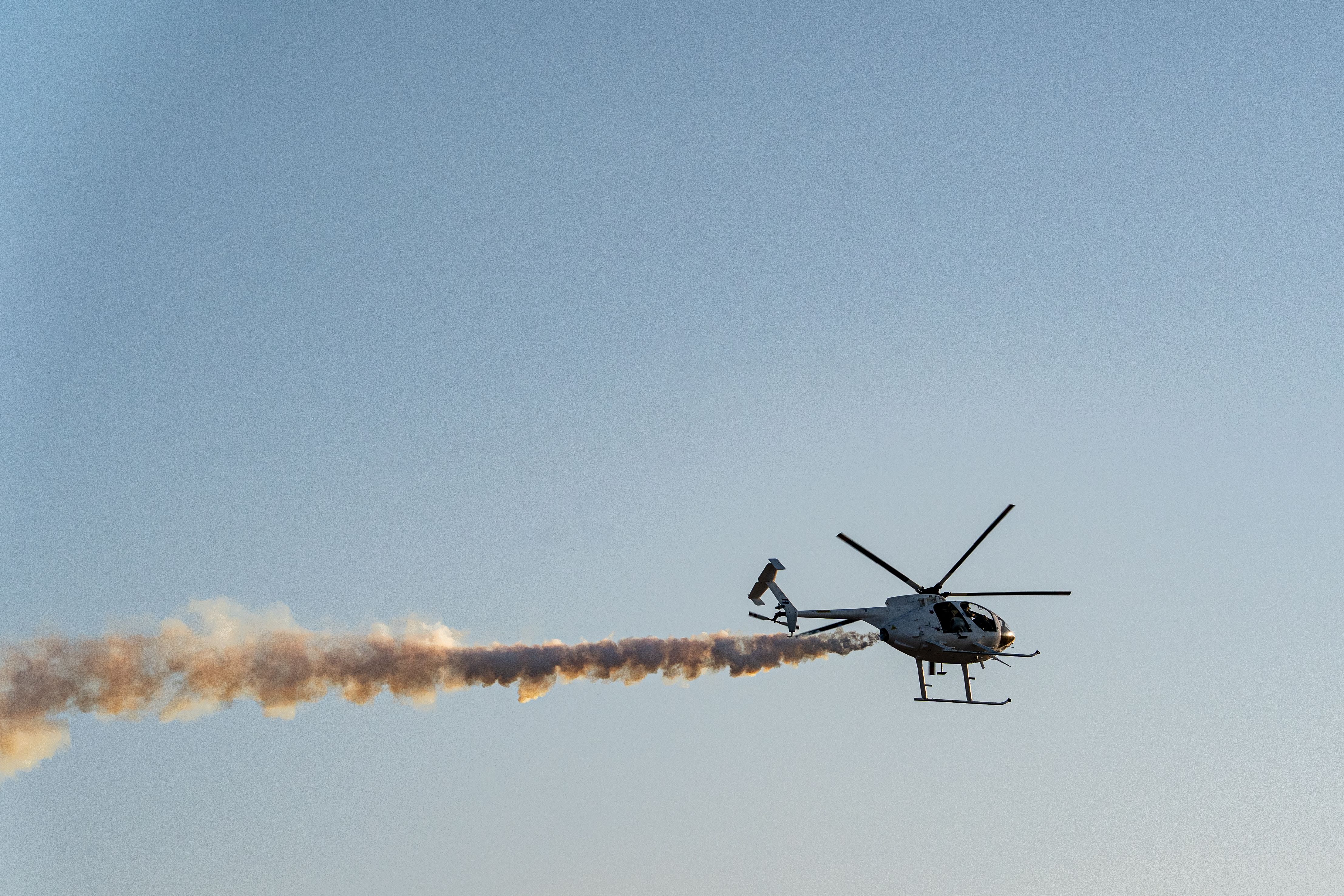
7. MD Helicopters MH-6 Little Bird — Small But Lethal
The MH-6 Little Bird is about as far from the King Stallion as you can get in terms of size. This small, nimble helicopter is the primary aircraft of the 160th Special Operations Aviation Regiment — the elite unit known simply as the "Night Stalkers."
Do not let its size fool you. The Little Bird and its attack variant, the AH-6, are precision instruments designed for some of the most demanding missions in the special operations playbook. They can insert a small team onto a rooftop, hover with remarkable precision in tight urban environments, and provide lethal close-air support when things go sideways.
- Role: Special operations insertion, extraction, and light attack
- Crew: One or two pilots, with passengers mounted on external bench seats
- Based on: The Hughes MD 369 airframe
- Operated by: 160th Special Operations Aviation Regiment (Night Stalkers)
Fun Fact: The Little Bird's attack variant (AH-6) can be configured with machine guns, rocket pods, and even Hellfire missiles on an airframe small enough to land on a city street or the roof of a building.
The Little Bird has been part of virtually every major special operations mission the U.S. military has conducted over the past several decades. Its combination of small size, precise handling, and lethal capability makes it one of a kind.
The 160th SOAR, which flies this helicopter, is known for its night operations and extreme precision. If you want to understand the full range of what unconventional military helicopters are capable of, the Little Bird is a perfect example.
If you want to go deeper on military aviation and rotorcraft technology, Flying411 covers everything from the physics of flight to the most remarkable helicopters ever designed — written in a way that actually makes sense.
8. Bell Boeing V-22 Osprey — The Hybrid That Changed Everything
The V-22 Osprey is not a traditional helicopter — it is a tiltrotor aircraft that takes off and lands like a helicopter but rotates its engines forward to fly like a turboprop plane in cruise flight. It is a remarkable engineering achievement and one of the most unique military aircraft in the world.
The Osprey is operated by the Marine Corps (MV-22B), Air Force (CV-22B), and Navy (CMV-22B). Each variant is optimized for slightly different missions, but all of them share the fundamental advantage of combining helicopter-like versatility with airplane-like speed and range.
- Cruise speed: Approximately 280 mph — far faster than any traditional helicopter
- Range: Significantly greater than comparable utility helicopters
- Troop capacity: Up to 24 combat-equipped troops
- Primary missions: Assault transport, special operations support, carrier logistics
Keep in Mind: The Osprey is not without its critics. It has faced scrutiny over its accident record, and its maintenance demands are higher than a conventional helicopter. But its combination of speed, range, and vertical lift capability remains unmatched.
The Osprey has served in Iraq, Afghanistan, and special operations missions around the world. Its ability to self-deploy over long distances without refueling, combined with its vertical landing capability, gives commanders a flexibility that traditional helicopters simply cannot match.
9. Bell UH-1Y Venom — The Huey's Modern Heir
The UH-1Y Venom is the Marine Corps' utility helicopter and a direct descendant of the legendary UH-1 Huey — arguably the most iconic helicopter in American military history. The Venom takes that famous lineage and brings it thoroughly into the 21st century.
The Venom shares the same 84 percent parts commonality with the AH-1Z Viper attack helicopter, which makes the Marine Corps' light attack and utility helicopter fleet unusually efficient to maintain and support in the field. It features modern glass cockpit avionics, improved engines, and a four-blade composite rotor system.
- Crew: Two pilots plus one or two crew chiefs
- Roles: Troop transport, command and control, close air support
- Key feature: High parts commonality with the AH-1Z Viper
- In service since: 2008 (with the Marine Corps)
Good to Know: The UH-1Y can be armed with .50-caliber machine guns, 70mm rockets, and even the Hellfire missile system, giving it a meaningful light attack capability in addition to its utility roles.
The Venom may not grab headlines the way the Apache or King Stallion do, but in the Marine Corps ecosystem it plays a critical role — flexible, maintainable, and capable across a wide range of missions.
How These Helicopters Compare: Quick Reference Table
| Helicopter | Branch | Primary Role | Max Lift Capacity | Notable Armament |
| AH-64 Apache | Army | Attack | N/A | Hellfire, 30mm cannon |
| CH-47 Chinook | Army | Heavy lift | ~25,000 lbs sling | Machine guns |
| UH-60 Black Hawk | Army/Air Force/Navy | Utility/transport | ~9,000 lbs sling | Varies by variant |
| CH-53K King Stallion | Marine Corps | Heavy lift | ~27,000 lbs at radius | N/A (transport) |
| AH-1Z Viper | Marine Corps | Attack | N/A | 20mm cannon, Hellfire, AIM-9 |
| MH-60R Seahawk | Navy | Maritime operations | Varies | Torpedoes, Hellfire |
| MH-6 Little Bird | Army (160th SOAR) | Special ops | Small team | Machine guns, rockets |
| V-22 Osprey | Marine Corps/Air Force/Navy | Transport/special ops | ~15,000 lbs | Machine guns (CV-22) |
| UH-1Y Venom | Marine Corps | Utility | Troop transport | .50-cal, rockets, Hellfire |
What Makes a Military Helicopter "Strong"?
When people talk about the strongest U.S. military helicopters, they usually mean a combination of several different qualities. Raw lift capacity is one measure — the CH-53K wins that contest easily. Firepower is another — the Apache is in a class of its own for attack helicopters.
But military strength in a helicopter also means:
- Survivability — Can it keep flying after taking hits? Systems like the Apache's redundant hydraulics and the Black Hawk's crash-resistant fuel system matter enormously.
- Mission flexibility — A helicopter that can do multiple jobs is worth more than a specialist with narrow capability.
- Availability — A helicopter that spends more time on maintenance than in the air is not helping anyone. Reliability matters as much as performance.
- Range and endurance — How far can it go, and how long can it stay in the fight?
Heads Up: "Strongest" in a military context rarely means just one thing. The CH-47 Chinook is the strongest lifter in the Army. The Apache is the strongest in pure attack capability. The Black Hawk is arguably the strongest in overall impact because of its sheer numbers and versatility.
Understanding these tradeoffs is part of what makes military aviation so fascinating. To understand the full spectrum of helicopter design — including some of the most creative and unconventional approaches engineers have ever tried — this look at the weirdest helicopters ever built is a great place to start.
The Evolution of Military Helicopter Design
Military helicopters have come a long way since the first experimental rotorcraft appeared on the battlefield in the mid-20th century. The early machines were fragile, underpowered, and limited in what they could carry or where they could operate.
Today's aircraft are the result of decades of iterative improvement. Composite rotor blades are lighter and more efficient than metal blades. Turboshaft engines deliver far more power for their weight than earlier designs. Digital avionics systems that once filled entire rooms now fit into cockpit displays the size of a laptop screen.
Key Advances That Made Modern Military Helicopters So Capable
Several technologies have been especially important in shaping the helicopters we see today:
- Fly-by-wire controls — Electronic control systems replace mechanical linkages, improving precision and reducing pilot workload. The CH-53K King Stallion uses this technology extensively.
- Composite materials — Lighter and stronger than metal, composites are now used in rotor blades, fuselage panels, and airframe components across virtually every modern military helicopter.
- Advanced sensors and targeting systems — Night vision, forward-looking infrared (FLIR), and millimeter-wave radar give modern helicopters the ability to fight effectively in complete darkness.
- Redundant systems — Critical hydraulics, electronics, and powertrains are often duplicated so that the aircraft can survive damage that would have downed an older helicopter.
Fun Fact: The AH-64 Apache was designed with the philosophy that it should be able to take a hit from a 23mm round and still complete its mission and return safely. That level of battlefield survivability was a significant engineering challenge.
These advances explain why helicopters introduced decades ago — like the Chinook and the Black Hawk — are still flying today after extensive upgrades. The airframe concept may be old, but the capabilities inside have been continuously refreshed.
Ready to learn more about the aircraft that shape modern aviation? Flying411 is your go-to destination for clear, honest, and fascinating coverage of the aviation world — from military marvels to general aviation basics.
Conclusion
The strongest U.S. military helicopters represent some of the most impressive engineering achievements in aviation history. From the Apache's precision firepower to the King Stallion's brute lifting force, from the Black Hawk's unmatched versatility to the Little Bird's special operations precision, each helicopter on this list fills a role that no other aircraft can replicate.
What is remarkable is that many of these aircraft have been serving for decades — and with continuous upgrades and improvements, they show no signs of becoming obsolete. The technology inside them keeps getting better, and the crews who fly them keep finding new ways to apply that technology in the field.
If this look at the strongest U.S. military helicopters got you curious about what else is possible in the world of rotary-wing aviation, there is plenty more to explore.
For more fascinating coverage of military aircraft, aviation history, and the science of flight, visit Flying411 — where the world of aviation is always worth looking up.
Frequently Asked Questions
What is considered the strongest helicopter in the U.S. military?
The CH-53K King Stallion is officially described by the U.S. Navy as the most powerful helicopter in the Department of Defense, based on its lifting capacity and engine output. It is operated by the U.S. Marine Corps.
What is the most heavily armed helicopter in the U.S. military?
The AH-64 Apache is widely regarded as the most capable dedicated attack helicopter in the U.S. fleet, armed with a 30mm chain gun, Hellfire anti-tank missiles, and Hydra rocket pods.
How many helicopters does the U.S. Army operate?
According to Congressional Budget Office data from 2023, the U.S. Army operates roughly 3,900 manned aircraft, the large majority of which are helicopters. The H-60 Black Hawk family makes up the largest single component of that fleet.
What is the difference between the CH-53E Super Stallion and the CH-53K King Stallion?
The CH-53K is a significant redesign of the CH-53E rather than a simple upgrade. It features new engines, a wider cargo cabin, composite rotor blades, and a digital fly-by-wire flight control system. Its lift capacity is said to be nearly triple the baseline performance of the CH-53E.
What is the 160th Special Operations Aviation Regiment?
The 160th SOAR, nicknamed the Night Stalkers, is a U.S. Army special operations unit that provides helicopter aviation support for special operations forces. It is known for night operations and extreme precision, and it operates aircraft including the MH-6 Little Bird, MH-60 Black Hawk variants, and MH-47 Chinook variants.
Is the V-22 Osprey actually a helicopter?
Technically, the V-22 Osprey is classified as a tiltrotor aircraft rather than a helicopter. It takes off and lands vertically like a helicopter but rotates its engines to fly horizontally like a turboprop aircraft. This hybrid design gives it a speed and range advantage that no conventional helicopter can match.
What branch of the U.S. military uses the most helicopters?
The U.S. Army operates the largest and most diverse helicopter fleet of any military branch, relying entirely on helicopters for rotary-wing combat, reconnaissance, transport, and logistics. Unlike the other branches, the Army does not operate traditional fighter jets