From the jungles of Vietnam to the rooftop of the White House, helicopters have written some of the most gripping chapters in aviation history. They pull people off cliff faces, deliver presidents to their destinations, and storm fortified compounds in the dead of night. No other flying machine does what they do.
But not every helicopter earns a place in the history books. Some stand out because of their combat record. Others because of their sheer power, their cultural footprint, or the sheer number of lives they saved. A handful managed to do all of the above.
These are the most famous helicopters in the world — the ones that changed warfare, reshaped aviation, and became icons that almost anyone can recognize on sight.
Key Takeaways
The most famous helicopters in the world earned their reputations through a mix of combat history, lifesaving service, cultural impact, and engineering breakthroughs. The Bell UH-1 Iroquois "Huey" is widely considered the most iconic helicopter ever built, largely because of its central role in the Vietnam War. Other legends include the Sikorsky UH-60 Black Hawk, the AH-64 Apache, the Boeing CH-47 Chinook, the Bell 47, the Mil Mi-24 Hind, and the Sikorsky VS-300 — the helicopter that started it all.
| Helicopter | Known For | First Flight |
| Bell UH-1 Iroquois "Huey" | Vietnam War icon, medevac | 1956 |
| Sikorsky UH-60 Black Hawk | U.S. Army workhorse, "Marine One" variant | 1974 |
| AH-64 Apache | Premier attack helicopter, global service | 1975 |
| Boeing CH-47 Chinook | Heavy-lift tandem rotor transport | 1961 |
| Bell 47 | First civilian-certified helicopter, M*A*S*H star | 1945 |
| Mil Mi-24 Hind | Soviet gunship/transport hybrid | 1969 |
| Sikorsky VS-300 | The world's first practical helicopter | 1939 |
Flying411 is a hub for aviation enthusiasts and professionals alike — a great place to explore aircraft history, helicopter physics, and everything the world of flight has to offer.
A Look at How Helicopters Got Here
Before getting into the legends, it helps to understand how helicopters came to exist at all. The dream of vertical flight goes back centuries. Leonardo da Vinci sketched a spiraling aerial screw in the 15th century, but it never left the page. Engineering had to catch up with imagination.
That catch-up moment finally arrived in the early 20th century. On September 14, 1939, Russian-American designer Igor Sikorsky lifted the VS-300 off the ground outside Stratford, Connecticut, and changed aviation forever. From that point on, the development of the helicopter moved fast.
Fun Fact: Igor Sikorsky is often called the "father of the helicopter," but he freely acknowledged the work of earlier pioneers. His VS-300 was not the first rotorcraft to leave the ground — but it was the first to prove the concept in a practical, controllable way.
The military recognized the potential almost immediately. Helicopters arrived too late for World War II to make a large-scale impact, but by the Korean War in the early 1950s, they were already changing the nature of battlefield medicine. By Vietnam, they had become central to how wars were fought.
If you want to understand the physics behind how these machines actually get off the ground, the science of helicopter flight is a fascinating read.
The 7 Most Famous Helicopters in the World
Each helicopter below earned its place through a combination of service, innovation, and staying power. Some changed warfare. Some saved lives. Some did both. Together, they represent the high-water marks of what rotary-wing aviation has achieved.
1. Bell UH-1 Iroquois — "The Huey"
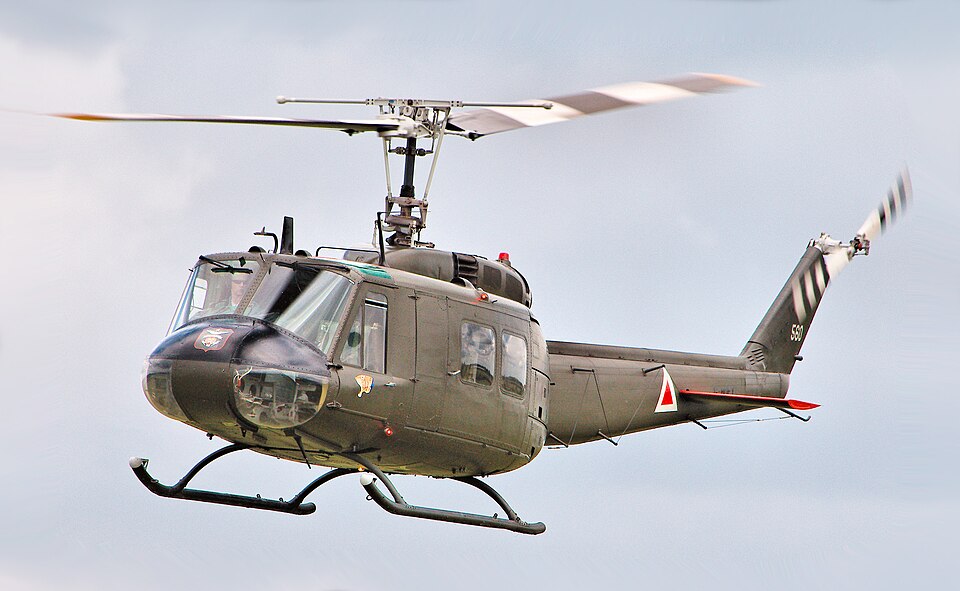
Ask almost anyone to picture a helicopter from the Vietnam War, and they will picture a Huey. That distinctive "whoop-whoop" sound — the result of its two-blade rotor system — is one of the most recognizable sounds in all of aviation history.
The Bell UH-1 Iroquois first flew in 1956 and entered U.S. Army service in 1959. Its nickname, "Huey," came from its early military designation, HU-1, before the Army officially redesignated it the UH-1. The name stuck, and it suited the aircraft perfectly — straightforward, tough, and hard to forget.
Why it became legendary:
- It was the first turbine-powered helicopter to enter U.S. military service
- It served in troop transport, medical evacuation, close air support, and cargo roles — all in one airframe
- Roughly 16,000 military and civilian variants are estimated to have been produced
- It saw combat in Vietnam, and its image became permanently linked to that war through photographs, film, and news coverage
- The civilian Bell 204 and 205 variants found work in law enforcement, firefighting, news coverage, and agriculture
The Huey is not just famous in America. Versions of the family have served in armed forces and civilian agencies across the globe for decades. The family is still in production today in updated forms. Few aircraft of any kind can claim that kind of staying power.
Pro Tip: If you want to understand just how many roles a single helicopter can fill, the Huey is the best example. It essentially proved that one well-designed rotorcraft could replace a whole fleet of single-purpose aircraft.
2. Sikorsky UH-60 Black Hawk
The Black Hawk entered U.S. Army service in 1979, designed partly to replace the aging Huey in the assault transport role. It did that job so well that it went on to become one of the most widely used military helicopters in the world.
Named after Black Hawk, a warrior of the Sauk American Indian tribe, the UH-60 is a four-blade, twin-engine, medium-lift utility helicopter. Since entering service, it has been used for troop transport, medical evacuation, search and rescue, special operations, and electronic warfare — among many other missions.
A few things that made it famous:
- The 2001 film Black Hawk Down brought the helicopter's name to a global audience
- The UH-60 was used in the 2011 U.S. Navy SEAL raid that resulted in the death of Osama bin Laden
- The VH-60N "White Hawk" variant serves as Marine One — the helicopter that transports the President of the United States
- More than 4,000 units have been produced, serving dozens of countries worldwide
- It has received continuous upgrades since entering service, with current variants significantly more capable than the original
Good to Know: The Black Hawk's name comes from a real historical figure, not a brand or nickname. Black Hawk was a warrior and leader of the Sauk people who fought against American expansion in the early 19th century. The U.S. Army has a long tradition of naming helicopters after Native American tribes and figures.
The Black Hawk is arguably the most recognized military helicopter in the world today, both for its operational record and its cultural footprint.
3. AH-64 Apache
The AH-64 Apache is what happens when you design a helicopter specifically to destroy things. It is one of the most advanced and feared attack helicopters ever built, and it has been the backbone of U.S. Army attack aviation for decades.
First flown in 1975, the Apache entered service in 1984. It was designed to survive and fight in bad weather, at night, and in contested airspace. Its systems reflected that ambition from the start.
What sets the Apache apart:
- Equipped with a 30 mm M230 Chain Gun under the nose
- Can carry a combination of Hellfire missiles, Hydra rockets, and Stinger air-to-air missiles
- Features an advanced target acquisition and night-vision system
- Has seen combat in Panama, the Gulf War, Iraq, Afghanistan, and other conflicts
- Serves in the armed forces of more than a dozen countries, including the United Kingdom, Israel, Japan, and the Netherlands
- Boeing has reported the Apache accumulating well over four million flight hours across its service life
Why It Matters: The Apache's night-vision and targeting systems were genuinely revolutionary when introduced. They allowed crews to operate effectively in conditions that would ground most other aircraft. That capability reshaped how armies thought about attack aviation.
The Apache is a regular crowd-pleaser at airshows, often performing demonstrations that include live ordnance. Videos of those performances have been watched many millions of times online, keeping the Apache firmly in the public eye. It remains one of the most feared helicopters in the world.
4. Boeing CH-47 Chinook
The Chinook has one of the most recognizable silhouettes in aviation. Its tandem rotor design — two large rotors spinning in opposite directions, one at each end of the fuselage — is unlike anything else in the sky. There is no mistaking it.
First flown in 1961, the CH-47 Chinook entered U.S. Army service in 1962. Its design placed two large rotors fore and aft instead of the main rotor plus tail rotor arrangement used by most helicopters. This eliminated the need for a tail rotor entirely, freeing up power and allowing the Chinook to carry much heavier loads.
Key facts about the Chinook:
- Can carry up to roughly 55 military personnel or several tons of cargo
- One of the faster military helicopters, capable of reaching speeds close to 200 mph
- Has served in Vietnam, the Falklands War, Iraq, Afghanistan, and many humanitarian operations
- Can carry underslung cargo loads using hooks beneath the fuselage, making it invaluable for construction and disaster relief
- The civilian version has been used for logging, firefighting, and heavy construction in remote areas
- The latest CH-47F variant features a digital flight control system and significantly upgraded avionics
Fun Fact: The Chinook's dual rotors cancel out each other's torque, which is why it has no tail rotor. Each rotor spins in the opposite direction to the other, creating a stable, balanced aircraft. It is one of those elegant engineering solutions that looks unusual but works beautifully.
The CH in the Chinook's designation stands for "Cargo Helicopter," which tells you everything you need to know about its primary purpose. It is the big truck of the helicopter world, and it has been doing heavy lifting for militaries and civilians alike for more than six decades.
5. Bell 47
The Bell 47 might not look like much next to a Black Hawk or an Apache. Its bubble cockpit, exposed steel-tube tail boom, and bare-bones construction give it the appearance of something assembled from leftover parts. But this modest-looking machine changed everything.
On March 8, 1946, the Bell 47 became the first helicopter certified for civilian use by what would become the FAA. That certification was a turning point. It opened the door to every civilian helicopter that followed.
The firsts that made the Bell 47 a legend:
- First helicopter certified for civilian use
- First helicopter to carry a U.S. president
- First to land on the White House lawn
- First to become a television news helicopter, when KTLA in Los Angeles used one dubbed the "Telecopter" in 1958
- Used by NASA to train Apollo astronauts for lunar lander approaches
- Served in the Korean War as the H-13 Sioux, performing critical medevac missions that saved countless lives
- Featured in the opening credits of the long-running television show M*A*S*H, making it one of the most recognized helicopter silhouettes in TV history
More than 5,600 were produced over a production run that lasted until 1974. Even today, restored Bell 47s appear at airshows and in private collections. There is also one hanging from the ceiling at the Museum of Modern Art in New York City — a fitting tribute to an aircraft that shaped an entire industry.
Keep in Mind: The Bell 47's bubble canopy and open-frame design were not just stylistic choices — they were practical engineering decisions that reduced weight and gave the pilot an excellent field of view. Many of those design principles are still visible in small helicopters built today.
6. Mil Mi-24 Hind
The Mil Mi-24 Hind is unlike anything else on this list. Most military helicopters are built to do one job well — either transport troops or attack targets. The Hind does both at the same time, and it does them well.
Developed in the Soviet Union, the Hind first flew in 1969 and entered service in 1972. Its design combined a heavily armored attack airframe with a troop compartment capable of carrying around eight soldiers. The Soviets essentially created a flying infantry fighting vehicle.
What made the Hind infamous:
- Saw extensive combat during the Soviet-Afghan War in the 1980s, where it became a defining symbol of that conflict
- Has served in conflicts across Africa, the Middle East, and Central Asia
- Armed with a nose-mounted cannon, rocket pods, and anti-tank missiles depending on the variant
- Its swept stub wings give it a distinctively menacing, almost predatory appearance
- Used by dozens of countries and remains in service with many armed forces today
- Often called a "flying fortress" for its combination of firepower, armor, and troop-carrying capacity
Heads Up: The Hind's dual role as both a gunship and a troop transport was a deliberate Soviet design philosophy. The idea was that it could suppress enemy positions with its weapons, then land nearby and deploy soldiers — all without needing another aircraft. It was an ambitious concept, and it worked.
The Hind has appeared in countless films, video games, and news broadcasts over the decades. Its distinctive silhouette has made it one of the most recognized Soviet-era military aircraft in popular culture. For fans of unusual military aircraft, it sits in a class of its own among strange military helicopters.
7. Sikorsky VS-300
Every helicopter on this list exists because of this one. The Sikorsky VS-300 was the machine that proved the modern helicopter concept was viable — and it did so in 1939, when vertical flight was still considered by many to be a fantasy.
Igor Sikorsky had been fascinated by helicopters since his youth in Russia. He made early attempts at building one before World War I, but the technology was not yet ready. He emigrated to the United States, built a successful fixed-wing aircraft business, and then returned to his original dream.
On September 14, 1939, the VS-300 made its first flight outside Stratford, Connecticut, piloted by Sikorsky himself. It was tethered to the ground for safety, but it flew. By 1941, Sikorsky had refined the design into a controllable, practical aircraft.
Why the VS-300 belongs on this list:
- Established the single main rotor plus tail rotor configuration that became the standard for most helicopters worldwide
- Directly led to the Sikorsky R-4, the first mass-produced helicopter in history, used by Allied forces in World War II
- Proved that a helicopter could be controlled reliably enough to be operationally useful
- Set the template that shaped nearly every helicopter built in the decades that followed
- Sikorsky flew the VS-300 himself for much of its test program, often wearing a suit and tie for public demonstrations
Good to Know: The VS-300 was not a sleek, finished aircraft. It went through many configurations during its development, with engineers experimenting with different tail rotor arrangements before settling on the design that worked. The process was messy and dangerous — but the result changed the world.
The VS-300 is preserved at the Henry Ford Museum in Dearborn, Michigan, where it remains a monument to one of aviation's most important breakthroughs. If the VS-300 had never flown, none of the helicopters on this list would exist.
Flying411 covers everything from helicopter history to the safest helicopters ever built — a great resource if you want to keep exploring rotary-wing aviation.
What These Helicopters Have in Common
Looking at these seven aircraft together, a few patterns stand out.
Innovation drives fame. Each helicopter on this list did something no helicopter had done before — or did something known helicopters could do, but better than anyone thought possible. The Bell 47 opened civilian aviation. The VS-300 made it all possible. The Apache redefined attack aviation.
Culture amplifies history. The Huey became synonymous with Vietnam partly because of the news footage that came out of that war. The Black Hawk became a household name because of a film. The Bell 47 became iconic because of a television series. History made these helicopters important, but culture made them famous.
Longevity matters. Every helicopter on this list served for decades, many of them in updated forms that are still in use. That staying power reflects engineering quality and adaptability. A helicopter that keeps earning its place through upgrades and new roles is one that becomes embedded in the culture.
Pro Tip: If you want to go deeper on helicopter design oddities and engineering experiments that never made the mainstream, the world of weird helicopters is full of fascinating machines that pushed boundaries in unexpected directions.
Military vs. Civilian Fame: A Quick Comparison
Most of the helicopters on this list earned their reputation through military service. But the line between military and civilian fame is often blurry.
| Helicopter | Primary Role | Civilian Impact |
| Bell UH-1 Huey | Military transport/medevac | Police, firefighting, news, agriculture |
| UH-60 Black Hawk | Military assault/utility | "Marine One," search and rescue |
| AH-64 Apache | Attack | Airshow performances, popular media |
| CH-47 Chinook | Heavy lift | Logging, firefighting, construction |
| Bell 47 | Military medevac / civilian utility | First civilian helicopter, TV star |
| Mil Mi-24 Hind | Attack/transport | Films, video games, global conflicts |
| Sikorsky VS-300 | Experimental prototype | Foundation of all modern helicopters |
Being famous in military circles and being famous in popular culture are two different things. The helicopters on this list managed to achieve both.
Ready to learn more about aviation history, helicopter design, and the world of flight? Flying411 has you covered with articles, guides, and resources for curious aviation minds at every level.
Conclusion
The most famous helicopters in the world did not earn their reputations by accident. They earned them by doing something remarkable — saving lives, changing warfare, carrying presidents, or simply being the first to prove that an idea worked. From the humble Bell 47 bubble cockpit to the armored Hind storming across Afghan mountains, each of these machines left a mark that time has not erased.
Helicopters are extraordinary machines. They hover, they land where planes cannot, and they go places that nothing else can reach. The legends on this list represent the best of what rotary-wing aviation has achieved. And there are surely more legends still to come.
If you want to keep exploring the world of helicopters and aviation history, Flying411 is the place to start.
FAQs
What is the most famous helicopter of all time?
The Bell UH-1 Iroquois, known as the "Huey," is widely considered the most famous helicopter ever built. Its central role in the Vietnam War, combined with its massive production numbers and continued service, gave it an iconic status that no other helicopter has fully matched.
What helicopter is used as Marine One?
The VH-60N "White Hawk" — a specialized variant of the Sikorsky UH-60 Black Hawk — is one of the helicopters that serves in the Marine One role, transporting the President of the United States when a helicopter is required.
Is the Mil Mi-24 Hind still in service?
Yes. The Mil Mi-24 Hind and its variants remain in active service with a number of armed forces around the world. It is one of the longest-serving military helicopters still in operational use.
What was the first helicopter ever made?
The Sikorsky VS-300, which first flew on September 14, 1939, is generally considered the first successful, practical helicopter to use the main rotor plus tail rotor configuration that became the standard design. Earlier rotorcraft existed, but the VS-300 established the blueprint that most helicopters still follow.
What makes the CH-47 Chinook different from other helicopters?
The Chinook uses a tandem rotor design, with two large rotors — one at the front and one at the rear — spinning in opposite directions. This eliminates the need for a tail rotor and allows the aircraft to carry very heavy loads. It is one of the most recognizable and capable heavy-lift helicopters ever built.