Most people think of helicopters as the aircraft that buzzes over traffic or lands on hospital rooftops. But a handful of these machines operate in a completely different league. They are built to carry tanks, artillery pieces, locomotives, and even other helicopters. These are the heavy-lift giants of the sky — and they are extraordinary pieces of engineering.
The idea of a helicopter lifting a tank sounds almost impossible. After all, modern main battle tanks like the M1 Abrams tip the scales at around 60 to 70 tons, which is far beyond what any rotorcraft can manage. But "a tank" does not always mean the heaviest one in the fleet. Light tanks, armored reconnaissance vehicles, and older battlefield armor can weigh anywhere from roughly 8 to 20 tons — and that is exactly where some of the world's most powerful helicopters enter the picture.
This guide walks through nine helicopters that can carry a tank or tank-class load, breaking down how they do it, what they have lifted in the real world, and why these flying workhorses continue to matter on and off the battlefield.
Key Takeaways
Helicopters that can carry a tank are specialized heavy-lift aircraft with payload capacities generally starting around 15,000 pounds and going far beyond 40,000 pounds for the most powerful machines. The Mil Mi-26 Halo is the largest and most capable production helicopter ever built, with a payload of up to around 20 metric tons. The CH-53K King Stallion leads the Western world in raw lift power, and the CH-47 Chinook remains the workhorse of tank-class transport for armies worldwide. In practice, these helicopters are most commonly used to lift light tanks, armored personnel carriers, and heavy artillery rather than full-sized main battle tanks, which typically exceed even the best heavy-lift helicopter's capacity.
| Helicopter | Country | Max External Payload | Notable Lift |
| Mil Mi-26 Halo | Russia | ~20 metric tons (44,000 lb) | Light tanks, APCs, other helicopters |
| Sikorsky CH-53K King Stallion | USA | ~16,329 kg (36,000 lb) | HMMWVs, armored vehicles |
| Sikorsky CH-53E Super Stallion | USA | ~16,329 kg (36,000 lb) | M551 Sheridan, artillery |
| Boeing CH-47 Chinook | USA / global | ~11,800 kg (26,000 lb) | M551 Sheridan, artillery |
| Sikorsky CH-54 Tarhe (Skycrane) | USA | ~9,000 kg (20,000 lb) | M551 Sheridan, bulldozers |
| Mil Mi-6 Hook | Soviet Union | ~12 metric tons (26,000 lb) | Armored vehicles, artillery |
| Mil Mi-12 Homer | Soviet Union | ~44 metric tons (record) | Prototype; record payload lifts |
| Kamov Ka-27 (heavy variants) | Russia | ~5 metric tons | Light armored vehicles |
| Boeing Vertol XCH-62 | USA (prototype) | ~22.7 metric tons (planned) | Never entered production |
Flying411 is a resource for aviation enthusiasts, from helicopter history to the latest in aircraft technology. If you love learning about incredible flying machines, you are in the right place.
Why Lifting a Tank by Helicopter Is So Difficult
Before getting to the machines themselves, it helps to understand what makes this kind of lift so demanding.
Density altitude is one of the biggest obstacles. The higher you go and the hotter the air, the less lift a rotor generates. A helicopter that can hoist 20 tons at sea level on a cool day might only manage 14 tons in the hot, high-altitude conditions common in mountain warfare zones. This is why published payload figures are best thought of as ceilings, not everyday operating numbers.
Weight class matters enormously. Tanks are generally grouped into three broad categories:
- Light tanks (roughly 8 to 20 metric tons): These are within reach of top-tier heavy-lift helicopters in some configurations.
- Medium tanks (roughly 20 to 40 metric tons): These are well beyond current single-helicopter capability.
- Main battle tanks (roughly 55 to 70 metric tons): Completely out of range for any helicopter.
The M551 Sheridan, for example, weighed around 15 metric tons — light enough to be slung beneath a CH-54 Tarhe. The M1 Abrams, at around 60 to 70 metric tons fully loaded, can only be moved by heavy transport aircraft.
Good to Know: The Mi-26 Halo is often cited as holding the world record for the greatest mass lifted by a helicopter to altitude, at a verified lift of over 56,000 kilograms during a 1982 record attempt — according to FAI records. That record stood as of the mid-2020s.
A Brief History of Heavy-Lift Helicopter Development
The push for helicopters that can carry a tank grew out of post-World War II military thinking. Planners recognized that fixed-wing transport aircraft needed runways. Battlefields rarely had them. A helicopter that could carry heavy equipment directly to a forward position — no airstrip needed — was a game-changing tactical asset.
The Soviet Union and the United States both raced to develop heavy-lift rotorcraft through the 1950s and 1960s. The Soviets produced the Mi-6, which held the title of the world's largest production helicopter for years. The Americans responded with the CH-54 Tarhe and later the CH-53 family. Both sides pushed lift capacity upward with each generation, eventually leading to the machines on this list.
For a deeper look into the broader story of rotating-wing aircraft, the history of helicopters covers the full arc from early experiments to the modern era.
Fun Fact: The Soviet Mil V-12 Homer, a prototype from the late 1960s, lifted more than 44 metric tons in testing — a record that has never been officially broken by any production helicopter. The aircraft had a side-by-side rotor arrangement unlike anything before or since.
9 Helicopters That Can Carry a Tank
Not every helicopter on this list has lifted a tank in active combat — but each one has the payload capacity, documented history, or engineering capability to do so under the right conditions.
Some are active military workhorses still flying missions today. Others are retired legends or ambitious prototypes that never made it to the flight line.
Together, they represent the full range of rotorcraft that have pushed — or come closest to pushing — the upper limits of what a helicopter can carry.
Mil Mi-26 Halo
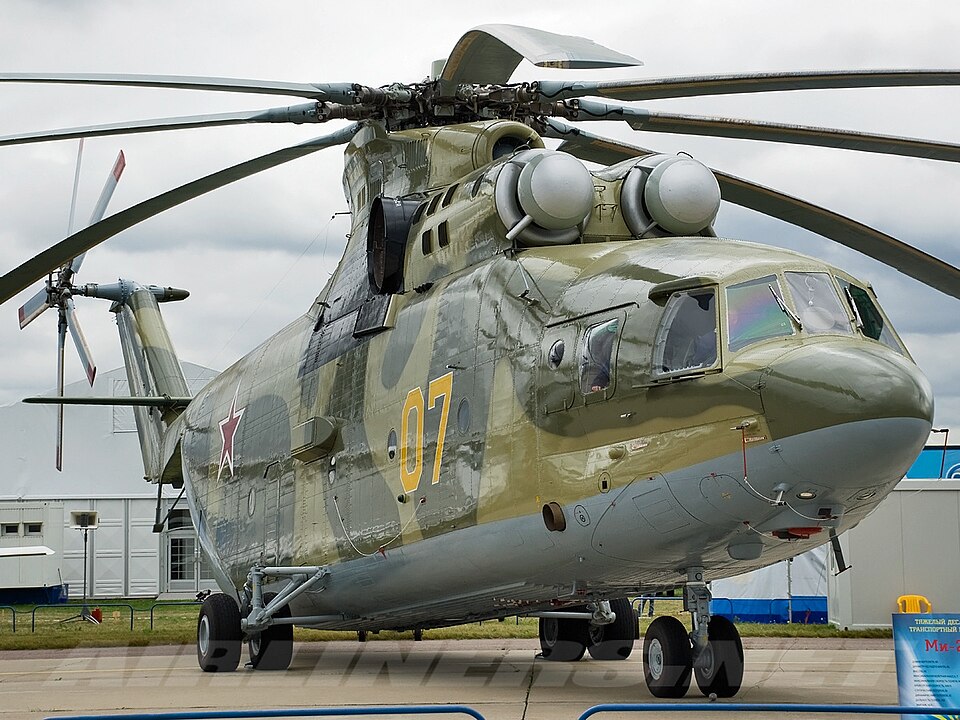
The Mi-26 is the gold standard. Developed by the Mil Moscow Helicopter Plant, this twin-engine giant entered Soviet military service around 1983 and remains in production today. It is widely regarded as the largest and most powerful production helicopter in the world.
Its payload of up to around 20 metric tons (approximately 44,000 pounds) allows it to carry amphibious armored personnel carriers, light armored vehicles, and other heavy equipment that no other production rotorcraft can match. The cargo cabin is comparable in size to that of a C-130 Hercules transport aircraft.
Real-world proof: In 2002, a civilian Mi-26 was leased to lift a damaged U.S. Army MH-47E Chinook helicopter out of a mountain in Afghanistan. The Chinook, with fuel, rotors, and non-essential equipment removed, was estimated to weigh around 12 metric tons — a load that exceeded the maximum payload of the CH-53E at that altitude.
Key specs:
- Max external payload: ~20,000 kg (44,000 lb)
- Engines: Two Lotarev D-136 turboshafts
- Rotor diameter: 32 meters (105 ft)
- Crew: 5
Why It Matters: The Mi-26 is the only production helicopter that can meaningfully approach the weight class of light tanks. Its combination of raw power, massive rotor, and large cargo bay makes it an irreplaceable asset for armies that need to move heavy armor without a runway.
Sikorsky CH-53K King Stallion
The CH-53K King Stallion is the most powerful helicopter in the United States military. Built by Sikorsky (a Lockheed Martin company), it entered service with the U.S. Marine Corps in the early 2020s as a replacement for the CH-53E Super Stallion.
Its three General Electric T408 engines — each producing around 7,500 shaft horsepower — give it a maximum external lift capacity of approximately 36,000 pounds (around 16,329 kilograms). That is roughly triple the baseline lift capacity of the CH-53E it replaced. It can carry two up-armored HMMWVs or a Light Armored Vehicle variant under demanding high/hot conditions.
The CH-53K also features fly-by-wire flight controls, a wider cargo bay (30 centimeters wider than the CH-53E), and a glass cockpit that significantly reduces pilot workload. It is the only heavy-lift helicopter in the Department of Defense fleet that can hold a precision hover in 40-knot wind gusts, according to program documentation.
Key specs:
- Max external payload: ~16,329 kg (36,000 lb)
- Engines: Three GE T408-GE-400 turboshafts
- Max gross weight: ~39,916 kg (88,000 lb)
- Crew: 2 pilots + up to 3 aircrewmen
Pro Tip: If you want to understand where the CH-53K fits among other strong U.S. military helicopters, a side-by-side comparison of the full heavy-lift lineup is worth a look.
Sikorsky CH-53E Super Stallion
The CH-53E Super Stallion preceded the King Stallion and remained the workhorse of U.S. Marine Corps heavy lift for decades. With three engines and a seven-bladed main rotor, it pushed the boundaries of what Western helicopters could carry.
Its maximum external payload sits at around 36,000 pounds — the same rated figure as the CH-53K — though real-world performance in high/hot conditions generally lags behind the newer aircraft. The Super Stallion can internally carry up to about 30,000 pounds of cargo, or transport vehicles like the HMMWV.
The CH-53E has lifted everything from artillery pieces to armored vehicles during its service life. In Vietnam-era exercises and testing, earlier members of the CH-53 family demonstrated the ability to lift the M551 Sheridan light tank.
Key specs:
- Max external payload: ~16,329 kg (36,000 lb)
- Engines: Three GE T64-GE-416 turboshafts
- Max internal cargo: ~13,607 kg (30,000 lb)
- Crew: 3
Boeing CH-47 Chinook
The CH-47 Chinook is arguably the most recognizable heavy-lift helicopter in the world. Its distinctive tandem-rotor design — with one rotor at each end of the fuselage — eliminates the need for a tail rotor and allows an unusually stable platform for heavy external loads.
The CH-47F, the most current variant, can lift up to around 26,000 pounds (approximately 11,800 kilograms) on an external sling load. Earlier variants, including the CH-47D, documented external lifts in similar ranges under ideal conditions. That capacity puts light tanks firmly within reach.
The Chinook has a verified history of sling-loading the M551 Sheridan. At around 15 metric tons, the Sheridan was well within the Chinook's capability in the right conditions — and the Chinook's speed (up to around 170 knots) made it an efficient mover even with heavy loads beneath it.
Key specs:
- Max external payload: ~11,800 kg (26,000 lb), F model
- Engines: Two Honeywell T55-GA-714A turboshafts
- Max gross weight: ~22,680 kg (50,000 lb)
- Crew: 3 (two pilots + crew chief)
Fun Fact: During Operation Desert Storm, CH-47Ds were described in Army after-action reports as the only mode of transportation capable of rapidly moving large numbers of troops, equipment, and supplies across the vast desert theater — a testament to the aircraft's enduring utility.
Flying411 covers everything from the world's most capable military rotorcraft to the latest trends in private aviation — a go-to destination for anyone serious about aircraft.
Sikorsky CH-54 Tarhe (S-64 Skycrane)
The CH-54 Tarhe — known commercially as the S-64 Skycrane — was a purpose-built "flying crane" with an unusual design. Instead of a traditional fuselage full of cargo, the Tarhe had a bare central spine with a cockpit at one end and a tail rotor assembly at the other. This left the underside completely open for external loads of almost any shape.
The Tarhe is historically significant because it is documented to have lifted the M551 Sheridan light tank on multiple occasions. At Redstone Arsenal, photos and records confirm the CH-54B carrying a Sheridan. Its maximum external payload was around 9 to 12.5 metric tons depending on the variant.
A unique feature was the rear-facing pilot station, which allowed a third crew member to fly the helicopter while directly observing the load below — enabling precision placement of heavy cargo in tight spots.
Key specs:
- Max external payload: ~9,000–12,500 kg depending on variant
- Engines: Two Pratt & Whitney JFTD12A turboshafts
- First flight: 1962
- Notable operators: U.S. Army, civilian heavy-lift contractors
Good to Know: After the U.S. Army retired its CH-54 fleet, many aircraft were acquired by civilian operators for heavy construction and firefighting. Erickson Air-Crane is said to operate one of the largest fleets of S-64 Aircranes in the world and continues to use them for precision lifts in remote locations.
Mil Mi-6 Hook
The Mi-6 was a landmark aircraft. When it entered service with the Soviet Air Force in the late 1950s, it was the world's largest helicopter — a title it held for many years. Powered by two Soloviev D-25V turboshaft engines, the Hook could carry a payload of up to around 12 metric tons.
That capacity was enough to move armored personnel carriers, artillery, and lighter armored vehicles. The Mi-6 served in both military logistics and civilian heavy-lift roles, contributing to Soviet industrial and infrastructure projects in remote regions.
Though long retired from frontline service, the Mi-6 laid the engineering and conceptual groundwork for the Mi-26 that followed it.
Key specs:
- Max payload: ~12,000 kg (26,455 lb)
- Engines: Two Soloviev D-25V turboshafts
- Max gross weight: ~42,500 kg
- Crew: 5–6
Keep in Mind: The Mi-6 was also one of the few helicopters of its era to have a set of small fixed wings to offload lift from the rotor in cruise flight — an engineering choice that improved range and efficiency at the cost of added complexity.
Mil V-12 Homer (Prototype)
The Mil V-12 is in a class of its own — a machine so ambitious that it was never put into full production despite shattering world records. The Homer used a side-by-side rotor configuration (two large rotor assemblies mounted on outrigger pylons) rather than the tandem layout of the Chinook or the single-main-rotor design of most other helicopters.
During testing, the V-12 is said to have lifted more than 44 metric tons to altitude — a record that, as of the mid-2020s, had never been officially broken by any other helicopter. That is the weight of several light tanks combined.
The Soviet military ultimately decided that the Mi-26 offered a better combination of performance and practicality. The V-12 program ended without a production order, but the aircraft remains a landmark in helicopter engineering.
Key specs:
- Achieved lift: Over 44,000 kg (verified record)
- Engines: Four Soloviev D-25VF turboshafts
- Rotor diameter: Two rotors, each approximately 35 meters
- Status: Prototype only; never entered production
Boeing Vertol XCH-62 (Heavy Lift Helicopter Prototype)
The XCH-62 was the United States' answer to the Soviet V-12. Developed in the early 1970s as part of the Army's Heavy Lift Helicopter (HLH) program, it was designed around a three-engine tandem-rotor layout with a planned payload of approximately 22.7 metric tons — enough to lift a wide range of armored vehicles.
The program was canceled before the aircraft reached completion, a victim of budget cuts in the mid-1970s. Had it entered production, it would have been the most capable Western heavy-lift helicopter of its era by a significant margin.
The XCH-62 represents what might have been: a true tank-carrying helicopter purpose-built for the U.S. military. Its cancellation left a gap that the CH-53E only partially filled.
Key specs:
- Planned max payload: ~22,700 kg (50,000 lb)
- Engines: Three Allison XT701 turboshafts (planned)
- Status: Prototype incomplete; program canceled ~1975
Heads Up: Development of the XCH-62 did influence later heavy-lift research. Some of the lessons from the HLH program fed into the design goals that eventually produced the CH-53K King Stallion decades later.
Kamov Ka-27 and Related Heavy Naval Variants
The Kamov Ka-27 family uses a coaxial rotor design — two rotors stacked on the same shaft spinning in opposite directions — which eliminates the torque reaction that requires a tail rotor on conventional helicopters. This makes the design compact and stable, ideal for shipboard operations.
While the standard Ka-27 is primarily an anti-submarine and naval utility helicopter, heavier Ka-32 variants used for crane and construction work can lift payloads of up to around 5 metric tons. That falls short of the lightest tanks on this list under normal conditions, but heavier proposed variants and specialized crane configurations can approach the weight class of the lightest armored vehicles.
The Kamov family is included here because it represents an important alternative design approach to heavy lift — one that trades raw capacity for compactness and deck-landing stability.
Key specs (Ka-32T crane variant):
- Max external payload: ~5,000 kg (11,023 lb)
- Engines: Two Klimov TV3-117V turboshafts
- Rotor system: Coaxial counter-rotating
- Crew: 2–3
How These Helicopters Compare
Here is a quick side-by-side view of the nine helicopters ranked by maximum external payload:
| Rank | Helicopter | Max External Payload | Status |
| 1 | Mil V-12 Homer | ~44,000 kg | Prototype only |
| 2 | Mil Mi-26 Halo | ~20,000 kg | In production |
| 3 | Boeing Vertol XCH-62 | ~22,700 kg (planned) | Canceled prototype |
| 4 | Sikorsky CH-53K King Stallion | ~16,329 kg | Active service |
| 5 | Sikorsky CH-53E Super Stallion | ~16,329 kg | Active service |
| 6 | Mil Mi-6 Hook | ~12,000 kg | Retired |
| 7 | Boeing CH-47 Chinook | ~11,800 kg | Active service |
| 8 | Sikorsky CH-54 Tarhe | ~9,000–12,500 kg | Retired / civilian use |
| 9 | Kamov Ka-32 (heavy variants) | ~5,000 kg | Active (civilian/military) |
What Tank Types Could These Helicopters Actually Lift?
This is the question that often gets glossed over in lists like this. So here is a realistic breakdown based on documented and plausible pairings.
Tanks within range of these helicopters:
- M551 Sheridan (~15 metric tons): Confirmed capable of being lifted by the CH-54 Tarhe and within range of the CH-47 Chinook and CH-53E under the right conditions.
- M22 Locust (~7.5 metric tons): The Locust was purpose-designed for glider transport in World War II and is well within range of most helicopters on this list.
- 13T amphibious APCs: The Mi-26 was specifically designed to transport 13-metric-ton amphibious armored personnel carriers, according to publicly available Soviet program documentation.
- Light reconnaissance vehicles and modern light tanks (~8–20 metric tons): Generally within the top three or four helicopters on this list, depending on conditions.
Tanks that no helicopter can lift:
- M1 Abrams (~60 to 70 metric tons): Not remotely possible.
- Leopard 2 (~62 to 65 metric tons): Same situation.
- T-72 (~40 to 46 metric tons): Far exceeds any production helicopter's capacity.
Quick Tip: When you see footage or claims of a helicopter carrying a "tank," look carefully at the vehicle being lifted. It is almost always a light tank, an armored personnel carrier, or a wheeled armored vehicle — not a modern main battle tank.
Real-World Missions: When Heavy-Lift Helicopters Moved Tanks
The battlefield applications of heavy-lift helicopter capability go far beyond exercises.
Vietnam War: CH-54 Tarhe helicopters regularly slung M551 Sheridan vehicles and M101 howitzer artillery pieces to forward positions. The aircraft also recovered downed helicopters and equipment that would otherwise have been lost or fallen into enemy hands. The most famous helicopters in the world includes several machines that earned their reputation in exactly this kind of mission.
Afghanistan (2002): As noted above, a civilian Mi-26 was leased to recover a damaged U.S. Army MH-47E Chinook from a remote mountain. The operation illustrated both the Mi-26's raw lifting power and the logistical creativity that heavy-lift capability makes possible.
Soviet / Russian doctrine: The Mi-26 was designed from the ground up for the rapid deployment of armored personnel carriers and mobile missile systems to locations delivered first by fixed-wing transport aircraft. This two-stage logistics model — fixed-wing to a staging area, helicopter to the final position — has influenced military planning worldwide.
Flying411 is your aviation resource for stories, specs, and insights across the full range of aircraft. Head over and explore the latest.
The Future of Heavy-Lift Helicopter Technology
The next generation of heavy-lift rotorcraft is already in development. The U.S. military's Future Long-Range Assault Aircraft (FLRAA) program focuses more on speed and range than raw lift, but parallel programs continue to push payload envelopes.
Russia has been working on an Mi-26 replacement, with proposed designs pointing toward payloads that could exceed current limits. China has also announced interest in a next-generation heavy-lift helicopter — developments worth watching for anyone tracking aircraft market trends.
The core engineering challenge remains unchanged: rotors generate lift, but rotor diameter is limited by tip speed, structural weight, and practical handling constraints. Getting meaningfully beyond the Mi-26's payload without a fundamentally different propulsion approach — such as hybrid or distributed electric systems — is extremely difficult with conventional helicopter architecture.
Key areas of development include:
- Advanced composite rotor blades for higher efficiency
- Hybrid-electric auxiliary power to supplement turbine output
- Improved gearbox design to handle higher torque loads
- Autonomous flight systems to reduce crew workload on precision lifts
Pro Tip: Speed and stealth matter too — for context on how military rotorcraft are evolving beyond raw lift capacity, the stealthiest helicopters in the world and the fastest helicopter in the world are worth reading alongside this article.
Conclusion
Helicopters that can carry a tank represent one of the most impressive achievements in rotorcraft engineering. From the Mi-26 Halo's record-breaking payload to the CH-53K King Stallion's combination of power and modern avionics, these machines push the limits of what a rotating-wing aircraft can do. Most cannot lift a modern main battle tank — that is simply beyond current physics and engineering — but they can move light armor, artillery, and armored personnel carriers with a speed and flexibility that no ground convoy or fixed-wing aircraft can match.
The key takeaway is that "lifting a tank" is less about the heaviest tank in the fleet and more about the specific vehicle, the conditions, and the helicopter's real-world capability on a given day. These nine machines have collectively reshaped military logistics, construction, and disaster response around the world.
For more on the incredible machines that make up the world of rotary-wing aviation, visit Flying411 — a resource for aviation fans who want more than just the basics.
FAQ
What is the only helicopter that can realistically carry a modern light tank?
The Mil Mi-26 Halo is generally considered the only production helicopter with enough payload capacity to carry a light tank in the 15-metric-ton class under favorable conditions. Helicopters like the CH-53K and CH-47 Chinook can approach this range but face practical limits at higher altitudes and temperatures.
Can the CH-47 Chinook lift an M1 Abrams tank?
No. The M1 Abrams weighs approximately 60 to 70 metric tons fully loaded, which is many times beyond the CH-47 Chinook's maximum payload capacity of around 11.8 metric tons. No helicopter currently in production can lift an M1 Abrams.
What is the heaviest load ever lifted by a helicopter?
According to FAI records, the Mil Mi-26 lifted approximately 56,768 kilograms to an altitude of 2,000 meters during a 1982 record attempt. The prototype Mil V-12 Homer is said to have achieved even heavier lifts in testing, at over 44 metric tons with standard payload (not record attempt) configurations, though records vary by source.
How does altitude affect a helicopter's ability to lift a tank?
Higher altitude means thinner air, which reduces rotor efficiency and engine power output. A helicopter that can lift a given load at sea level may only manage a fraction of that weight at higher elevations. This is called "density altitude" and is a major planning factor in mountain or high-plateau operations.
Are there any helicopters currently being developed that will exceed the Mi-26's payload?
Russia has proposed a next-generation heavy-lift helicopter with a reported target payload that could exceed the Mi-26, though as of the mid-2020s no successor had entered production. China has also discussed similar programs. In the West, no current program specifically targets a payload beyond the CH-53K's 36,000-pound external limit.