When a wildfire tears through the hills, the first thing many people look up for is a helicopter. These aircraft do far more than drop water. They scout fire lines, move crews into rugged terrain, pull survivors out of danger, and keep ground teams supplied with tools and food for days at a time.
Some are massive machines that can haul thousands of gallons of retardant on a single pass. Others are small and fast, built to slip into tight canyons and report back what the flames are doing.
Understanding the different firefighting helicopter types helps you appreciate just how much science, strategy, and skill goes into stopping a wildfire from the air.
Each aircraft fills a specific role, and choosing the right one for the right job can mean the difference between a contained fire and a catastrophe.
Key Takeaways
The main firefighting helicopter types are classified by the U.S. government into three groups: Type 1 (heavy), Type 2 (medium), and Type 3 (light). Each type carries a different water capacity, serves a different tactical role, and works best in specific fire conditions. Well-known models include the Sikorsky S-64 Skycrane, the Sikorsky S-70 Firehawk, the Bell UH-1H Super Huey, and the Kaman K-Max. These aircraft may drop water or fire retardant using internal belly tanks or external buckets called Bambi Buckets, and they can refill quickly from nearby lakes, rivers, and portable tanks.
| Helicopter Type | Water Capacity | Primary Role | Common Models |
| Type 1 (Heavy) | Up to ~2,650 gallons | Large fire suppression, cargo, crew transport | Sikorsky S-64 Skycrane, CH-47 Chinook |
| Type 2 (Medium) | Up to ~300 gallons | Initial attack, crew transport, utility | Bell 205, Sikorsky S-70 Firehawk, Bell 212 |
| Type 3 (Light) | Up to ~180 gallons | Reconnaissance, precision drops, fast initial attack | Bell 407, Airbus AS350 B3 |
| Helitanker | Varies | Precision retardant delivery | Erickson Air-Crane, Kamov Ka-32 |
| Multi-Mission | Varies | Combined suppression, rescue, MEDEVAC | Sikorsky S-70i Firehawk |
At Flying411, we cover the full world of aviation, from the aircraft battling our nation's worst wildfires to the machines you can fly yourself. Keep reading to learn exactly how each type of firefighting helicopter earns its place in the sky.
How Helicopters Are Used in Wildfire Operations
Helicopters bring something fixed-wing aircraft simply cannot: the ability to hover. That one capability unlocks a long list of missions that are impossible for planes to perform.
When a fire breaks out in steep, roadless terrain, helicopters are often the first aircraft on scene. They can assess the fire from above, drop water to slow its spread, and put crews on the ground at a trailhead or even directly at the fire's edge. As the fire grows, larger helicopters take over the heavy work while smaller ones keep scouting and supporting.
Here is what firefighting helicopters are used for:
- Water and retardant drops directly onto burning vegetation
- Crew transport to and from remote fire lines
- Cargo sling loads of tools, food, water, and fuel
- Fire reconnaissance to track fire behavior in real time
- Search and rescue of injured or stranded firefighters and civilians
- Aerial ignition to set controlled burns that cut off a fire's fuel
- Short-haul rescue of injured personnel via a tethered rope system
- Medical evacuation (MEDEVAC) of critically injured people
Why It Matters: Helicopters can reach fires in areas with no roads and no runway. They are often the only aircraft that can safely operate in narrow valleys, near ridgelines, and over populated neighborhoods where precision matters most.
The Three Federal Helicopter Types Explained
The National Interagency Fire Center (NIFC) organizes firefighting helicopters into three standard types based on size, speed, and water-carrying capacity. These classifications help incident commanders request the right aircraft for any situation.
Type 1: The Heavy Hitters
Type 1 helicopters are the largest, fastest, and most capable aircraft in wildfire aviation. They are also the most expensive to operate.
These machines can typically carry around 700 gallons or more of water or retardant in a bucket or internal tank, and some specialty helitankers push that number to well over 2,000 gallons. Type 1 aircraft can also transport larger crews, sometimes up to 15 firefighters at a time, along with their gear and supplies.
Fun Fact: The Erickson S-64 Air-Crane can refill its 2,650-gallon tank in under a minute by hovering over a water source and using a draft snorkel, then fly directly back to the fire line.
They work closely with ground crews, making precision drops right where incident commanders need them. Their size lets them carry fire retardant as well as water, which is especially useful for creating defensible lines ahead of a fast-moving fire.
Type 2: The Workhorses
Type 2 helicopters sit in the middle of the range. They are not as powerful as Type 1 machines, but they are more maneuverable and more affordable to operate for extended periods.
These aircraft can carry up to roughly 300 gallons of water using an external bucket or internal tank, and they can transport up to nine firefighters at a time. They are strong initial attack resources, meaning they can be the first helicopters dispatched to a new fire start.
Pro Tip: Type 2 helicopters like the Bell 205 and Bell 212 are especially common because they balance water capacity with crew transport ability, making them flexible enough to switch roles as the mission changes.
They also excel at utility work: ferrying supplies, positioning crews at remote camps, and conducting reconnaissance flights during an extended campaign fire.
Type 3: The Fast Scouts
Type 3 helicopters are the smallest aircraft in the federal classification system. What they lack in raw capacity they make up for in speed, agility, and the ability to operate in tight terrain.
These machines typically carry a 180-gallon water bucket and can transport four to five firefighters. Importantly, they often cruise faster than Type 2 helicopters, which means they can arrive at a new fire start sooner and get eyes and water on the problem before it grows.
Good to Know: Because of their smaller fuel tanks and lighter airframes, Type 3 helicopters can operate from smaller, more primitive helibases. This gives them a big advantage in remote areas where there is no infrastructure.
The Main Firefighting Helicopter Types: A Closer Look
Now let's go deeper. These are the specific aircraft you are most likely to see battling wildfires across the United States and beyond.
The Sikorsky S-64 Skycrane / Erickson Air-Crane
If there is one helicopter that defines aerial firefighting, it is the Sikorsky S-64 Skycrane. This aircraft was originally a military heavy-lift machine, developed in the early 1960s as the CH-54 Tarhe for the U.S. Army. Its open-frame, "flying crane" design, with a bare-bones spine fuselage and massive rotor head, was built around carrying external loads rather than passengers.
Erickson Inc. of Oregon purchased the type certificate and manufacturing rights from Sikorsky in 1992 and transformed the platform into the definitive aerial firefighting tool it is today. The company has given each aircraft its own name, including well-known examples like "Elvis," which has fought fires in Australia, and "The Incredible Hulk."
What makes it special for firefighting:
- Carries approximately 2,650 gallons of water or retardant in an integrated belly tank
- Can refill from open water sources in under a minute using a hover snorkel
- Uses microprocessor-controlled tank doors for precise drop coverage
- Also equipped with a front-mounted foam cannon on some configurations
The S-64's snorkel system allows it to draft water from lakes, rivers, reservoirs, and even seawater in coastal fire situations. That refill speed is a major tactical advantage: the faster a helicopter can cycle between the water source and the fire line, the more water it puts on the fire per hour.
Fun Fact: During a deployment in Greece, one Erickson S-64 Helitanker reportedly flew an average of around 10 hours per day, dropping hundreds of thousands of gallons of water on fires that threatened populated areas near Athens.
You can learn more about how some of the fastest helicopters in the world compare in terms of speed and performance.
The Sikorsky S-70 Firehawk
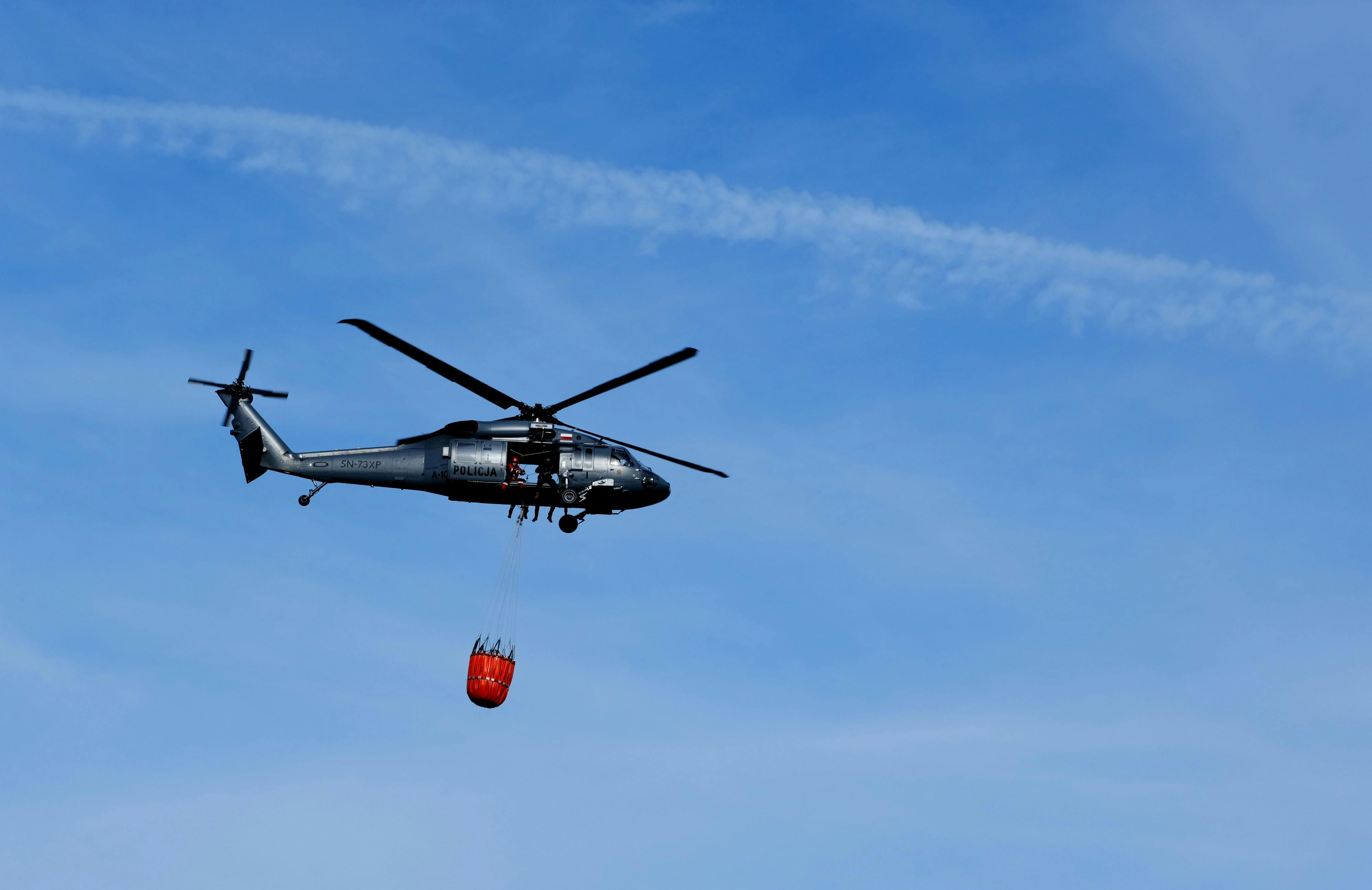
The Sikorsky S-70i Firehawk is one of the most widely used firefighting helicopters in the United States today. It is the civilian and specialty-mission version of the famous UH-60 Black Hawk, a military platform that has been in service since the late 1970s.
The Firehawk is a true multi-mission aircraft. It carries an internal 1,000-gallon belly tank that does not need to be removed between missions. That means a Firehawk can fly from a water source directly to the fire without stopping, gaining time on every run compared to aircraft that carry external buckets.
Key Firehawk capabilities:
- Internal 1,000-gallon water tank for precision drops
- Can transport up to 11 wildland firefighters and their gear
- Equipped for search and rescue, hoist operations, and MEDEVAC
- Night-vision compatible cockpit for after-dark firefighting
- Powered by two General Electric turboshaft engines for strong performance at altitude
Keep in Mind: CAL FIRE, the Los Angeles County Fire Department, and the Colorado Division of Fire Prevention and Control all operate S-70i Firehawk aircraft. This helicopter has become the modern standard for state and county fire agencies across the western United States.
The Firehawk's ability to switch roles mid-mission, from water drops to rescue to cargo hauling, without landing and reconfiguring, makes it extraordinarily useful on complex fires where conditions change quickly.
The Bell UH-1H Super Huey
Few helicopters are as recognizable as the Bell UH-1 Huey. Originally designed for military service in the late 1950s, the Huey became iconic during the Vietnam War and has been flying in firefighting operations for decades since.
The Bell UH-1H Super Huey is the most common variant found in aerial firefighting fleets. CAL FIRE operated a large fleet of Super Hueys for many years, and they remain a fixture at helibases across the country.
The Huey is valued for its proven reliability, relatively low operating costs, and ease of maintenance. It carries a 320 to 400-gallon Bambi Bucket as a typical firefighting load and can transport a crew of firefighters in the cabin alongside that mission. It is well-suited as a Type 2 or light Type 1 resource depending on the specific variant and configuration.
Pro Tip: The Bambi Bucket carried by Hueys and many other helicopters is a collapsible, flexible tank that can be filled by dipping into any water source that is deep enough to submerge it. Because it collapses when empty, it adds relatively little aerodynamic drag.
The Boeing CH-47 Chinook
The Boeing CH-47 Chinook is a tandem-rotor heavy-lift helicopter originally built for the U.S. Army. Its unique twin-rotor configuration gives it exceptional stability and load-carrying ability, and it has been adapted for firefighting under government contracts in several western states.
The Chinook can carry a very large Bambi Bucket or an internal tank system, giving it a water capacity that can approach or exceed 3,000 gallons depending on the configuration. It is also extremely capable as a crew and cargo transport aircraft.
Why the Chinook matters in fire operations:
- High payload capacity for both water and cargo
- Can transport large numbers of firefighters and heavy equipment
- Effective in high-altitude environments where other helicopters struggle
- Operated under contract by CAL FIRE and the U.S. Forest Service
Good to Know: The Chinook's twin-rotor design means it has no tail rotor. That makes it somewhat easier to maneuver in windy conditions and removes one potential mechanical failure point from the equation.
If you are curious about helicopters built around raw lifting power, our overview of helicopters that can carry a tank shows just how capable some of these platforms can be.
The Kaman K-Max
The Kaman K-Max is a unique aircraft: a purpose-built intermeshing-rotor helicopter designed from the start for external load operations. Unlike most helicopters that carry loads below a conventional airframe, the K-Max is a dedicated aerial crane, optimized to carry heavy slung loads efficiently.
In firefighting, the K-Max typically operates with a Bambi Bucket in remote, rugged terrain. Its intermeshing rotor design, where two rotors turn in opposite directions on intersecting axes, eliminates the need for a tail rotor and gives the aircraft outstanding hover efficiency.
K-Max highlights:
- Single-pilot operation, keeping crew costs low
- Designed around external load efficiency, making it a very capable water-bucket aircraft
- Effective in mountainous terrain and narrow canyons
- Has also been tested in unmanned configurations for autonomous firefighting missions
Fun Fact: The K-Max has been tested in remote fire operations as an optionally piloted or fully autonomous aircraft, making it one of the first helicopters seriously evaluated for unmanned aerial firefighting.
The Kamov Ka-32
The Kamov Ka-32 is a Russian-designed medium helicopter widely used in Europe and Asia for firefighting. Its coaxial rotor design, where two sets of rotors spin in opposite directions on the same vertical axis, gives it excellent stability and maneuverability.
The Ka-32 is typically equipped with a Bambi Bucket in the roughly 1,000-gallon range or can carry external foam and retardant tanks. Its coaxial configuration also makes it less sensitive to tail rotor failure in smoky, low-visibility conditions.
Heads Up: The Ka-32 has seen widespread use in firefighting fleets across Spain, Portugal, South Korea, and other countries. However, given recent geopolitical developments, some European agencies that operated Ka-32 aircraft have been moving toward Western-built alternatives.
The Bell 407 and Airbus AS350 B3
These two light helicopters represent the Type 3 category. Both are highly maneuverable, can operate at high altitudes, and are used extensively for reconnaissance, initial attack on small fires, and crew transport in mountainous terrain.
The Bell 407 is a single-engine turbine helicopter that offers strong altitude performance and a comfortable power margin. The Airbus AS350 B3 is legendary for its high-altitude capability, having set numerous records at extreme elevations.
In firefighting, these aircraft are often flown by helitack crews: firefighters specially trained to rappel from the helicopter directly to the fire line or to be inserted at a clearing near the fire. Their small size lets them work from almost any flat surface.
Quick Tip: If you have ever seen a helicopter with a long rope dangling below it, hovering near a steep ridgeline while firefighters rappel down, it was almost certainly a Type 3 aircraft like the Bell 407 or AS350 B3.
Firefighting Helicopter Equipment: Buckets, Tanks, and More
The aircraft is only half the story. What a helicopter carries into battle matters just as much as its size and speed.
Bambi Buckets vs. Fixed Tanks
The two main water-delivery systems for firefighting helicopters are external collapsible buckets (commonly called Bambi Buckets after the most popular brand) and fixed internal or belly-mounted tanks.
| Feature | Bambi Bucket | Fixed/Internal Tank |
| Refill method | Dipping into water source | Ground fill or hover snorkel |
| Precision | Moderate | Higher (microprocessor controlled) |
| Setup time | Minimal | Requires installation |
| Water capacity | Varies by size, generally lower | Up to 2,650 gallons |
| Best for | Remote areas, initial attack | High-volume repeated drops |
Bambi Buckets are popular because they are relatively inexpensive, easy to attach and detach, and can be filled from very shallow water sources that a tank snorkel cannot reach. Fixed tanks offer higher volume and more precise delivery but require a deeper or larger water source to refill efficiently.
Fire Retardant vs. Water
Helicopters can drop plain water, water mixed with foam or gel thickeners, or long-term fire retardant. Retardant, often colored red with ferric oxide to mark where it has been dropped, chemically slows the combustion of vegetation even after it dries. Water cools and suppresses active flames but does not have the same lasting chemical effect.
Why It Matters: Dropping retardant ahead of a fire line can slow or stop the fire's advance, giving ground crews time to build containment lines. Water is more useful when dropping directly on active flames or protecting structures.
The Role of Helitack Crews
Helicopters do not fight fires alone. They work hand in hand with helitack crews: specially trained firefighters who travel to fires by helicopter and can be inserted directly into terrain that would take hours to reach on foot.
What helitack crews do:
- Rappel from hovering helicopters to remote fire locations
- Serve as the first ground attack force on new fire starts
- Coordinate with airborne helicopters to guide water and retardant drops
- Provide structure protection and evacuation support in communities near fires
Flying411 covers some of the most fascinating aircraft in aviation. If you are interested in the broader world of helicopter design and history, our guide to helicopter facts and history is a great place to start.
If you have ever dreamed of flying one of these remarkable machines, Flying411 has everything you need to explore helicopter flight training, aircraft types, and the path to getting airborne.
How Technology Is Changing Aerial Firefighting
The helicopters of today are dramatically more capable than those of 30 years ago, and the pace of change is accelerating.
Night Flying and Infrared Systems
Wildfires do not stop burning at sundown. The ability to fight fire at night used to be extremely limited, but modern aircraft like the S-70i Firehawk are equipped with night-vision compatible cockpits, forward-looking infrared (FLIR) cameras, and precise GPS systems that allow night operations in many conditions.
FLIR cameras can see heat through smoke, helping pilots identify hotspots and active fire areas that would be completely invisible to the naked eye after dark.
Autonomous and Remotely Piloted Aircraft
The Kaman K-Max has already been tested as an unmanned aerial firefighting platform. Companies and government agencies are actively working on autonomous helicopter systems that could operate without a pilot onboard, reducing risk to human crews and potentially allowing around-the-clock operations in hazardous conditions.
Good to Know: Airbus recently completed trials of a coordinated aerial firefighting system that links aircraft, helicopters, drones, and ground crews through a shared digital network. This kind of integrated approach may define the future of wildfire suppression.
Precision Drop Systems
Modern helitankers like the Erickson S-64 Air-Crane use microprocessor-controlled tank doors that can be calibrated based on flight speed, altitude, and wind conditions. This allows pilots to place a precise pattern of water or retardant on exactly the right spot, even from altitude and at speed.
Choosing the Right Helicopter for the Right Fire
Not every fire needs the same response. Incident commanders use a mix of aircraft types because each one fills a specific role that others cannot.
Here is a simplified framework:
- New fire start in remote terrain: Send Type 3 (fast, agile, arrives early) and Type 2 (carries crew and water) aircraft immediately.
- Large, established fire with complex terrain: Deploy Type 1 helitankers for heavy retardant drops and Type 2 aircraft for crew and cargo support.
- Fire threatening structures or communities: Use the Firehawk or similar multi-mission aircraft for precision drops, rescue capability, and MEDEVAC readiness.
- Extremely remote or high-altitude fire: Use the K-Max, Bell 407, or AS350 B3 for their agility and ability to operate from minimal infrastructure.
The best outcomes happen when these aircraft work together as a coordinated fleet, with each type doing what it does best.
Keep in Mind: The NIFC and agencies like CAL FIRE pre-position aircraft across the country before fire season begins, placing the right types in the right regions based on historical fire risk and geography.
If you are interested in the aviation side of a career in or around aviation, check out some of the best helicopter flight schools in the U.S. for a look at where future pilots get their training.
Conclusion
Firefighting helicopter types range from the nimble Bell 407 darting into a narrow canyon on initial attack, all the way to the massive Erickson S-64 Air-Crane cycling thousands of gallons an hour over an active fire front. Each type has a role, and the best aerial firefighting operations use all of them together in a coordinated effort. Understanding what these aircraft do, and why each one exists, makes it easier to appreciate the skill and planning that goes into stopping a wildfire before it becomes a disaster.
Whether you are an aviation enthusiast, a firefighting professional, or someone who simply looked up during a California wildfire and wondered what that enormous helicopter was doing, the answer is always fascinating.
Dig deeper into the world of rotary-wing aviation with Flying411, your trusted guide to everything that flies.
FAQs
What is the most commonly used firefighting helicopter in the United States?
The Sikorsky S-70 Firehawk and the Bell UH-1H Super Huey are among the most widely operated firefighting helicopters in the U.S. State agencies like CAL FIRE and county fire departments across the West rely heavily on these platforms for both water drops and crew transport.
What is a helitanker?
A helitanker is a helicopter equipped with a fixed internal tank designed for high-volume water or retardant delivery. The Erickson S-64 Air-Crane is the best-known example, capable of carrying over 2,600 gallons and refilling in under a minute using a hover snorkel.
How do firefighting helicopters refill with water?
Helicopters with Bambi Buckets dip their bucket directly into a lake, river, reservoir, or portable tank. Helitankers with fixed tanks use a hanging snorkel or ram-scoop system to draft water while hovering over a water source, or they can be filled by ground-based water tenders at a helibase.
Can firefighting helicopters operate at night?
Some can. Modern aircraft like the Sikorsky S-70i Firehawk are equipped with night-vision-compatible cockpits and FLIR cameras that allow limited night operations. However, many fire agencies restrict nighttime flying due to the added risks of low visibility, smoke, and terrain.
What is a Bambi Bucket?
A Bambi Bucket is a collapsible, flexible water container that is suspended beneath a helicopter by a longline. The pilot dips the bucket into a water source to fill it, then flies to the fire and releases the water through a valve at the bottom. The bucket collapses when empty, reducing drag during transit. It is one of the most widely used water delivery systems in aerial firefighting.
Are there unmanned firefighting helicopters?
Unmanned firefighting helicopter technology is actively being developed and tested. The Kaman K-Max has been evaluated in optionally piloted configurations, and several companies and government agencies are working toward autonomous rotary-wing platforms that could fly fire suppression missions without a pilot on board.
What is the difference between fire retardant and water for aerial drops?
Water cools active flames and suppresses burning material in the moment of impact. Fire retardant, often colored red, contains chemicals that slow or prevent combustion even after the liquid dries. Retardant is typically used ahead of the fire line to slow the fire's advance, while water is used more directly on active flame zones or for structure protection.