Two helicopters. Two very different jobs. And both of them are legends.
When people talk about military aviation, the AH-64 Apache and the UH-60 Black Hawk come up again and again. These machines have flown over some of the most dangerous places on earth — from the deserts of Iraq to the mountains of Afghanistan. They are built by different teams, for different reasons, and they do their jobs better than almost anything else in the sky.
But what actually separates them? Is one better than the other? And what makes each one special in its own right?
If you have ever wondered what sets the apache helicopter vs black hawk apart, you are in the right place. This article breaks down the history, design, firepower, specs, real-world roles, and key differences between these two iconic machines — without the technical jargon.
Key Takeaways
When comparing the apache helicopter vs black hawk, the most important thing to understand is that these two helicopters were never meant to compete with each other — they were built for completely different jobs. The AH-64 Apache is a dedicated attack helicopter, designed to find and destroy enemy targets. The UH-60 Black Hawk is a utility helicopter, built to carry troops, supplies, and wounded soldiers safely in and out of combat zones. The U.S. Army uses both together because each one fills a role the other cannot.
| Feature | AH-64 Apache | UH-60 Black Hawk |
| Primary Role | Attack / Anti-armor | Utility / Troop Transport |
| Crew | 2 (Pilot + Gunner) | 3-4 (Pilot, Co-pilot, Crew Chiefs) |
| Troop Capacity | 0 (attack only) | Up to 11 combat-equipped soldiers |
| Top Speed (approx.) | Around 182-188 mph | Around 182 mph |
| Range (approx.) | Around 300 miles combat radius | Around 320 miles standard range |
| Primary Weapons | 30mm cannon, Hellfire missiles, rockets | Machine guns (defensive); optional missiles |
| First Service Entry | 1986 | 1979 |
| Manufacturer | Boeing | Sikorsky (Lockheed Martin) |
| Role Flexibility | Low (specialized attacker) | High (multi-mission platform) |
If you love digging into helicopter specs, performance, and aviation history, Flying411 is a great resource to keep in your bookmarks. Their content covers everything from rotorcraft design to real-world flight comparisons.
A Tale of Two Helicopters: How They Were Born
These two helicopters were not born at the same time, and they did not come from the same need.
The Black Hawk Comes First
The UH-60 Black Hawk entered U.S. Army service in 1979, replacing the older Bell UH-1 Iroquois — better known as the "Huey" — that had served throughout the Vietnam War. The Army needed something stronger, faster, and more capable of operating in modern combat environments.
Sikorsky Aircraft won the design competition and delivered a tough, versatile machine named after the Sauk war chief Black Hawk. From day one, it was designed to carry troops, move gear, and support medical evacuations. It was built to do many things well, not just one thing perfectly.
Fun Fact: The Black Hawk has been used by the U.S. military for well over four decades and has accumulated what many sources describe as millions of flight hours across dozens of countries.
The Apache Is Built to Fight
The AH-64 Apache came from a different need entirely. The Army wanted a dedicated attack helicopter that could destroy tanks and heavily armored vehicles — especially in a potential large-scale conflict in Europe during the Cold War era.
Hughes Helicopters won that competition, and the Apache made its first flight in 1975. It entered Army service in 1986. Boeing eventually took over production, and the Apache has been continuously upgraded ever since.
Good to Know: The Apache's name comes from the Apache people of the southwestern United States, following a U.S. Army tradition of naming helicopters after Native American nations and tribes.
The latest version, the AH-64E Guardian, remains in production and is operated by around 19 countries.
Design Philosophy: Attack vs. Utility
The biggest difference between these two helicopters is not their speed or their weapons — it is why they were designed in the first place.
The Apache Is Built Around the Fight
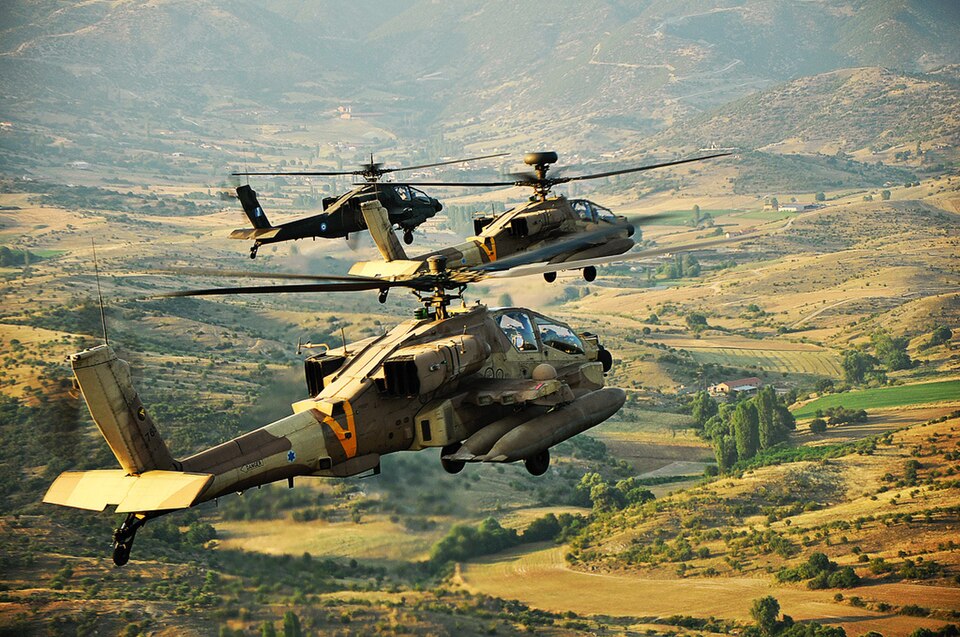
The AH-64 Apache is a narrow, streamlined machine built for two people in a tandem cockpit. The pilot sits in the rear seat, slightly elevated. The gunner sits up front. Both can fly the aircraft, and both can operate the weapons independently.
Everything about the Apache's body is shaped for combat. It is low and aerodynamic. Its armor can reportedly withstand hits from shells up to 23mm. Its fuel tanks are self-sealing. There is a blast shield between the two crew members so that if one is hit, the other can still operate the aircraft.
Why It Matters: The Apache's tandem cockpit arrangement is not just about fitting two people — it narrows the aircraft's profile, making it a smaller target from the front.
The Apache also features the Target Acquisition and Designation Sight / Pilot's Night Vision Sensor (TADS/PNVS), which allows the crew to detect heat signatures from targets like tanks even through darkness, smoke, and bad weather. This gave the Apache a massive edge when it was first introduced, and modern upgrades have made that system even more capable.
The Black Hawk Is Built Around the Mission
The UH-60 Black Hawk has a completely different shape. Its wide, rounded fuselage is designed to carry people and cargo. The cabin is large enough to hold up to 11 fully equipped combat soldiers in an assault configuration. In a medevac setup, it can carry around 6 stretchers.
The Black Hawk's sliding doors on each side allow for quick loading and unloading under fire. Its design prioritizes getting people in and out fast — which is the whole point.
Pro Tip: The Black Hawk's External Stores Support System (ESSS) adds two wing-like pylons on each side of the fuselage. Each wing can carry up to 5,000 pounds of equipment, including fuel tanks or missiles.
Firepower: No Contest on Offense
This is where the comparison becomes the most one-sided.
The Apache Is a Flying Weapons Platform
The Apache carries a 30mm M230 chain gun mounted under its nose. This cannon can fire around 625 rounds per minute and can track independently of the aircraft's heading using helmet-mounted targeting — meaning the gunner just has to look at a target, and the gun follows.
Beyond the cannon, the Apache can carry up to 16 AGM-114 Hellfire missiles — a laser-guided or radar-guided anti-tank weapon capable of engaging targets several miles away. It can also carry Hydra 70 unguided rocket pods and, in some configurations, air-to-air missiles.
Fun Fact: The name Hellfire is said to be a backronym for "Helicopter Launched, Fire and Forget" — though later versions became laser-guided rather than fully autonomous.
The Apache's AN/APG-78 Longbow radar, mounted in a dome above the main rotor on the AH-64D and later variants, can reportedly detect, classify, and prioritize multiple targets simultaneously — even through terrain, weather, and electronic interference.
The Black Hawk Is Defensively Armed
The Black Hawk was never designed as an attack helicopter. In its standard configuration, it carries pintle-mounted machine guns — typically M240 or similar — on each side door for crew defense. These are for suppression, not sustained combat.
That said, the Black Hawk can be equipped with more firepower when the mission calls for it. With ESSS pylons, it can carry Hellfire missiles, rocket pods, or .50 caliber Gatling guns. Special operations variants like the MH-60L DAP (Direct Action Penetrator) can be armed quite heavily, including with Hellfire missiles, a 30mm cannon, and miniguns.
But those are the exceptions. The standard Black Hawk is not a gunfighter — it is a workhorse.
Speed, Range, and Performance
Here is where things get more interesting. These two helicopters are actually surprisingly close in some performance numbers — but they use that performance very differently.
Good to Know: Military helicopter specifications vary across variants and are often presented differently depending on load, altitude, and conditions. The figures below are approximate and based on widely cited sources.
AH-64 Apache Performance
- Top speed: Approximately 182-188 mph (depending on variant)
- Cruising speed: Around 165 mph
- Combat radius: Approximately 150 miles; around 300 miles with external fuel tanks
- Max endurance: Roughly 2.5-3 hours with a full combat load
- Service ceiling: Around 21,000 feet
The Apache is agile and quick for a heavily armed machine. Its maneuverability is a core part of its survivability — it can fly low, use terrain as cover, and pop up to engage a target before retreating quickly.
UH-60 Black Hawk Performance
- Top speed: Approximately 182 mph
- Cruising speed: Around 150-165 mph
- Standard range: Around 320 miles; up to 1,200+ nautical miles with external tanks for self-deployment
- Payload (internal): Around 2,600-3,200 lbs internally; up to 9,000 lbs via external sling hook
- Service ceiling: Around 19,000 feet
The Black Hawk's range advantage — especially with ESSS fuel tanks — is one of its most valuable traits. It can deploy itself over very long distances without needing a tanker aircraft, which makes it highly flexible for global operations.
Keep in Mind: The Black Hawk's ability to sling-load a 105mm howitzer and ammunition gave it a massive logistical role that the Apache simply cannot fill.
Key Differences Between the Apache Helicopter and Black Hawk
Now that we have covered the background, here is a focused look at the core differences between these two helicopters. These are the factors that shape how each machine is used — and why the Army needs both.
1. Role and Mission
The Apache is a dedicated attack helicopter. Every design choice — its narrow profile, its weapons systems, its sensors — is geared toward finding and destroying targets. It does not transport troops, carry cargo, or perform rescues.
The Black Hawk is a utility helicopter. It was built to be flexible. Troop transport, medevac, search and rescue, resupply, special operations, VIP transport — it has done all of these, often in the same week.
2. Crew Size and Function
The Apache carries two people: a pilot and a co-pilot/gunner. Both have dual controls. Both can operate the weapons. The design keeps the crew small and focused on combat tasks.
The Black Hawk typically flies with a crew of three to four — a pilot, co-pilot, and one or two crew chiefs. The crew chiefs manage the cargo, assist with loading, operate door guns, and act as additional eyes during flight.
3. Weapons Systems
The Apache's weapons are its reason for existing. The 30mm chain gun, Hellfire missiles, and Longbow radar are precision tools for battlefield destruction.
The Black Hawk's weapons are secondary. Door-mounted machine guns provide self-protection. In specialized variants, more firepower can be added — but the aircraft is not optimized for it.
4. Survivability Features
Both helicopters include some level of armor and crash protection. But they approach survivability differently.
The Apache uses armor plating, self-sealing tanks, and radar evasion and countermeasure systems to survive in high-threat environments. It is built to operate near or over enemy positions.
The Black Hawk uses speed and agility to reduce time in the danger zone. Its design prioritizes rapid ingress and egress — get in, deliver the troops or supplies, and get out before the enemy can react effectively.
5. Cargo and Troop Capacity
The Apache carries zero troops and negligible cargo. There is essentially no cabin space designed for passengers.
The Black Hawk can carry up to 11 combat soldiers internally, or sling-load up to 9,000 pounds externally. In a medevac role, it can carry around 6 patients on stretchers.
6. Variants and Adaptability
The Apache's variants are mostly incremental upgrades — improved sensors, better engines, and enhanced connectivity (AH-64A, AH-64D Longbow, AH-64E Guardian). The core mission remains the same across all of them.
The Black Hawk's variants span an enormous range of missions. The SH-60 Seahawk serves the U.S. Navy in anti-submarine warfare. The HH-60 Pave Hawk performs combat search and rescue for the Air Force. The MH-60 serves special operations forces. The HH-60M is a dedicated medevac platform. There are over a dozen official variants.
Learning about tandem rotor helicopters is a great way to understand why different rotor configurations were developed for different operational needs — context that makes the Black Hawk's design choices even more interesting.
7. Crew Training Requirements
Apache training is highly specialized. Pilots learn to operate the aircraft's advanced targeting systems, fire control radar, and weapons employment procedures. The gunner's role requires intensive training on sensor operation and weapons engagement.
Black Hawk training is broader. Pilots learn the aircraft's multi-mission capabilities and must be ready to operate in diverse environments — from urban medevac runs to mountain resupply operations.
8. Cost and Maintenance
The Apache is more expensive to acquire and, historically, more costly to operate per flight hour. Earlier variants of the AH-64D reportedly cost well over $10,000 per flight hour. The newer AH-64E Guardian has significantly reduced that figure, though it remains a high-end platform.
The Black Hawk's unit cost is generally lower than the Apache's, and its widespread use across the military has created a mature, well-supported maintenance and logistics network.
Heads Up: Operating costs for military helicopters vary widely based on variant, operational tempo, and maintenance approach. Figures cited in different sources can differ significantly.
If you want to understand how advanced turboshaft engines power these incredible machines, there is a great guide on the best turboshaft engine helicopters that breaks down the technology in plain language.
Real-World Combat History
Both helicopters have long and well-documented service histories. Neither of them is just a concept — they have been tested in actual conflicts.
Apache in Combat
The Apache made its combat debut in 1989 during military operations in Panama. It proved its night-fighting capability almost immediately. During Operation Desert Storm in 1991, Apache helicopters were reportedly among the first aircraft to strike Iraqi air defense systems — firing Hellfire missiles to open corridors for coalition aircraft.
The Apache has since seen extensive use in the ongoing conflicts in Afghanistan and Iraq, as well as in other operations around the world. It has become closely associated with close air support and anti-armor missions.
Fun Fact: According to Boeing, the AH-64 Apache fleet has accumulated well over 5 million total flight hours, with more than 1 million of those hours in combat operations.
Black Hawk in Combat
The Black Hawk's combat history is just as extensive, if less headline-grabbing. It has been the backbone of U.S. Army aviation since the late 1970s, performing thousands of troop-insertion, medevac, and resupply missions across every major conflict the U.S. has been involved in.
The helicopter became widely known to civilian audiences through the 1993 battle in Mogadishu, Somalia — later portrayed in the book and film "Black Hawk Down." The incident highlighted both the Black Hawk's importance in modern operations and its vulnerability when operating in dense urban environments without adequate support.
Special operations variants of the Black Hawk were reportedly used in the 2011 operation that resulted in the death of Osama bin Laden — including a classified low-observable version that incorporated stealth features.
Variants Worth Knowing
Both helicopters have produced a wide family of variants. Here is a quick look at the most notable ones.
Apache Variants
- AH-64A: The original production model, entered service in 1986
- AH-64D Longbow: Added the Longbow millimeter-wave radar dome for all-weather, multi-target engagement
- AH-64E Guardian: The current production standard; improved engines, connectivity, and support for unmanned systems
Black Hawk Variants
- UH-60A/L/M: Standard utility transport variants, each with improved engines and avionics
- HH-60M: Dedicated medevac helicopter with medical equipment
- MH-60 (various): Special operations variants operated by the 160th Special Operations Aviation Regiment
- SH-60/MH-60 Seahawk: Naval anti-submarine warfare and ship-based utility variant
- HH-60 Pave Hawk: Air Force combat search and rescue platform
- VH-60: VIP transport, used for presidential support missions
The sheer number of Black Hawk variants reflects its design philosophy: build a platform that can be adapted for almost anything.
Exploring helicopters with wheels vs skids is a great companion read if you want to understand how landing gear design shapes a helicopter's operational role — something clearly illustrated by comparing the Apache and Black Hawk.
Who Uses Them Around the World?
Both the Apache and the Black Hawk are operated internationally, but the Black Hawk has a significantly wider global reach.
The Apache has been exported to around 19 countries, including the United Kingdom, Israel, Saudi Arabia, Japan, the Netherlands, South Korea, and several others. Every operator uses it primarily in the attack role.
The Black Hawk — in its various forms — has been adopted by dozens of countries across the world. It serves in military aviation, coast guard operations, disaster relief, firefighting support, and even civilian emergency services in some regions. The design's adaptability has made it one of the most widely exported military helicopters in history.
Why It Matters: The Black Hawk's civilian and paramilitary applications — including its use in firefighting support — make it relevant far beyond military aviation. You can read more about fire-fighting helicopter types and how helicopters like the Black Hawk are adapted for those critical missions.
Can They Work Together?
Yes — and they often do.
The Apache and the Black Hawk are designed to complement each other, not compete. A typical air assault operation might look like this: Apache helicopters fly ahead of the force, clearing the landing zone of enemy threats. Black Hawks then fly in with troops, land quickly, and extract once the mission is complete. The Apaches provide continuous air cover overhead.
This kind of coordination is a core part of U.S. Army aviation doctrine. The two helicopters fill roles that the other cannot, which is exactly why the Army invests in both.
If you are fascinated by unconventional helicopter designs and how rotorcraft engineering shapes capability, Flying411 has a detailed look at synchropter advantages and disadvantages that puts innovative rotor systems in helpful context.
Which One Is "Better"?
This is the question most people want answered — and the honest answer is that it depends entirely on what you need.
If you need to destroy a tank from several miles away while flying at night in bad weather, the Apache is in a category of its own.
If you need to move 11 soldiers into a hot landing zone, pull out wounded personnel, or deliver supplies to a remote outpost, the Black Hawk is the right tool.
Neither helicopter can do the other's primary job well. The Apache has no real passenger capacity. The Black Hawk, in its standard form, is not built to hunt and destroy armored vehicles. They are not interchangeable — they are complementary.
Keep in Mind: Some specialized Black Hawk variants, like the MH-60L DAP, can be armed quite heavily for direct combat. But these are purpose-built variants, not the standard utility model.
The better question might be: which one would you rather see on your side? For most missions, the answer is both.
For more unconventional perspectives on rotorcraft capability, the guide on helicopters that can fly upside down explores just how far helicopter engineering has pushed the boundaries of what these machines can do.
Conclusion
The apache helicopter vs black hawk debate is really a conversation about purpose. The AH-64 Apache is one of the most capable attack helicopters ever built — precise, lethal, and designed from the ground up to dominate the battlefield. The UH-60 Black Hawk is one of the most versatile utility helicopters in aviation history — adaptable, durable, and trusted with some of the most important and sensitive missions the military undertakes.
Both have earned their reputations through decades of real-world service. Both have saved lives and shaped military strategy. And both continue to fly, in updated forms, around the world today.
Understanding what makes each one exceptional is the first step to appreciating just how remarkable modern military aviation really is.
For more in-depth articles on helicopters, rotorcraft design, and aviation history, head over to Flying411 — your go-to source for clear, honest aviation content.
FAQs
Can a Black Hawk helicopter carry troops while an Apache provides air cover?
Yes, this is a common operational pairing. The Apache clears threats ahead of the formation while Black Hawks transport troops into the landing zone, with the Apaches continuing to provide protection overhead throughout the mission.
Is the AH-64 Apache faster than the UH-60 Black Hawk?
The two helicopters have surprisingly similar top speed figures — both reach approximately 182 mph in their standard variants. The Apache's newer AH-64E variant can push slightly beyond that. Neither is dramatically faster than the other in straight-line speed.
Can a Black Hawk be armed to fight like an Apache?
In standard configuration, the Black Hawk carries only defensive machine guns. Specialized variants, like the MH-60L DAP used by special operations units, can carry Hellfire missiles, rocket pods, and other heavy weapons — but these are not typical Black Hawks and are purpose-built for a more aggressive role.
How many countries operate the Apache or Black Hawk?
The Apache is used by around 19 countries as of recent reporting. The Black Hawk and its variants are operated by significantly more — dozens of countries use H-60 family helicopters in various military, paramilitary, and emergency services roles.
What replaced the Huey, and was the Black Hawk the direct replacement?
Yes. The UH-60 Black Hawk was specifically developed to replace the Bell UH-1 Iroquois, commonly known as the Huey, as the U.S. Army's primary tactical transport helicopter. It entered service in 1979 and has been the Army's workhorse ever since.