If you have ever watched a small rotorcraft buzz overhead and wondered whether it was a helicopter or something else entirely, you are not alone. At first glance, a gyrocopter and a helicopter look remarkably similar. Both spin a rotor above the fuselage. Both can operate in tight spaces. But once you dig a little deeper, these two aircraft turn out to be very different machines with very different strengths.
The gyrocopter vs helicopter debate matters whether you are a curious beginner, a student pilot weighing your options, or someone who already flies and wants to add a new rating. Cost, training requirements, safety profiles, and what each aircraft can actually do in the real world all paint a picture that helps you match the right aircraft to your goals.
Understanding those differences is what this article is all about.
Key Takeaways
A gyrocopter uses a free-spinning, unpowered rotor for lift and a separate propeller for thrust, while a helicopter uses one engine-driven rotor for both lift and propulsion. This core mechanical difference shapes everything else: gyrocopters cost significantly less to buy, operate, and maintain, and they are generally easier to learn to fly. Helicopters offer far greater versatility, including the ability to hover, fly in any direction, and perform missions that gyrocopters simply cannot. For recreational flying, the gyrocopter often wins on value. For professional or mission-critical work, the helicopter is hard to beat.
| Factor | Gyrocopter | Helicopter |
| Rotor power source | Unpowered (autorotation) | Engine-driven |
| Can hover | No | Yes |
| Purchase cost | Generally much lower | Significantly higher |
| Operating cost (approx.) | Lower per hour | Higher per hour |
| Ease of learning | Easier | More demanding |
| Runway needed | Short runway required | No runway needed |
| Engine-out safety | Strong (rotor already autorotating) | Requires quick pilot response |
| Best use | Recreation, touring, training | Search and rescue, transport, utility |
| FAA term | Gyroplane | Helicopter |
Flying411 covers the full spectrum of rotorcraft — from gyrocopters to helicopters and everything in between. If you are trying to figure out which type of aircraft fits your flying life, Flying411 is a great place to start.
Two Rotorcrafts: How They Work
The single biggest difference between a gyrocopter and a helicopter is what powers the rotor.
In a helicopter, the engine drives the main rotor directly. That spinning rotor does two jobs at once: it generates lift to keep the aircraft airborne and provides propulsion for movement in any direction. This is why a helicopter can hover in place, fly backward, fly sideways, and rise or descend vertically without any forward motion at all. The tail rotor counters the torque created by the main rotor spinning, which keeps the fuselage from spinning in the opposite direction.
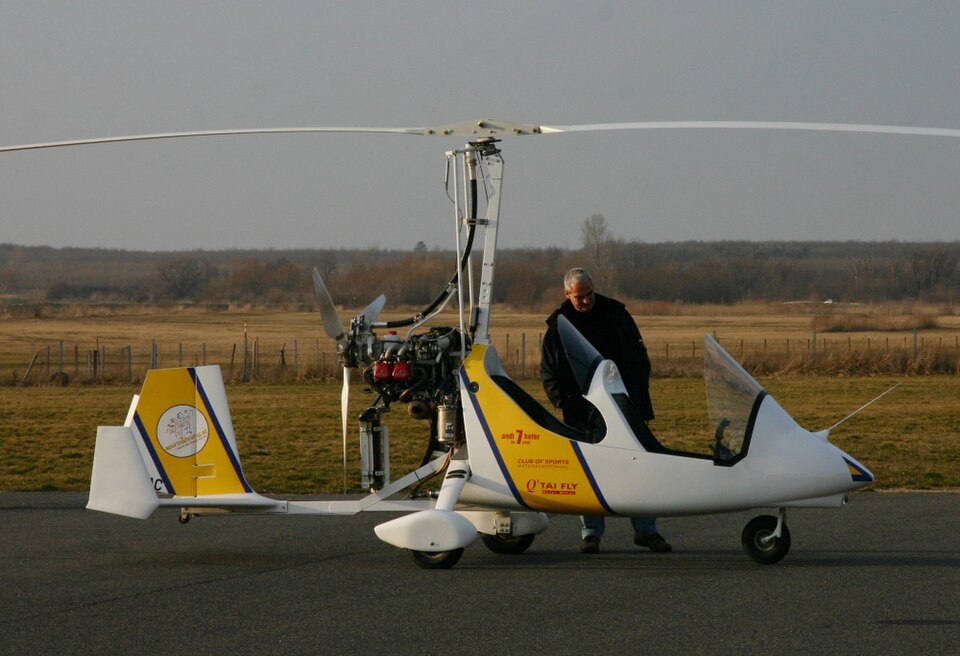
In a gyrocopter (also called a gyroplane or autogyro), the rotor is not connected to the engine at all during flight. Instead, a separate propeller mounted on the front or rear of the aircraft pushes it forward. As the gyrocopter moves through the air, the airflow passes upward through the unpowered rotor, causing it to spin on its own. This process is called autorotation, and it is what generates lift.
Think of it like a pinwheel: it does not need a motor, just moving air.
Good to Know: The FAA officially uses the term "gyroplane" for this aircraft category. You will see "gyrocopter," "autogyro," and "gyroplane" used interchangeably in everyday conversation, but on FAA paperwork, "gyroplane" is the standard term.
Because the gyrocopter rotor is always autorotating during normal flight, it is never at risk of stall. There is no powered rotor to lose drive. And that fact has big implications for safety, which we will cover in detail below.
A Look at Gyrocopters
The gyrocopter came first. Spanish engineer Juan de la Cierva invented the autogyro after one of his fixed-wing aircraft stalled and crashed during its first flight in 1919. Determined to create an aircraft that could fly safely at very low speeds, he began experimenting with rotor-based lift. After several failed prototypes, his fourth design, the C.4, made the first successful autogyro flight in January 1923 at Getafe airfield in Madrid, Spain.
What made the C.4 work was a clever mechanical solution: hinged rotor blades that could flap independently. This equalized the lift on both sides of the rotor disc as the aircraft moved, solving the rolling problem that had plagued his earlier designs.
Fun Fact: The safety built into that autogyro design was demonstrated almost immediately. On January 20, 1923, just days after the first successful flight, the autogyro suffered an engine failure at about 25 to 35 feet in the air. In a fixed-wing aircraft that would likely have meant a crash. The autogyro simply descended gently to the ground without damage to the aircraft or injury to the pilot.
Cierva's invention is said to have laid the groundwork for the modern helicopter, particularly through the articulated rotor system. When Igor Sikorsky developed the first mass-produced helicopter in the early 1940s, helicopters quickly became the dominant rotorcraft because of their ability to hover. The autogyro faded from mainstream use but never disappeared. Today, gyroplanes enjoy a dedicated following among private pilots and recreational flyers across the U.S.
Gyrocopter vs Helicopter: 8 Key Differences Explained
Here is a clear look at how these two aircraft stack up across the most important categories.
1. Hovering Ability
The helicopter wins outright here. A helicopter can hover motionless at any altitude, making it ideal for search and rescue, power line inspection, aerial filming, and precision cargo delivery. A gyrocopter cannot hover. It needs continuous forward airspeed to keep air flowing through the rotor. Remove that airspeed and the rotor stops generating lift.
This is the single most significant operational limitation of the gyrocopter.
2. Runway Requirements
Gyrocopters need a short runway or clear strip to take off and land. The distance is much shorter than a fixed-wing aircraft, but it is not zero. Most gyrocopters can take off in a surprisingly short distance, sometimes as little as 50 to 100 feet under ideal conditions, depending on the model and wind.
Helicopters need no runway at all. They can lift straight up from any flat surface large enough to fit the aircraft, including rooftops, ship decks, and tight mountain clearings.
Pro Tip: If you are thinking about operating from a private property strip or a small grass airfield, a gyrocopter could work well. If you need to land in a backyard or a confined clearing with no open approach, only a helicopter will do.
3. Purchase Cost
Gyrocopters are generally far more affordable to purchase than helicopters. Entry-level kit-built gyrocopters can be found at costs that put them well within reach of many private pilots, while production-certified models carry higher but still considerably lower price tags than comparable helicopters. Even the smallest and most basic certified helicopters tend to cost significantly more than a comparable gyrocopter.
4. Operating and Maintenance Costs
This is where gyrocopters show one of their biggest advantages. Helicopters are mechanically complex. Multiple interconnected systems, a tail rotor, a transmission, and numerous moving parts all require regular attention. It is commonly estimated that high-performance helicopters can require around five hours of maintenance for every hour of flight.
Gyrocopters have a simpler design. Fewer moving parts means less to maintain, and parts tend to be cheaper when repairs are needed.
Why It Matters: For agencies and private pilots flying regularly, operating cost differences can add up quickly. A gyrocopter can offer a dramatically lower hourly cost compared to a comparable helicopter, making it a meaningful consideration for anyone flying on a budget.
5. Training and Pilot Certification
Learning to fly a helicopter is widely considered one of the most challenging skills in aviation. Hovering alone can take many hours of dual instruction to master. The helicopter acts like an inverted pendulum: any small movement tends to amplify until the pilot corrects it. Add in the coordination required between the collective, cyclic, and pedals, and the learning curve is steep.
Gyrocopters are generally considered easier to fly. There is no hovering to learn. The aircraft behaves more like a fixed-wing plane in many respects, and the controls are simpler. Many students log significantly fewer hours to reach proficiency in a gyroplane than in a helicopter.
There is also an interesting path for pilots who want both ratings. Some flight schools offer a structured progression where students earn their commercial gyroplane certificate first, then transition to helicopters. Because hours in a gyroplane count toward rotorcraft time, this path can result in substantial savings on the total cost of earning both certificates.
Keep in Mind: FAA ratings for gyroplanes and helicopters are separate categories. A gyroplane certificate does not allow you to fly a helicopter, and vice versa. You need a specific rating for each.
6. Safety in Engine Failure
Both aircraft types have features that help pilots survive an engine failure, but they work differently.
In a helicopter, an engine failure requires the pilot to immediately enter autorotation by lowering collective pitch to keep the rotor spinning. If the pilot reacts quickly and correctly, the rotor stores enough rotational energy to flare and land safely. The window for that reaction is short, and the maneuver requires practice. Certain flight conditions, such as low altitude combined with low airspeed, create a zone known as the dead man's curve where even a skilled pilot may not have enough rotor energy to recover safely.
In a gyrocopter, the rotor is already autorotating during normal flight. An engine failure simply means the propeller stops. The rotor keeps spinning, the aircraft continues to generate lift, and the pilot descends toward a landing area. The gyrocopter does not have a dead man's curve in the same sense.
Heads Up: This does not mean gyrocopters are risk-free. Pilot error, poor design, and improper loading can all create dangerous situations. Safe flying in any aircraft requires proper training and good judgment.
7. Speed and Range
Helicopters generally outperform gyrocopters in speed and range. Many production helicopters cruise comfortably at over 100 knots, with some reaching considerably higher speeds. Some high-performance models cover distances that gyrocopters cannot match.
Gyrocopters tend to be slower, with typical cruise speeds ranging from roughly 60 to 100 miles per hour depending on the design. Range is also more limited. For cross-country travel or long-range missions, helicopters hold the advantage.
8. Noise and Vibration
Gyrocopters are generally quieter than helicopters at comparable sizes. The absence of a tail rotor and a simpler rotor system contribute to a lower overall noise footprint. For pilots who value low-impact recreational flying, that is a meaningful benefit.
Flying411 offers in-depth resources on helicopter performance, design, and comparisons that help pilots and aviation enthusiasts make informed decisions. Browse the latest content to deepen your understanding of rotorcraft.
Real-World Use Cases: Which Aircraft Fits the Mission?
Different missions call for different tools. Here is a practical breakdown of where each aircraft tends to shine.
When a Gyrocopter Makes More Sense
- Recreational flying and aerial touring over scenic landscapes
- Pilot training and building rotorcraft hours at a lower cost
- Wildlife observation and low-altitude survey work
- Agricultural monitoring over flat terrain
- Budget-conscious private ownership where hovering is not required
When a Helicopter Is the Better Choice
- Search and rescue operations requiring hovering over a specific location
- Medical evacuation from sites without clear landing zones
- Law enforcement surveillance and pursuit
- Offshore and remote operations where vertical takeoff is essential
- Commercial transport of passengers or cargo to difficult locations
Many aviation professionals point out that a gyrocopter can handle a large percentage of typical private flying missions at a fraction of the cost. For that remaining percentage of missions that genuinely require hovering or vertical takeoff from confined spaces, the helicopter is simply the right tool.
What About Synchropters and Other Rotorcraft?
Beyond the standard helicopter and gyrocopter, the rotorcraft world includes some interesting variations. Synchropters use two intermeshing rotors that spin in opposite directions, eliminating the need for a tail rotor entirely. This design offers some stability and payload advantages in certain conditions.
On the military side, comparing different helicopter platforms reveals how dramatically helicopters can vary in mission capability, size, and complexity. Even within the attack helicopter category, distinct differences exist, as seen when looking at purpose-built combat aircraft side by side.
And if you are considering helicopter ownership from a practical standpoint, something as simple as the landing gear design affects how and where you can operate. Likewise, the powerplant matters: turbine-powered helicopters offer performance that piston-powered gyrocopters cannot match, though at a considerably higher cost.
Flying Training: Getting Licensed in Each Aircraft
Gyroplane Certification (FAA)
To fly a gyroplane in the U.S., you need either a Sport Pilot certificate with a gyroplane category or a Private Pilot certificate with a gyroplane category. The FAA minimum requirements for a private gyroplane certificate include a set number of flight hours, including solo and cross-country time. Your actual hours to proficiency may be lower than for a helicopter, and the checkride covers gyroplane-specific maneuvers and emergency procedures.
Helicopter Certification (FAA)
A Private Pilot certificate with a helicopter category requires meeting FAA minimum aeronautical experience requirements, including a minimum number of total flight hours, dual instruction, and solo time. Because learning to hover is time-intensive, many students take longer than the minimum to feel fully comfortable.
Fun Fact: According to aviation educators, students who train in a gyroplane first sometimes find the transition to helicopter training easier in certain respects, because they already understand rotorcraft aerodynamics and autorotation in a hands-on way.
Sport Pilot Option
Gyrocopters included in the Light Sport Aircraft (LSA) category offer an additional pathway for pilots who qualify for a Sport Pilot certificate. This can reduce training time and cost even further for pilots whose goals fit within the Sport Pilot operating limits.
Safety Considerations for Both Aircraft
Safety in any aircraft comes down to three things: the aircraft's design, the pilot's training, and sound decision-making in flight. Both gyrocopters and helicopters have earned solid safety records when operated correctly.
A 2004 FAA review of ultralight gyrocopters raised concerns about certain designs that were being flown without proper certification or pilot training. Subsequent regulatory changes tightened the definition of ultralight aircraft and improved oversight. Today, certified gyroplanes operating under FAA rules are a different proposition from the unregulated ultralights of earlier decades.
Helicopter safety statistics vary widely depending on the type of operation. Commercial operations, training flights, and personal flying all show different risk profiles. For context on how helicopter risk compares to other transportation modes, data suggests that helicopter travel compares more favorably to car travel than many people assume, particularly for operations under professional management.
Good to Know: In both aircraft, maintaining currency and proficiency is one of the most important safety factors. Pilots who fly regularly and practice emergency procedures are consistently safer than those who fly infrequently without recurrent training.
Conclusion
The gyrocopter vs helicopter question does not have one universal answer. It depends on what you want to do, how much you want to spend, and the kind of flying experience you are after.
Gyrocopters offer an accessible, affordable, and genuinely enjoyable way to experience rotorcraft flight. They are mechanically simpler, kinder on the budget, and rewarding to fly. Helicopters offer versatility and capability that no gyrocopter can match, along with a price tag that reflects that capability.
If you are still weighing the options or want to learn more before making any decisions, Flying411 has the resources to help you think it through. The right aircraft for you is out there. Flying411 can help you find it.
FAQs
Can a gyrocopter land if the engine fails?
Yes. Because the gyrocopter's rotor is already spinning through autorotation during normal flight, an engine failure does not immediately affect rotor speed. The pilot can continue to control the descent and land safely as long as a suitable landing area is within reach.
Do you need a special license to fly a gyrocopter in the U.S.?
Yes. The FAA requires at least a Sport Pilot certificate with a gyroplane category or a Private Pilot certificate with a gyroplane category to fly a gyrocopter as pilot in command. Training requirements depend on which certificate level you pursue.
Are gyrocopters allowed to fly at night?
Standard gyrocopters certified as Light Sport Aircraft have limitations that typically restrict night flying. Gyroplanes certified under different categories may have different operating limitations. Check the specific aircraft's FAA-approved documentation and your certificate privileges before flying at night.
Can a gyrocopter fly in rain or strong winds?
Gyrocopters can handle moderate weather conditions, but like most light aircraft, they are not well suited for instrument meteorological conditions, heavy rain, or severe turbulence. Pilots should always check weather carefully before flight and stay within the aircraft's approved operating envelope.
Which is harder to build from a kit, a gyrocopter or a helicopter?
Kit-built gyrocopters are generally considered simpler to construct than kit helicopters. Gyrocopter kits have fewer mechanical systems to assemble and are more commonly available at accessible price points. Kit helicopters exist but tend to be more complex, more expensive, and less common in the homebuilt community.