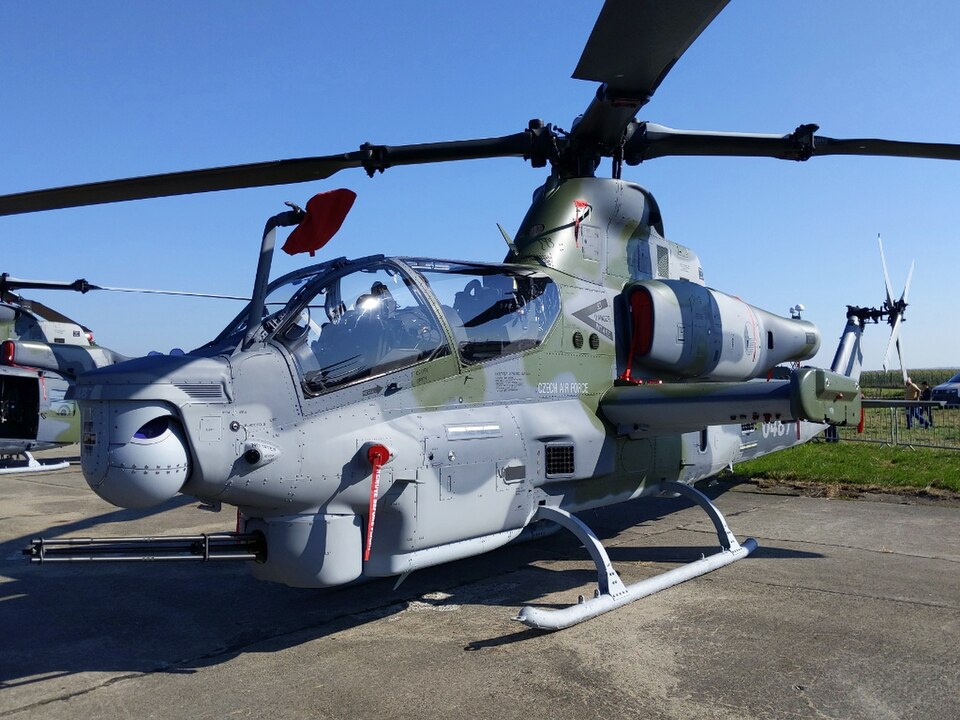
Few rivalries in military aviation spark as much debate as the one between the AH-1Z Viper and the AH-64 Apache. These two American attack helicopters represent the absolute best of rotary-wing combat aircraft — and yet they could not be more different in how they were built, who flies them, and what they were designed to do.
The Viper belongs to the United States Marine Corps. The Apache belongs to the U.S. Army. Both are fast, deadly, and packed with cutting-edge technology. Both have seen real combat. And both have their passionate defenders.
So when you put the viper helicopter vs apache side by side, which one actually comes out on top? The answer is more nuanced than you might think — and it all comes down to what you're comparing. Let's dig into the details.
Key Takeaways
The AH-1Z Viper is faster and more agile, making it a strong choice for missions that demand speed and air-to-air capability. The AH-64 Apache is heavier, carries a bigger punch, and offers superior targeting systems and combat range — making it the dominant platform for sustained ground-attack operations. Neither helicopter is strictly "better." Each excels in the role it was built for, and the best choice depends entirely on the mission.
| Feature | AH-1Z Viper | AH-64E Apache |
| Operator | U.S. Marine Corps | U.S. Army |
| Manufacturer | Bell Textron | Boeing |
| Max Speed | ~200 knots (230 mph) | ~150 knots (173 mph) |
| Classification | Medium attack helicopter | Heavy attack helicopter |
| Primary Gun | 20mm M197 cannon | 30mm M230 chain gun |
| Combat Range | ~125 miles | ~260 miles |
| Key Advantage | Speed and agility | Firepower and targeting |
| Air-to-Air Capable | Yes | Limited |
| Rotor Blades | 4-blade composite | 4-blade steel/composite |
If you love digging into aviation comparisons like this one, Flying411 is a great place to explore more deep-dive articles on aircraft performance, military aviation, and everything in between.
A Tale of Two Helicopters: Different Branches, Different Missions
Before comparing specs, it helps to understand why these two helicopters exist in the first place. The U.S. military does not simply pick one attack helicopter and hand it to everyone. Each branch has its own doctrine, its own mission profile, and its own requirements.
The U.S. Army operates in long-range land warfare scenarios. It needs a helicopter that can cover hundreds of miles of battlefield, destroy armored columns, and stay in the fight for extended periods. The Apache was built for exactly that.
The U.S. Marine Corps operates in expeditionary environments — often from ships, in tight combat zones, and alongside ground forces pushing inland from a coastline. The Marines need a helicopter that is lighter, faster, and easier to maintain in austere conditions. The Viper fits that role.
Why It Matters: The reason these two helicopters are hard to compare directly is that they were never intended to replace each other. They serve different commanders, different battle plans, and different operational realities.
The History Behind Each Aircraft
From Cobra to Viper: The AH-1Z Lineage
The AH-1Z Viper traces its roots back to the Bell AH-1 Cobra, which first flew in the 1960s and became iconic during the Vietnam War. Bell has been delivering helicopters to the U.S. military since 1959, starting with the UH-1 Iroquois — the famous "Huey."
The Viper itself emerged from the H-1 Upgrade Program, which the U.S. Department of Defense launched in 1996. The goal was to take the older AH-1W Super Cobra and transform it into a fully modern attack helicopter. Bell upgraded the airframe with a four-blade composite rotor system, an integrated glass cockpit, improved landing gear, and new engines.
The AH-1Z officially entered Marine Corps service in 2010. It replaced the two-bladed AH-1W Super Cobra and brought the Marines into a new era of rotary-wing attack capability.
Fun Fact: The four-blade composite rotor on the AH-1Z is said to be significantly quieter than the two-blade system it replaced — which matters more than you'd think when you're trying to approach an enemy position without being heard.
From AAH to Apache: The AH-64 Story
The AH-64 Apache has a longer and more storied history. In the early 1970s, the U.S. Army launched the Advanced Attack Helicopter (AAH) program, looking for a next-generation platform that could outperform the AH-1 Cobra in firepower, range, and performance. Hughes Helicopters won the contract, and the aircraft was officially named the Apache in late 1981 — following the Army's tradition of naming helicopters after Native American tribes.
The first production Apache entered Army service in 1986. It went on to see action in Panama, the Gulf War, the Balkans, Afghanistan, Iraq, and numerous other theaters. Over the decades, Boeing (which acquired Hughes) upgraded the platform through the AH-64A, B, C, D (Longbow), and finally the AH-64E Guardian — the current production model.
Good to Know: The AH-64 fleet has accumulated well over 5 million flight hours, including more than a million hours in combat operations — a testament to how widely used and battle-tested this platform truly is.
Side-by-Side Specs: Viper Helicopter vs Apache
Now for the part most people come here for. Here is how the two helicopters compare on the numbers that matter most.
Size and Weight
The two helicopters are remarkably similar in size. The AH-1Z is about 58.4 feet long and 14.3 feet tall. The AH-64E is about 58.2 feet long and 12.7 feet tall. So physically, they are almost twins.
Where they diverge is weight. The Viper has a maximum takeoff weight of around 18,500 lbs. The Apache comes in closer to 23,000 lbs when fully loaded for combat. That weight difference has real consequences for performance, range, and payload.
Pro Tip: Heavier is not always worse. The Apache's higher max takeoff weight means it can carry more weapons and fuel for longer missions — which is exactly what Army doctrine demands.
Speed and Agility
The AH-1Z Viper has a clear edge here. It can reach speeds of around 200 knots, or roughly 230 miles per hour. The AH-64E Apache tops out closer to 150 knots, or about 173 miles per hour. That is a meaningful gap.
The Viper's lighter airframe and modern composite rotor also give it better maneuverability. An Army Apache repairman once described the Viper as a "medium attack helicopter" while calling the Apache a "heavy" — and that classification captures the real difference well.
Combat Range
This is where the Apache pulls ahead significantly. The AH-64E has a combat radius of roughly 260 miles, depending on weapons load. The AH-1Z operates closer to a 125-mile combat radius under similar conditions. For Army operations that may require striking targets deep behind enemy lines, that extra range is not just useful — it's critical.
How They Compare: 8 Key Areas of the Viper vs Apache Matchup
Both helicopters are impressive on paper, but the real differences show up when you dig into specific categories. Speed, firepower, range, and survivability all tell different stories — and in some areas the gap between these two aircraft is surprisingly large.
Here is how the AH-1Z Viper and AH-64 Apache stack up across eight of the most important performance and capability areas.
1. Main Cannon
The AH-1Z Viper carries a 20mm M197 three-barrel rotary cannon. It is a potent weapon, but the Apache's 30mm M230 chain gun is significantly more powerful. The M230 can fire up to around 625 rounds per minute and is slaved to the pilot's helmet via the Integrated Helmet and Display Sighting System (IHADSS) — meaning the gun follows wherever the pilot looks.
The Apache's 30mm round hits harder and is more effective against armored targets. In the medium-versus-heavy distinction mentioned earlier, the cannon difference is one of the clearest examples.
2. Anti-Tank Missiles
Both helicopters can carry the AGM-114 Hellfire missile — the gold standard of helicopter-launched anti-tank weapons. The Hellfire is a laser-guided missile capable of destroying heavily armored vehicles at ranges of several kilometers.
The Apache can carry up to 16 Hellfires. The Viper carries fewer due to its smaller weapons pylons and lighter airframe. For pure anti-armor punch, the Apache wins on payload capacity.
Fun Fact: The name "Hellfire" is said to be a shortened acronym from the original program name: Helicopter Launched, Fire and Forget Missile. The Army reportedly liked the shorter version considerably more.
3. Air-to-Air Capability
This is one area where the Viper has a genuine and meaningful advantage. The AH-1Z was designed with air-to-air combat as part of its mission profile. It can carry AIM-9 Sidewinder air-to-air missiles and is equipped with systems designed to engage enemy aircraft.
The Apache can also carry Stinger or Sidewinder missiles, but air-to-air combat is far more central to the Viper's design philosophy. For the Marines operating in environments where enemy aircraft or helicopters may be a real threat, this matters.
4. Targeting Systems
The Apache has long been considered the gold standard for helicopter targeting technology. The AH-64D and AH-64E models carry the AN/APG-78 Longbow radar system, which is capable of tracking and prioritizing large numbers of targets simultaneously across a wide battlespace. Newer versions use Lockheed Martin's Modernized Target Acquisition Designation Sight/Pilot Night Vision System (MTADS/PNVS), providing enhanced visibility in all conditions.
The AH-1Z features a modern glass cockpit and a capable targeting suite, but the Longbow radar system on the Apache has no equivalent on the Viper. For large-scale armored engagements, the Apache's ability to rapidly identify and prioritize targets is a major tactical advantage.
Keep in Mind: The AH-64E can also control unmanned aerial vehicles (UAVs) from the cockpit, extending its sensor reach far beyond what the helicopter can see directly. This capability gives Army units a massive intelligence advantage on the modern battlefield.
5. UAV Integration
Speaking of drones — the AH-64E Guardian is built for drone teaming in a way the Viper simply is not. The latest Apache variants can command UAVs like the MQ-1C Gray Eagle directly from the cockpit, using them to scout ahead, mark targets, or even strike independently. This is a fundamental shift in how attack helicopters operate and gives the Apache a force-multiplication capability that is hard to overstate.
6. Survivability
The Apache was designed with crew survivability as a top priority. Its armored crew compartment can withstand hits from rounds up to 23mm. The airframe incorporates around 2,500 lbs of protective materials and a self-sealing fuel system. The rotor blades are engineered to absorb significant damage and keep flying.
The Viper is built tough as well, but it is lighter — and in this context, lighter means less armor. For heavily contested airspace with significant ground fire, the Apache's survivability edge is real.
Heads Up: Survivability is not just about armor plating. Both helicopters use different approaches to reduce their radar and infrared signatures, and both carry countermeasures systems to defeat incoming missiles.
7. Maintenance and Logistics
The AH-1Z has a notable advantage in maintenance simplicity. It shares a high degree of parts commonality with the UH-1Y Venom utility helicopter — both come from the H-1 upgrade program. For the Marines operating from ships and in expeditionary environments with limited maintenance infrastructure, that commonality is a huge practical benefit.
The Apache is a more complex aircraft. Its heavier systems and more advanced electronics require more maintenance hours per flight hour. For a land-based Army with robust logistics support, this is manageable. For austere shipboard operations, it's a challenge.
8. Export Success and Global Reach
The AH-64 Apache is the clear winner in terms of global adoption. More than 1,200 Apaches are currently in service with armies around the world, including those of the United Kingdom, Japan, Egypt, India, Israel, and many others. Apache production is reportedly booked out well into the 2030s.
The AH-1Z has found export customers as well — including Bahrain, the Czech Republic, and Nigeria — but in much smaller numbers. When South Korea chose between the two in the early 2010s, they selected the AH-64E. The Apache's track record and widespread support network make it a more attractive option for many buyers.
At Flying411, we cover a wide range of aviation topics — from military rotorcraft to general aviation and everything in between. If you're passionate about aircraft, you'll find plenty to dig into.
Which One Wins? Breaking Down the Results
There is no single winner here — and that's the honest answer.
If you value speed, maneuverability, air-to-air capability, and ease of maintenance in expeditionary conditions, the AH-1Z Viper is a remarkable aircraft that fits the Marine Corps mission like a glove.
If you value firepower, combat range, targeting sophistication, survivability, and drone integration, the AH-64E Apache is in a class of its own.
The Apache is often described as the heavier, more capable platform. The Viper is faster, lighter, and more agile. Think of it like comparing a heavy fighter to a sports car. Both are exceptional. Both serve a purpose. And neither should be dismissed.
Pro Tip: The best way to think about this comparison is by mission type. Short-range expeditionary support from a ship? Give the edge to the Viper. Long-range armored column destruction in a land war? The Apache is the choice.
One additional factor worth noting: the AH-1Z's production run for U.S. military use appears to be winding down, while the AH-64E continues to be manufactured and upgraded. The Apache's future includes the AH-64E Version 6.5, which adds even more advanced networking, drone-teaming, and targeting capabilities. Over time, that trajectory likely gives the Apache the long-term edge.
If you're curious how these attack helicopters compare to other rotary-wing aircraft, a breakdown of how the Seahawk and Black Hawk differ is a great starting point for understanding how mission requirements shape helicopter design. You might also find it useful to read about how gyrocopters differ from traditional helicopters to appreciate just how specialized attack helicopter design really is.
For those curious how attack helicopters stack up against fixed-wing aircraft, there is a detailed look at how the Apache compares to a fighter jet that puts the Apache's capabilities into an even wider context. And for a completely different angle on aviation, the comparison between helicopters and jets covers what separates rotary and fixed-wing platforms in terms of performance and role.
Real-World Combat Record
Both helicopters have earned their reputations in actual combat.
The Apache has the longer record. It played a key role in Operation Desert Storm, helping destroy Iraqi early warning radar installations in an action that opened the coalition's air campaign. It has seen extensive use in Afghanistan, Iraq, and other theaters over more than three decades of service.
The Viper is newer in its current form, but the Marine Corps has relied on the H-1 lineage — including the Super Cobra it replaced — in combat going back to Vietnam. The Viper itself has been used in combat operations in support of Marine expeditionary forces.
Both aircraft have proven themselves in real combat conditions. Neither is a paper tiger.
Good to Know: If you're wondering how drones are changing the attack helicopter world, a comparison of drone vs helicopter capabilities covers how unmanned systems are reshaping the battlefield role that helicopters have traditionally filled.
What About the Pilots?
Flying either of these helicopters requires extensive training and a military background. These are not civilian aircraft. But understanding what it takes to fly military rotorcraft can give you a deeper appreciation for how demanding the certification process is.
For those curious about what aviation licensing involves at a broader level, the difference between a helicopter license and a fixed-wing pilot license provides a helpful overview of how rotary-wing and fixed-wing training diverge.
Ready to go deeper into aviation? Flying411 covers everything from military aircraft comparisons to civilian flight training and general aviation news — and it's a great resource whether you're an enthusiast or a future pilot.
Conclusion
The viper helicopter vs apache debate is one of aviation's most engaging matchups — and for good reason. Both aircraft represent the pinnacle of American attack helicopter engineering, and both carry a legacy built in real combat around the world.
The AH-1Z Viper is fast, agile, and perfectly suited to the Marine Corps' way of war. The AH-64E Apache is heavier, more powerful, and loaded with targeting and drone-teaming technology that makes it the dominant platform for large-scale land operations.
Choosing between them is really a question of mission. And when the mission demands the best, both helicopters answer the call.
If this kind of deep-dive comparison is your thing, Flying411 has plenty more where this came from — pull up a seat and start exploring.
FAQs
What is the main difference between the AH-1Z Viper and the AH-64 Apache?
The biggest differences are in size, role, and operator. The Viper is a lighter, faster medium attack helicopter used by the U.S. Marine Corps, while the Apache is a heavier, more heavily armed platform used by the U.S. Army with superior range and targeting systems.
Is the AH-1Z Viper faster than the AH-64 Apache?
Yes. The AH-1Z Viper can reach speeds of around 200 knots, compared to the Apache's top speed of roughly 150 knots. The Viper's lighter airframe gives it a clear speed and agility advantage.
Can the AH-1Z Viper shoot down other aircraft?
The AH-1Z was designed with air-to-air capability in mind and can carry AIM-9 Sidewinder air-to-air missiles. This makes it more capable in air-to-air engagements compared to the Apache, which focuses primarily on ground attack.
How much does an AH-64 Apache cost?
The price for a modern AH-64E Apache Guardian is estimated at around $35 million per unit at base configuration, with fully equipped versions reportedly reaching closer to $50 million when advanced systems and weapons are included.
Why does the U.S. Marine Corps use the Viper instead of the Apache?
The Marines prioritize lighter, faster aircraft that can operate from ships and in expeditionary environments with limited maintenance support. The AH-1Z shares parts with the UH-1Y Venom utility helicopter, reducing logistics complexity — something that matters enormously in Marine operations.