You've heard both words your whole life. A news anchor says "the helicopter landed on the rooftop." Someone on the street watches it pass and says "look at that chopper." Same aircraft. Two very different words. So which one is right?
The short answer is: both are. But the longer answer is a lot more interesting. The debate between chopper vs helicopter touches on aviation history, military slang, popular culture, and how language takes on a life of its own. Whether you're new to aviation or just curious about the words people use, this breakdown will clear things up and give you a few fun facts to share the next time a rotorcraft flies overhead.
Key Takeaways
A chopper and a helicopter are the same aircraft. "Chopper" is an informal nickname that came out of military slang, most likely during the Korean War era, when soldiers described the rhythmic chopping sound of rotor blades slicing through the air. "Helicopter" is the formal, technical term used by pilots, the FAA, aviation professionals, and official documents. In everyday American English, both words are widely understood and used interchangeably, though context shapes which one fits better.
| Topic | Key Detail |
| Are they different aircraft? | No — a chopper is simply a nickname for a helicopter |
| Origin of "chopper" | Military slang, linked to the rotor blade's chopping sound and motion |
| Which term do pilots use? | "Helicopter" — professionals rarely say "chopper" |
| When is "chopper" appropriate? | Casual conversation, media, entertainment, informal contexts |
| When is "helicopter" appropriate? | Technical writing, official documents, formal communication |
| Other nicknames | Heli, helo (military), whirlybird, copter |
| FAA definition | A rotorcraft that depends on engine-driven rotors for horizontal motion |
Flying411 covers the world of aviation in plain language — from rotorcraft basics to buying your first aircraft, it's a go-to resource for anyone curious about flying.
Where Did the Word "Chopper" Come From?
The word "chopper" has a surprisingly rich history. It did not appear in aviation from day one. The formal term "helicopter" comes from Greek roots: "helix" meaning spiral, and "pteron" meaning wing. When Igor Sikorsky and other early aviation pioneers were developing practical rotary-wing aircraft in the late 1930s and early 1940s, "helicopter" was the standard term from the start.
"Chopper" came later, born out of practicality and personality. Most sources trace it to the Korean War, roughly between 1950 and 1953, when American military personnel began using it as shorthand. The rotor blades of Bell helicopters — particularly the small, nimble models used for medical evacuation during that conflict — made a distinctive rhythmic thud as they beat the air. Soldiers heard that chop-chop-chop sound and the nickname stuck.
Fun Fact: The Bell 47, a lightweight helicopter used for medical evacuation during the Korean War, is widely credited with popularizing the word "chopper" among U.S. military personnel. Its rotor sound was said to be especially pronounced.
By the time the Vietnam War rolled around, "chopper" was firmly embedded in military culture. Troops relied on helicopters for nearly everything — troop transport, supply runs, medical evacuations, and fire support. In that high-tempo, high-stakes environment, a short punchy word was more useful than a four-syllable technical term. "The chopper's coming" conveyed urgency in a way that felt natural.
From there, the word moved into pop culture. Movies, television, and news media picked it up. Action films from the 1970s and 1980s made "chopper" sound exciting and gritty. News crews covering breaking stories would cut to "the news chopper" overhead. Over time, millions of Americans heard the word so often that it became completely normal — even when they had no connection to aviation at all.
Why the Rotor Blades Inspired the Name
The physics behind the nickname make a lot of sense. Helicopter rotor blades do not simply spin — they cut through the air at high speed, generating lift by creating a pressure difference above and below the blade. That cutting, slicing motion is visually similar to chopping. And aurally, the sound it produces — especially on older or smaller rotorcraft — is unmistakably rhythmic, like something being chopped repeatedly.
Early observers, journalists, and soldiers saw and heard a machine that seemed to be literally chopping the sky. The name followed naturally.
The Technical Definition of a Helicopter
Before going further, it helps to know what a helicopter actually is — by the book.
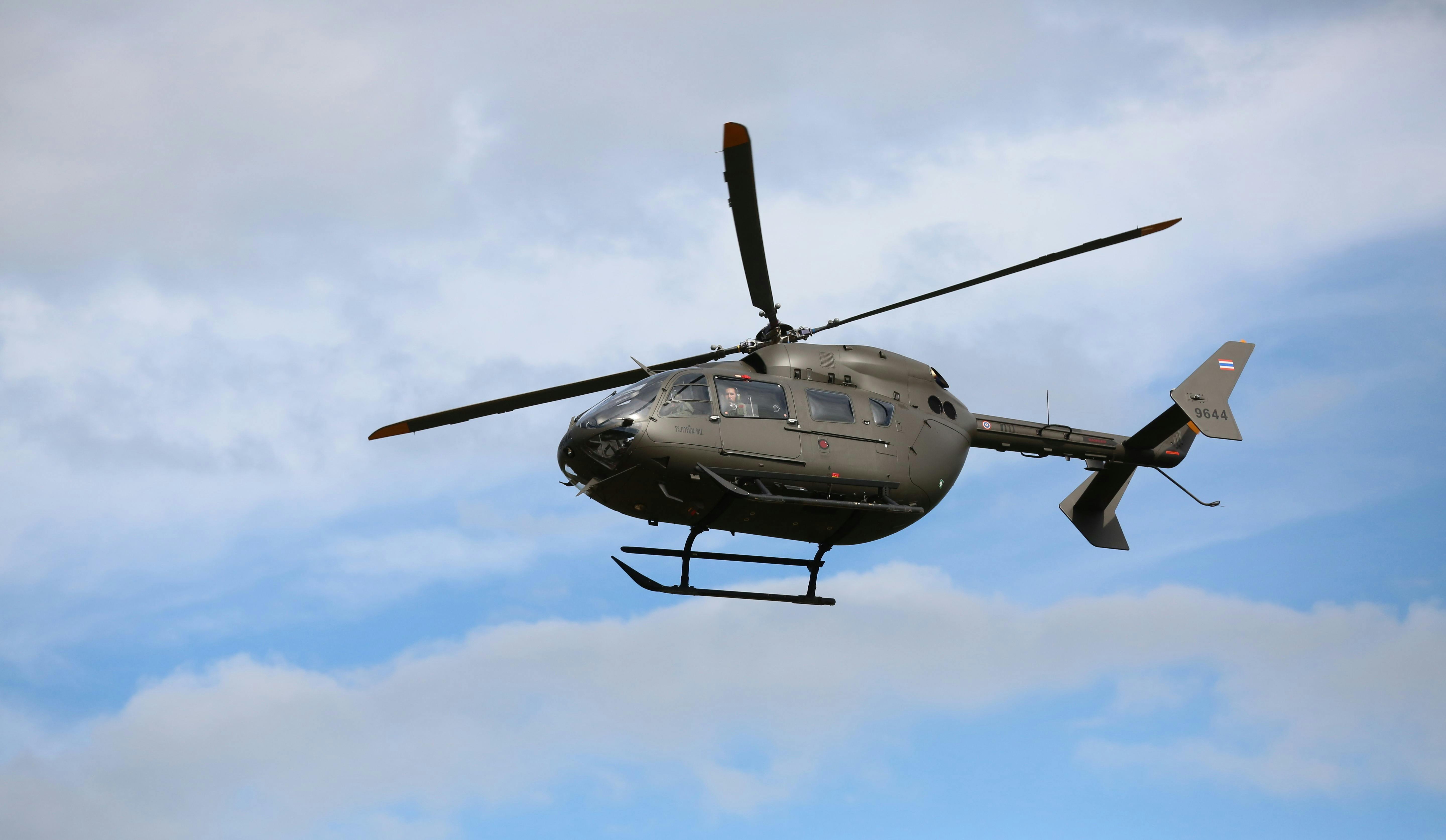
The FAA defines a helicopter as a rotorcraft that depends on engine-driven rotors for its horizontal motion. That means the spinning blades above the aircraft do two jobs at once: they generate lift (keeping the aircraft airborne) and thrust (moving it forward, backward, or sideways). This dual role is what makes helicopters so different from fixed-wing aircraft, which rely on forward speed and wing shape to stay aloft.
Good to Know: Helicopters are classified as rotary-wing aircraft. The broader category of "rotorcraft" also includes gyrocopters and autogyros — but those are different machines. A gyrocopter, for example, uses an unpowered rotor for lift and a separate engine for thrust, which is a meaningfully different design. You can read more about how gyrocopters and helicopters compare if you want to dig into that distinction.
Key helicopter capabilities include:
- Vertical takeoff and landing — no runway required
- Hovering — holding a fixed position in midair
- Omnidirectional flight — moving forward, backward, sideways, and diagonally
- Low-altitude operation — flying close to terrain, buildings, or water
These abilities make helicopters extraordinarily useful in situations where fixed-wing aircraft simply cannot operate.
How a Helicopter Generates Lift
The main rotor system does the heavy lifting — literally. As the blades spin, they create airflow over their curved surface, generating a low-pressure zone above the blade and a high-pressure zone below it. That pressure difference produces lift, pulling the aircraft upward.
A tail rotor counteracts the torque produced by the spinning main rotor. Without it, the fuselage would spin in the opposite direction of the blades. The tail rotor provides directional control and keeps everything pointed the right way.
The pilot uses three main controls:
- Collective — changes the pitch of all rotor blades simultaneously, raising or lowering altitude
- Cyclic — tilts the rotor disk to direct movement horizontally
- Tail rotor pedals — adjust yaw, or the direction the nose is pointing
Pro Tip: Helicopter controls require more coordination than fixed-wing controls. Changing one input often requires adjusting the others to compensate. This is one reason helicopter pilots describe flying as a constant balancing act.
Chopper vs Helicopter: Key Differences in How the Words Are Used
Here is where the real comparison lives. The aircraft itself is identical. What changes is the word — and the word carries a lot of baggage.
| Category | Helicopter | Chopper |
| Formality | Formal, technical | Informal, casual |
| Who uses it | Pilots, FAA, engineers, journalists | General public, media, military slang |
| Contexts | Official docs, manuals, news | Movies, everyday conversation, action scenes |
| Connotation | Neutral, professional | Edgy, urgent, cool |
| Geographic preference | Universal | More common in American English |
| Can refer to other things? | No | Yes — also a type of motorcycle, a cutting tool |
In the Aviation Industry
Ask a working helicopter pilot what they fly and they will almost certainly say "helicopter." Aviation professionals, mechanics, air traffic controllers, and FAA examiners use the formal term. In official communication — flight plans, maintenance logs, airworthiness certificates — only "helicopter" appears.
This is not a rule anyone had to write down. It is simply a reflection of professional norms. The industry treats "chopper" the way a surgeon might treat "tummy" — technically understood, but not something you say in the operating room.
Why It Matters: In aviation, precise language matters for safety. Using standardized terms eliminates ambiguity in high-stakes communication. That is why "helicopter" dominates in professional settings, even when "chopper" is perfectly clear in casual use.
In the Military
Military usage is the exception. American service members have used "chopper" and "helicopter" interchangeably for decades, and both are considered acceptable in that context. Vietnam veterans and Korean War veterans are on record using the terms side by side, often in the same sentence. The word "helo" (pronounced HEE-lo) is also common in U.S. military aviation slang, especially in the Navy and Marine Corps.
In Media and Pop Culture
Hollywood loves the word "chopper." It sounds harder, faster, more cinematic. A character in a thriller does not duck as a helicopter approaches — they duck as a chopper swoops in. The word carries a kind of urgency and cool that "helicopter" simply does not have in an entertainment context.
News broadcasts blend both terms. A reporter might say "the police helicopter is circling the area" in a formal standup, then cut to a chyron that reads "NEWS CHOPPER LIVE." Both are intentional choices shaped by tone and pacing.
The Many Roles of Helicopters (By Any Name)
Regardless of what you call them, helicopters are among the most versatile aircraft ever built. Here is a look at the major roles they fill — and why no other aircraft type can fully replace them.
1. Search and Rescue
Helicopters can hover over precise locations, lower rescue swimmers or medics on cables, and operate in conditions that ground teams cannot reach. They are essential in maritime rescue, mountain rescue, and disaster response. The ability to land in a clearing or on a rooftop gives them a reach that no fixed-wing aircraft can match.
2. Emergency Medical Services
Air ambulance helicopters transport critically injured patients faster than ground units can travel in congested or remote areas. Onboard medical teams can begin treatment in flight, and modern EMS helicopters are equipped to function as mobile trauma units. Response time saved is often the difference between survival and loss.
3. Military Operations
Military helicopters serve in roles ranging from troop transport to armed attack. The UH-60 Black Hawk, one of the most recognized military helicopters in the world, handles troop transport, medevac, and special operations. Attack helicopters carry weapons systems designed for air-to-ground engagements. You can explore how the Seahawk and Black Hawk helicopters compare for a closer look at military variants.
4. Law Enforcement
Police aviation units use helicopters for suspect pursuit, surveillance, search and rescue, and SWAT support. <br>Thermal imaging cameras, searchlights, and night vision equipment make police helicopters effective around the clock. According to a 2024 report by Bell, there are roughly 4,000 public safety helicopters operating globally — a figure that reflects how central aerial support has become to modern law enforcement.
5. Firefighting
Helicopters carry water or fire retardant to attack wildfires from above. Some are equipped with large tanks or hang a Bambi bucket — a collapsible water container — beneath the fuselage to scoop water from nearby lakes or reservoirs. They also transport firefighters to remote locations inaccessible by road.
6. News and Media
Aerial news coverage relies heavily on helicopters. News organizations use them to broadcast live footage of traffic, weather, breaking events, and natural disasters. The "news chopper" — to use the popular term — has been a fixture of American television since the 1960s.
7. Tourism and Sightseeing
Helicopter tours offer views that no ground-level experience can replicate. Cities like New York, Las Vegas, and Honolulu operate regular sightseeing flights that give passengers aerial perspectives of landmarks and landscapes. Heli-skiing operations use helicopters to drop skiers onto backcountry slopes.
8. Offshore Energy
Oil and gas platforms rely on helicopters to transport crews and equipment to and from offshore rigs. These flights operate in challenging maritime conditions and require specialized aircraft and highly trained pilots.
9. Agriculture
Agricultural helicopters spray crops, apply fertilizers, and support land surveys across large farming operations. Their ability to fly low and slow over irregular terrain makes them effective where ground equipment is impractical.
10. VIP and Executive Transport
High-net-worth individuals, government officials, and corporations use helicopters to bypass ground traffic and reach destinations quickly. Executive helicopters are configured for comfort, with soundproofing, leather seating, and advanced avionics.
If you're researching helicopter ownership or aviation investments, Flying411 offers practical guides to help you understand the costs, types, and considerations involved.
How Does a Helicopter Compare to Other Aircraft?
The helicopter occupies a unique space in aviation — it is not the only rotary-wing aircraft, and it is certainly not the only aircraft people compare it to.
Helicopter vs. Jet Aircraft
Jets are faster and more fuel-efficient over long distances, but they require runways and cannot hover. Helicopters trade speed for flexibility. For short urban hops or operations in remote terrain, a helicopter wins on access every time. The comparison between helicopters and jets highlights just how different their strengths are.
Helicopter vs. Drone
Drones — or unmanned aerial vehicles — can perform some helicopter-like missions at a fraction of the cost. Surveillance, photography, and package delivery are areas where drones are increasingly competitive. But drones cannot carry passengers or large payloads, and they are restricted in many airspace environments. The differences between drones and helicopters are worth understanding for anyone following aviation technology trends.
Attack Helicopter vs. Fighter Jet
In military aviation, the comparison between attack helicopters and fighter jets reveals dramatically different design philosophies. Attack helicopters specialize in low-altitude, close-support roles — suppressing ground targets and supporting infantry. Fighter jets operate at high speed and altitude, engaging aerial threats and striking targets at range. You can read more about how the Apache helicopter compares to a fighter jet to see those differences laid out clearly.
Keep in Mind: No single aircraft type is best at everything. Helicopters are unmatched in low-speed, low-altitude versatility. Jets dominate in speed and range. Drones are changing the equation in surveillance and light operations. The right tool depends entirely on the mission.
Helicopter Licensing: What Does It Take to Fly One?
Getting behind the controls of a helicopter — or a chopper, if you prefer — requires dedicated training and certification. The FAA issues a separate rotorcraft-helicopter rating, which is distinct from a fixed-wing pilot certificate.
Helicopter student pilots must learn to manage all three controls simultaneously, master hovering (one of the most physically demanding skills in aviation), and develop comfort with autorotation — the emergency procedure used if engine power is lost.
Training typically involves a combination of ground school, simulator time, and flight hours with a certified flight instructor. The requirements differ between a private pilot certificate and a commercial certificate. Understanding the differences between a helicopter license and a general pilot license is a good starting point if you're thinking about learning to fly.
Heads Up: Flying a helicopter is significantly more expensive than flying a fixed-wing aircraft, both in training costs and ongoing operating expenses. Fuel burn, maintenance complexity, and instructor rates all tend to be higher. Factor this in early when budgeting for flight training.
Should You Say Chopper or Helicopter?
Here is a simple way to think about it.
Use "helicopter" when:
- Writing a report, article, or official document
- Speaking with aviation professionals
- Filing paperwork or communicating with the FAA
- You want to be unambiguous in any international context
Use "chopper" when:
- You are in casual conversation
- You are writing fiction, entertainment scripts, or informal content
- You are in a military context where the slang is understood
- You just think it sounds cooler — because honestly, it does
Neither word is wrong. They describe the same machine. The choice is entirely about register, audience, and tone.
Quick Tip: If you are traveling internationally, stick with "helicopter." The informal slang "chopper" is most common in American English and may cause confusion in other English-speaking regions or among non-native English speakers.
Conclusion
The chopper vs helicopter debate turns out not to be a debate at all. They are the same remarkable aircraft, just dressed in different language. "Helicopter" is the precise, professional term — the one that belongs in cockpits, control towers, and official documents. "Chopper" is the word that came up from the trenches, from soldiers who heard those rotor blades chopping the air over Korea and Vietnam, and it never left the cultural vocabulary.
Both words point to one of the most capable and versatile machines ever built by human hands — an aircraft that can hover motionless, land in a parking lot, and fly where no jet or drone can follow. Whether you call it a chopper or a helicopter, the respect the machine has earned is the same.
If you want to learn more about helicopters, compare aircraft types, or explore what it takes to get into aviation, Flying411 is the resource that keeps it all straightforward, honest, and accessible — no jargon required.
FAQs
Is a chopper the same thing as a helicopter?
Yes. "Chopper" is an informal nickname for a helicopter. The two terms refer to the same type of aircraft. The difference is only in formality and context.
Why do pilots not usually say "chopper"?
Most helicopter pilots and aviation professionals use "helicopter" because it is the precise, standardized term used across the industry. "Chopper" is understood but considered informal, similar to calling a car a "ride" in a professional setting.
What other nicknames exist for helicopters?
Common nicknames include "heli," "helo" (used in the U.S. military, particularly the Navy), "copter," and "whirlybird." Each has its own cultural or regional origin, though none are used in formal aviation communication.
Where did the word "helicopter" originally come from?
The word comes from the Greek words "helix" (meaning spiral) and "pteron" (meaning wing). It was used to describe the spiral-wing concept of rotary-wing flight long before practical helicopters were built.
Can helicopters fly in bad weather?
Some helicopters are certified for instrument flight rules (IFR) operations, meaning they can fly in low visibility and poor weather conditions using cockpit instruments alone. Many smaller or older helicopters are limited to visual flight rules (VFR) and must stay out of clouds and low visibility conditions. Weather capability depends heavily on the specific aircraft and its avionics.