A Grand Caravan burns roughly 0.35 gallons of Jet A for every nautical mile it travels. A PC-12 covers that same mile on about 0.24 gallons. The airplane with the bigger hourly fuel bill is the cheaper one per mile, and that single inversion explains most of the arguments people have about these two airplanes.
The Cessna 208B Grand Caravan vs Pilatus PC-12 question gets framed as a budget decision, but it almost never is. These are two different tools that happen to share a propeller, a PT6 and a single pilot seat. One is a truck with wings that will land on 2,000 feet of gravel with 3,000 pounds in the back. The other is a pressurized, 280-knot office that crosses three states before lunch. Pick the wrong one and you will spend years paying for capability you never use.
The Short Answer
Buy the Caravan if your flying is short, heavy and unpaved: cargo feeder routes, skydiving, floats, island hops, mission and utility work, or anything where the payload number matters more than the clock. Buy the PC-12 if you move people instead of boxes over 400 to 1,200 nautical miles, want a pressurized cabin with a lavatory, and need to arrive fast enough that a business day still works. The Caravan is cheaper to buy, cheaper per hour and tougher on rough strips. The PC-12 costs more per hour and less per mile, and it is the only one of the two that makes a 900-nm day trip practical.
What Each One Really Costs Per Hour
Hourly numbers in aviation are only as honest as the assumptions behind them, so here are the assumptions: Jet A at about $6.50 per gallon at a typical FBO in late 2025 (operators with contract fuel often pay a dollar or more less), average annual utilization of 300 to 400 hours, and engine money set aside every hour rather than borrowed from the future.
| Variable cost item | Cessna 208B Grand Caravan | Pilatus PC-12 (NG) |
| Fuel | ~58 gph, about $375/hr | ~65 gph, about $425/hr |
| Engine reserve or program rate | $150–$200/hr | $225–$275/hr |
| Propeller reserve | $20–$30/hr | $25–$35/hr |
| Scheduled and unscheduled maintenance | $150–$200/hr | $200–$275/hr |
| Typical variable total | $700–$800/hr | $900–$1,050/hr |
| Cost per nautical mile at normal cruise | about $4.60 | about $3.70 |
These are planning figures drawn from operator-reported budgets and engine program rates, not quotes. Your real number swings with fuel price, how hard you push the engine and whether you are on a Pratt & Whitney Canada Eagle Service Plan or self-insuring the overhaul.
Fixed costs tell a similar story. Insurance on an owner-flown PC-12 commonly lands somewhere between the high teens and the mid-thirties in thousands of dollars a year, with low-time pilots paying more and sometimes being required to carry a mentor pilot for the first season. Caravan hull values are generally lower, so premiums usually are too, though commercial Part 135 operations push them back up. Both airplanes need real hangar space, both need recurrent training at a simulator provider, and both will cost you $6,000 to $12,000 a year to keep a pilot current and insurable.
Why It Matters: The PC-12 costs roughly 25 to 35 percent more per hour and still moves a passenger-mile for less money. If your missions are 150 nm hops, that efficiency never shows up on your invoice. If they are 700 nm, it shows up every single trip.
If you want to build your own numbers rather than borrow ours, our guide on how to calculate aircraft operating cost per hour walks through the same method we used above, and how much to set aside per flight hour covers the reserve side in detail.
Edge: Caravan on cost per hour, PC-12 on cost per mile — which one counts depends entirely on how far you fly.
Payload and Range: What You Can Actually Carry
This is where brochure numbers mislead people most. Both airplanes advertise useful loads in the 3,500 to 3,900 pound range. Neither will carry that much and full fuel at the same time, because no airplane does.
Textron Aviation currently publishes a useful load of approximately 3,532 pounds for the Grand Caravan EX, with 335 gallons of usable fuel weighing approximately 2,246 pounds. That leaves around 1,286 pounds of payload with full tanks in the published configuration. On shorter missions, carrying less fuel can free up considerable payload capacity, although the aircraft's maximum payload, cargo compartment limits and weight-and-balance restrictions still apply. This ability to trade unnecessary fuel for additional freight is one of the Caravan's greatest advantages.
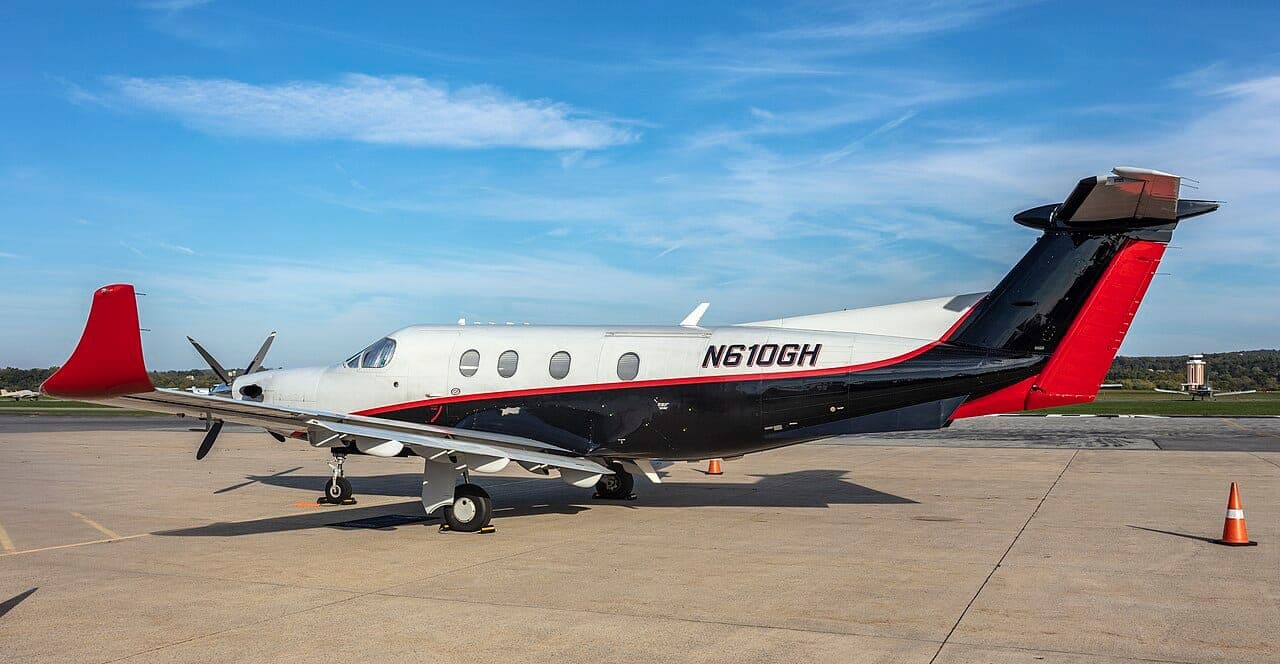
The Pilatus PC-12 NGX has a maximum takeoff weight of 10,450 pounds and approximately 2,704 pounds of usable fuel. In a representative six-seat executive configuration, Pilatus publishes a basic operating weight of approximately 6,803 pounds, leaving about 943 pounds of available payload with full fuel. Other aircraft configurations may differ. The PC-12 also has a maximum zero fuel weight of 9,039 pounds, which limits how much payload can be carried even when fuel is reduced. Buyers must calculate the individual aircraft's weight and balance rather than assume it can carry six adults and their baggage with full tanks.
Range is the mirror image. Textron quotes maximum range of about 964 nm for the Grand Caravan EX, and in practice owners plan 600 to 750 nm legs at useful loads. Pilatus quotes about 1,800 nm for the NGX at long-range cruise with four passengers. A PC-12 flies Dallas to Seattle with one stop and does New York to Miami nonstop with the family aboard. A Caravan doing that trip is a two-day event.
Heads Up: The Caravan is unpressurized. Its 25,000-foot certified ceiling exists mostly for terrain and weather, not for comfort — above roughly 12,500 feet you are on oxygen, and with passengers in the back that gets old fast. Most Caravan time is flown in the low teens or below, right where the weather lives.
| Specification | Cessna 208B Grand Caravan EX | Pilatus PC-12 NGX |
| Engine | Pratt & Whitney Canada PT6A-140, 867 shp | Pratt & Whitney Canada PT6E-67XP, 1,200 shp |
| Maximum takeoff weight | 8,807 lb | 10,450 lb |
| Typical useful load | ~3,500 lb | ~3,800 lb |
| Usable fuel | 332 US gal (about 2,224 lb) | about 402 US gal (about 2,700 lb) |
| Payload with full fuel | ~1,300 lb | ~1,100–1,200 lb |
| Maximum cruise speed | 185 ktas | 290 ktas |
| Typical cruise fuel burn | 55–65 gph | 60–72 gph |
| Maximum range | about 964 nm | about 1,800 nm |
| Maximum operating altitude | 25,000 ft | 30,000 ft |
| Pressurization | None | Yes, 5.75 psi differential |
| Takeoff over 50 ft at MTOW | about 2,160 ft | about 2,650 ft |
| Landing over 50 ft | about 1,870 ft | about 1,830 ft |
| Cabin length / width / height | about 16.6 ft / 5.25 ft / 4.5 ft | about 16.9 ft / 5.0 ft / 4.8 ft |
| Maximum seating | Up to 14 including crew | Up to 9 passengers plus crew |
| Lavatory | No | Yes (executive configurations) |
| Float and amphibian options | Yes, factory-supported | No |
Edge: Caravan for raw payload on short legs, PC-12 for carrying people a long way in one go. Genuinely a draw until you name the mission.
Flying411 keeps single-engine turboprop listings in one place, so you can compare a Grand Caravan and a PC-12 side by side without hopping between brokers.
Speed, Pressurization and What the Cabin Feels Like
The speed gap is the largest single difference between these airplanes, and it compounds. A PC-12 NG cruises around 270 to 280 knots true at FL280. A Grand Caravan EX tops out near 185 knots and most owners plan 160 to 170. On a 600-nm trip that is roughly two hours twenty in the Pilatus against three hours forty in the Cessna. Do that trip twice a week and the PC-12 gives you back something like 120 hours a year.
Pressurization changes more than comfort. The PC-12 climbs over most weather instead of threading it, keeps a cabin near 10,000 feet at the top of its FL300 ceiling, and lets passengers sit in normal clothes with a drink and a laptop. It has a flushing lavatory in executive layouts, a real airstair door and an aft cargo door big enough for a wheelchair or a bicycle. Pilatus built it as an executive airplane that happens to be good at dirt strips.
The Caravan cabin is wider at the floor and taller in the aisle than most people expect, but it is noisier, colder at altitude and shaped around boxes. Nine to fourteen seats fit in commuter layouts, which is why so many island and regional carriers fly them. For passengers on a 35-minute hop between islands, nobody cares. For a 500-nm business trip in summer turbulence, everybody cares.
Keep in Mind: Both aircraft can be equipped and approved for flight into known icing conditions, but operators must verify the individual aircraft's installed equipment, certification and operating limitations. The PC-12's higher cruise altitude and climb performance may provide more options for avoiding some icing layers, although climbing clear is never guaranteed. The unpressurized Caravan generally operates at lower altitudes and has a history of icing-related operating restrictions and safety concerns. In either aircraft, known-icing approval does not authorize unrestricted flight through severe icing or freezing precipitation outside the aircraft's approved envelope.
Edge: PC-12, and it is not close, for anything involving paying passengers in the back and a schedule to keep.
Maintenance, Engines and Downtime
Both airplanes are built around PT6A variants, which is the best news in this comparison. Parts are everywhere, overhaul shops are everywhere, and the failure modes are documented better than almost any powerplant in general aviation.
Earlier Grand Caravan models use the 675-shp Pratt & Whitney Canada PT6A-114A, while the Grand Caravan EX uses the 867-shp PT6A-140, which has a published 4,000-hour overhaul interval in Textron's aircraft specification documentation. Earlier Pilatus PC-12 models use the PT6A-67B, and the PC-12 NG uses the PT6A-67P. The PC-12 NGX uses the electronically controlled PT6E-67XP, featuring integrated engine and propeller controls, a published 5,000-hour TBO, and 600-hour scheduled maintenance intervals. Its digital monitoring capabilities help manage engine health but do not eliminate scheduled overhaul requirements. Engine maintenance costs depend on the specific model, operating program and component condition.
Airframe maintenance is where the Caravan quietly wins. It is a simple, unpressurized, fixed-gear airplane with a phased inspection program, and the mechanic population that knows it is enormous — Textron says more than 3,000 Caravans have been delivered since 1984, and a large share of them fly commercially every day. The PC-12 adds retractable gear, a pressure vessel and more systems, and while Pilatus support is widely regarded as the best in the business, there are fewer shops that truly know the airplane and they are not cheap.
Good to Know: Whichever you buy, the logbooks matter more than the paint. Turbine airplanes are bought on records: engine trend monitoring data, cycle counts, compliance with service bulletins and ADs, and corrosion history on float-operated Caravans. Our guide on how to verify real engine and airframe hours is worth reading before you put money down.
Edge: Caravan. Simpler airplane, broader shop network, smaller engine events.
Where Each One Can Operate
Runway performance is closer than the weight difference suggests. The Grand Caravan EX needs about 2,160 feet to clear 50 feet at max weight; the PC-12 needs around 2,650. Both land in under 2,000 feet over an obstacle. Both are certified for unimproved surfaces, and Pilatus has gone out of its way to prove the PC-12 on gravel and grass.
The separation shows up in the margins. The Caravan sits high on fixed gear with a propeller well clear of the dirt, carries an optional cargo pod, and is available on amphibious floats — a factory-supported option that opens up an entire category of work the PC-12 simply cannot do. Operators in Alaska, the Maldives, the Canadian north and the Caribbean fly Caravans for exactly that reason. The PC-12's retractable gear and lower-slung prop make it capable off hard-packed surfaces but less suited to repeated rough-field pounding, and no one is putting floats on one.
There is also the regulatory dimension. Both are approved for single-pilot operation, and both are heavily used in Part 135 charter and cargo work. The PC-12 became the dominant single-engine turbine in US passenger charter partly because the FAA allowed single-engine IFR passenger operations under Part 135, and the Caravan dominates the small-package feeder world for the same structural reason — it carries freight cheaply over short stages.
Pro Tip: If there is any chance you will put the airplane on a charter certificate later, talk to an operator before you buy, not after. Interior configuration, avionics and inspection program choices that are fine for a private owner can cost five figures to unwind when a Part 135 certificate holder adds the aircraft.
Edge: Caravan, for the simple reason that it can go places the PC-12 cannot, including water.
Flying411 keeps turbine listings, specifications and seller details in one place, so you can compare equipment, engine time and configuration before you call anyone.
Resale and How the Market Treats Each One
Both airplanes hold value unusually well for the category, and for the same reason: steady commercial demand underneath the private market. When a private owner sells a Caravan, there is a cargo feeder, a skydiving operation or a missionary group that wants it. When a private owner sells a PC-12, there is a charter operator or a fractional program that wants it. That floor is why neither type depreciates like a piston twin.
Acquisition costs are substantially different. The Grand Caravan EX generally occupies a lower price bracket than a comparably modern PC-12. However, Pilatus introduced the PC-12 PRO in March 2025, with customer deliveries beginning later that year, making it the successor to the NGX. Buyers comparing new aircraft in 2026 should therefore consider the PC-12 PRO, while the NGX remains an important used-market option. Earlier PC-12s and Grand Caravans sell for significantly less than newer examples, with equipment, engine condition, maintenance history and airframe hours strongly influencing individual prices.
One factor that favors the Caravan on resale: the global fleet is large and international, and the airplane's buyers are often operators who care about hours remaining and nothing else. One that favors the PC-12: the airplane has had essentially no credible direct competitor for 30 years, and its reputation with charter operators keeps the bid strong. The arrival of the Beechcraft Denali may change that calculus over time, which we covered in our Denali versus PC-12 comparison.
Edge: Draw. Both hold value better than almost anything else with one engine.
Which One Should You Buy?
The owner-flown business traveler. You fly 200 to 300 hours a year, mostly 400 to 900 nm, usually with two to five people and bags, and you need to be there for a 10 a.m. meeting. Buy the PC-12. The pressurization, the speed and the cabin are the entire point, and the higher hourly rate buys you shorter days and fewer overnight stays. A Caravan would technically do these trips and you would hate every one of them by the second winter. If you are weighing the PC-12 against a smaller, faster single, our look at used PC-12 versus TBM 850/900 ownership costs covers that fork.
The operator hauling freight, jumpers, divers or passengers on short stages. Your legs are under 300 nm, your revenue is tied to pounds or seats rather than speed, and your airfields are not always paved. Buy the Caravan, and buy the 208B rather than the shorter 208 unless you have a specific reason not to — we break that choice down in Cessna 208 versus 208B. Lower acquisition cost, lower hourly cost and a maintenance network that spans the planet make the economics work at rates a PC-12 cannot match.
The mixed-mission owner or non-profit. You carry people some days and cargo others, you operate into strips that are not always kind, and some destinations are on water. Caravan, with a cargo pod and possibly floats. You will give up speed and comfort, but you will be able to say yes to missions the PC-12 has to decline. This is the profile where the Caravan's flexibility is worth real money.
The step-up buyer coming from a cabin-class piston twin. If you are moving up from something like a 340A or a 421C, the PC-12 is the natural landing spot — similar cabin feel, pressurization you already understand, and one turbine instead of two tired geared pistons. Budget for a serious jump in fixed costs, not just hourly ones. Readers making that comparison often start with our Cessna 414A versus 421C cost-per-hour breakdown before pricing turbines.
Fun Fact: FedEx Feeder helped make the Caravan what it is. The airline ordered the type in quantity in the 1980s and shaped the design brief around picking up freight at small airports in weather, which is a large part of why the airplane carries such a big door, such a sturdy gear and such a forgiving wing.
Matching the Airplane to the Mission, Not the Spec Sheet
The honest resolution of Cessna 208B Grand Caravan vs Pilatus PC-12 is that these airplanes barely compete. They overlap on a Venn diagram of "single turbine, nine-ish seats, short-field capable," and almost nowhere else. Write down your last twenty trips — distance, people, weight, surface, weather — and one of these two will be obviously wrong. If most of those legs are under 300 nm and heavy, the Caravan will save you money every hour you fly. If most of them are over 500 nm with passengers who expect to be comfortable, the PC-12 will save you time you cannot buy back, and it will do it for less money per mile than the airplane that looks cheaper on paper.
Whichever way you lean, buy on records and engine time first and cosmetics last. A turbine single with clean logs, trend monitoring data and time left before overhaul is worth far more than a pretty one with a question mark in the engine section.
Flying411 keeps Caravan and PC-12 listings in one place, so you can compare engine time, configuration and equipment across both types before you commit to a type at all.
When you are ready to compare listings, visitFlying411and see what is on the market today.