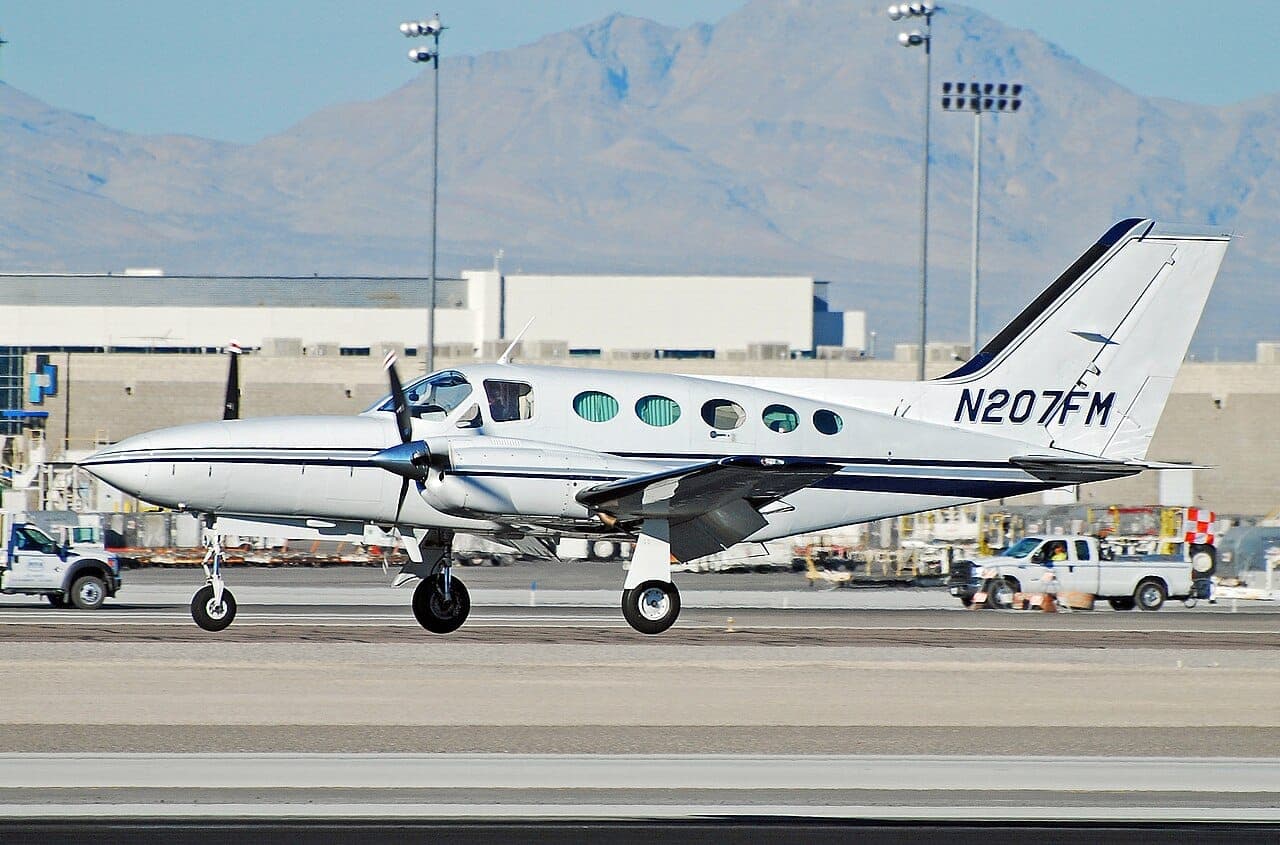
Ask around a twin Cessna ramp and someone will tell you the geared engines on a 421C have a shorter published overhaul interval than the direct-drive engines in a 414A. That is not always true. Continental lists a 1,600-hour recommended TBO for the GTSIO-520-L in the Golden Eagle. The Chancellor's TSIO-520-NB has a 1,600-hour baseline, increasing to 1,800 hours for eligible engines with serial number 1006000 or later. The gearbox does not automatically mean a shorter published TBO, but the installed engine's model, serial number and maintenance history matter.
So the real question in a Cessna 414A vs 421C comparison is not whether the geared engine dies early. It is where the extra money actually goes, and whether what you get back — payload, a lower cabin altitude, about fifteen more knots — is worth roughly a hundred dollars an hour in direct operating cost. Over 150 hours a year, that gap is about $15,000. That is the difference between an airplane you fly and an airplane that sits.
This article walks the numbers line by line, using 2025 shop quotes and fuel prices, so you can see which part of the gap is the gearbox and which part is simply the cost of 130 extra horsepower.
Key Takeaways
Yes, the 421C costs more per hour than the 414A — roughly $100 to $110 more in direct operating cost at today's fuel prices — but only about a quarter of that gap belongs to the gearbox itself. The bigger share is fuel, because 375 horsepower per side burns more than 310 does, and the rest is spread across a more complex exhaust and accessory section. Continental lists the same 1,600-hour TBO for both engines, so the geared engine is not a short-life engine on paper; it is an unforgiving one in practice, and a 421C flown by someone who yanks the throttles will not see TBO. Per nautical mile the gap narrows to about 14 percent, because the 421C is genuinely faster and carries several hundred more pounds. If you fly four people and bags under 600 nautical miles, the 414A is the cheaper and easier airplane; if you regularly fill the seats and need the altitude, the 421C earns its keep.
What "Geared" Actually Changes
The TSIO-520-NB in the 414A is a direct-drive engine. The crankshaft turns, the propeller turns, same speed, 2,700 rpm at full power for 310 horsepower a side. Simple.
The GTSIO-520-L in the 421C adds a reduction gearbox between the crankshaft and the propeller flange. That lets the crankshaft spin to 3,400 rpm — much faster than a direct-drive Continental — while the propeller turns well below that. The engine makes 375 horsepower per side out of the same 520 cubic inches, and the propeller still works in an efficient speed range instead of pushing its tips toward the speed of sound.
Think of it the way a bicycle works. You can pedal slowly in a high gear, or quickly in a low one, and the gearing is what lets your legs spin at a comfortable rate while the wheel does something different. The gearbox buys horsepower and a quieter, smoother propeller disc. It also buys parts that the 414A simply does not have.
Why the geared engine has a bad reputation
The GTSIO-520's reputation for eating itself comes from two things, and neither is the gear train failing on its own.
The first is specific output. At 375 horsepower from 520 cubic inches, the GTSIO works each cylinder harder than the 414A's engine does at 310 horsepower from the same displacement. Cylinder head temperatures run higher, valves and guides see more heat, and top overhauls between majors are more common. Operators and twin Cessna shops consistently report that cylinder work, not gearbox work, is what makes a 421C expensive.
The second is pilot technique. A geared engine does not like having the propeller drive it. Chop the throttles in a descent and the windmilling prop pushes back through the gear train, loading teeth that were designed to be pushed the other way. Pilots trained properly on the 421C lead with gentle throttle movements and hold a minimum manifold pressure in descent so power always flows engine-to-propeller. Do that, and 1,600-hour runs are normal. Fly it like a 182 and you will meet your overhaul shop early.
Heads Up: Insurance underwriters know this. Most will require formal initial and annual recurrent training in a 421C simulator before they will write a policy, and a few will not quote a low-time owner-pilot at all. Budget for the training before you budget for the airplane.
Flying411 keeps pressurized twin Cessna listings in one place, so you can compare engine times, SID status and avionics across the 340A, 414A and 421C without chasing five different brokers.
Fuel Burn and the Cost of Speed
Fuel is the single largest line item in either airplane, and it is where most of the per-hour gap lives.
A 414A at a typical 65 percent cruise in the low twenties burns somewhere around 16 to 17 gallons per side, so call it 33 gallons an hour total, holding roughly 190 to 200 knots true. A 421C at a comparable setting burns about 19 to 21 gallons per side — 40 gallons an hour total — for roughly 205 to 215 knots true. Owners who lean aggressively and accept slower cruise can pull both numbers down, and owners who run high power settings in the flight levels will see both go up.
At $6.50 a gallon for 100LL, a price that is realistic for self-serve at a mid-size field in 2025 and low for full service at a busy one, that is about $214 an hour in the 414A and about $260 in the 421C. Forty-six dollars an hour, before anything else happens.
But fuel per hour is the wrong unit for a traveling airplane. Divide by speed and the picture shifts. The 414A spends about $1.10 of fuel per nautical mile; the 421C about $1.24. On a 500-nautical-mile leg that is a $70 difference, and the 421C gets there roughly fifteen minutes sooner with more in the back.
Why It Matters: If you mostly fly short legs with two people aboard, you pay the 421C's fuel premium and never collect the payload or speed that justifies it. The geared engine makes economic sense when the airplane is loaded and the legs are long.
The Head-to-Head Numbers
| Item | Cessna 414A Chancellor | Cessna 421C Golden Eagle |
| Engines | Two Continental TSIO-520-NB, 310 hp each, direct drive | Two Continental GTSIO-520-L, 375 hp each, geared |
| Published TBO | 1,600 hours; 1,800 for qualifying later TSIO-520-NB engines | 1,600 hours |
| Production years | 1978–1985 | 1976–1985 |
| Approximate number built | About 516 | About 860 |
| Max takeoff weight | 6,750 lb | 7,450 lb |
| Typical useful load | Approximately 1,750–1,950 lb | Approximately 2,000–2,300 lb |
| Usable fuel, standard main tanks | Approximately 202 gal | Approximately 206 gal |
| Typical cruise, mid-twenties | 190–200 kt true | 205–215 kt true |
| Typical total fuel burn at 65% | About 33 gph | About 40 gph |
| Max cabin pressure differential | 4.4 psi | 5.0 psi |
| Field overhaul, per engine (2025 shop quotes) | $55,000–$70,000 | $75,000–$95,000 |
| Engine reserve, both engines, per hour | About $75 | About $103 |
| Fuel cost per hour at $6.50/gal | About $214 | About $260 |
| Estimated total direct cost per hour | $440–$470 | $540–$580 |
| Direct cost per nautical mile | About $2.33 | About $2.65 |
The direct-cost rows above include fuel, oil and consumables, engine and propeller reserves, turbocharger and exhaust reserves, and an allowance for the annual inspection and routine maintenance spread over 150 flight hours a year. They do not include insurance, hangar, financing, database subscriptions or recurrent training. Those are fixed costs, and they punish the owner who flies fifty hours a year far more than the one who flies two hundred.
If you want to build your own version of this table with your own fuel price and your own annual utilization, our walkthrough on how to calculate aircraft operating cost per hour lays out the method step by step.
Overhaul, Top Overhaul and the Parts Bill
Here is the part of the gap that genuinely belongs to the gearbox.
A field overhaul on a TSIO-520-NB from a shop that does nothing but twin Cessnas runs roughly $55,000 to $70,000 per engine as of 2025, depending on whether cylinders are new or reconditioned, what the crankshaft inspects out at, and what accessories go with it. The same shops quote roughly $75,000 to $95,000 for a GTSIO-520-L. The gear train, the gear case, and the additional inspections required on those components account for most of the difference.
Spread across 1,600 hours and two engines, that is about $75 an hour of reserve in the 414A against about $103 in the 421C. Twenty-eight dollars an hour. Real money, but notably less than the fuel difference, and far less than the hangar talk suggests.
Where the 421C quietly costs more is between overhauls. Cylinder work on a high-output geared engine is more frequent, and a top overhaul on one side can run $18,000 to $25,000 once you have pulled, inspected and replaced six jugs with associated labor. The 414A's engines are not immune — turbocharged Continentals are hard on cylinders in any installation — but owners of both types report the 421C needing jug work sooner and more often.
Keep in Mind: "Mid-time" means less on a geared engine than on a direct-drive one. An 800-hour GTSIO-520 that has been flown by three different renters and descended at idle is worth less than a 1,200-hour engine flown by one careful owner with a borescope report every annual. Buy the logbook and the oil analysis history, not the tach number.
Parts availability is the other quiet difference. There are more TSIO-520 cores in circulation than GTSIO-520 cores, and more shops comfortable working on them. When a gear case needs replacing, you wait. Twin Cessna specialists are honest about lead times, and a 421C down for a gearbox part can sit for weeks longer than a 414A down for a cylinder.
If you want more background on how Continental's 520-series engines are put together and what changes between variants, our comparison of the IO-520 and IO-550 covers the family's architecture, and the Lycoming IO-540 versus Continental IO-520 piece explains why Continental's big-bore design behaves the way it does under heat.
Airframe Maintenance: Where They Are Almost the Same
This is the part buyers underestimate. Strip the engines out of the comparison and these two airplanes are close cousins. The 414 was created by hanging lower-powered engines on a pressurized fuselage borrowed from the 421 — a Golden Eagle cabin at a Chancellor price. The 414A gained the wet wing and the higher gross weight, but the cabin cross-section, the pressurization plumbing, the gear, and most of the systems are family.
That means the airframe bills look similar. A clean annual inspection on either airplane at a shop that knows the type runs roughly $9,000 to $15,000 as of 2025. Add deferred items, corrosion, a leaking door seal or a tired gear actuator and it doubles without much effort. Turbocharged exhaust systems on both airplanes crack, and they get inspected often, because an exhaust leak inside a nacelle is a fire risk rather than an inconvenience. Both run dual magnetos per engine, which means four magnetos per airplane and four 500-hour inspections to schedule — our guide to the magneto 500-hour check explains when overhauling beats replacing.
The SID question
Cessna published Supplemental Inspection Documents for its 400-series twins, covering structural areas such as wing spars, carry-through structure, control surfaces and the pressure vessel. In the United States, whether a particular SID inspection is mandatory depends on applicable airworthiness directives, airworthiness limitations and the aircraft's approved or required maintenance program. Ordinary Part 91 owners are not automatically required to complete every manufacturer-recommended SID, while Part 135 operators may have additional inspection-program obligations. Other countries can impose different requirements, so owners should verify the rules applicable to their aircraft and operation.
A first-time SID compliance on a 414A or a 421C can run well into five figures, and the number depends almost entirely on what the inspectors find once panels come off. The airplanes are the same age and the inspections are the same inspections. This cost does not favour either model — but an airplane that has already been through SIDs, with the paperwork to prove it, is worth meaningfully more than one that has not.
Good to Know: Ask for SID status in writing before you spend a dollar on a pre-buy. "The shop says it has been done" is not the same as a signed compliance list that names each inspection and the date it was performed.
Flying411 keeps maintenance-heavy details like engine time, last overhaul date and inspection history alongside each listing, so you can compare two cabin-class twins on condition rather than on asking price alone.
Payload, Cabin and Mission Fit
The 421C's case rests here, not on efficiency.
Max takeoff weight is 7,450 pounds for the 421C and 6,750 pounds for the 414A. Equipped useful loads vary considerably, but a published Twin Cessna ownership comparison places typical 414A examples around 1,750 to 1,950 pounds and many 421Cs around 2,000 to 2,300 pounds. With 202 gallons of usable main-tank fuel, a 414A carrying 1,850 pounds of useful load has approximately 638 pounds remaining for occupants and baggage. A 421C with 206 gallons of usable main-tank fuel and 2,000 to 2,300 pounds of useful load has approximately 764 to 1,064 pounds remaining. Optional tanks, installed equipment and the individual aircraft's weight and balance can change these figures significantly.
The 421C also pressurizes harder. Published maximum differential is 5.0 psi against the 414A's 4.4, which puts the cabin roughly 1,500 feet lower at any given flight level. On a four-hour leg at FL240 with a passenger who gets headaches, that is not a specification — it is the reason they agree to fly with you again.
Climb and single-engine performance favour the 421C as well, which matters on a hot day out of a high-elevation field with the airplane loaded. The 414A climbs adequately; the 421C climbs with authority. If your routes involve terrain, the extra 130 horsepower per side changes what you can legally and comfortably plan.
Pro Tip: Weigh the airplane you are buying. Published useful loads for both types came off factory paperwork decades ago, and forty years of avionics, insulation, paint and interior work have added weight to most airframes. A current weight and balance from an actual scale run is one of the cheapest items in a pre-buy and one of the most revealing.
If you are still deciding between the whole twin Cessna family rather than just these two, our broader look at the 340A, 414A and 421C covers where the smaller 340A fits. Owners looking at unpressurized alternatives often cross-shop the Navajo Chieftain and Cessna 402C, which trade the pressure vessel for lower upkeep.
So Does the Geared Engine Really Cost More?
Yes — but not for the reason most people give.
Break the roughly $105-an-hour estimated direct-cost gap into its parts and about $46 comes from fuel under the stated cruise assumptions. Another $28 comes from the higher estimated engine overhaul reserve, using a 1,600-hour planning interval for both engine types. That reserve difference reflects the entire GTSIO-520 overhaul package, including its gearbox and other engine components, rather than the gearbox alone. The remainder is an allowance for additional cylinder, accessory, exhaust and unscheduled maintenance. Actual costs depend on the engines installed, shop quotations and operating conditions.
Put differently: the gearbox accounts for roughly a quarter of the difference. Horsepower accounts for most of the rest. If someone sells you a 421C on the premise that the geared engines are the only reason it costs more, they have skipped the arithmetic.
The honest summary of operating economics is that the 414A is cheaper per hour and cheaper per mile, and the 421C is cheaper per pound-mile when you actually fill it. Under about four people and bags, the 414A wins outright. Above that, the 421C is not a luxury — it is the only one of the two that can legally do the trip with full fuel.
Heads Up: Neither airplane forgives low utilization. Pressurized twins punish sitting: seals dry out, cylinders corrode, and the annual grows. Below roughly 75 hours a year, the fixed costs on either model swamp every per-hour figure in this article, and a charter card starts to look sensible. Our guide to how much to set aside per flight hour shows how to build reserves that survive a slow year.
Flying411 keeps current cabin-class twin listings in one place, so you can compare a fresh-engine 414A against a mid-time 421C and see what the market is really asking for each.
Conclusion
The answer to the Cessna 414A vs 421C question comes down to how often your airplane is full. Both engines carry the same 1,600-hour TBO, both airframes carry the same SID burden, and both annuals land in the same five-figure neighbourhood. The 421C costs roughly $100 to $110 more per flight hour in direct costs, and about three quarters of that is simply what 750 total horsepower drinks and wears compared with 620.
Buy the 414A if you fly two to four people on legs under 600 nautical miles, want the shorter list of specialist shops to matter less, and would rather spend the savings on avionics. Buy the 421C if you regularly carry five or six, fly longer legs, or operate from hot and high fields — and only if you will commit to the recurrent training that keeps the gear train happy. The geared engine is not fragile. It is specific about how it is flown, and the owners who respect that get to 1,600 hours as reliably as anyone flying a Chancellor.
Whichever way you lean, buy the maintenance history first and the airplane second. A 421C with documented compression trends and a careful single owner will cost you less over five years than a 414A with fresh paint and vague logbooks.
When you are ready to compare listings, visitFlying411and see what is on the market today.
Frequently Asked Questions
Does the GTSIO-520 have a shorter TBO than the TSIO-520?
No. Continental publishes a 1,600-hour recommended time between overhauls for both the GTSIO-520-L used in the 421C and the TSIO-520-NB used in the 414A. Earlier geared variants fitted to the 421, 421A and 421B carried shorter recommended intervals, which is where much of the confusion comes from. Remember that TBO is a recommendation, not a limit, for privately operated aircraft under Part 91 — condition and compliance with airworthiness requirements determine when an engine actually comes off.
How much more does a 421C cost per hour than a 414A?
Using 2025 fuel at $6.50 a gallon and 150 flight hours a year, direct operating cost works out to roughly $440 to $470 an hour for a 414A and $540 to $580 for a 421C. That is about $100 an hour, or around $15,000 a year at that utilization. Per nautical mile the gap shrinks to about 14 percent, because the 421C cruises faster.
Is a top overhaul more likely on the geared engine?
Owners and twin Cessna shops report more frequent cylinder work on the GTSIO-520 than on the TSIO-520, and the reason is specific output rather than the gearbox. The geared engine makes 375 horsepower from the same displacement that produces 310 in the Chancellor, so each cylinder works harder and runs hotter. Careful leaning, a well-set-up engine monitor and disciplined descent planning all push that interval further out.
Can a low-time pilot get insured in either airplane?
It is harder than most first-time twin buyers expect, and harder in the 421C than the 414A. Underwriters typically want a multi-engine rating, meaningful total time, formal initial training in type and annual recurrent training thereafter, plus a dual check-out period with a type-experienced instructor. Owners report annual hull and liability premiums in the $10,000 to $22,000 range as of 2025, with the 421C generally at the higher end. Get a quote before you make an offer, not after.
What should a pre-buy inspection focus on for these two?
Borescope every cylinder and get compression numbers in writing; pull and inspect the exhaust system in both nacelles; check SID compliance documentation item by item; look hard at the pressure vessel, door seals and the area around the wing carry-through for corrosion; and verify gear rigging and actuator condition. On a 421C, add a gearbox inspection and a close read of oil analysis history. Use a shop that works on 400-series Cessnas every week, not the one closest to the airplane.
Which one is easier to sell later?
Both have small, knowledgeable buyer pools, and in both cases engine time, SID status and avionics drive the price far more than the model badge does. The 414A draws more first-time cabin-class buyers because the operating numbers are less intimidating; the 421C draws buyers who need the payload and are not shopping on cost per hour. An airplane with current paperwork, documented engine care and modern avionics sells in either type. One without sits.