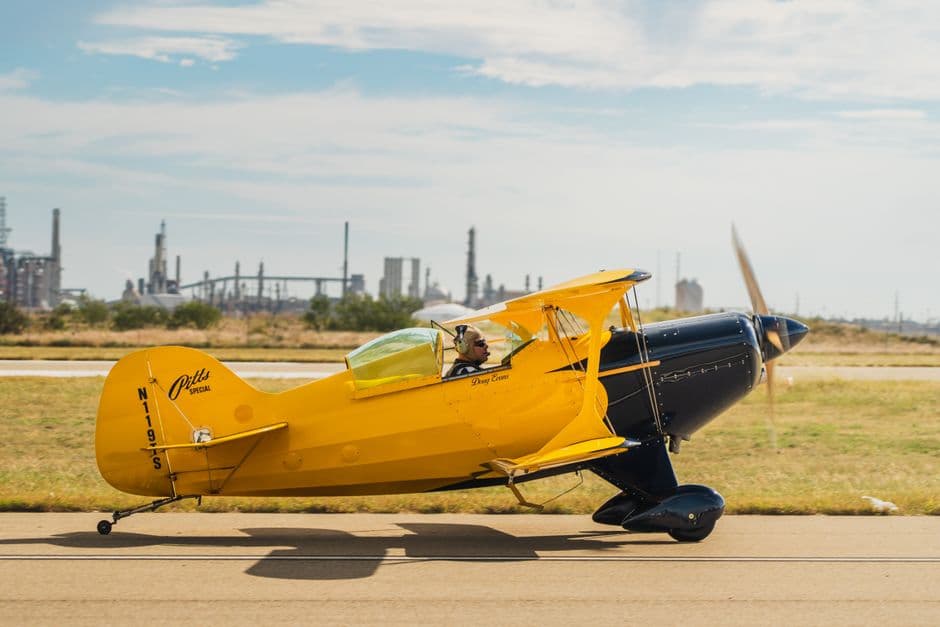
The assumption behind most Pitts shopping is that the single-seat airplane is the cheap one. On the purchase price and at the fuel pump that holds up nicely. Where it falls apart is the insurance quote and the first six months of ownership, because nobody can sit behind you in a single-seat biplane and talk you through your first wheel landing. That is the honest frame for Pitts S-1 vs Pitts S-2B: you are not just choosing between one seat and two, you are choosing between a lower sticker price with a steeper entry cost, and a higher sticker price that buys you a training airplane you can grow into.
Both are the same basic idea — a small steel-tube, wood and fabric biplane that Curtis Pitts first drew up in 1944 and that has been winning contests ever since. They just solve the problem at different sizes. Think of the S-1 as a sport motorcycle and the S-2B as the same machine stretched for a pillion seat and given a much bigger motor to carry it.
The Short Answer
Buy the single-seat S-1 if you already have solid tailwheel and aerobatic time, you fly alone, you want the lowest cash cost per hour, and you are comfortable carrying liability-only insurance or accepting a stiff hull rate. Buy the two-seat S-2B if you are coming to the Pitts from a Decathlon or a Citabria, want dual instruction from a Pitts-qualified instructor, plan to share the airplane with a partner or carry passengers, or need an aircraft that allows you to complete an insurer-required checkout. The S-1 is cheaper to own. The S-2B is cheaper to learn in, and for a lot of first-time Pitts buyers that is the number that actually decides it.
What You Are Actually Buying
"Pitts S-1" is not one airplane, and that matters more than any spec sheet. The S-1C and S-1D are amateur-built airplanes made from plans, usually with a 150 hp Lycoming O-320 or a 180 hp O-360 and flat-bottom lower wings. The S-1S is the factory-certified single-seater, with symmetrical wings, four ailerons and a 180 hp Lycoming IO-360. The S-1T added a 200 hp AEIO-360 and a constant-speed prop. Later one-off derivatives like the S-1-11B "Super Stinker" carry 260 hp. Two airplanes with the same three-letter label can be twenty years and forty thousand dollars apart in what they are worth and what they can legally do.
The S-2B is far more uniform. Christen Industries put it into production in the early 1980s and Aviat Aircraft of Afton, Wyoming carried it on until the S-2C replaced it in the late 1990s. Every one has a 260 hp Lycoming AEIO-540-D4A5 driving a Hartzell constant-speed propeller, two seats in tandem with the pilot in command in the back, and a factory type certificate behind it. Aviat still supports the type with parts, which is a real and underrated advantage when you need a wing fitting or a cowling piece.
Fun Fact: Betty Skelton's S-1C, "Little Stinker," hangs upside down in the entrance hall of the Smithsonian's Udvar-Hazy Center. It is painted red and white and it is roughly the size of a large motorcycle with wings — which is exactly the right first impression of what an S-1 is.
The category difference drives paperwork too. An experimental amateur-built S-1 gets a condition inspection every twelve months, which the original builder can sign off if they hold the repairman certificate for that airplane, or any A&P can do. A certified S-1S, S-1T or S-2B needs a full annual inspection signed by an A&P with inspection authorization, and every applicable airworthiness directive has to be tracked and complied with. The Pitts AD history has centred on wood wing spars, wing attach hardware and fuel system items over the years, so get the AD research done as part of the prebuy rather than discovering it in your first annual.
Why It Matters: If a seller cannot tell you which S-1 variant you are looking at, which wings are on it and whether it was built from plans or by the factory, you are not ready to make an offer. On this type, the variant is the valuation.
Purchase Price: Where the Money Really Goes
Asking prices on both types move around with engine time, fabric age and avionics, so treat any number you read as a starting point and check what is actually listed today. What is reliable is the shape of the market. Plans-built S-1C and S-1D airplanes sit at the bottom, often with older engines, fixed-pitch props and flat-bottom wings. Factory S-1S and S-1T airplanes sit a tier above, because they are certified, symmetrical-wing airplanes with better aerobatic manners and a traceable history. S-2B prices sit above both, with a wide spread between a high-time ex-school airplane and a low-time private example with fresh fabric.
The important point for a buyer is that the purchase price is the smallest part of the gap. On a fabric-and-wood aerobatic biplane, the three numbers that really set your cost of entry are time since engine overhaul, time since the airplane was last recovered, and whether the wood has ever been opened up and inspected properly. A cheap Pitts with a 1,900-hour engine and 25-year-old fabric is not cheap. It is a payment plan with the invoices still in front of you.
Pro Tip: Budget a prebuy by a shop that knows Pitts airplanes specifically, not just any A&P. They will pull inspection panels to look at the wood spars and ribs for compression cracks and glue failures, check the wing attach fittings for corrosion, punch-test the fabric, and look hard at the tailwheel spring and lower longerons. A few hundred dollars of inspection here routinely saves five figures.
One more purchase-side difference: resale. The S-2B has a built-in buyer pool because flight schools, ride operators and aerobatic instructors want two seats. A single-seat Pitts sells to a narrower group — people who already know they want a single-seat Pitts. In a slow market that usually means the S-1 sits on the market longer, even when it is priced fairly.
Edge: S-1 on cash outlay, S-2B on how easy it is to sell again.
Flying411 keeps aerobatic singles and two-seaters in one place, so you can compare engine times, fabric age and asking prices across the whole Pitts family before you book a prebuy.
Insurance: Where the Single-Seat Pitts Bites
This is the dimension that surprises people, and it is the reason this article exists. Aerobatic biplanes are a specialty line. The underwriters who write them are a short list, and they price on pilot experience far more than on airplane value.
For either airplane, expect the application to ask for a tailwheel endorsement, meaningful tailwheel pilot-in-command time — commonly in the 25 to 50 hour range before a hull quote gets interesting — plus dual aerobatic instruction and a checkout. Liability-only coverage for a qualified pilot is usually affordable, in the high hundreds to low thousands of dollars a year. Hull coverage is where it gets expensive: brokers who place aerobatic hulls generally quote a percentage of the insured value rather than a flat figure, and on a Pitts that percentage runs several times what you would see on a nosewheel trainer. For reference, you can see what the other end of the scale looks like in our Cessna 172 insurance price guide — a 172 owner and a Pitts owner are not shopping in the same world.
Here is the structural problem with the S-1. An insurer's favourite risk-control tool is "X hours of dual in make and model before solo." You cannot do that in a single-seat airplane. There is no back seat. Your first flight in your S-1 is a solo flight, no matter how experienced you are, and underwriters price that reality in. The usual workaround is to do your dual in an S-2B or a similar type with a Pitts-experienced instructor, then present that time on the application. Some owners of experimental S-1s skip hull coverage entirely, insure liability only and self-fund the airframe risk. That is a legitimate strategy, but it means a ground loop comes out of your own pocket.
The S-2B flips it. Dual in type is available, so the underwriter can write a sensible requirement and you can meet it. Rates as a percentage of hull value tend to be a little friendlier for the same pilot. But the S-2B is worth more, so the dollar premium is usually the larger of the two anyway. If you plan to carry passengers or give instruction, say so up front — passenger-carrying and instructional use change the policy, and quietly doing either outside the policy terms is how claims get denied.
Heads Up: Check whether your policy covers aerobatics at all, and whether it covers competition and airshow flying. Plenty of standard policies exclude airshow and competition operations, or require a separate endorsement. Read the exclusions page before you enter your first contest.
Edge: S-2B. Easier to insure, easier to satisfy the open-pilot and checkout requirements, even though the premium dollars are higher.
Side-by-Side Numbers
Figures below are for the factory-certified Pitts S-1S and the Christen/Aviat Pitts S-2B, using manufacturer published data. Plans-built S-1C and S-1D airplanes vary widely and should be checked against the individual airplane's own weight and balance and flight manual.
| Spec | Pitts S-1S | Pitts S-2B |
| Seats | 1 | 2, tandem (PIC in rear) |
| Certification | Type certified (S-1C/S-1D are amateur-built) | Type certified |
| Engine | Lycoming IO-360, 180 hp | Lycoming AEIO-540-D4A5, 260 hp |
| Propeller | Fixed pitch | Hartzell constant speed |
| Published TBO | 2,000 hours | 2,000 hours |
| Wingspan | 17 ft 4 in | 20 ft 0 in |
| Length | About 15 ft 6 in | 17 ft 9 in |
| Typical empty weight | Approximately 720–850 lb, depending on aircraft configuration | About 1,150 lb |
| Maximum Gross weight | 1,150 lb | 1,700 lb normal category; 1,625 lb aerobatic category |
| Useful load | Approximately 300–430 lb, depending on actual empty weight | About 475 lb in aerobatic category or 550 lb in normal category, based on a 1,150 lb standard empty weight |
| Fuel capacity | About 20 US gal | 29 US gal total (28 usable) in normal operations; 24 US gal total (23 usable) permitted for aerobatic operations |
| Cruise | About 150 mph (130 kt) | About 152 mph (132 kt) |
| Rate of climb | About 2,600 fpm | About 2,700 fpm |
| Roll rate | Roughly 180 deg/sec | Roughly 200–240 deg/sec |
| Typical aerobatic fuel burn | 13–15 gph | 18–22 gph |
| Typical cruise fuel burn | 10–12 gph | 14–16 gph |
| Hangar footprint | Fits almost any T-hangar | Fits most T-hangars; measure the door |
Keep in Mind: The S-2B's 475-pound useful load in the aerobatic category is not as generous as it sounds. Its 24-gallon fuselage tank holds approximately 144 pounds of fuel, leaving about 331 pounds for occupants and parachutes at the standard 1,150-pound empty weight. The additional five-gallon wing tank is intended for normal-category cross-country operations and must not be counted as usable fuel during aerobatics. Actual payload depends on the aircraft's weight and balance, and two adults with parachutes may exceed the aerobatic weight limit.
Maintenance, Fabric and Engine Reserves
Both airplanes are steel-tube fuselages with wood wings under fabric. That construction is strong, repairable and light, and it ages a bit like a wooden boat — fine for decades if it stays dry and gets looked at, expensive if it has sat outside with a tired cover. Fabric life depends on the covering system and the storage, and a full strip-and-recover on a Pitts is a five-figure job at any competent shop, with the S-2B costing more simply because there is more of it. Any wood that turns up rotten or cracked while the airplane is open adds to that.
Inspections are the routine cost. An experimental S-1 condition inspection is the cheapest line item in this comparison, often under $1,500 when an A&P does it and effectively free in labour if you built the airplane and hold the repairman certificate. A certified S-1S or S-1T annual is a step up. An S-2B annual is the most expensive of the three: six cylinders instead of four, a constant-speed prop and governor, two sets of controls, two seats and harnesses, and more fabric to inspect. Nothing exotic, just more of everything.
Engine equipment also differs between Pitts variants. The certified S-1S originally uses a Lycoming IO-360-B4A, while the S-2B uses an AEIO-540-D4A5 equipped for inverted operation. Owners should verify the installed engine, inverted oil and fuel systems, and any approved modifications before budgeting maintenance. Aerobatic engines also lead a hard life — constant power changes, negative g, lots of cycles. Many Pitts owners report overhauling before the published 2,000-hour TBO, not because the engine fails but because an aerobatic engine that is nursed past its best is a bad bet over a hard deck. Plan your reserve against something closer to 1,500 hours of useful life than 2,000.
Overhaul cost is the biggest single difference between the two airplanes. A four-cylinder 360-series overhaul is substantially cheaper than a six-cylinder 540, and the S-2B adds a constant-speed propeller overhaul on top. Our guide to what aircraft engines actually cost walks through how field overhauls, factory overhauls and factory rebuilts differ in price and in what you get. If you are buying an older Pitts with an older engine, our piece on maintaining vintage aircraft engines is worth reading before you commit.
Here is a worked hourly estimate. These are planning numbers built from stated assumptions, not quotes: 100LL at $6.50 a gallon (a reasonable 2025 US self-serve average, with coastal FBOs charging more), and engine reserve calculated as overhaul cost spread over 1,500 hours.
| Direct hourly cost | Pitts S-1S | Pitts S-2B |
| Fuel, mixed aerobatic and cruise flying | 12 gph = $78 | 17 gph = $111 |
| Engine overhaul reserve | $25–$30/hr | $35–$45/hr |
| Propeller and accessory reserve | $3–$5/hr | $8–$12/hr |
| Routine maintenance between annuals | $15–$25/hr | $20–$35/hr |
| Rough direct total | $120–$140/hr | $175–$205/hr |
Add fixed costs on top: hangar, insurance, annual or condition inspection, database and ADS-B equipment if fitted, and a recovering fund. Hangaring a Pitts is one of the few places where it is genuinely cheap — both airplanes are small enough to tuck into a standard T-hangar, and the S-1 will often share one. Leaving a fabric airplane tied down outside is the single fastest way to turn a good Pitts into a project.
Good to Know: Neither airplane is a cross-country machine, and the fuel numbers tell you why. Twenty gallons at 11 gph in an S-1 is under two hours with any sensible reserve, and the seating position and noise mean you will want to stop before the fuel does. People do fly Pitts airplanes long distances. They just do it in legs.
Edge: S-1, clearly. Smaller engine, fixed-pitch prop, fewer systems, cheaper inspections and a cheaper overhaul.
Flying411 keeps engine times, propeller details and fabric history visible on listings in one place, so you can compare what a Pitts is really going to cost you after the purchase, not just at it.
Flying It: Training, Currency and What Each Gives Back
The S-1 is the sharper airplane. It is lighter, it decelerates faster, and it responds to small inputs in a way that rewards a current pilot and punishes a rusty one. Visibility over the nose on the ground is close to zero, so you taxi in S-turns and you fly a curved approach. Landings are the hard part on both airplanes — the gear is stiff, the wheels are small, and the airplane has no interest in staying straight if you let it drift. Insurers know the claim history here. So do owners.
The S-2B carries more mass and more inertia. That does not make it forgiving exactly, but it does make it steadier, and the 260 hp engine gives you energy to fix mistakes. More to the point, it has a back seat. You can get a proper checkout in it. You can bring a coach along for contest practice and have them watch your sequence from inside the airplane rather than from a lawn chair. You can take your partner or your kid flying. For a lot of owners, that last item alone justifies the bigger engine bill.
Competition-wise, the S-1 family is the lighter and more capable platform at the top end — factory S-1S and S-1T airplanes have been contest winners for decades, and a US team flying S-1S airplanes took the 1972 World Aerobatic Championships. The S-2B is a genuinely competitive airplane through the middle categories and is the airplane most aerobatic schools in the US chose when they needed something stronger than a Decathlon.
Heads Up: Under FAR 91.307, if you carry anyone other than a required crewmember and exceed 60 degrees of bank or 30 degrees of pitch, every occupant needs an approved parachute, and that parachute has to have been packed within the preceding 180 days by a certificated rigger for a synthetic canopy. Two rigs plus repacks are a real recurring cost on the S-2B that the S-1 owner flying solo does not carry.
Currency matters more than hours on either airplane. Pitts pilots who fly weekly stay sharp. Pitts pilots who fly four times a year tend to have a bad afternoon eventually. If your realistic flying rate is low, the two-seater at least lets you buy an hour with an instructor to knock the rust off, which you cannot do in your own S-1.
Edge: S-2B for learning, coaching and sharing. S-1 for the pilot who already has the skills and wants the purest version of the airplane.
Which One Should You Buy?
The experienced tailwheel pilot who flies alone. If you have a few hundred hours of tailwheel time, you have done real aerobatic training in a Decathlon or an S-2 and you have nobody to take along, buy the S-1. It costs less to acquire, it costs about a third less per hour to fly, the inspections are cheaper, and when the engine comes due you are writing a four-cylinder cheque instead of a six-cylinder one. Decide early whether you want hull coverage. If the answer is yes, get a quote before you make an offer, because the answer may shape which S-1 you buy. If the answer is liability only, make sure you can genuinely absorb the loss of the airframe.
The move-up pilot coming from a Citabria or Decathlon. Buy the S-2B. The extra money buys you the one thing you actually need right now — an instructor in the airplane with you while you learn to land it. Factor the parachutes, the higher premium and the 540 overhaul reserve into your first-year budget. If after two hundred hours you decide you only ever fly solo, sell it and move to an S-1 with a much stronger insurance résumé behind you. That path costs more over five years but it is the low-risk one, and the S-2B will resell faster than the S-1 will.
The partnership or the ride-giver. S-2B, with no real argument. Two seats means two people can fly together, an instructor can check out each partner, and if you ever want to offset costs with instruction or rides, the single-seater cannot do it at all. Just put the operating agreement in writing up front, including who pays for a ground loop and how the recovering fund gets built. The same cost-sharing logic we lay out in our RV-10 vs SR22 ownership cost comparison applies here, just with smaller numbers and a bigger maintenance reserve.
The budget-first buyer. A plans-built S-1C or S-1D is the cheapest way into a Pitts, and plenty of them are excellent airplanes. Just go in knowing what you are taking on: build quality varies enormously, parts support depends on who made the parts, and you want a shop that has worked on homebuilt Pitts airplanes to go over it panel by panel before money changes hands. A solid preventive maintenance routine goes a long way on a fabric airplane — our guide on maintaining an aircraft to extend its life covers the habits that keep these airframes healthy.
Flying411 keeps listings for single-seat and two-seat aerobatic aircraft side by side in one place, so you can compare what an S-1 and an S-2B are really asking before you decide which problem you would rather own.
Buy the Mission, Not the Badge
The whole Pitts S-1 vs Pitts S-2B question comes down to one honest answer about yourself: do you need someone else in the airplane, ever? If the answer is no, and you have the skills already, the single-seater is the better value by a wide margin — cheaper to buy, cheaper by roughly $50 to $70 an hour to fly, cheaper to inspect and cheaper to overhaul. If the answer is yes, even occasionally, the S-2B earns back its premium in training, insurance ease and resale depth. Neither one is a cheap airplane to own badly. Both reward an owner who hangars them, flies them often, keeps a real reserve for the engine and the fabric, and gets the prebuy done by someone who knows the type.
When you are ready to compare listings, visitFlying411and see what is on the market today.