The Van's RV-10 and Cirrus SR22 are both fast, four-seat cross-country airplanes, but they operate under very different ownership rules. The RV-10 is an experimental amateur-built aircraft with greater flexibility in maintenance, parts and avionics, while the SR22 is a type-certificated aircraft supported by a factory service network and the CAPS whole-airframe parachute. Those differences have a major effect on what each airplane costs to own and maintain.
From thirty feet away they look like the same mission. Four people, bags, 700 to 900 nautical miles, a glass panel, and a real IFR airplane at the end of it. From the checkbook, they are not the same airplane at all. One lives inside the certified world of type certificates, Airworthiness Directives and factory service centers. The other lives under an experimental airworthiness certificate with a set of operating limitations stapled into the back of the paperwork.
The question buyers actually type into a search box is simple: is a Van's RV-10 really cheaper to own than a Cirrus SR22, and by how much? The honest answer is yes, meaningfully cheaper to run, but the savings are not evenly distributed and a few of them disappear entirely if you did not build the airplane yourself. This article walks the real line items so you can see where the money goes.
Key Takeaways
An RV-10 typically costs 30 to 45 percent less per flight hour than an SR22 of similar capability, mostly because it burns four to six fewer gallons an hour, carries a cheaper engine overhaul, and gets a condition inspection instead of a certified annual. It has no CAPS parachute to repack, no factory-only parts channel, and no requirement that replacement avionics carry a TSO. Against that, the SR22 is easier to finance and insure, has a deeper and more transparent resale market, and comes with a whole-airframe parachute and a factory support network that a homebuilt simply does not have. One important ownership variable is who can sign the annual condition inspection. The original builder may qualify for the aircraft-specific Experimental Aircraft Builder repairman certificate. Under current FAA rules, an owner may also qualify for a Light-Sport repairman certificate with an inspection rating that can cover an E-AB aircraft, provided the certificate privileges and the aircraft's operating limitations allow it. Otherwise, an appropriately certificated mechanic must perform the condition inspection.
| Quick answer | Van's RV-10 (E-AB) | Cirrus SR22 (certified) |
| Engine | Lycoming IO-540, 260 hp | Continental IO-550-N, 310 hp |
| Typical cruise fuel burn | About 10–12 gph | About 15–17 gph at higher power settings |
| Typical cruise speed owners report | Roughly 160–175 kt true | Roughly 175–183 kt true (normally aspirated) |
| Gross weight | 2,700 lb | 3,400–3,600 lb depending on model year |
| Whole-airframe parachute | No | Yes, CAPS standard |
| Yearly inspection | Condition inspection; authorized A&P, builder-repairman, or qualifying Light-Sport repairman depending on operating limitations | Annual inspection, IA required |
| Typical acquisition, flying example | Roughly $200,000–$350,000 | Roughly $300,000 used to $1M+ new |
| Financing | Limited lenders, larger down payment | Widely financed, standard terms |
What You Are Actually Buying
The RV-10 in one paragraph
Van's Aircraft designed the RV-10 as its four-seat kit, built around the 260-horsepower Lycoming IO-540. Gross weight is 2,700 pounds, empty weights on completed airplanes usually land somewhere in the 1,550 to 1,700 pound range depending on how heavy the builder's panel and interior are, and that leaves roughly 1,000 to 1,100 pounds of useful load. With around 60 gallons usable, owners commonly plan 800-plus nautical mile legs with reserves. Van's estimates the build at roughly 2,000 hours for a typical first-time builder, and plenty of people take longer. The company filed for Chapter 11 reorganization in late 2023 and emerged in 2024 with revised kit pricing, which is worth knowing if you are pricing a fresh kit rather than a finished airplane.
The SR22 in one paragraph
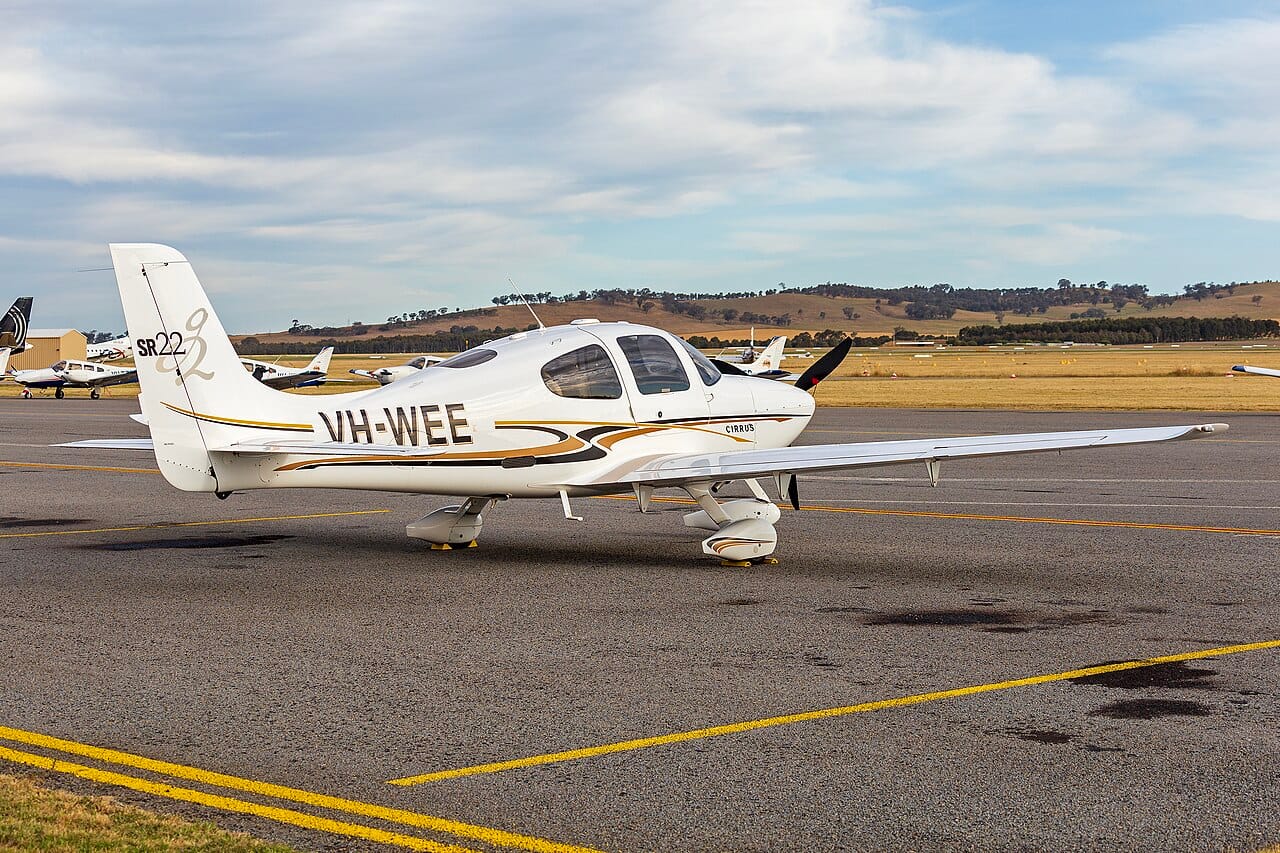
The Cirrus SR22 is a certified, factory-built four-seater with the 310-horsepower Continental IO-550-N, a side-yoke, and the Cirrus Airframe Parachute System as standard equipment. It has been in continuous production since 2001, which means there is a used market spanning more than two decades of avionics generations. If you want the purchase-price picture in detail, we cover it separately in Cirrus SR22 price: how much does a Cirrus SR22 cost, and the range picture in how far can a Cirrus SR22 fly.
Why It Matters: These two airplanes are close enough in mission that the decision really does come down to money, regulation and risk tolerance. That is unusual. Most airplane comparisons are settled by capability long before cost enters the room.
The Rulebook Difference Nobody Explains Well
Condition inspection versus annual inspection
A certified airplane gets an annual inspection signed by a mechanic holding an Inspection Authorization. An amateur-built experimental gets a condition inspection once every twelve calendar months, performed to the scope and detail of 14 CFR Part 43 Appendix D — the same checklist — but it can be signed by any A&P mechanic. No IA required. That one word changes the labor rate and the availability of who can do the work.
Shops that specialize in RVs commonly quote condition inspections in the high hundreds to low thousands of dollars for a straightforward airplane. Certified SR22 annuals at a Cirrus Service Center more typically start in the mid-thousands before anything is found, and a thorough one on an older airframe can run well past that. Owners report the gap widens as airplanes age, because the certified airplane must use approved parts and approved data for every repair.
The repairman certificate — and why it may not be yours
Under 14 CFR 65.104, the FAA may issue a Repairman Certificate (Experimental Aircraft Builder) to the primary builder of an amateur-built aircraft. That certificate is aircraft-specific and lets the holder perform its required condition inspection. It does not transfer when the airplane is sold. Current FAA rules also allow qualifying Light-Sport repairmen with an inspection rating to perform condition inspections on E-AB aircraft they own when their certificate privileges and the aircraft's operating limitations permit it. A buyer who qualifies for neither route will need an appropriately certificated mechanic to perform the annual condition inspection.
This is the cost line buyers of finished RV-10s miss most often. You can still do essentially all of your own maintenance on an experimental — there is no Part 43 preventive-maintenance list limiting you the way there is on a certified airplane — but you need an A&P to sign that annual condition inspection every year, forever. Budget for it.
Heads Up: Buying a partially completed RV-10 kit does not automatically make you the primary builder either. The FAA's "major portion" rule, explained in Advisory Circular 20-27, looks at who fabricated and assembled more than half the aircraft. Sort this out before money changes hands, not after.
Airworthiness Directives and parts
Airworthiness Directives apply to the products identified in each directive. The amateur-built RV-10 airframe itself is not a type-certificated product, but a type-certificated engine, propeller or appliance installed on the airplane can still be subject to mandatory AD compliance. For example, an applicable AD against a certificated Lycoming engine remains enforceable even when that engine is installed on an E-AB aircraft. The SR22's certificated airframe, engine, propeller and installed appliances can likewise be subject to applicable ADs.
Parts follow the same logic. An RV-10 owner can install a non-certified Garmin G3X Touch or Dynon HDX panel, an experimental autopilot, or a non-TSO'd electronic ignition, and the cost difference against equivalent certified hardware is frequently 50 to 70 percent. An SR22 owner replacing an alternator or an attitude source is buying an approved part through an approved channel at an approved price.
Flying411 keeps four-seat piston listings, specs and ownership guides in one place, so you can compare an experimental build against a certified cabin without opening six tabs.
Running the Numbers: Hourly Cost
What does each one cost per flight hour?
The table below uses 100LL at $6.00 a gallon and assumes 100 hours a year. Adjust fuel to your own field — it swings the total more than anything else. These are planning estimates, not quotes.
| Variable cost per hour | RV-10 | SR22 |
| Fuel | ~11 gph, about $66 | ~16 gph, about $96 |
| Oil, filters, consumables | $5–8 | $6–10 |
| Engine overhaul reserve | $20–28; use the current Lycoming TBO applicable to the installed IO-540 | $30–40; verify current Continental guidance for the installed IO-550 |
| Propeller reserve | $4–7 | $6–10 |
| Unscheduled maintenance | $15–25 | $30–45 |
| CAPS repack reserve | None | $15–25 |
| Rough total | $110–135/hr | $185–225/hr |
The overhaul reserves deserve a note. Lycoming revised its TBO guidance in 2026, allowing up to 2,600 hours for many eligible factory-new and factory-rebuilt IO-540 engines, while other engines and overhaul histories may retain shorter recommended intervals. Continental's applicable guidance should likewise be checked for the specific IO-550-N installed in the SR22. For Part 91 operations, recommended TBO is generally a planning and maintenance consideration rather than an automatic regulatory retirement limit, but airworthiness requirements and applicable life limits still apply.
Good to Know: The CAPS line in that table is not optional maintenance on a Cirrus. The parachute system carries a ten-year repack and rocket replacement interval, and owners report totals in the mid-teens to mid-twenty-thousands depending on model year and shop. An SR22 approaching its repack deadline is worth noticeably less than one fresh out of it, and that is the first thing an experienced buyer checks.
Fixed costs, the part people forget
Hangar rent is identical — the ramp does not care about your airworthiness certificate. State property or use tax depends on where you base, not what you fly. Where the fixed side splits is insurance and inspection.
| Annual fixed cost | RV-10 | SR22 |
| Yearly inspection, clean airplane | Roughly $800–2,500 | Roughly $3,500–7,000 |
| Insurance (hull plus liability) | Higher rate per $100 of hull; fewer carriers | Competitive market, more carriers |
| Database and subscription fees | Often lower, experimental avionics | Certified nav data, datalink, Cirrus IQ |
| Factory support | Type club, builder network | Cirrus Service Center network |
Insurance: The Place Experimental Bites Back
Why is an RV-10 harder to insure?
Brokers consistently report that fewer carriers write amateur-built hulls, and those that do charge a higher rate per dollar of insured value than they would on a comparable certified single. Underwriters look at three things on an RV-10: who built it, how many hours you have in type, and whether you have completed formal transition training. It is common for a policy to require five to ten hours of dual in an RV-10 before solo, plus a minimum total time and an instrument rating for full hull coverage.
The SR22 has its own underwriting culture, and it is not cheap either. Cirrus insurers typically want Cirrus-specific factory or CSIP transition training, recurrent training every twelve months, and they price low-time pilots in high-value hulls aggressively. On a $600,000 SR22 with a 300-hour pilot, the premium can be the second-largest line in the budget after fuel.
Pro Tip: Get an insurance quote in writing before you sign a purchase agreement on either airplane. The quote is free, it takes a day, and it is the fastest way to find out whether your logbook matches your ambitions. We go deeper on this in our guide to aircraft insurance costs.
What about financing?
This is the other structural disadvantage. Most aviation lenders will finance a certified SR22 on standard terms — long amortization, modest down payment, rates tied to ordinary collateral rules. Amateur-built aircraft are a different conversation. Some lenders decline homebuilts outright, others require a larger down payment and a shorter term, and almost none will finance an unfinished kit as an aircraft. Builders commonly fund kits from cash, home equity, or an unsecured line of credit. If you are comparing monthly outlay rather than sticker price, read our overview of aircraft financing and leasing before you fall in love with a kit.
Mission, Safety and the Things Money Cannot Fix
Does the SR22 actually do more?
Yes, a bit. The SR22 has more horsepower, more gross weight, and in the turbocharged SR22T a flight-level capability the RV-10 simply does not have. Known-ice protection is available on certified Cirrus models; there is no equivalent approved system for an experimental, and any ice equipment on an RV-10 is a builder decision with no certification behind it. If your mission is regular hard-IFR travel in the upper teens with a full cabin, the certified airplane is the better tool.
For a 500-nautical-mile trip with two adults, two kids and bags at 8,000 feet, though, the RV-10 does it about as fast on a third less fuel, with control harmony that RV owners describe as noticeably lighter than a Cirrus side-yoke. It is a genuinely sporty airplane that happens to seat four.
Keep in Mind: The RV-10 has no whole-airframe parachute. CAPS has a documented record of successful saves, and for many family buyers that single feature settles the argument regardless of the spreadsheet. There is no dollar figure that makes this an apples-to-apples comparison.
Operating limitations you should read before you buy
Under 14 CFR 91.319, an experimental aircraft may not be operated for compensation or hire, with narrow exceptions. It also must complete a flight test period — typically 25 or 40 hours depending on whether the engine and propeller combination is certificated — before carrying passengers. Some operating limitations restrict flight over densely populated areas during that phase. None of this matters for personal travel, but it rules out leaseback, charter, and most flight-school economics. An SR22 can go on a leaseback line at a flight school; an RV-10 cannot.
Flying411 gathers ownership cost guides, model comparisons and current listings in one place, so you can size up the rules before you size up the airplane.
Resale and Depreciation
Which one holds value better?
Well-built RV-10s have held value unusually well for homebuilts. The type has a deep builder community, a well-documented kit, and enough completed airplanes flying that buyers have comparables. But the spread between examples is enormous, and it is driven by the builder more than the airframe. A meticulous build with complete documentation, photographs of closed-up structure, a clean panel and an established maintenance history sells near the top of the range. An orphan build with thin records sells at a discount that no amount of avionics fixes.
The SR22 depreciates like a new car for its first several years, then flattens. A 2006 SR22 G2 and a 2021 G6 are separated by a very wide price band, and the used market prices avionics generation, CAPS status and engine time with real precision. Our article on aircraft valuation and depreciation walks through how those adjustments stack up.
Quick Tip: When you inspect a used RV-10, treat the build log the way you would treat a certified airplane's logbooks. Photos of the wing spar before skinning, a documented weight and balance, engine and prop paperwork, and a named A&P who has been signing the condition inspections are what separate a $300,000 airplane from a $200,000 one.
Who Should Buy Which
Buy or build the RV-10 if…
You enjoy wrenching, you want to spend less per hour, you are comfortable being your own support network, and you can pay cash or nearly so. You fly personally, not commercially. You value the freedom to put any panel you like in the airplane next year without hunting for an STC. If you are the builder, you also get the repairman certificate and the lowest-cost ownership path available in a 170-knot four-seater.
Buy the SR22 if…
You want to fly, not maintain. You need financing. You want a whole-airframe parachute, known-ice capability, a factory service network, and a liquid resale market. You may put the airplane on a leaseback or use it for training. You are trading time for money, and you are honest about that.
Fun Fact: Van's Aircraft kits have produced more completed, flying amateur-built airplanes than any other design family in history — well over 10,000 RVs of all models have flown. That is why RV-10 parts, advice and transition instructors are easier to find than for almost any other homebuilt.
If you want to widen the field before you commit, our roundup of the best four-seat planes covers the certified alternatives, and the Cessna 182 vs Cirrus SR22 and Diamond DA50 vs Cirrus SR22 comparisons show where the SR22 sits against its certified rivals. If you are weighing engine size rather than certification category, Cirrus SR20 vs SR22 is the place to start.
Conclusion
Comparing Van's RV-10 vs Cirrus SR22 ownership costs is really a comparison of two different relationships with an airplane. The RV-10 gives you a roughly 35 to 45 percent lower hourly cost, a cheaper yearly inspection, and near-total freedom over parts and upgrades — in exchange for doing the work, finding your own support, paying cash, and flying without a parachute. The SR22 gives you a turnkey, financeable, well-supported traveling machine with a safety system that has saved lives, and it charges you every year for that privilege.
Price both on paper with your own fuel cost, your own hangar rent, and a real insurance quote in hand. Then be honest about how you want to spend your Saturdays. That answer usually decides it faster than the spreadsheet does.
When you are ready to compare listings, visitFlying411and see what is on the market today.
Frequently Asked Questions
Can I do my own maintenance on an RV-10 I bought used?
Yes, almost all of it. Experimental amateur-built aircraft are not bound by the Part 43 preventive-maintenance list that limits certified owners. What you cannot do without the builder's repairman certificate is sign the twelve-month condition inspection — that requires an A&P, though not an IA.
Is an RV-10 legal for IFR flight?
Yes, almost all of it. Experimental amateur-built aircraft are not limited by the Part 43 preventive-maintenance list in the same way as certified aircraft. The annual condition inspection is different: the original builder may sign it with the appropriate Experimental Aircraft Builder repairman certificate, and a qualifying Light-Sport repairman may also be able to sign it under current FAA rules if the aircraft's operating limitations permit. Otherwise, an appropriately certificated mechanic is required.
How much does it cost to build an RV-10 from scratch?
Kit pricing changes, so get a current quote directly from Van's. As a planning figure, builders typically report a finished airplane totaling somewhere in the low-to-mid six figures once engine, propeller, avionics, paint and interior are added, with the panel being the single largest swing factor. Van's estimates roughly 2,000 build hours.
Does an SR22 really cost twice as much to fly?
Not quite twice, but the gap is real. Using typical fuel burns, overhaul reserves and the CAPS repack, most owners land around $185 to $225 per hour on an SR22 against $110 to $135 on an RV-10, before fixed costs. Fuel price and annual utilization move both numbers significantly.
Can I put an RV-10 on leaseback or use it for flight training?
Generally no. Section 91.319 prohibits operating an experimental aircraft for compensation or hire, with limited exceptions. You can receive instruction in your own experimental under FAA policy, but you cannot run it as a rental or a school airplane the way you could a certified SR22.
Do Airworthiness Directives apply to an RV-10?
The amateur-built RV-10 airframe itself is not a type-certificated product, but type-certificated components installed on it can still be subject to mandatory Airworthiness Directives. If your RV-10 uses a certificated Lycoming engine or certificated propeller, any AD that applies to that specific product and configuration must be complied with according to its terms.