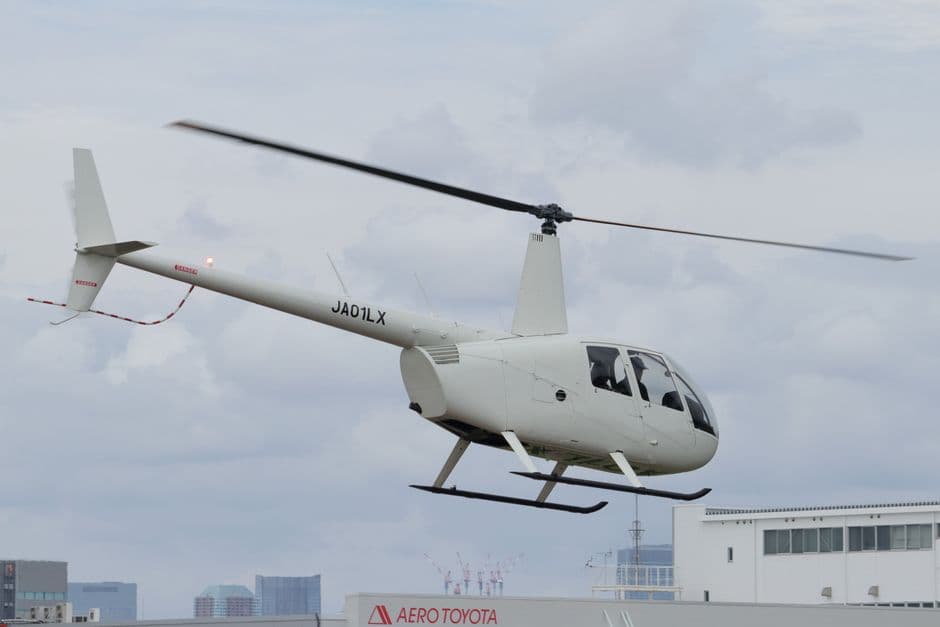
At low flying hours the Robinson R22 vs Guimbal Cabri G2 question has a clear answer: the Cabri is cheaper per hour, because nothing on it retires the whole airframe on a calendar date. At 300 or 400 hours a year the two land within about $20 an hour of each other, and the R22's lower purchase price and deeper parts network can flip the result back the other way.
That gap matters because the R22 has significant scheduled maintenance requirements at 2,200 hours and at 12 years. However, Robinson distinguishes the 2,200-hour inspection and associated component overhaul work from its 12-year inspection and maintenance requirements for lower-time helicopters. Both can be expensive, but they do not necessarily involve replacing or overhauling exactly the same components. This article compares those maintenance obligations with the Cabri G2's individual component intervals, along with insurance, SFAR 73, parts availability and resale considerations.
Key Takeaways
Both helicopters use the same Lycoming O-360-J2A engine, but they handle wear in opposite ways. Robinson overhauls everything at once at 2,200 hours or 12 years, whichever comes first, which behaves like a balloon payment on a lease: fly a lot and you spread it over many hours, park it and you still owe the same money. Guimbal spreads the cost across individual component lives, so the Cabri's hourly reserve is higher but its calendar exposure is much smaller. Modeled in 2025 dollars, an owner flying 100 hours a year spends roughly $460 an hour in an R22 against roughly $400 in a Cabri; at 400 hours a year the figures converge near $270 and $260. The Cabri costs more to buy and insure, and that capital difference can erase its reserve advantage for a private owner who does not fly much.
| Specification | Robinson R22 Beta II | Guimbal Cabri G2 |
| Engine | Lycoming O-360-J2A, derated | Lycoming O-360-J2A, derated |
| Takeoff power | 131 hp takeoff; 124 hp continuous | Up to 160 hp takeoff; 145 hp continuous on the applicable modified configuration |
| Main rotor | 2-blade teetering, semi-rigid | 3-blade fully articulated, composite |
| Anti-torque | Conventional 2-blade tail rotor | 7-blade shrouded Fenestron |
| Max gross weight | 1,370 lb | 1,543 lb (700 kg) |
| Typical useful load | About 490 lb | About 595 lb (270 kg), depending on equipment |
| Usable fuel | 19.2 gal main; 30.1 gal with aux tank | About 45 gal (170 L) |
| Cruise / VNE | Up to 96 kt / 102 kt | About 100 kt / 130 kt |
| Endurance | About 3 hours with aux tank | About 4.5 hours |
| Fuel burn (100LL) | About 9–10 gph | About 9 gph |
| Airframe overhaul | Mandatory at 2,200 hr or 12 years | None; components on individual lives |
| Engine TBO | 2,200 hr / 12 yr (done with airframe) | 2,200 hr / 12 yr per Lycoming SI 1009 |
| SFAR 73 training rules | Applies | Does not apply |
| US certification | FAA TCDS H10WE, 1979 (Beta II 1995) | FAA type certificate, December 2015 |
| Modeled all-in cost at 400 hr/yr | About $272/hr | About $262/hr |
Flying411 keeps two-seat piston helicopter listings in one place, so you can compare R22s and Cabri G2s by hours and years remaining before overhaul, not just by asking price.
Same Engine, Two Completely Different Clocks
The engine is an interesting similarity in this comparison. Both helicopters use the Lycoming O-360-J2A, but their installations and operating ratings differ. Robinson limits the R22 Beta II to 131 horsepower for takeoff and 124 horsepower continuous. The Cabri G2, with the applicable Guimbal engine modification, is rated for up to 160 horsepower at takeoff and 145 horsepower continuously. The Cabri also has a higher maximum gross weight, at approximately 1,543 pounds compared with the R22's 1,370 pounds. These differences affect performance and operating requirements, but they do not by themselves establish which engine installation will cost less to maintain.
What differs is everything around the engine. Robinson's maintenance manual puts a 2,200-hour or 12-year overhaul in the airworthiness limitations section. Because it sits there, FAR 91.403 makes it a legal requirement, not a suggestion. At that point the helicopter goes back to the factory or to an authorized service center, and the airframe, gearboxes, rotor system, controls and engine are all overhauled together. The clocks reset to zero.
Guimbal uses a component-based maintenance program rather than a single scheduled overhaul of the entire helicopter. However, this does not mean the Cabri's components can remain in service indefinitely. Guimbal's maintenance manual specifies overhaul intervals for major assemblies, including the main and tail rotor gearboxes, swashplate and engine, along with separate life limits and inspections. The published Issue 08 manual lists a 2,000-hour or 12-year engine overhaul interval, with a possible extension to 2,400 hours under applicable Lycoming guidance. Owners must verify the current approved maintenance requirements, applicable airworthiness directives and any authorized extensions rather than assume that every manufacturer's interval is optional under Part 91.
Why It Matters: The important distinction is how each manufacturer schedules maintenance, not simply whether one engine may operate beyond TBO. Robinson requires extensive calendar-based work on the R22, while Guimbal schedules overhaul and replacement work across individual assemblies. Cabri owners must still comply with applicable airworthiness limitations, airworthiness directives and required maintenance instructions. An engine's condition-monitoring results alone do not authorize exceeding a mandatory limit.
What the R22's 12-Year Overhaul Actually Costs
Owners and service centers in 2024 and 2025 have reported factory overhaul pricing for the R22 Beta II in the range of roughly $220,000 to $260,000, depending on what the teardown finds, what options you add back and whether you use the factory or an authorized field overhaul. Get a written quote before you budget — this number has moved up steadily, and it is the largest single check the airplane will ever ask for.
Use $240,000 as a working figure and the math is unforgiving in one direction only.
The hours you actually fly decide the rate
Spread $240,000 across the full 2,200 hours and the reserve is about $109 an hour. That is the number a busy flight school sees, because a school flying 400 hours a year reaches 2,200 hours in five and a half years, well inside the 12-year window.
For lower-utilization owners, calendar-based maintenance can increase the effective hourly cost considerably. At 150 hours annually, an R22 accumulates 1,800 hours over 12 years; at 100 hours annually, it accumulates 1,200 hours; and at 75 hours annually, just 900 hours. However, the actual maintenance reserve at these utilization levels must be based on the applicable 12-year inspection and component-maintenance costs, rather than automatically dividing a full 2,200-hour overhaul quote by the hours flown. Owners should obtain separate quotations for the 12-year work and the 2,200-hour inspection package.
Keep in Mind: The 12-year clock runs on the calendar, not on your logbook. A helicopter sitting in a hangar through a slow winter, a long maintenance delay or a change in your work schedule is still burning the most expensive asset it owns.
We cover the same arithmetic in more detail in How to Calculate Aircraft Operating Cost Per Hour, and the reserve-setting side in How Much to Set Aside Per Flight Hour.
What the Cabri's Component TBOs Actually Cost
The Cabri never presents one giant invoice, which is the whole pitch. Instead you get a series of medium invoices scattered across the years as individual components reach their limits. In budget terms that is healthier, the way replacing one appliance at a time is easier than remodeling a kitchen, but it is not free.
Operators generally budget somewhere in the region of $60 to $90 an hour for Cabri dynamic component replacement, plus an engine reserve. A field overhaul on an O-360 in 2025 typically runs in the $40,000 to $50,000 range for a helicopter installation, which is about $20 an hour at full TBO and around $25 to $38 an hour if the calendar gets there first. Add it up and the Cabri's total reserve sits roughly in the $90 to $115 band across most utilization levels, and — critically — it barely moves when you fly less, because most of it is hour-based.
Two cautions. First, Guimbal does apply calendar limits to rubber and elastomeric items, so a Cabri that sits is not entirely immune to the passage of time. Second, parts come from one factory in France. That means currency exposure, longer lead times than the same-day shipping Robinson owners take for granted out of Torrance, and a smaller pool of factory-trained technicians in the United States. A grounded helicopter waiting two weeks for a part is a cost even if the part itself is reasonable.
Heads Up: Before you buy either machine, ask the seller for the airworthiness limitations pages with every component's remaining time filled in. On a Cabri that single document is the difference between a fair price and an expensive surprise, and on an R22 it tells you exactly how many years and hours you have before the balloon payment lands.
Cost Per Hour at 100, 150 and 400 Hours a Year
A useful operating-cost comparison must account for the different maintenance schedules of these helicopters. The R22 has separate 2,200-hour and 12-year maintenance requirements, while the Cabri G2 uses component-specific overhaul, inspection and replacement intervals. A model based on a $240,000 R22 overhaul and a $70-per-hour Cabri component reserve can illustrate high-utilization costs, but it cannot reliably predict low-utilization ownership expenses without separate quotations for calendar-based work. Fuel, insurance, hangar expenses and routine maintenance must also be added using current operator-specific estimates.
| Cost line (per flight hour) | R22 at 100 hr/yr | Cabri at 100 hr/yr | R22 at 150 hr/yr | Cabri at 150 hr/yr | R22 at 400 hr/yr | Cabri at 400 hr/yr |
| Fuel and oil | $67 | $64 | $67 | $64 | $67 | $64 |
| Overhaul / TBO reserve | $200 | $108 | $133 | $95 | $109 | $90 |
| Routine maintenance | $55 | $60 | $45 | $48 | $38 | $40 |
| Insurance and hangar | $142 | $172 | $95 | $115 | $58 | $68 |
| Total | $464 | $404 | $340 | $322 | $272 | $262 |
The shape of the result is more useful than the exact dollars. Below roughly 120 hours a year the Cabri pulls clearly ahead, by $50 to $70 an hour, and the gap widens the less you fly. Between about 150 and 400 hours a year the two are close enough that the deciding factors are what you paid, what you insure it for and how fast you can get parts.
The model is also sensitive in predictable ways. If your Cabri's component reserve comes in nearer $50 an hour than $70, the Cabri wins at every utilization level. If you buy an R22 overhaul at $200,000 from a field shop rather than $260,000 from the factory, the R22 narrows the gap at 100 hours a year by about $50 an hour. Build the table with your own quotes rather than ours.
Good to Know: If you are weighing a two-seat trainer against a four-seat machine, the step up is smaller than the hourly numbers suggest once you count seats. Robinson R44 vs R22 walks through where that crossover sits, and R44 Raven vs Cabri G2 compares the Guimbal against the bigger Robinson.
Insurance, SFAR 73 and the Costs That Hide Outside the Logbook
Insurance is the second-largest variable after the overhaul reserve, and it runs in opposite directions for these two. The Cabri carries a higher hull value, so a percentage-based hull premium costs more in dollars even if the rate is similar. Against that, brokers have noted that the Cabri's loss record in primary training — helped by a three-blade articulated head, higher rotor inertia and a shrouded Fenestron that is hard to strike — has made some underwriters more comfortable with low-time student exposure. Get real quotes for both airframes with your own pilot resume attached; generic rates are nearly useless in this segment.
Then there is SFAR 73. The FAA's special rule for the R22 and R44 requires specific awareness training, minimum make-and-model time and an annual flight review for pilots acting as pilot in command, and it sets a 200-hour helicopter minimum with 50 hours in the R22 for instructors teaching in one. The rule has been in force since 1995 and remains current. The Cabri falls outside it entirely.
For a school, that cuts both ways. Hiring a CFI qualified to teach in an R22 is harder and sometimes more expensive. But a student who trains in an R22 arrives at the R44 and R66 with Robinson time already banked, and that matters when the jobs are in Robinson cockpits. A Cabri graduate heading for an R44 has to build SFAR 73 time from scratch, which is dual hours in a more expensive helicopter.
Pro Tip: Check the R22 logs for Robinson Service Bulletin SB-78, the bladder fuel tank retrofit. Most of the fleet has it by now, but an aircraft that does not is both a safety question and a bill waiting for you.
Flying411 keeps Robinson and Guimbal listings side by side, so you can compare total time, years since overhaul and avionics on the same screen instead of chasing spec sheets across a dozen tabs.
Resale: Where the R22 Gets Some of That Money Back
The overhaul reserve table above treats $240,000 as pure expense. It is not, and this is the point most cost comparisons miss. A factory-overhauled R22 comes back as a zero-time machine with a fresh 12-year clock, and the market prices it accordingly — far closer to a new helicopter than to the tired airframe you sent away. A meaningful slice of that overhaul spend returns to you as residual value when you sell.
That also means you can shop the other direction. An R22 with two years and 300 hours left before overhaul trades at a steep discount, and for a buyer who plans to overhaul anyway and hold the machine for another decade, that discount is a legitimate strategy. Just do not confuse a cheap purchase price with a cheap helicopter.
The Cabri's resale picture is different in kind. Robinson has built roughly 4,600 R22s since 1979, so the used market is deep, global and liquid. Guimbal has delivered several hundred Cabris since 2008, so used examples are scarce and values have held firm — but if you need to sell in a hurry, there are fewer buyers to call. Thin markets cut both ways.
Fun Fact: Bruno Guimbal designed the Cabri while working as an engineer at Eurocopter, and the three-blade main rotor head borrows directly from the elastomeric bearing technology used on much larger turbine helicopters. That is part of why a 1,543-pound two-seater has a rotor system that feels like something off a far bigger machine.
Capital cost is the last piece. A used R22 can be bought for a fraction of what a Cabri costs, and the interest on that difference is real money. At 7% on a $200,000 gap, you are paying about $14,000 a year — which at 150 hours a year is roughly $93 an hour, enough to wipe out the Cabri's reserve advantage several times over. If you are financing, run the loan into your model before you decide.
Flying411 keeps asking prices, hours and locations together, so you can see what the capital gap between a mid-time R22 and a Cabri G2 actually looks like today rather than guessing at it.
Which One You Should Buy
If you are a private owner flying under about 120 hours a year, buy the Cabri G2. The R22's 12-year overhaul is the wrong cost structure for low utilization, and no amount of careful flying changes that. If you are a flight school or a busy commercial operator putting 300 hours or more on the airframe each year, the two are close on operating cost and the R22 usually wins on total cost, because it is cheaper to buy, cheaper to insure, easier to staff with qualified instructors and backed by a parts pipeline that keeps aircraft on the line.
In the middle — 150 to 250 hours a year — the Robinson R22 vs Guimbal Cabri G2 decision stops being arithmetic and starts being judgment. Ask yourself how much the Cabri's crashworthy seats, crash-resistant fuel system and more forgiving rotor are worth to you, how far your nearest Guimbal-trained mechanic is, and whether your students need Robinson time for the jobs they want. Those answers are worth more than the last $20 an hour. For a different angle on the same trade-off, R22 vs Schweizer 300CBi looks at the third serious option in this class, and What It Costs to Own a Robinson R44 Raven shows how the Robinson overhaul model scales up.
When you are ready to compare listings, visitFlying411and see what is on the market today.