Most shoppers treat these two as the same airplane with different cabins, and assume the six-seat one must cost noticeably more to fly. The first half is close to true. The second half is mostly wrong: run the numbers honestly and the gap in hourly cost between a Bonanza F33A vs A36 is under thirty dollars an hour. The real money is in the purchase price, and the real decision is about what you put in the back.
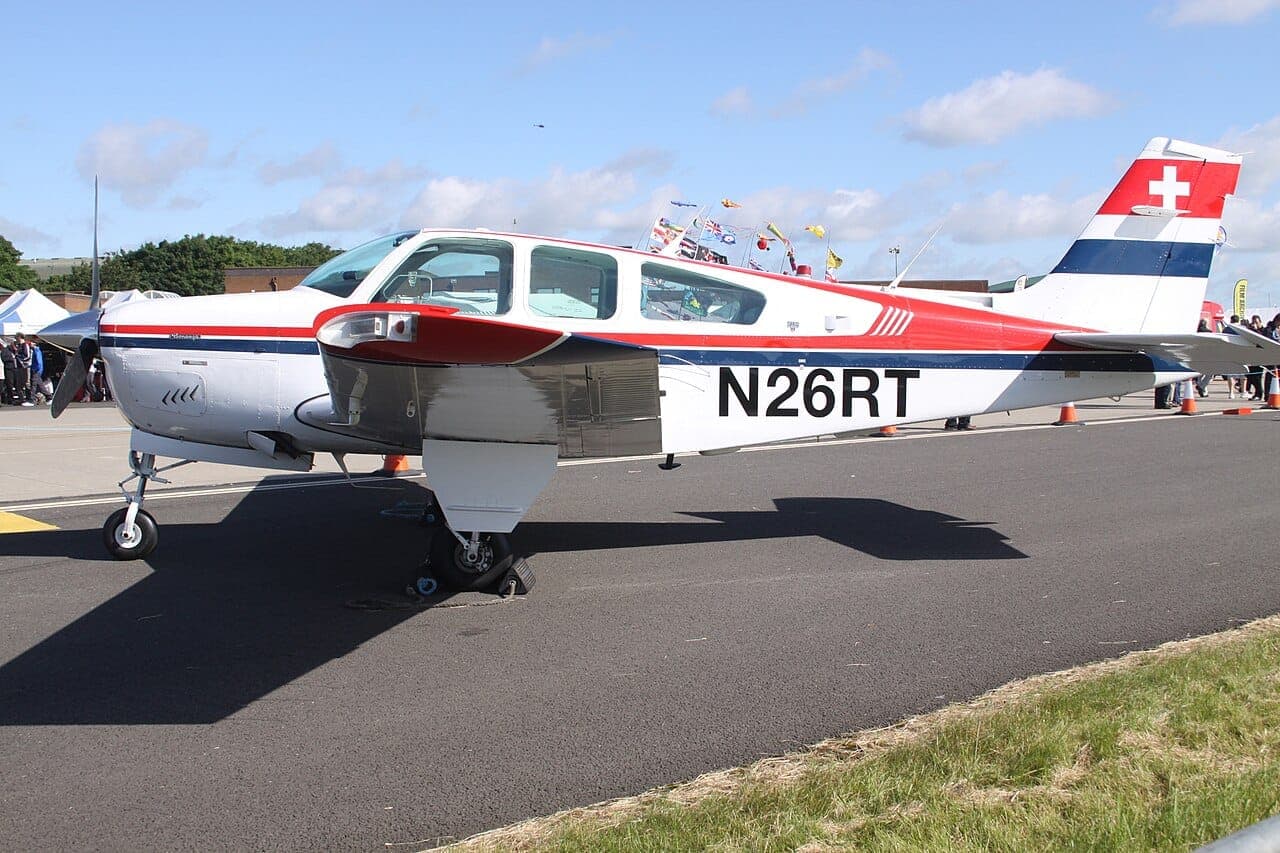
Both are straight-tail Bonanzas built on the same wing, the same retractable gear and the same Continental big-bore six. Beechcraft stretched the 33-series fuselage by about ten inches, moved the cabin forward relative to the wing, and added a pair of aft double doors on the right side. That is the whole story in one sentence — and it changes more than it sounds like it should.
The Short Answer
Buy the F33A if you fly with one or two people most of the time and want a relatively affordable way into a genuine 170-knot Beech. It costs less to buy, costs a little less per hour, and generally offers strong climb performance. Buy the A36 if you need six available seats, easier passenger access, or more room for bulky cargo. However, carrying six occupants requires careful fuel and weight-and-balance planning, especially with heavier adults and baggage aboard. The A36's larger cabin and aft double doors justify the premium for owners who regularly need that flexibility. If your typical flight is just you, one passenger and two bags, the F33A may provide better value.
Same Wing, Different Cabin — and Why Loading Decides It
The F33A is the straight-tail descendant of the Debonair, which itself was a V-tail Bonanza with a conventional empennage. It seats four as standard, with a fifth seat available on many airplanes, and has one cabin door on the right front. Baggage goes through the cabin into an aft shelf rated to about 270 pounds.
The A36 came out of a different brief. Beechcraft stretched the 36-series specifically as a utility and air-taxi airplane, which is why it got the wide double doors on the right rear — wide enough for a stretcher, a crate or a folded bicycle. Standard seating is six, usually in club configuration with the middle pair facing aft. The aft cabin and baggage area will take substantially more weight than the F33A's shelf.
The subtler difference is where the cabin sits over the wing. Because Beechcraft moved the seating forward relative to the spar, the A36 tolerates rear-seat passengers and aft baggage better than the 33-series does. F33A owners learn quickly that filling the back seats and the baggage shelf can push the center of gravity to the aft limit before the airplane is anywhere near gross weight. It is a little like loading a pickup truck versus a station wagon — the truck's bed is behind the axle, so weight back there moves the balance fast.
Heads Up: Weight and balance on the 33-series is not a formality. Plenty of F33As are out of aft CG with two adults in the back seats and bags on the shelf, even with half fuel. Run an actual loading sheet during your pre-buy on the airplane's real empty weight, not a book number.
Edge: A36, decisively, for anyone who regularly carries people or bulky cargo.
What They Cost to Buy
The A36 has consistently asked more than a comparable-year F33A — commonly 20% to 30% more for similar avionics, paint, interior and engine time. There are a lot of reasons for that, but two matter: there are far more buyers who want six seats than four, and Beechcraft built the 36-series in much larger numbers over a much longer run, which keeps it visible and liquid in the used market.
Year and equipment move the price more than the model does. A 1984-or-later A36 with the 300-horsepower Continental IO-550-B, a modern glass panel and a mid-time engine is a different financial animal than a 1972 airplane with steam gauges and a runout. The same is true of F33As, which were built from 1970 all the way to 1994.
As of November 2026, Flying411 had 5 Beechcraft Bonanza aircraft listed, asking $100,000 to $750,000 (median $335,000), with model years from 1960 to 1984 and a median total time of 4,500 hours. That spread covers every Bonanza variant on our listings, V-tails included, so treat it as the shape of the market rather than a price for either specific model — and remember these are asking prices on live listings, not sale prices.
Flying411 keeps Beechcraft Bonanza listings in one place, so you can compare F33A and A36 airframes by year, engine time and avionics instead of guessing at what the premium actually buys.
Edge: F33A on acquisition cost — you get the same wing and nearly the same speed for meaningfully less money.
| Specification | Bonanza F33A | Bonanza A36 (1984+) |
| Production years | 1970–1994 | 1970–2005 (A36); continued as G36 |
| Engine | Continental IO-520-BB | Continental IO-550-B (IO-520-BB before 1984) |
| Horsepower | 285 hp | 300 hp (285 hp on earlier airplanes) |
| Published TBO | Generally 1,700–1,900 hr for the IO-520-B series, depending on engine serial number and applicable guidance | Generally 1,700–1,900 hr for the IO-550-B, depending on engine serial number and applicable guidance |
| Seats | 4 standard, 5 optional on many | 6, club seating common |
| Cabin access | One right-front door | Right-front door plus aft double doors |
| Max gross weight | 3,400 lb | 3,650 lb |
| Typical useful load | ~1,150–1,300 lb | ~1,100–1,350 lb |
| Usable fuel (standard) | 44 or 74 gal, depending on F33A serial number and fuel-system option | 74 gal standard on 1984-and-later A36 models; earlier aircraft may have 44 or 74 gal |
| Max cruise (book) | ~172–176 kt | ~175–176 kt |
| Rate of climb (book) | ~1,150 fpm | ~1,030 fpm |
| Takeoff over 50 ft (book) | ~1,800 ft | ~2,000 ft |
| Service ceiling | ~17,500–18,000 ft | ~18,500 ft |
| Wingspan | 32 ft 10 in on early F33As; 33 ft 6 in on later examples | 33 ft 6 in |
| Length | ~26 ft 8 in | ~27 ft 6 in |
Cost Per Hour to Fly
Here is the part people get wrong. Both airplanes burn big-bore Continental fuel, both need the same gear inspections, both sit in the same hangar. The A36 carries a bit more airplane around and, in the 300-horsepower version, burns about a gallon and a half more an hour at the same percentage of power. That is the honest extent of the operating difference.
The table below assumes 100 hours a year, 100LL at $6.50 a gallon (self-serve prices varied widely through 2025 and 2026, so substitute your own field's number), a $400-a-month hangar and insurance for an instrument-rated owner with time in type. Change any of those and the totals move — the method matters more than the exact figure, and we walk through it in detail in How to Calculate Aircraft Operating Cost Per Hour.
| Cost item (100 hrs/year) | F33A | A36 (IO-550) |
| Fuel burn, 65–75% power | ~15 gph | ~16.5 gph |
| Fuel at $6.50/gal | $97.50/hr | $107.25/hr |
| Oil and consumables | $5/hr | $5/hr |
| Engine reserve | ~$32/hr ($55,000 over a conservative 1,700-hr planning interval) | ~$35/hr ($60,000 over a conservative 1,700-hr planning interval) |
| Propeller reserve | $3/hr | $4/hr |
| Unscheduled maintenance reserve | $25/hr | $28/hr |
| Variable subtotal | ~$162/hr | ~$179/hr |
| Annual inspection | $4,000/yr | $4,500/yr |
| Insurance | $3,000/yr | $3,500/yr |
| Hangar | $4,800/yr | $4,800/yr |
| Registration, databases, misc | $1,200/yr | $1,200/yr |
| Fixed subtotal | $13,000/yr | $14,000/yr |
| Fixed cost spread over 100 hrs | $130/hr | $140/hr |
| Total cost per hour | ~$292/hr | ~$319/hr |
| Total annual cost | ~$29,200 | ~$31,900 |
Roughly $27 an hour, or about $2,700 a year at 100 hours. That is less than one unplanned cylinder. If you are comparing an A36 built before 1984, it has the same 285-horsepower IO-520-BB as the F33A, and the two airplanes cost within a handful of dollars an hour of each other.
Keep in Mind: The engine and prop reserves above are not optional savings — they are the real cost of the hours you are flying, just paid later. If you are not actually setting that money aside each month, your "cheap" Bonanza is borrowing from a bill that always arrives. Our guide to how much to set aside per flight hour walks through sizing those numbers.
Edge: F33A, but by a margin small enough that it should not decide the purchase on its own.
Performance and Real-World Load
In cruise these two are close enough that you will not notice from the left seat. Book figures put both in the 172 to 176 knot range at high cruise power, and most owners plan 165 to 170 knots at a fuel burn in the mid-teens. Where the F33A pulls ahead is climb and runway: it is a couple of hundred pounds lighter at gross with nearly the same power, so it gets off the ground sooner and up to altitude faster.
Useful load overlaps heavily and depends on how each aircraft is equipped. Air conditioning, avionics, interior modifications and other equipment affect the available payload. Fuel capacity also varies: some F33As have 44 usable gallons, while others have 74, and later A36 models generally carry 74 usable gallons. With 74 gallons aboard, fuel weighs approximately 444 pounds, leaving the remaining useful load for passengers and baggage. The A36 provides more seating and cabin flexibility, but six occupied seats do not guarantee that the aircraft can legally carry six adults and their bags with full fuel. Always calculate weight and balance using the individual aircraft's records and approved loading envelope.
Good to Know: Many F33As fly behind a 300-horsepower IO-550 installed under an aftermarket STC. Those conversions genuinely improve climb and give a few knots back, and they are well regarded. What they do not do is add a cabin — a converted F33A is still a four-seat airplane with a shelf in the back.
If you want this comparison with a V-tail in the mix, we covered that pairing separately in Bonanza F33A vs V35B, and the A36 against its most common six-seat rival in Cessna 210 vs A36 Bonanza.
Edge: Draw on speed, F33A on climb and short-field, A36 on usable load flexibility.
Maintenance, Inspections and Resale
Mechanically these airplanes are siblings, and a shop that knows one knows the other. The expensive items are shared: the electric landing gear retraction system with its motor, rod ends and no-back spring; fuel cells that eventually weep; Continental cylinders that go soft somewhere in the second half of TBO; and magnetos that want attention at the 500-hour mark, which we cover in the magneto 500-hour check.
Both models are supported by the American Bonanza Society, whose service clinics are the single best maintenance resource either airplane has. ABS clinics catch spar carry-through corrosion, gear rigging problems and control-system wear that a routine annual often misses. Factor one into your first year of ownership regardless of which model you choose.
Straight-tail owners avoid the recurring airworthiness directive work tied to the V-tail's ruddervator structure, which is one of the quiet reasons the 33 and 36 series hold value well. Check the airworthiness directive list against the specific serial number during the pre-buy, and understand what the pre-buy is and is not covering — see Pre-Buy or Annual? What Each One Covers.
On resale, the A36 is the easier airplane to sell. Six seats and a cargo door widen the buyer pool, and the type has stayed in production far longer, which keeps parts and shop familiarity strong. The F33A sells well too, but to a narrower audience.
Heads Up: Insurance for either airplane is written on the pilot more than the model. Retractable gear plus 285 horsepower plus six seats means most underwriters want an instrument rating and will specify dual instruction in type — commonly 10 to 25 hours for a low-time buyer. Get a quote before you sign a purchase agreement, not after.
Flying411 keeps Bonanza listings with their engine times, avionics and model years in one place, so you can compare a runout F33A against a mid-time A36 on the figures that actually drive your first-year costs.
Edge: A36 on resale and marketability; draw on maintenance cost.
Which One Should You Buy?
The owner-pilot who flies with a spouse. Two adults, two bags, 500-nautical-mile trips, maybe a third person a few times a year. Buy the F33A. You save real money up front, the climb performance is better at the weights you actually fly, and the fourth seat covers your occasional passenger. Spend the difference on a decent panel and an engine with life left.
The family flyer or the pilot with a business. Four to six people, kids with gear, golf clubs, a dog crate, or clients who need to get in and out of the airplane without climbing over a wing. Buy the A36 and do not agonize over the premium. The aft double doors alone change how the airplane gets used, and the loading envelope keeps you legal with weight in the back. If you are weighing this against a fixed-gear hauler, our A36 vs Cessna 182 cost comparison is the next read.
The first-time retractable buyer on a firm budget. Look hard at the F33A, and look at an earlier A36 with the 285-horsepower IO-520 as well — those often price closer to an F33A than the later IO-550 airplanes do, and the hourly cost is nearly identical. If a Bonanza of any flavor still feels like a stretch, the Debonair is the same airframe family at a lower entry point.
Pro Tip: Whichever you choose, weigh the airplane during the pre-buy if the last weighing is decades old. Paint, interiors and avionics added over fifty years quietly erase useful load, and an inherited equipment list is not evidence.
The Honest Bottom Line
The Bonanza F33A vs A36 question is not really a performance question or a cost-per-hour question. At $292 against $319 an hour on identical assumptions, the operating gap is small enough that it should never be the deciding factor. The decision is cabin versus capital: pay the A36's purchase premium for space, doors and a forgiving loading envelope, or keep that money and accept a four-seat airplane that flies just as fast and climbs a little better.
Answer one question honestly — how many people and how much stuff do you carry on a typical trip, not on your best imagined trip — and the choice makes itself.
Flying411 keeps F33A and A36 listings side by side in one place, so you can compare asking price against engine time and equipment before you commit to a pre-buy.
When you are ready to compare listings, visitFlying411and see what is on the market today.
Frequently Asked Questions
Can an F33A really carry six people?
No. The F33A is a four-seat airplane, with a fifth seat offered as an option on many examples. The fuselage is about ten inches shorter than the A36's and there are no aft double doors. If you need six seats, the A36 is the airplane.
Does an IO-550 conversion make an F33A equal to an A36?
It closes the performance gap and then some — the 300-horsepower conversions improve climb noticeably and add a few knots. It does nothing for cabin volume, cargo access or the aft center-of-gravity limit, which are the real reasons buyers choose the A36.
Which one is cheaper to insure?
The F33A, modestly, mostly because hull values tend to be lower. The bigger variable by far is pilot experience: total time, time in type and whether you hold an instrument rating will swing your premium more than the model choice does.
Is the A36 harder to land?
Not harder, but different. It is heavier and tends to sit more nose-heavy at light rear loadings, so it wants a deliberate flare and attention to trim. Both airplanes reward precise speed control on final; carry extra knots into the flare and either one will float a long way down the runway.