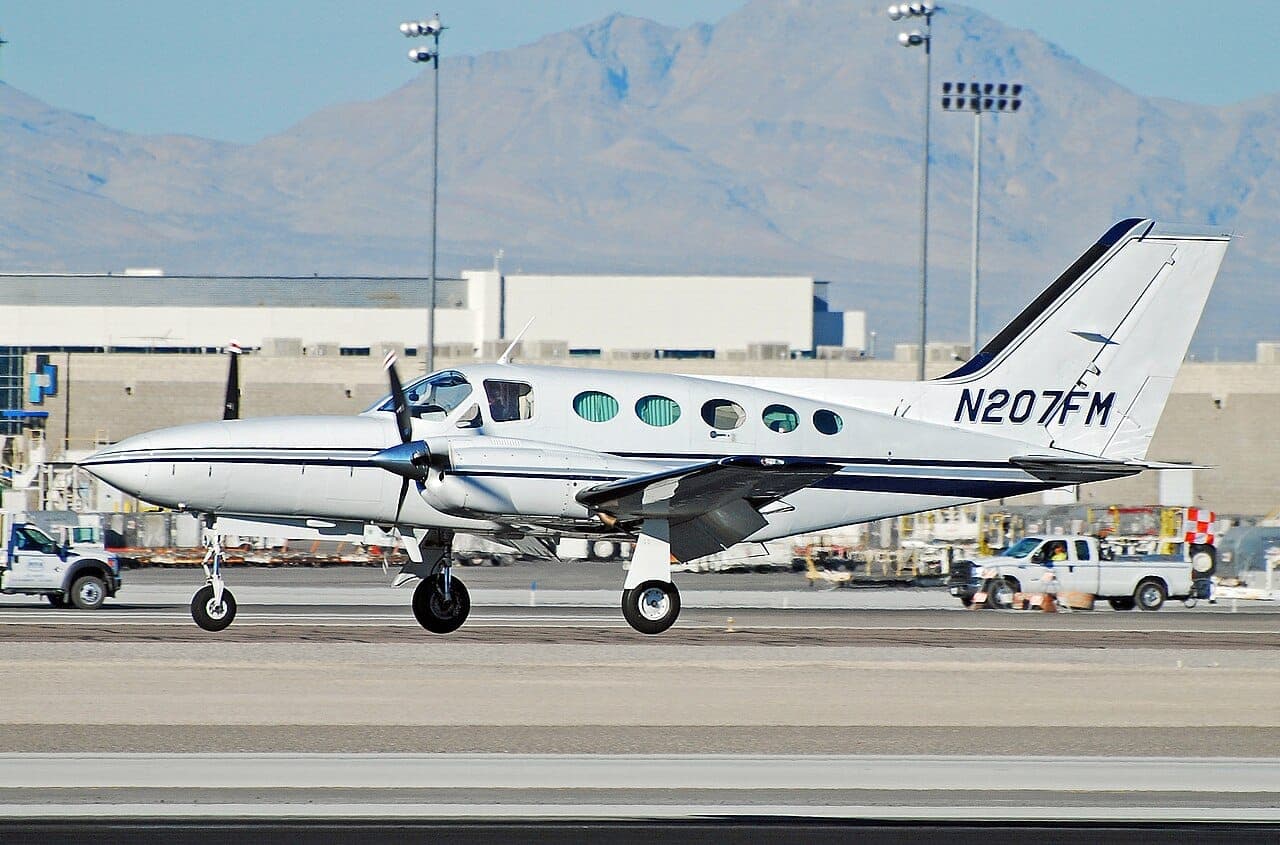
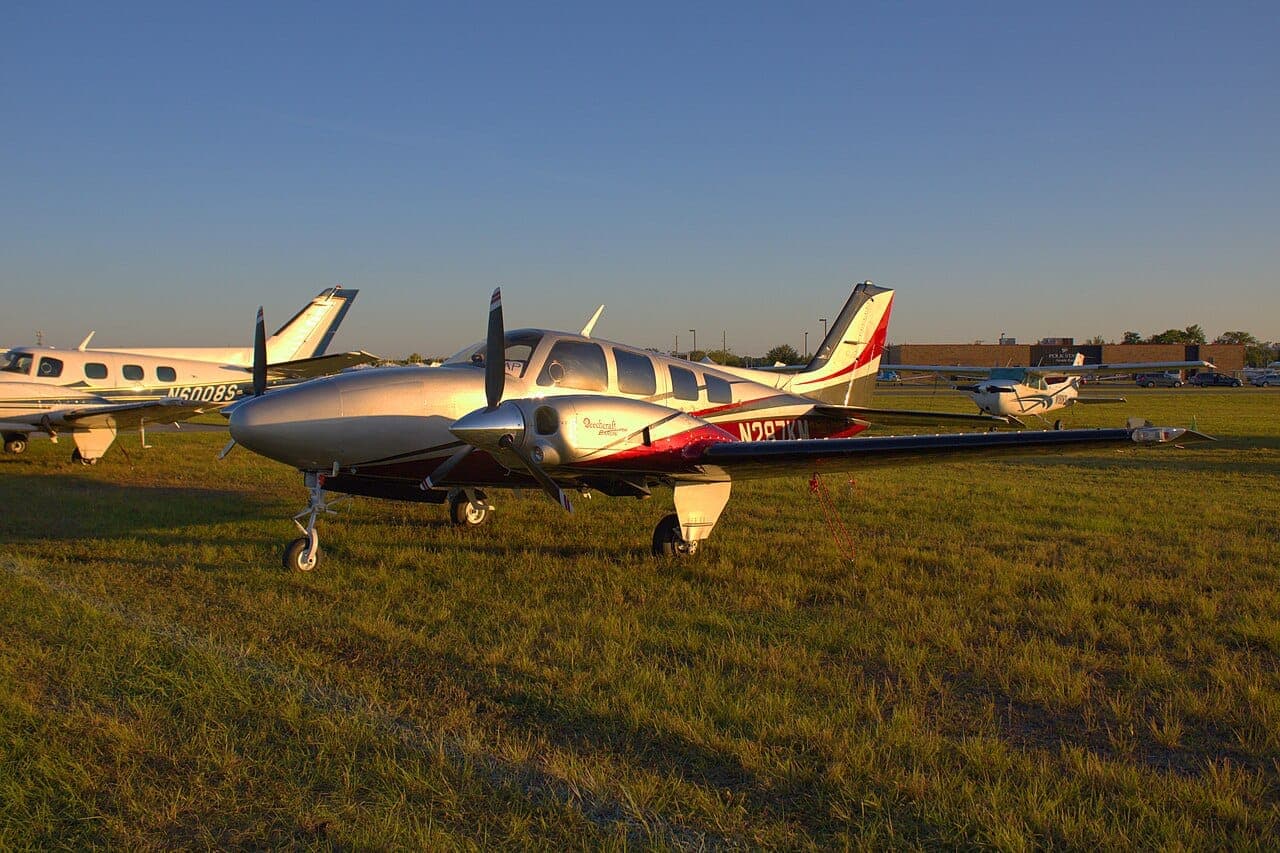
For most owners flying 100 to 200 hours a year, the Cessna 340A vs Beechcraft Baron 58P question lands on the Cessna: it burns a little less fuel, there are roughly three times as many of them in the fleet, and more shops have seen one. The Baron 58P is faster for the fuel it burns and feels better built to many pilots, but it is a smaller, more specialized fleet, and specialized airplanes cost more to keep flying.
That is the headline. The rest of this article shows where the two actually diverge — engine reserves, inspection programs, cabin and payload, and how long each one sits on the market when you want out — so you can tell whether your mission flips the answer. For some buyers it does.
The Short Answer
Buy the Cessna 340A if you want the widest cabin, the easiest entry, the best-supported pressurized piston twin fleet, and the lowest annual bill of the two — it is the sensible default for an owner-flown airplane carrying four adults and bags at 180 to 200 knots in the mid-20s. Buy the Beechcraft Baron 58P if you value Beech handling and build quality, want the extra 15 to 20 knots the later 325-horsepower airframes deliver, and you have already found a good Beech shop and a clean, well-documented example. The Baron rewards an owner who is willing to pay for a narrower support network; the Cessna forgives one who is not.
What You Pay to Get In
Both airplanes came out of the same era and sell in the same general neighborhood today. The Cessna 340 was built from 1972, with the improved 340A — 310-horsepower Continental TSIO-520-NB engines — running from 1976 to 1984. Cessna built roughly 1,300 of them. Beech built the pressurized Baron 58P from 1976 to 1985, and fewer than 500 left the factory, which is the single most important fact about owning one.
Asking prices on both spread enormously, and the spread has almost nothing to do with the model and almost everything to do with engines, avionics and paperwork. An airplane with two run-out engines, a 1990s panel and a thin logbook can look like a bargain and then cost you $150,000 in the first eighteen months. An airplane with mid-time engines, a modern GPS navigator, working known-ice equipment and complete records costs more up front and far less to own.
As of October 2026, Flying411 had 3 Cessna 340s listed, model years 1977 to 1981, with a median total time of 5,200 hours. The three Barons listed at the same time were earlier, unpressurized models from 1964 to 1979 asking $130,000 to $165,000 — a useful read on the Baron family generally, but not a price for a 58P, which is a different and scarcer airplane. These are asking prices on live listings, not sale prices or appraisals.
Pro Tip: On either type, pay a specialist — a Twin Cessna shop for the 340A, a Beech shop for the 58P — to do the pre-buy. A general-aviation mechanic who has never opened a pressurized twin will miss exhaust cracks, nacelle corrosion and gear rigging that cost five figures to put right.
Edge: Draw on price, Cessna on selection — there are simply more 340As to choose from.
Flying411 keeps pressurized piston twin listings in one place, so you can compare engine times, avionics and model years side by side instead of chasing them across a dozen tabs.
Fuel, Engines and the Hourly Number
This is where buyers expect a big gap and find a small one. Both airplanes use turbocharged Continental TSIO-520-series engines. The stock Cessna 340A uses 310-horsepower TSIO-520-N engines, with the TSIO-520-NB widely installed in the fleet. Early Baron 58Ps use 310-horsepower TSIO-520-L or -LB engines, while later aircraft use 325-horsepower TSIO-520-WB engines. Although they belong to the same engine family, their configurations and maintenance requirements are not identical.
In cruise, plan on about 30 to 34 gallons an hour total in a 340A at normal high cruise, and 34 to 38 in a 58P pushed hard. At a $6.50-a-gallon 100LL price — a reasonable 2026 planning number, though your field may be well above or below it — that is roughly $200 an hour in the Cessna and $230 in the Baron. Over 150 hours a year the difference is about $4,500. Real, but not decisive.
Engine reserve narrows it further. Continental's published time-between-overhaul letter (SIL 98-9 and its revisions) lists these TSIO-520 variants between 1,400 and 1,600 hours depending on the exact dash number, so check the letter against the data plates on the airplane you are buying rather than assuming. Overhauls as of 2025 and 2026 run roughly $55,000 to $75,000 an engine installed, and that is before you add turbochargers, exhaust, props and governors — budget another $10,000 to $20,000 a side if those are tired. Divide a $70,000 engine event by 1,400 hours and you are putting away $50 an hour per engine. A 1,600-hour TBO moves that to about $44. Across two engines the two airplanes land within $10 an hour of each other.
Why It Matters: On a pressurized piston twin, cabin air is bled off the turbocharger compressors and warmed through heat exchangers wrapped around hot exhaust. A cracked exhaust component is not just a power problem — it is a carbon monoxide path into the cabin. Both types carry repetitive exhaust inspection requirements for exactly that reason, and both deserve a CO detector regardless of what the inspection schedule says.
Edge: Cessna 340A, by about $30 an hour in fuel — small enough that mission and condition matter more.
The Numbers Side by Side
| Figure | Cessna 340A | Beechcraft Baron 58P |
| Production years | 1976–1984 (340 from 1972) | 1976–1985 |
| Approximate number built | About 1,300 (340 and 340A combined) | Fewer than 500 |
| Engines | Two Continental TSIO-520-NB, 310 hp | Two Continental TSIO-520-L (310 hp) or -WB (325 hp) |
| Published TBO | 1,600 hours; up to 1,800 for qualifying TSIO-520-NB serial numbers | 1,400–1,600 hours depending on engine model and serial number |
| Seats | 6 | 6 |
| Maximum takeoff weight | 5,990 lb | 6,100–6,200 lb by year |
| Typical equipped useful load | About 1,700–1,900 lb | About 1,700–1,900 lb |
| Maximum usable fuel | Up to about 203 gallons with optional tanks | Up to about 190 gallons |
| Typical cruise | About 180–200 KTAS in the low-to-mid 20s | About 195–215 KTAS in the low-to-mid 20s |
| Cruise fuel burn | About 30–34 gph | About 34–38 gph |
| Maximum cabin pressure differential | 4.2 psi | 3.75 psi on earlier 58Ps; 3.9 psi on later aircraft and certain earlier serial numbers |
| Certified ceiling | About 29,800 ft | 25,000 ft |
| Cabin width | Roughly 4.5 ft | Roughly 3.5 ft |
| Cabin entry | Airstair door, aft left | Single aft cabin door on the left side, with exterior boarding steps |
Keep in Mind: Useful load on a 45-year-old airframe is whatever the current weight and balance says, not what the brochure said. De-ice boots, oxygen, a heavy old panel and three paint jobs can eat 200 pounds. Always ask for the current equipment list before you fall in love with a number.
Maintenance, Inspections and Parts
Here the gap widens. Textron Aviation now owns both brands, so new factory parts come from the same place, but the used-parts market and the shop knowledge base do not. With roughly 1,300 built and an active type club in The Twin Cessna Flyer, a 340A owner can usually find a salvage nacelle door, a known fix for a stubborn gear squawk, and three shops within a day's flight that have done the work before. A 58P owner has the American Bonanza Society and a smaller pool of airplanes to pull parts from. Scarcity shows up as downtime, which is the expensive kind of cost because it does not appear on any invoice.
Structural inspection programs matter on both. Cessna published Supplemental Inspection Documents for the 300 and 400 series twins, covering spar caps, carry-through structure and wing attach areas. Part 91 owners in the United States are not required to comply, but many buyers and insurers now expect to see them done, and the first pass can run well into five figures. Textron has published similar supplemental inspections for the Beech twins. Treat either program as a question to ask during the pre-buy, not a surprise to discover at your second annual.
Systems differ in ways that show up in the shop. The 340A uses a hydraulic power pack for the landing gear, which works well and leaks when it gets old. The Baron uses an electric gear motor and gearbox — simple and durable, but the 58P is the heaviest airframe Beech ever hung on that system, and worn gear components and brakes are a recurring expense. Pressurization controllers, outflow valves and door seals age on both and are not cheap on either.
A realistic annual inspection on a healthy pressurized piston twin runs $8,000 to $15,000 in 2026, before squawks. Owners of both types report that number doubling in a year when exhaust, turbos or gear come due at once. Budget for the bad year, not the good one.
Heads Up: The 340A's tip tanks, wing lockers and auxiliary tanks give it long legs and a fuel system with enough selector positions to get a careless pilot in trouble. Fuel mismanagement shows up repeatedly in twin Cessna accident reviews. Transition training in type is not optional on this airplane, and your insurer will say the same thing.
Edge: Cessna 340A, clearly — bigger fleet, deeper parts pool, more shops that know it.
Flying411 keeps engine times, total time and model year on every twin listing in one place, so you can see which airplanes are approaching an overhaul before you book a trip to look at one.
Cabin, Payload and How It Feels Up Front
The 340A has the better cabin for passengers, and it is not close. It is about a foot wider, and it has an airstair door at the back left — you walk up into it rather than fold yourself through a single door and over a seat. For anyone carrying clients, in-laws or a spouse who is not already sold on light twins, that door does more for the ownership experience than 15 knots ever will. The Cessna also has a pressurization advantage, with a maximum differential of approximately 4.2 psi compared with 3.75 psi on earlier Baron 58Ps and 3.9 psi on later examples. At the same flight altitude and maximum differential pressure, the Cessna can maintain a somewhat lower cabin altitude, although the difference is smaller on the later Baron models.
The Baron answers with the controls. Beech built the 58P on the Baron 58 airframe with a heavier structure, and pilots who have flown both nearly always say the Beech is the nicer airplane to hand-fly — better harmonized, more honest in turbulence. It is also faster on the same engine family, particularly the later 325-horsepower versions, and it climbs well for its weight. If you fly mostly alone or with one other person and you care more about how the airplane feels than how the back seats feel, that is a real argument.
Payload is close enough to call even. Both carry roughly 1,700 to 1,900 pounds of useful load in typical equipped condition, and both make you choose between full fuel and full seats. Fill a 340A's optional tanks to 203 gallons and you have used over 1,200 pounds on fuel alone. The honest way to think about either airplane is four adults, bags and three to four hours of fuel with reserves. That is a genuinely useful machine — and it is the same answer for both types.
Fun Fact: The Cessna 340 borrowed the pressurized fuselage cross-section concept from Cessna's larger cabin twins, which is why a six-seat airplane in this weight class has a cabin that feels closer to a 414 than to a Baron. If you want to see how that family scales, our Cessna 340A vs 414A vs 421C comparison walks through the step up.
Edge: Cessna 340A for cabin and access, Baron 58P for speed and handling — pick by who is sitting in the airplane.
Resale and Time on the Market
Scarcity cuts both ways. There are fewer 58Ps, so when a good one comes up, buyers who want that airplane specifically have no substitute — and a clean, well-equipped example with records tends to find its buyer. But the pool of people shopping a pressurized Baron is also small, and sellers of specialized airplanes generally wait longer than sellers of common ones. The 340A sells into a broader market with more active brokers and more comparable airplanes, which makes it easier to price and easier to move.
What drives resale on both is identical: engine time remaining, a current navigator and ADS-B compliance, known-ice equipment if it is installed and working, continuous logbooks, and a clean corrosion record. An airplane with 300 hours left on both engines is worth meaningfully less than the same airplane with 900, no matter which badge is on the tail. If you want the broader context on how twin values behave, our roundup of the best twin-engine piston aircraft is a useful starting point, and the Beechcraft Duke B60 ownership breakdown is a cautionary tale about what happens when a beautiful airplane has a very small fleet behind it.
Edge: Cessna 340A, on liquidity rather than value retention.
Which One Should You Buy?
The owner-flown family and business traveler. You carry three or four people, you want them comfortable and unbothered at FL230, and you would rather not explain to anyone why the airplane is in the shop again. Buy the 340A. The cabin, the airstair door, the higher pressurization differential and the depth of the support network all point the same direction. Spend the money you save on acquisition finding one with mid-time engines and a modern panel.
The pilot who flies for the flying. You are mostly solo or two-up, you have flown Beech airplanes before, and the way a control yoke feels matters to you. Buy the Baron 58P — but find your shop before you find your airplane. If there is no Beech twin specialist within reasonable reach of your home field, the airplane will frustrate you no matter how good it is. Owners who make the 58P work almost always have that relationship in place first.
The buyer who is not sure pressurization is worth it. Be honest about how often you will actually fly above 15,000 feet. Pressurization adds a controller, an outflow valve, door seals, bleed plumbing and inspection requirements to an airplane that already has two engines and two turbo systems. If your typical trip is 300 miles at 10,000 feet, an unpressurized Baron 58 or a Cessna 310R will do the job for materially less money — our Baron 58 vs Cessna 310R comparison covers that pair, and the Baron B55 vs B58 cost breakdown shows how much lighter the bill gets further down the range.
Flying411 keeps Cessna and Beechcraft twins in one place, so you can compare a pressurized airplane against the unpressurized alternative before you commit to the extra systems.
Making the Call on Your Mission
Settle Cessna 340A vs Beechcraft Baron 58P on three questions, in this order: who rides in the back, where you will get it worked on, and what the engines have left. Answer those honestly and the airplane usually picks itself. The 340A is the family car of pressurized piston twins — roomier, better supported, easier to live with. The 58P is the sports sedan — faster, sharper, and happiest with an owner who is not casual about maintenance. Both are 40-plus-year-old high-performance machines where condition outweighs model every single time, so put your energy into the pre-buy and the logbooks rather than the badge.
When you are ready to compare listings, visitFlying411and see what is on the market today.
Frequently Asked Questions
Is the Baron 58P really faster than the Cessna 340A?
Yes, generally by about 15 to 20 knots in the same conditions, more so with the later 325-horsepower TSIO-520-WB engines. It also burns roughly 3 to 5 gallons an hour more to do it. On a 600-mile trip that is maybe 15 minutes saved, which matters to some owners and not to others.
What does an annual inspection cost on either airplane?
Plan on $8,000 to $15,000 as of 2026 for a straightforward annual on a healthy example, with squawks on top. Exhaust systems, turbochargers, landing gear and pressurization components are the items that turn an ordinary annual into an expensive one, and they come due on both types.
How many hours a year do you need to fly to justify one?
Fixed costs — hangar, insurance, annual, database subscriptions — land somewhere in the $25,000 to $35,000 range before you burn a drop of fuel, so the per-hour number falls sharply with use. Below about 75 hours a year, the fixed costs dominate and most owners are better served by chartering or by a simpler airplane. Above 150 hours a year, either twin starts to look reasonable against the alternatives.
Which is easier to insure?
Neither is easy for a low-time pilot. Underwriters treat pressurized piston twins as high-performance equipment and typically want a multi-engine rating, a meaningful number of hours in type or a structured transition course, and annual recurrent training. Get a quote before you sign a purchase agreement — the insurance answer has killed more of these deals than the inspection has.