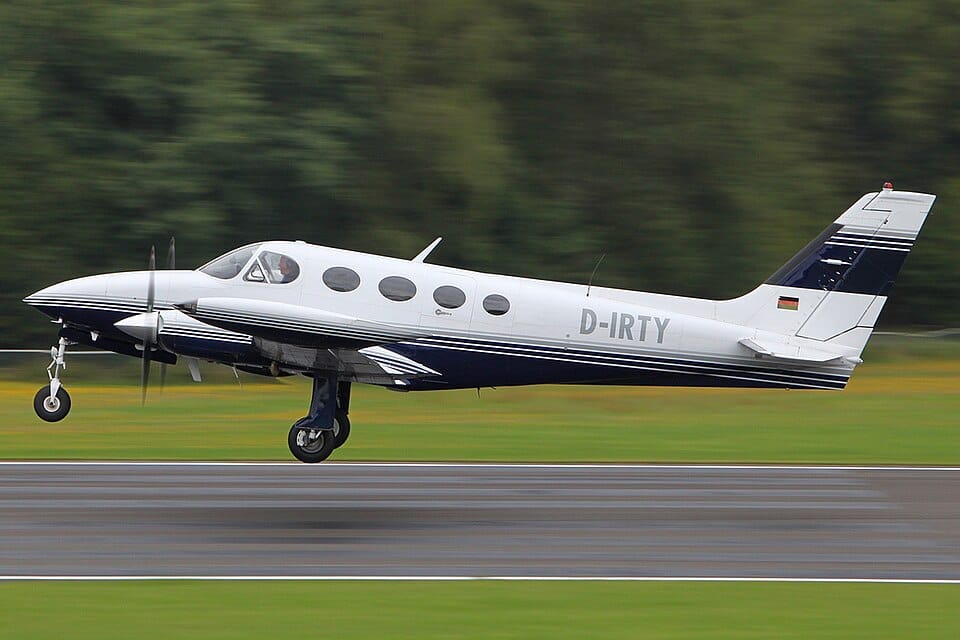
Walk down the ramp at almost any general aviation airport with a maintenance shop on the field and you will eventually find them parked in a row: three swept-tail Cessna twins with oval cabin windows, airstair doors and big three-blade props. To a casual eye they look like the same airplane in three sizes. To the person holding the checkbook, they are three very different ownership propositions, and the gap between them is measured in tens of thousands of dollars a year.
These are the cabin-class, pressurized piston twins Cessna built through the 1970s and early 1980s: the Model 340A, the 414A Chancellor and the 421C Golden Eagle. They all let you fly in the low twenties with a cabin altitude around 8,000 feet, all cruise faster than any single-engine piston you can buy for the money, and Many examples are equipped with ice protection, weather radar and modern weather-capable avionics, but those capabilities vary by serial number and individual aircraft.”
The 340A, for example, was not universally FIKI-equipped; appropriate equipment/approval depends on the airplane.. They are also the last rung on the ladder before turbine ownership, which is exactly why buyers keep circling back to them.
If you are trying to decide which pressurized Cessna twin to buy, the honest answer is that the decision has almost nothing to do with which one looks best on a spec sheet. It comes down to how many people you actually carry, how much runway you have at home, and whether your budget can absorb a geared engine overhaul without flinching. Here is how the three compare where it counts.
Key Takeaways
The Cessna 340A is the smallest, cheapest to feed and easiest to hangar of the three, and it suits two to four adults with bags flying 500 to 800 nautical miles at a time. The 414A Chancellor uses the same 310-horsepower Continental TSIO-520-N/NB engine family found in the 340A but wraps it around the larger 421-style cabin and a longer bonded wet wing, making it a strong compromise between payload and operating cost. The 421C Golden Eagle is the fastest and most powerful, with 375-horsepower geared GTSIO-520-L/N engines, but those geared engines are generally more expensive to overhaul and reward careful power management. Across all three, airframe condition matters more than paint: spar and Supplemental Inspection Document (SID) status, exhaust condition and engine history can drive the real cost of ownership. Build a substantial maintenance reserve for engines, exhaust, pressurization, deice equipment and aging-airframe work.
| If you... | Buy this one |
| Fly two to four people, want the lowest fuel and overhaul bills, and have a standard 40-foot hangar | Cessna 340A |
| Need a real six-seat cabin with a center aisle, decent full-fuel payload, and piston-normal overhaul costs | Cessna 414A Chancellor |
| Regularly fill the seats, want 200-plus knots and the most cabin, and can fund geared-engine reserves | Cessna 421C Golden Eagle |
| Want the cheapest entry price and accept older systems and a heavier maintenance gamble | Early Cessna 414 (tip tanks) or 421B |
| Are really shopping for turbine reliability and dispatch rate | Skip all three and read our twin turboprop guide |
What Separates These Three Airplanes
Cessna's piston twin line was built like a set of nesting boxes. The 340 combined a new, narrow pressurized fuselage with the 414's wing and landing gear and a modified 310 empennage. The 414 used the larger 421-style pressurized fuselage with direct-drive turbocharged Continental engines, while the 421 paired the large cabin with more powerful geared engines. The 414 took the 340's engines and married them to the large-cabin fuselage from the 421. The 421 kept that big cabin and added geared engines to haul it. Once you see that lineage, the differences make sense.
How different is the cabin, really?
Very. The 340A cabin is a snug six-place arrangement: you step through the airstair door and slide into place, and the two aft seats are best thought of as occasional seats or a place for bags. The 414A and 421C share the wider, taller large-cabin fuselage with a proper center aisle, a refreshment console and a club seating option. Passengers notice the difference the second they climb aboard. Think of it as the difference between a compact crossover and a minivan: the same number of seat belts, a completely different experience for the people in the back.
Why It Matters: If your mission is you, your spouse and two bags, the 340A's smaller cabin costs you nothing and saves you fuel on every leg. If you routinely carry four or five adults who value a wider cabin and a real center aisle, the 414A and 421C offer a meaningful comfort advantage. They are roomier than the 340A, but they are not stand-up cabins, the 414A and 421C are not a luxury, they are the requirement.
What about the wings?
The original Model 414 (1970 through 1977) used tip tanks and the shorter wing shared with the 401/402. The original Model 414 used tip tanks and a shorter-span wing. For 1978, the 414A Chancellor adopted a bonded wet-wing design as part of Cessna's 400-series redesign, eliminated the tip tanks and increased gross weight. The design followed the 421C's wet-wing concept, but the wings are not identical: the 414A's span is about 44 feet, versus about 41 feet for the 421C, which cleaned up the airplane, raised gross weight and eliminated the tip tanks. The 340A kept tip tanks throughout. That wet wing is a genuine improvement in handling and useful load, and it is one of the strongest arguments for buying a 414A rather than an early 414.
Piston or geared piston?
The 340A and 414A use Continental TSIO-520-N or -NB engines, depending on serial number and configuration, rated at 310 horsepower. Published TBO is not a single 1,400-hour figure: it varies with the specific N/NB engine and serial number, with later NB engines having longer published intervals. The 421C uses 375-horsepower geared GTSIO-520-L or -N engines with a 1,600-hour published TBO. Always verify the installed engine serial number against current Continental guidance. The 421C uses the geared GTSIO-520-L, rated at 375 horsepower, with a published TBO of 1,600 hours. The gear reduction lets the crankshaft spin faster than the propeller, which is how Cessna got 375 horsepower out of a 520-cubic-inch engine without unacceptable propeller tip speeds. It works, and the 421C is quieter in the cabin than you expect. It also adds a gearbox, and gearboxes do not forgive abrupt throttle handling.
Flying411 keeps Cessna 340A, 414A and 421C listings in one place, so you can compare engine times, avionics and asking prices side by side instead of chasing three separate searches.
Head-to-Head Numbers
Published figures come from Cessna's manuals and the FAA type certificate data sheets; the cruise and fuel numbers below reflect what owners and type-club members typically plan for in real operations, which is usually a little slower and thirstier than the brochure.
| Spec | 340A | 414A Chancellor | 421C Golden Eagle |
| Production years | 1976–1984 | 1978–1985 | 1976–1985 |
| Engines | 2 × Continental TSIO-520-NB, 310 hp | 2 × Continental TSIO-520-NB, 310 hp | 2 × Continental GTSIO-520-L, 375 hp |
| Published TBO | 1,400 hr | 1,400 hr | 1,600 hr |
| Max takeoff weight | About 5,990 lb | About 6,750 lb | About 7,450 lb |
| Seats | 6 | 6, 8 optional | 6, 8 optional |
| Usable fuel | Roughly 180–205 gal depending on options | Roughly 206 gal | Roughly 213 gal |
| Pressure differential | About 4.2 psi | About 4.2 psi | About 4.2 psi |
| Certified ceiling | Near 30,000 ft | Near 31,000 ft | Near 30,000 ft |
| Typical planning cruise | 180–200 kt | 190–210 kt | 200–220 kt |
| Typical total fuel burn | 30–33 gph | 34–38 gph | 40–46 gph |
| Cabin | Narrow six-place | Large cabin, center aisle | Large cabin, center aisle |
| Relative purchase price | Lowest | Middle | Highest |
Good to Know: Standard fuel capacity is not the same across the three. A 340A has 163 usable gallons in its standard configuration, with factory configurations commonly reaching 183 or 203 gallons. The 414A and 421C each carry 206 usable gallons in their standard wet wings, while the 421C can carry more with optional nacelle tanks. Range therefore depends heavily on tank configuration, altitude and power setting; the 340A burns the least, but a standard-tank 414A can have more still-air range than a standard-tank 340A, while the 421C trades range for speed and payload. On a 700-nautical-mile trip the 421C arrives noticeably earlier; on a 1,000-nautical-mile trip the 340A may be the one that does it without a stop.
The Money Question: What Each One Costs to Own
Engine reserves are the whole ballgame
Purchase price differences between these airplanes are small compared with the engine reserve difference. Overhaul shops generally quote a TSIO-520 overhaul in the mid five figures per engine, with the geared GTSIO-520 running substantially higher, often half again as much or more, because of the gearbox, the accessory drives and the smaller pool of shops willing to do the work. Multiply by two, divide by TBO, and you have a per-hour reserve. Do that math honestly before you fall in love with a 421C.
Here is the trap that catches first-time cabin-twin buyers: an airplane advertised with "mid-time" engines can be the most expensive one on the market if those hours were accumulated over twenty calendar years. Cylinder and case corrosion tracks the calendar, not the tach. Our guide on how often you should run an aircraft engine explains why a low-time twin that sat for years is a bigger gamble than a high-time twin that flew 150 hours a year.
Pro Tip: When you compare two candidates, convert engine time to dollars. Take the overhaul quote for that engine type, subtract what has been used, and adjust the asking price accordingly. A 421C with 200 hours since overhaul on both sides can be a better buy than a cheaper one at 1,400 hours, even if the sticker looks worse. If you are on the other side of that trade, our piece on whether to overhaul before selling covers the same math from the seller's chair.
What else drives the annual bill?
Pressurization, turbochargers, exhaust systems, deice boots, combustion heaters and retractable gear all cost money on a schedule. Expect a routine annual inspection on any of the three to land in the five figures at a shop that knows twin Cessnas, and expect the first annual after purchase to be worse, because that is when everything the previous owner deferred becomes yours. Exhaust system inspection is not optional maintenance on these airplanes; a cracked turbocharger-side component in a nacelle is a genuine hazard, not a squawk.
The combustion cabin heater deserves special mention. These units require periodic pressure decay checks and overhauls per the manufacturer's instructions, and a heater that is out of time grounds your winter flying. Ask for the heater's paperwork specifically.
Heads Up: Insurance is a real gate on these airplanes, not a formality. Underwriters generally want a multi-engine and instrument-rated pilot with meaningful time, plus type-specific initial training and annual recurrent training. A low-time pilot moving up from a single may find the 421C quoted at a premium that changes the whole decision, or declined outright. Get an insurance quote before you sign a purchase agreement.
Flying Them: Runway, Workload and Engine Handling
How much runway do you need?
All three are comfortable on paved runways of 4,000 feet or more at sea level with reasonable temperatures. The 340A is the most flexible of the group and works from shorter fields with a light load. As weight, altitude and temperature climb, the accelerate-stop and single-engine climb numbers matter far more than book takeoff distance, and the 421C at gross on a hot day needs real planning. Run the charts for your home field in August, not January.
Is the geared engine actually a problem?
It is a discipline problem more than a design problem. GTSIO-520 operators who make smooth, deliberate power changes, follow the manufacturer's recommended power settings, avoid pushing the propeller against the gearbox on descent, and fly the airplane regularly generally report reaching or approaching TBO. Operators who slam the throttles, shock-cool on descent, or let the airplane sit for months do not. The 421C rewards a professional touch, which is a fair description of the whole airplane.
Keep in Mind: Single-pilot IFR in a pressurized twin at FL200 with ice in the forecast is a real workload. Published single-engine climb rates for this class are modest, in the range of a couple hundred to around 350 feet per minute at sea level at gross weight, and they shrink fast with altitude and heat. That is why recurrent training on engine-out procedures is money well spent, and why insurers insist on it.
Flying411 tracks avionics fit, deice equipment and engine times across cabin-class twin listings, so you can see which airplanes are already equipped for the weather flying you plan to do.
What upgrades are worth paying for?
Three categories move the needle. First, engine conversions: RAM Aircraft in Waco, Texas has long offered Series conversions for the 340, 414 and 421 that add intercooling, higher rated power or both, and a documented RAM conversion with logbooks is a real value add. Second, vortex generator kits, which several suppliers certify for these airframes and which can lower minimum control speed and in some cases raise gross weight. Third, modern avionics: a WAAS navigator, a current autopilot and an engine monitor with downloadable data. That engine monitor is not a luxury on a turbocharged twin. It is your early warning system.
If you are new to the buying process generally, start with our overview on how to buy a private plane, then come back to the model-specific homework below.
Pre-Buy: What to Check Before You Sign
Airframe paperwork
Textron Aviation publishes Supplemental Inspection Documents for the 300 and 400 series, covering structural inspections tied to calendar time and cycles. In the United States these are not mandatory for most Part 91 operators, but they are how you find fatigue and corrosion before it finds you, and buyers increasingly expect to see compliance status. Wing spar inspections have been the subject of FAA and Cessna attention on 400-series airframes, so ask specifically what has been inspected, when, and by whom, and get the sign-offs in hand.
Check the airworthiness directive list against the logbooks line by line. Check for damage history, corrosion in the wing lower surfaces and nacelles, and evidence of long periods outside. A well-documented airplane that lived in a dry hangar beats a shinier one with gaps in the records every time.
Quick Tip: Use a shop that works on twin Cessnas every week, not the shop closest to the seller. The pre-buy inspection framework we laid out for the Cessna 172 applies here too, but the cabin twin version takes several days and costs several thousand dollars. That is the cheapest money you will spend on the airplane.
Systems to test in flight
Fly it before you buy it, and specifically verify that pressurization holds a stable cabin at altitude, that both turbochargers make rated manifold pressure, that the gear and flaps cycle normally, that the deice boots inflate evenly, that the heater lights and holds, and that the autopilot couples and tracks. Pull the engine monitor data and look at the whole flight, not just cruise.
Fun Fact: Cessna built roughly a thousand 340s and 340As, and the 400-series large-cabin twins together number in the low thousands. That means parts support depends heavily on specialist suppliers and type clubs. The Twin Cessna Flyer community and similar owner organizations are genuinely useful here, and joining before you buy is one of the smartest pre-purchase moves available.
So Which One Should You Buy?
Buy the 340A if...
Your typical trip is two to four people with bags, you want the lowest fuel and overhaul costs in the pressurized class, and you value being able to fit in an ordinary hangar and operate from shorter runways. The 340A is the entry point to pressurized flying and the one most owners can actually afford to fly 150 hours a year.
Buy the 414A Chancellor if...
You need the big cabin and the payload but do not want geared engines. The 414A is the sweet spot for a lot of owner-pilots: the same TSIO-520-NB engines and overhaul costs as the 340A, the same fuselage as the 421C, and the improved bonded wet wing. It is slower than a 421C by ten to fifteen knots and burns less doing it.
Buy the 421C Golden Eagle if...
You fill the seats, you want the fastest and quietest cabin-class piston twin Cessna made, and you have funded reserves for geared engines. The 421C is the best airplane of the three and the most expensive to keep. It is a fine choice for an owner with a real budget and a professional approach to engine handling, and a poor choice for someone stretching to buy it.
Or skip the pistons entirely?
Be honest about this option. If you need high dispatch reliability and you are going to fly 200-plus hours a year, the annual cost gap between a 421C and an entry-level turboprop narrows more than you would guess. Our roundup of the best twin turboprop aircraft is worth reading before you commit, and our article on whether private planes are a good investment will keep your expectations calibrated on resale.
Flying411 gathers pressurized piston twins and entry-level turboprops in one searchable place, so you can compare the real cost-per-mile tradeoff instead of guessing at it.
Conclusion
Choosing among these three airplanes is mostly an exercise in matching your mission to your maintenance budget. The 340A is the practical one, the 414A Chancellor is the balanced one, and the 421C Golden Eagle is the capable one that asks the most in return. Whichever pressurized Cessna twin you end up with, the airplane's history and the quality of your pre-buy inspection will matter more to your ownership experience than the model designation on the tail. Hire the specialist, read the logs, price the engines, get the insurance quote, and then go fly in the low twenties with a cup of coffee and a smooth ride while everyone else is scud running.
When you are ready to compare listings, visitFlying411and see what is on the market today.
Frequently Asked Questions
Which pressurized Cessna twin is cheapest to operate?
The 340A. It burns roughly 30 to 33 gallons per hour total versus 40 to 46 for a 421C, and its TSIO-520-NB engines cost materially less to overhaul than the 421's geared GTSIO-520-L. Over a 150-hour year that difference alone can run to the price of a decent used car.
Is the 421C's geared engine really a deal breaker?
No, but it is a budget item you cannot ignore. Continental publishes a 1,600-hour TBO for the GTSIO-520-L, and owners who fly regularly and handle power smoothly generally do well. The risk is buying an airplane that sat, or flying it like a trainer. If a surprise gearbox bill would hurt, buy the 414A.
What is the difference between a Cessna 414 and a 414A Chancellor?
The earlier 414 uses tip tanks and the shorter 401/402-style wing at a lower gross weight. The 414A, from 1978, has the longer bonded wet wing shared with the 421C, no tip tanks, a higher maximum takeoff weight and generally better handling. Most buyers should prefer the 414A unless the price gap is large and the airplane's records are excellent.
Can a private pilot fly one of these?
Legally you need a multi-engine rating, and a high-altitude endorsement applies to pressurized aircraft with the appropriate service ceiling and maximum operating altitude under the FAA's rules. Practically, insurers will want an instrument rating, meaningful multi-engine time and type-specific initial and recurrent training. Plan on a structured transition, not a weekend checkout.
How much should a pre-buy inspection cost?
Expect several thousand dollars and several days at a shop that specializes in twin Cessnas, including a borescope of every cylinder, a compression check, a pressurization test, a full logbook and AD review, and a check of SID compliance status. Treat any seller who resists a thorough pre-buy as a seller with something to hide.
Are these good airplanes for building multi-engine time?
They are expensive tools for that job. If hour-building is the goal rather than transportation, a simpler piston twin makes far more sense, and our guide to the best planes for time building covers the realistic options. Buy a cabin twin because you need the cabin, the speed and the pressurization.