The Airbus H125 is limited to 2,250 kg (4,961 lb) when everything is inside the cabin, but Airbus clears it to 2,800 kg (6,173 lb) when the extra weight is hanging from the cargo hook. That is a 1,212-lb jump you can only use with a sling load, and it tells you almost everything about how these two machines were designed to earn their keep.
A Bell 407 vs Airbus H125 decision is rarely about which is the better helicopter. Both are excellent. It is about which one matches the work you intend to do, because the mission drives the hourly cost far more than the badge on the tail boom does.
The Short Answer
If you move people in seats — corporate shuttles, air medical, law enforcement, tours with six paying backsides — the Bell 407 gives you one more passenger seat and a wider, quieter cabin, and you will accept a slightly higher hourly cost to get it. If you move weight on a hook, work high and hot, or operate from short unimproved sites, the H125 is the cheaper and more capable tool, with a simpler rotor head and a little less fuel going out the exhaust. On a like-for-like hour of flying, the H125 typically lands a bit lower on direct operating cost; the 407 usually wins on revenue per hour because it carries more.
The Engine Bill: M250-C47B vs Arriel 2D
The Bell 407 runs a Rolls-Royce M250 (C47E/4 in the current 407GXi), a FADEC-controlled turbine rated at 862 shp for takeoff and derated in the airframe. Its published time between overhaul is 3,500 hours. The H125 runs a Safran Arriel 2D, rated at roughly 847 shp for takeoff, with an overhaul interval Safran has pushed out repeatedly over the life of the engine — do not assume the number in an old brochure applies to the serial number you are buying. Confirm the current interval against the engine's modification standard before you build a reserve.
Both engines are modular, which matters more than most first-time turbine buyers realise. You are not always writing one enormous cheque. A compressor or gas producer module can come due on its own, and the accessory gearbox on its own, so the spend arrives in instalments. That is also why two helicopters with identical airframe hours can have wildly different engine liability — the modules may be at completely different points in their lives.
Both manufacturers sell hourly support. Rolls-Royce covers the M250 family through its authorised FIRST Network service centres, and Safran offers Support-By-the-Hour coverage on the Arriel. The rates are negotiated, not published, but the logic is the same as a jet engine program: you trade a higher known cost per hour for protection against a surprise that could ground a revenue machine for months.
Heads Up: When you compare two listings, compare engine status, not asking price. An aircraft with 300 hours to overhaul and one with 3,000 hours remaining are two different financial animals, even if the airframe times match. Ask for the module-by-module status sheet in writing.
Edge: Draw — both are mature, supported turbines, and the specific engine's remaining life matters more than the brand.
Fuel Burn and the Real Hourly Number
Operators generally plan the Bell 407 at roughly 45 to 50 US gallons per hour and the H125 at roughly 42 to 47, depending on gross weight, temperature and how hard you push the cruise. At a 2025 working figure of about $6.00 a gallon for Jet A — substitute your own FBO or contract price, because that number swings from under $5 to over $8 — the 407 burns something like $270 to $300 an hour in fuel and the H125 something like $250 to $280. Call it $20 to $30 an hour in the H125's favour. Over 400 hours a year, that is real money, but it is not the line item that decides this.
The line items that decide it are reserves. A sensible owner sets aside money every hour for the engine overhaul, for life-limited dynamic components, and for the scheduled inspections that arrive whether you fly or not. Add fuel, reserves and routine maintenance together and most civil operators of either type budget in the $650 to $900 per flight hour range for direct costs as of 2025, with the 407 sitting toward the upper half of that band because it is the heavier machine with more rotating parts. Fixed costs — hangar, insurance at roughly one to two percent of hull value for commercial work, recurrent training, database subscriptions — sit on top and are driven by your hull value and your operation, not by the model.
If you have never built one of these budgets from scratch, our guide on how to calculate aircraft operating cost per hour walks through the method, and how much to set aside per flight hour covers the reserve side specifically.
Edge: H125, by a modest margin on fuel and a slightly larger one on airframe maintenance.
| Figure | Bell 407 (407GXi) | Airbus H125 (AS350 B3e) |
| Engine | Rolls-Royce M250-C47E/4, FADEC | Safran Arriel 2D, FADEC |
| Takeoff power rating | 862 shp | 847 shp |
| Main rotor | 4 blades, soft-in-plane | 3 blades, Starflex head |
| Seats (crew + passengers) | 1 + 6 | 1 + 5 |
| Max gross weight, internal | 5,000 lb (2,268 kg) standard; 5,250 lb (2,381 kg) optional | 4,961 lb (2,250 kg) |
| Max gross weight, external load | 6,000 lb (2,722 kg) | 6,173 lb (2,800 kg) |
| Typical useful load | ~2,300 lb | ~2,350 lb |
| Cruise speed | ~133 kt | ~132 kt |
| Range, standard fuel | ~330 nm | ~340 nm |
| Usable fuel, standard | ~127 US gal | ~143 US gal |
| Planning fuel burn | 45–50 US gal/hr | 42–47 US gal/hr |
| Max operating altitude | ~20,000 ft | 23,000 ft (7,010 m) |
| Engine TBO | 3,500 hr | Extended by Safran over time — verify by modification standard |
| Final assembly | Mirabel, Quebec | Columbus, Mississippi (North America) |
Figures are manufacturer published data and common operator planning numbers as of 2025. Configuration, kit and modification standard change them.
Airframe Maintenance: Three Blades or Four
This is where the two helicopters genuinely differ in cost, and it comes down to the rotor head. The H125 uses the Starflex head that Aérospatiale introduced on the Ecureuil in the 1970s — a glass-fibre star that flexes instead of hinging, with no lubrication points on the main head. Fewer greasing points means fewer scheduled tasks, fewer seals and fewer parts to replace. Airbus has sold that simplicity for fifty years, and mechanics who have worked both types back it up.
The 407 carries a four-blade soft-in-plane head inherited from the military OH-58D program, bolted to an airframe descended from the 206L LongRanger. Four blades buy you a smoother ride and more lift, and passengers notice the difference immediately. They also mean four blades to inspect, four dampers, and a heavier dynamic component set with its own life limits. Think of it as the difference between a four-cylinder and a six: the six is smoother and pulls harder, and it has more parts that eventually want attention.
Keep in Mind: Neither type's maintenance manual cares how much you paid. Calendar-driven inspections arrive on the date regardless of hours flown, so a helicopter flying 120 hours a year carries a much higher cost per hour than the same machine flying 500. Low utilisation is the single most expensive habit in turbine helicopter ownership.
Edge: H125 — the simpler head and lighter dynamic system cost less to keep legal.
Mission Fit: Seats Versus Altitude
The 407 cabin is wider and flatter, with clamshell doors on the left side that air medical operators love because a stretcher slides straight in. Six passenger seats instead of five matters enormously if you sell tour seats: that sixth seat is pure margin on an hour you were flying anyway. For corporate work, the 407's cabin noise and vibration levels are the reason a lot of executive departments pick it.
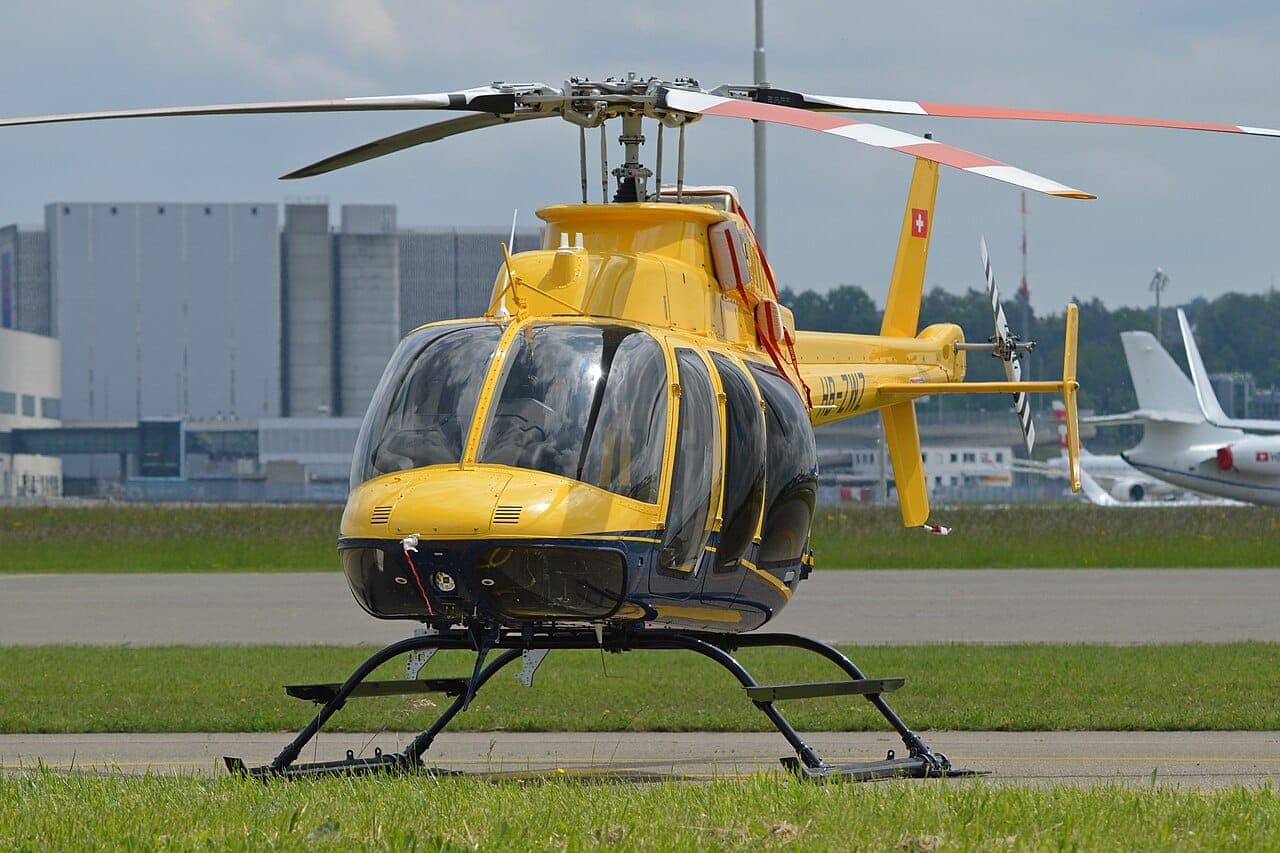
The H125 answers with altitude and hook work. Its 23,000 ft maximum operating altitude and strong hot-and-high hover performance are why it dominates mountain rescue, powerline construction, heli-logging, firefighting and ski operations around the world. The high skid gear, removable doors and sliding cabin doors make it a natural working platform. Airbus has delivered more than 6,000 aircraft in the AS350/H125 Ecureuil family since 1975, and the type is assembled for the North American market in Columbus, Mississippi.
Fun Fact: On 14 May 2005, test pilot Didier Delsalle landed an AS350 B3 on the 29,029-ft summit of Mount Everest and held it there — the highest helicopter landing ever recorded. No other civil single has come close.
Good to Know: The Bell 407 first flew in 1995 and entered service in 1996, and Bell has delivered well over 1,500 of them. It is not a niche airframe — parts, training and maintenance capability are available almost anywhere you would want to operate.
Flying411 keeps light turbine helicopter listings in one place, so you can compare engine status, avionics fit and total time across Bell 407 and H125 airframes side by side rather than tab by tab.
Edge: Bell 407 for passengers, H125 for altitude and external loads. A genuine split decision.
Resale and Residual Value
Both types hold value better than almost anything else in the light single turbine class, for the same reason: a deep worldwide fleet, active commercial demand, and a long production run that keeps support alive. The H125 has the larger installed base globally and the broadest spread of utility roles, which gives it unusually resilient demand when one segment softens. The 407 has a strong North American market anchored in EMS, law enforcement and corporate flying, and completed EMS or police machines with current avionics tend to find buyers quickly.
What actually drives resale on either is the same short list: hours remaining to engine overhaul, condition and life remaining on dynamic components, logbook completeness, corrosion history, and whether the avionics are current. A 407GXi with the Garmin G1000H NXi flight deck sells differently from a 1997 407 with analogue instruments, even if the hours are similar. If you want to see where these two fit against the rest of the class, our roundup of the best light turbine helicopters puts them next to the Bell 505, R66 and 206L.
Edge: Draw — both are blue-chip, and individual aircraft condition outweighs model.
Which One Should You Buy?
The tour or charter operator selling seats. Buy the 407. Six passengers instead of five is a 20% revenue increase on an hour whose costs barely change, and the smoother four-blade ride gets you better reviews. The extra $30 or so an hour in fuel and the heavier maintenance load are paid for by the first seat you sell.
The utility operator with a hook. Buy the H125. The 2,800 kg external gross weight, the hot-and-high margins, the simpler rotor head and the lower fuel burn all point the same direction. If your work is powerline, survey, construction, fire support or mountain operations, this is not a close call.
The owner-flown or corporate buyer. Look hard at the cabin and at your typical passenger count. If you routinely carry four or fewer, you may not need either — a Bell 505 or Robinson R66 will do the job for materially less per hour, as covered in our R66 versus Bell 505 ownership comparison. If you carry five or six regularly, or operate in and out of high-altitude airports, step up — and pick the 407 for comfort or the H125 for terrain.
Pro Tip: Before signing anything, get a pre-purchase inspection at a service centre that works on that specific type every week, not a general rotorcraft shop. Turbine helicopter discrepancies are expensive in a way that fixed-wing buyers are not prepared for, and the inspection fee is a rounding error against a module overhaul you did not budget for.
Flying411 keeps turbine helicopter listings, specifications and ownership guides in one place, so you can compare the real cost drivers before you book a viewing.
Making the Call
The honest resolution to Bell 407 vs Airbus H125 is that the H125 costs a little less per hour to run and the 407 earns a little more per hour when seats are what you sell. Neither gap is large enough to override mission fit. Pick the airframe that matches the work, then shop hard on engine time remaining and component life — that is where the four- and five-figure surprises live. If you are still deciding between turbine and piston at all, our explainer on piston versus turbine helicopters is worth reading first, and the 206B versus 206L cost comparison shows how much cabin size alone moves the numbers.
When you are ready to compare listings, visitFlying411and see what is on the market today.