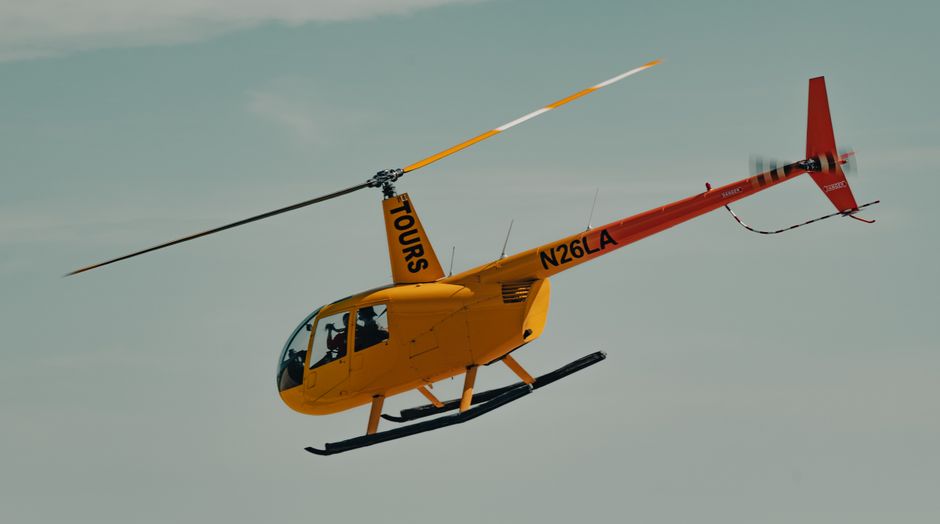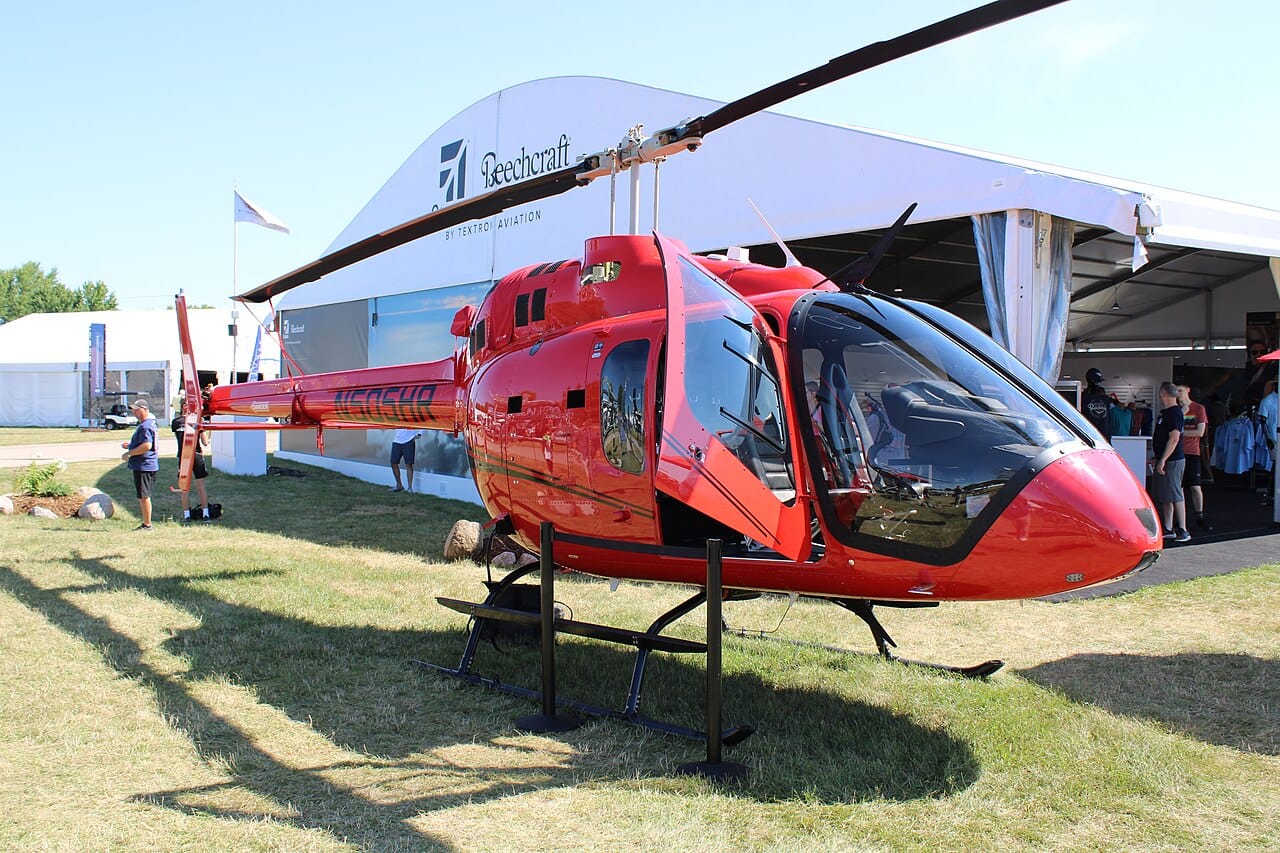
Most buyers assume the answer to Robinson R66 vs Bell 505 ownership costs is settled before the conversation starts: the Robinson is the cheap turbine, the Bell is the expensive one, end of story. On purchase price and fuel burn that is true. On cost per flight hour it is only true if you actually fly the thing, because the R66 carries a 12-year calendar overhaul that the Bell 505 does not, and a lightly flown R66 can end up with a higher overhaul cost per hour than a hard-working 505.
That one difference is worth hundreds of thousands of dollars over a decade of ownership, so it deserves more attention than the sticker price. Think of it like a gym membership billed by the year: cheap if you go three times a week, painfully expensive if you go once a month. Here is how the two aircraft actually compare, line by line.
| Spec | Robinson R66 Turbine | Bell 505 Jet Ranger X |
| Engine | Rolls-Royce RR300, 300 shp engine; helicopter rated 270 shp takeoff / 224 shp continuous | Safran Arrius 2R, 505 shp engine takeoff rating; Bell 505 transmission rated 475 shp takeoff / 428 shp continuous |
| Engine control | Mechanical governor, pilot-managed start | Dual-channel FADEC |
| Seats | 5 (1 pilot + 4) | 5 (1 pilot + 4) |
| Max gross weight | 2,700 lb | 3,680 lb internal |
| Useful load (typical) | About 1,400 lb | About 1,500 lb |
| Max cruise | About 110 kt | 125 kt |
| Usable fuel (standard) | About 73.6 US gal | 84.85 US gal” |
| Typical cruise fuel burn | 17–19 gph | 28–32 gph |
| Range (no reserve) | About 325 nm | About 306 nm at max gross weight |
| Engine Maintenance Basis | 2,000-hour RR300 Preventative Maintenance Inspection | 3,000-hour Arrius 2R TBO” |
| Airframe overhaul | 2,000-hour / 12-year inspection, whichever comes first | No fixed airframe overhaul; individual component lives and inspections |
| Standard avionics | Analog panel, Garmin touchscreen and HeliSAS autopilot optional | Garmin G1000H NXi glass panel |
| Certification | Day/night VFR | Day/night VFR |
| Baggage | Lockable compartment rated 300 lb | Aft baggage compartment, externally accessible |
What each one costs to buy
New, these are not in the same tax bracket. As of 2025, a new R66 Turbine lands roughly in the $1.1 to $1.4 million band depending on options — air conditioning, the auxiliary fuel tank, glass panel, floats, autopilot. A new Bell 505 typically lands in the mid-$3 million range once equipped. Call the gap $2 million to $2.5 million.
That gap is the single biggest number in the whole comparison, and it never goes away. Financed at a typical 2025 rate, or simply counted as capital you are not earning a return on, $2.2 million costs you somewhere around $150,000 to $180,000 a year. Fly 150 hours and that difference alone is about $1,000 per hour before you burn a drop of Jet A.
On the used side, the R66 has a deep market. Robinson has delivered well over 1,300 of them since certification in 2010, so there is a real supply of mid-time machines and a real trail of transaction history. The 505 is newer and scarcer — Bell marked its 500th delivery in 2024 — so used examples are fewer and tend to be recent, low-time airframes that have not lost much against new.
Why It Matters: Depreciation on a used R66 is better understood than on a used 505 simply because more of them have changed hands. Predictability is worth money when you are planning an exit in five years.
Flying411 keeps light turbine helicopter listings in one place, so you can compare R66 and 505 airframes side by side instead of chasing two separate markets.
Fuel, and why the burn gap is smaller than it looks
The RR300 in the R66 sips 17 to 19 gallons an hour in cruise. The Arrius 2R in the 505 drinks 28 to 32. At $6.50 a gallon for Jet A — a fair 2025 planning figure for FBO retail, though you will pay more in the Northeast and less at a self-serve pump in the middle of the country — that is roughly $115 per hour versus roughly $195.
Eighty dollars an hour. Over 150 hours a year, $12,000. Real money, but not the number that decides this purchase. People fixate on fuel burn because it is the cost they watch tick by on the gauge. The costs that actually move the needle are the ones you only see once every few years.
What you get for the extra fuel
The 505 is not burning more fuel for nothing. You get 15 knots more cruise, roughly 1,000 lb more gross weight to work with, a FADEC that manages the start and the power turbine for you, and a flat cabin floor with removable seats that makes it genuinely useful for hauling gear. The R66 answers with a 300-lb lockable baggage compartment in the tailcone — an unusually civilized feature in this class, and the one piece of the Robinson that owners mention first when asked what they would miss.
The 12-year clock: the real cost divider
Here is where the comparison turns. Robinson requires the R66 to undergo its 2,000-hour/12-year inspection at 2,000 hours or 12 years in service, whichever threshold applies first. That is not a condition-based inspection you can defer with a good logbook. It is a calendar date, and the airframe comes apart whether you have flown 2,100 hours or 400.
Shops and owners report the R66 overhaul package, including engine work, generally landing somewhere in the $250,000 to $350,000 range depending on the shop, the condition of the dynamic components, and how much the RR300 needs. Spread that over the hours you actually flew:
| Annual hours flown | Hours at the 12-year mark | Overhaul cost per hour (at $300,000) |
| 50 | 600 | About $500 |
| 80 | 960 | About $313 |
| 120 | 1,440 | About $208 |
| 185 | 2,000 (hour limit reached) | About $150” |
At roughly 167 hours a year the R66 reaches 2,000 hours at about the same time as the 12-year calendar point, so a $300,000 inspection/overhaul allowance works out to about $150 per flight hour, and the overhaul reserve is a sane $136 per hour. At 50 hours a year the same bill works out to roughly $500 per hour, which is more than many owners budget for the entire direct operating cost.
The Bell 505 has no equivalent whole-airframe calendar overhaul. It has component lives, scheduled inspections and an engine TBO, and those bills are not small — but they are tied mostly to hours and cycles, not to a date on a certificate. The low-utilization owner is not punished the same way.
Keep in Mind: The 12-year clock is also a used-buying trap. Two R66s with identical hours can be worth very different money if one has nine years left on the calendar and the other has two. Check the date of last overhaul or manufacture before you check anything else.
Where the 505 spends its maintenance money
The Arrius 2R is a more expensive engine to overhaul than the RR300 in absolute dollars, which is unsurprising at double the horsepower. Safran offers support-by-the-hour coverage that converts the overhaul into a predictable hourly rate, and most 505 operators enroll — which is exactly the point. The 505's maintenance spend is designed to be smooth and hours-based. The R66's is cheap per flight hour and then arrives as one enormous lump.
Operators typically plan on $500 to $700 per hour all-in direct for the 505 and $300 to $450 for the R66, assuming both are flown enough to reach their hour limits rather than their calendar limits. If you want the mechanics behind those numbers, our breakdown of piston versus turbine helicopter operating economics explains why turbine reserves behave so differently from piston ones.
Insurance, training and who the insurer will let fly it
Hull value drives premium, so a $3.5 million 505 costs considerably more to insure than a $1.2 million R66 — brokers generally quote hull rates in the low single digits of percent for owner-flown light turbines, which puts the R66 in a rough $20,000 to $35,000 band and the 505 meaningfully higher, often double or more, as of 2025.
Pilot qualification is the subtler cost. The R66 is deliberately easy to step into from an R44: same control feel, same Robinson handling philosophy, and Robinson's factory safety course is the standard path. Note that the special training rules of SFAR No. 73 apply to the R22 and R44, not to the R66 — a point that surprises buyers who assume all Robinsons carry the same requirement.
The 505 is a larger, heavier, more powerful aircraft with FADEC and dual hydraulic systems, and insurers tend to ask for more turbine time and more time in type before they will write an owner-pilot alone in it. If you are coming out of a piston trainer, the realistic route into a 505 includes a chunk of paid dual you should budget for.
Good to Know: Neither aircraft is certified for instrument flight. Both are day and night VFR machines. If hard IFR is in your mission, this entire comparison is the wrong shelf — you are shopping twin-engine.
Mission fit: the part cost tables cannot settle
Cost per hour only matters if the aircraft does the job. Two scenarios separate these helicopters cleanly.
The private owner flying 80 to 150 hours a year
This is the R66's natural home. Four seats plus a pilot, 350 nm of range, a baggage hold for actual luggage, and acquisition and fuel costs that are roughly a third of the Bell's. Robinson's dealer and parts network is broad, and parts pricing is famously reasonable for the class. If you are flying yourself and your family on weekends and short business hops, the R66 is cheaper to own and it is not close.
The caveat is the calendar. If your honest annual utilization is 50 hours, you are paying for a 2,200-hour overhaul you will never use. At that level of flying, serious buyers should at least price out shared ownership or charter before signing anything.
The commercial, utility or charter operator
Here the 505 earns its price. The extra 1,000 lb of gross weight, the flat floor, the external baggage access, the 125-knot cruise, the FADEC that reduces hot-start exposure with rotating pilots, and the glass panel with built-in engine trend monitoring all matter when the aircraft is working rather than touring. Hours accumulate fast in commercial service, which means the 505's hours-based maintenance model works in your favor and the R66's calendar limit stops being a penalty at all — you would hit 2,200 hours in six or seven years anyway.
Tour operators, utility work, law enforcement and flight schools with serious turbine programs tend to land on the Bell for exactly this reason. For context on where both sit in the broader class, see our rundown of the best light turbine helicopters compared.
Flying411 keeps turbine and piston rotorcraft listings in one place, so you can see how an R66's remaining calendar time is priced against a low-hour 505.
Resale and the ten-year picture
Run the two out to a decade and the shape of the deal becomes clear. The R66 owner has spent far less capital, burned far less fuel, and then faces one large overhaul bill at year 12 — a bill that can be partly handed to the next buyer by selling before the clock runs out, which is precisely what a lot of R66 owners do. Robinson's large installed fleet means a mid-calendar R66 sells readily.
The 505 owner has tied up two to three times the capital, paid more for fuel and insurance, and in exchange held an aircraft with no calendar guillotine, higher payload, and a newer market that has not yet established a long depreciation curve. Bell's product support network is deep and global, which matters if your flying takes you away from Robinson dealer territory.
Pro Tip: Ask any R66 seller for the overhaul date in writing and the current hour meter in the same email. Then price the remaining calendar years as a line item, the way you would price remaining engine time on a piston twin. Sellers rarely volunteer it.
Heads Up: Both aircraft use crash-resistant fuel systems, but older R66s built before Robinson's bladder-tank retrofit program was complete should be checked for compliance. Verify it on the specific airframe rather than assuming it by model year.
If your shortlist also includes piston options, the companion pieces on R44 versus R66 and R44 Raven versus Bell 505 cover the step up from piston power, and what it costs to own an R44 Raven gives you a baseline for how much the turbine step actually adds.
Conclusion
On the question most buyers are really asking — Robinson R66 vs Bell 505, which is cheaper to own — the R66 wins on almost every line: a purchase price around a third of the Bell's, 40 percent less fuel burn, lower insurance, cheaper parts, and an easier insurance path for an owner-pilot stepping up from an R44. For private flying at 80 to 150 hours a year, it is the clearly cheaper aircraft and the easier one to get into.
The Bell 505 wins when the aircraft has to work. Its hours-based maintenance model, extra 1,000 lb of gross weight, flat cabin floor, 125-knot cruise and FADEC earn their keep in commercial service, and it carries no 12-year calendar overhaul to punish you for the years you fly less than planned. And if your honest utilization is under about 60 hours a year, neither aircraft is cheap — the R66's overhaul reserve alone can approach $500 per hour at that rate, which is the number to put in front of yourself before you commit.
When you are ready to compare listings, visitFlying411and see what is on the market today.
Frequently Asked Questions
Does the R66's 12-year overhaul really apply even if I barely fly?
Yes. Robinson's requirement is 2,200 hours or 12 years, whichever comes first, and the calendar limit is not waivable by low hours. The practical workaround most owners use is selling the aircraft with several years of calendar time still on it, so the overhaul becomes the next owner's problem — and is reflected in the price.
Can I fly a Bell 505 as a private owner-pilot?
Yes, with the right rating and insurance approval. The 505 is a single-pilot, day/night VFR helicopter and plenty of private owners fly their own. Expect your insurer to ask for more turbine and in-type time than an R66 would require, and budget for the dual instruction that gets you there.
Is the Bell 505 faster enough to matter?
Over a 150 nm leg, 125 knots versus 110 knots saves you roughly nine minutes. Over a long day of tour or utility flying it adds up to a meaningful extra trip. For weekend private flying, speed is not the reason to choose the Bell — payload and cabin flexibility are.
Which holds its value better?
The R66 has the longer and deeper transaction record, with well over 1,300 built since 2010, so its depreciation curve is predictable and mid-calendar machines move quickly. The 505 is newer with fewer units sold, which means less data and currently thin supply of used airframes. Neither is a bad resale story; the R66's is simply better documented.