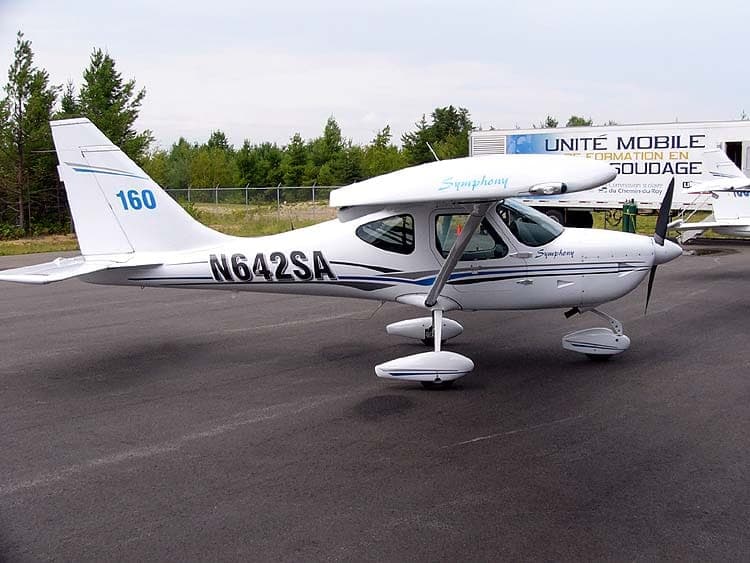
For most first-time owners, the SportCruiser vs Symphony SA-160 question comes down to one trade: the SportCruiser is cheaper to feed and simpler to inspect, while the Symphony is a certified airplane with a stronger airframe, more payload and almost no factory behind it. Both are two-seaters, not four-seaters, and that is the first thing to get straight before you start shopping.
This article lays out what each one actually costs to run, who is allowed to fly and sign off on it, and which of the two leaves you with something you can sell later. The spec sheets look closer than the ownership experience is.
The Short Answer
If you want the lowest annual bill and you fly short local trips with one passenger and light bags, buy the SportCruiser. A Rotax 912ULS burning five gallons an hour of car gas, a condition inspection a trained owner can sign for, and a factory in the Czech Republic still building the same airframe add up to the cheapest honest path into ownership available in a modern aircraft. If you need more cabin load, a tougher airframe for grass strips, and the comfort of a standard FAA type certificate with a Lycoming up front, the Symphony SA-160 is the better airplane — but you will pay more per hour, you will need an A&P for every annual, and you may wait months to find one for sale and months again to sell it.
What You Are Actually Buying
The SportCruiser, built by Czech Sport Aircraft in Kunovice and sold briefly in the United States as the PiperSport in 2010 and 2011, is a Special Light-Sport Aircraft. It is an all-metal, low-wing two-seater with a big bubble canopy, a 100-horsepower Rotax 912ULS and a maximum takeoff weight of 1,320 pounds under its original LSA certification. Think of it as a modern two-seat sports car: light, quick on the controls, happy on 91-octane pump gas, and not built to haul much.
The Symphony SA-160 comes from a different family altogether. It started life in Germany as the OMF Symphony, drawn from the Glasair GlaStar kit design, and was certified in the United States in 2001 before Symphony Aircraft Industries took production to Trois-Rivières, Quebec. Production stopped when the company failed in the late 2000s, and fewer than a hundred airframes were built across both runs. It is a high-wing two-seater with a welded steel tube cabin cage wrapped in composite, metal wings, and a Lycoming O-320-D2A turning a fixed-pitch prop. The cage is the reason owners describe it as a pickup truck compared with the SportCruiser's roadster.
That difference in certification matters more than the shapes do. The SportCruiser is built and maintained to ASTM consensus standards. The Symphony holds a standard airworthiness certificate under Part 23, which means every repair, every part and every annual follows the same rules as a Cessna 172.
Heads Up: Neither of these is a four-seat airplane. If you need back seats, you are shopping in a different class entirely — our roundup of the 9 Best 4 Seater Planes is the better starting point.
Edge: Symphony SA-160, for airframe strength and cabin load; SportCruiser, for simplicity.
Flying411 keeps light sport and certified two-seaters in one place, so you can compare a SportCruiser and a Symphony side by side instead of hunting two separate corners of the market.
Finding One, and What It Costs to Get In
Supply is the hidden cost here. Several hundred SportCruisers and PiperSports are on the US registry, and there is usually a working selection for sale at any given moment. As of 2025, clean examples with Dynon or Garmin glass and mid-time engines have generally traded somewhere between the high five figures and roughly $120,000, with engine time, the state of the five-year rubber replacement and panel upgrades driving most of the spread.
The Symphony is a different exercise. With fewer than a hundred built worldwide and a type certificate that has changed hands since the company folded, you may see one or two offered in a year. Price is negotiated rather than quoted, and the small pool cuts both ways: there is no crowd of sellers to undercut you, and no crowd of buyers when you want out.
Keep in Mind: A thin market is a real financial risk, not just an inconvenience. If you need to sell inside two or three years, the airplane that twenty people are looking for beats the airplane that two people are looking for, almost regardless of condition.
Edge: SportCruiser, by a wide margin, on availability and on your ability to exit.
| Specification | Czech Sport SportCruiser | Symphony SA-160 |
| Certification | S-LSA (ASTM standards) | FAA standard type certificate, Part 23 |
| Seats | 2 | 2 |
| Engine | Rotax 912ULS, 100 hp | Lycoming O-320-D2A, 160 hp |
| Recommended TBO | Up to 2,000 hours or 15 years for qualifying Rotax 912ULS engines; older engines may have shorter intervals unless eligible extensions were completed | Generally 2,000 hours for overhauled Lycoming O-320-D2A engines; qualifying factory-new or factory-rebuilt engines may have a 2,600-hour interval under Lycoming SI 1009BF, subject to applicable requirements and calendar recommendations |
| Approved fuel | 91 AKI unleaded auto fuel or 100LL | 100LL (minimum grade 91/96 avgas) |
| Max takeoff weight | 1,320 lb as originally certificated S-LSA | 2,150 lb |
| Typical empty weight | About 780–830 lb equipped | Approximately 1,450 lb standard empty weight; verify actual aircraft |
| Typical useful load | Roughly 490-540 lb | Approximately 700 lb at published standard empty weight; actual aircraft vary |
| Usable fuel | About 30 US gal | About 30 US gal |
| Cruise, 75% power | About 110-115 kt | About 115-120 kt |
| Typical fuel burn | About 5-5.5 gph | About 8-9 gph |
| Stall, flaps down | Around 39 kt | Mid-40s kt |
| Landing gear | Fixed tricycle, nosewheel | Fixed tricycle, nosewheel |
| Production status | In production as the PS-28 Cruiser | Out of production since the late 2000s |
Fuel, Inspections and the Yearly Bill
This is where the SportCruiser pulls ahead and does not give the lead back. The Rotax 912ULS is a liquid-and-air-cooled, geared, high-revving engine closer in character to a modern motorcycle engine than to a traditional aircraft engine, and it is happy on 91-octane unleaded from the pump. At five gallons an hour, fuel costs roughly half to two-thirds of what the Lycoming costs per hour even before you count the price gap between mogas and 100LL. The Lycoming O-320-D2A runs 8.5:1 compression and is approved on avgas, so auto fuel is generally not an option.
Inspections split the same way. A SportCruiser certificated as an S-LSA needs an annual condition inspection performed by an appropriately rated A&P mechanic, repair station or light-sport repairman holding a maintenance rating with the appropriate aircraft privileges. An owner may obtain that maintenance rating through FAA-accepted training, but the shorter light-sport repairman inspection-rating course does not authorize annual inspections on S-LSA aircraft. The Symphony requires an annual inspection under the standard-airworthiness rules, normally signed off by an A&P mechanic with inspection authorization. The Symphony needs a full Part 23 annual signed by an A&P, and any airworthiness directive that touches the Lycoming, the prop or the airframe applies in full.
| Estimated direct cost | SportCruiser | Symphony SA-160 |
| Fuel per hour (2025 prices) | About $25-$35 | About $50-$60 |
| Engine reserve per hour | Roughly $11-$13 (Rotax exchange overhaul) | Roughly $16-$19 (field overhaul) |
| Annual inspection | Condition inspection, commonly $700-$1,500 | Certified annual, commonly $1,500-$3,000 |
Those per-hour figures are estimates built on 2025 fuel prices and typical shop rates; your field will vary. The pattern does not. Fly 100 hours a year and the SportCruiser saves you something close to $3,000 in fuel and inspection costs alone.
Pro Tip: Rotax calendar work catches buyers out. The 912 series has a five-year rubber hose and component replacement, a 15-year calendar life alongside the 2,000-hour TBO, and carburetor synchronisation on a schedule. Ask when the rubber was last done before you make an offer — a deferred five-year is a four-figure surprise.
Edge: SportCruiser, clearly, on both fuel and the annual.
Flying411 keeps Rotax-powered and Lycoming-powered two-seaters listed together, so you can weigh the fuel bill against the panel before you book a pre-buy.
Parts, Support and Orphan Risk
Czech Sport Aircraft is still in business and still building essentially this airframe as the EASA type-certified PS-28 Cruiser, which flight schools on both sides of the Atlantic use as a trainer. Airframe parts, canopies, gear legs and service documents come from a company that answers the phone. Rotax support in North America is mature, with distributors, parts and independent shops in most regions.
The Symphony has no factory. What saves it is that most of the expensive hardware is generic: the Lycoming O-320-D2A is one of the most common engines in general aviation, the prop is a standard Sensenich-class fixed-pitch unit, and the brakes, tires and instruments are off-the-shelf. The vulnerable items are the composite fuselage shell, the canopy and doors, cowling and windows — the pieces nobody else makes.
Why It Matters: Orphan risk is rarely about the engine. It is about a cracked cowling or a crazed window that stops the airplane for six months because the only source is another owner's shelf. Find the Symphony owner group before you buy, not after.
Edge: SportCruiser, because the manufacturer is still there.
Who Can Legally Fly Each One
This used to be the SportCruiser's trump card and it no longer is. Before the FAA's MOSAIC rule, a sport pilot certificate limited you to aircraft meeting the old light-sport definition, which the SportCruiser met and the Symphony did not. Under the FAA's MOSAIC rules, effective October 22, 2025 for sport-pilot privileges, qualifying airplanes are no longer subject to the former 1,320-pound light-sport weight limit. Instead, 14 CFR Section 61.316 requires a maximum clean-configuration stall speed (VS1) of 59 knots calibrated airspeed at maximum certificated takeoff weight and the most critical center of gravity, along with other aircraft limitations. The SportCruiser qualifies under its established light-sport configuration. However, published Symphony SA-160 specifications list a clean stall speed of approximately 60 knots indicated airspeed, so the Symphony should not be described as sport-pilot eligible without confirming its official calibrated stall speed from approved aircraft documentation. Our guide to which planes a sport pilot can fly under MOSAIC walks through the eligibility test in detail.
What has not changed is the maintenance side. Sport pilot privileges in a certified airplane do not let you inspect it like an LSA; the Symphony still needs its Part 23 annual. And insurers still treat the two differently. Hull values are lower on the SportCruiser, but light-sport premiums have historically run high relative to hull value for low-time pilots, partly because of the type's training-fleet accident record. Get real quotes on both before you commit, because the gap is smaller than the price tags suggest.
Good to Know: If you are weighing either of these against a used certified trainer, our comparison of the Sundowner, Cessna 172 and Cherokee covers the four-seat side of the same budget question.
Edge: SportCruiser for established sport-pilot eligibility. The Symphony SA-160's eligibility needs verification against its approved clean-stall-speed data.
Which One Should You Buy?
The weekend flyer with one regular passenger. Buy the SportCruiser. Hundred-mile breakfast runs, local sightseeing and currency flying are exactly what it was built for, and five gallons an hour means you will actually fly it instead of watching the fuel bill. Read our SportCruiser costs and known issues guide before the pre-buy, and pay particular attention to nosegear and firewall history.
The owner who flies off grass, loads bags, or wants a conventional airplane. Buy the Symphony, with your eyes open. The steel cage, the 160-horsepower Lycoming and the extra hundred-odd pounds of cabin load make it the more capable machine, and a standard type certificate means any A&P can work on it. Budget for higher fuel and annual costs, and accept that you are buying into a small club.
The buyer who may resell in two or three years. SportCruiser, without much debate. Liquidity is a feature, and in a two-seat market it is worth more than a few knots of cruise.
Flying411 keeps asking prices, equipment lists and engine times for both types in one place, so you can see how thin or deep the market really is before you commit.
The Cheaper Door Into Ownership
On pure numbers, SportCruiser vs Symphony SA-160 is not close: the Rotax, the mogas approval and the condition inspection make the SportCruiser the cheaper airplane to own by several thousand dollars a year at typical private-owner hours. The Symphony earns its keep only if you specifically need what it has — load, ruggedness and the certainty of a certified airframe. Buy the one that matches the flying you will actually do, then check the engine's calendar items and the pre-buy before you check the paint. For a wider look at the budget end of the market, our roundups of the best light sport aircraft and small sport planes for affordable flying are worth an hour of your time.
When you are ready to compare listings, visitFlying411and see what is on the market today.