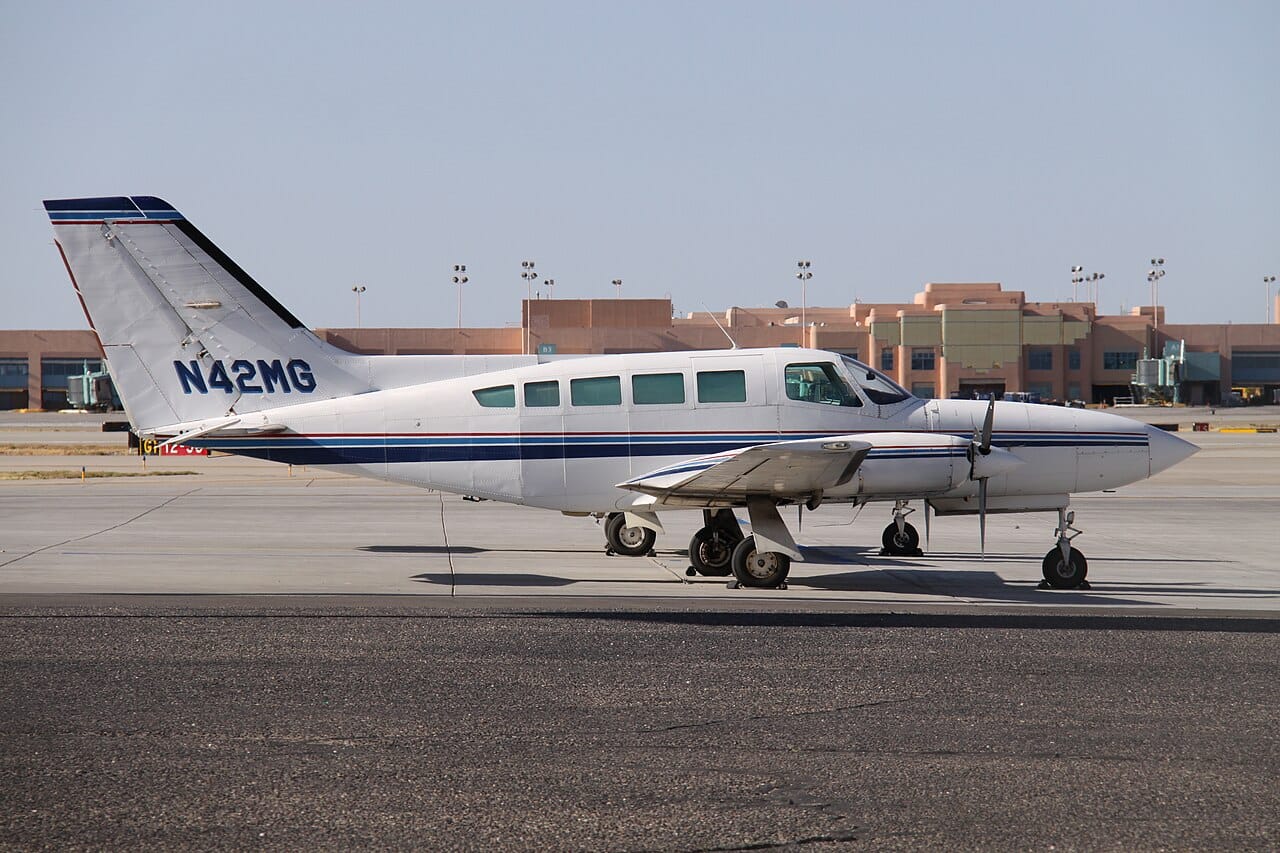
Fly either of these airplanes a hundred nautical miles and the fuel, oil and engine-reserve bill lands within about three cents a mile of the other. That is the first thing to understand about Piper Navajo Chieftain vs Cessna 402C operating costs: the Chieftain burns roughly four gallons an hour more, but it also goes about fifteen knots faster, and the two cancel each other out almost exactly.
So the money is not really in the fuel flow. It is in the airframe, the inspection paperwork, and which parts department you end up calling at 4 p.m. on a Friday. That is where these two cabin twins part ways, and where a buyer can win or lose $20,000 in a single year.
The Short Answer
Buy the Chieftain if you are hauling weight, flying Part 91, and you want counter-rotating propellers and an annual inspection that behaves predictably year after year. Buy the 402C if you value the bonded wet wing over fuel bladders, want the deeper commercial parts pool that a decade of commuter service left behind, and you are willing to budget properly for Cessna's supplemental inspection program. Neither airplane is cheap; both will cost a serious owner somewhere north of $50,000 a year at 150 hours once you count hangar, insurance and a real annual. The difference between a good example and a tired one dwarfs the difference between the two types.
Fuel Burn, Speed and the Cost Per Mile
The Chieftain runs two 350-horsepower Lycomings. The 402C runs two 325-horsepower Continentals. Neither airplane is pressurized, so most owners live between 8,000 and 14,000 feet and plan conservatively.
In practice, Chieftain owners flight-plan around 200 to 210 knots true on roughly 38 to 42 gallons an hour total. Cessna 402C owners plan 185 to 195 knots on about 34 to 38 gallons an hour. Call it 40 gph at 205 knots versus 36 gph at 190 knots.
At $6.50 a gallon for 100LL — a fair national ballpark for 2025, though you will find it under $6 at some self-serve pumps and over $8 at a full-service FBO — the Chieftain burns about $260 an hour in fuel and the 402C about $234. Divide by the speed and you get $1.27 per nautical mile versus $1.23. The Cessna wins by a nose, and the nose disappears the moment you load four more passengers into the Piper.
Why It Matters: Comparing gallons per hour between two airplanes of different speeds is like comparing two pickup trucks on gallons per hour of idling. Gallons per nautical mile is the number that shows up on your credit card.
Edge: Draw — the 402C sips a little less, the Chieftain gets there sooner, and per mile they are effectively tied.
Engines, TBO and the Overhaul Math
Here is the comparison most shoppers get backwards. The Chieftain's Lycoming TIO-540-J2BD and counter-rotating LTIO-540-J2BD are published at a 1,800-hour operating-hour TBO. The Cessna 402C's Continental TSIO-520-VB is also currently published at 1,800 hours, so there is no blanket 200-hour TBO advantage for the Piper.
It mostly is not. Field overhauls on the big-bore Lycomings, with turbo, accessories and installation, have been quoted in the rough neighborhood of $60,000 to $75,000 per engine as of 2025; the TSIO-520 tends to come in a little lower, in the $55,000 to $70,000 range. Run the division. At $67,000 over 1,800 hours, the Chieftain reserves about $37 per engine hour. At $62,000 over 1,800 hours, the Cessna reserves about $34 per engine hour. Across two engines, that gives the 402C a modest reserve advantage on these assumptions, though actual overhaul pricing and engine condition matter far more.
Add propeller overhauls (both types run three-blade props on roughly 2,000-hour or six-year cycles, typically several thousand dollars each), plus turbochargers, wastegates and exhaust components that neither type lets you ignore. A realistic combined powerplant reserve on either airplane is $95 to $110 per hour.
Heads Up: Reaching TBO is a recommendation for Part 91 operators, not a rule, but turbocharged big-bore engines rarely reward optimism. Cylinder work between overhauls is the norm on both types, and a top overhaul on one side can run well into five figures. If you want the longer view on how idle time hurts these engines, our guide on how often you should run an aircraft engine is worth ten minutes.
Edge: Draw, with a slight nod to the Chieftain if you fly enough hours to actually use the longer TBO.
| Specification | Piper PA-31-350 Navajo Chieftain | Cessna 402C |
| Production years | 1973–1984 | 1979–1985 |
| Engines | Lycoming TIO-540-J2BD / LTIO-540-J2BD, 350 hp each | Continental TSIO-520-VB, 325 hp each |
| Published TBO | 1,800 hours | 1,800 hours |
| Propellers | Three-blade, counter-rotating | Three-blade, same rotation |
| Critical engine | None (counter-rotating) | Left engine |
| Max takeoff weight | 7,000 lb | 6,850 lb (6,885 lb ramp) |
| Typical useful load | ~2,400–2,700 lb | ~2,300–2,600 lb |
| Usable fuel | ~182 US gal (bladder cells) | ~206 US gal (bonded wet wing) |
| Seats | Up to 8–10 including crew | Up to 9–10 including crew |
| Planning cruise | 200–210 KTAS | 185–195 KTAS |
| Planning fuel burn | 38–42 gph total | 34–38 gph total |
| Wingspan | 40 ft 8 in | 44 ft 1 in |
| Service ceiling (manufacturer) | ~24,000 ft | ~26,900 ft |
| Pressurized | No | No |
Flying411 keeps cabin-class piston twins from both camps in one place, so you can compare engine times, avionics and damage history side by side instead of across four browser tabs.
Airframe Inspections: SIDs, Wet Wings and Bladders
This is the dimension that actually separates the two airplanes, and it is the one shoppers skip.
Cessna published Supplemental Inspection Documents — SIDs — for its 300- and 400-series twins in the early 2010s. These are structural and systems inspections tied to calendar time and hours: wing spar caps, carry-through structure, control surfaces, landing gear components. For U.S. Part 91 operators they are not legally mandatory, but many foreign authorities made them compulsory, most insurers ask about them, and any serious buyer will. Shops and owners commonly describe first-time compliance on a 400-series twin as a five-figure event, frequently $20,000 or more, and far worse if corrosion turns up behind a panel.
Piper has no equivalent fleet-wide SID campaign on the PA-31. The Chieftain has its own list of recurring items — turbo exhaust system inspections, gear rigging, the combustion heater's periodic pressure-decay check — but the airframe inspection load tends to be more predictable from year to year.
Fuel is the other structural story. The 402C carries its fuel in a bonded wet wing, which means no bladders to replace, but sealant does eventually weep and a serious reseal is expensive and labor-heavy. The Chieftain uses rubber fuel cells, which are a known consumable: budget for a set eventually, and inspect them during pre-buy rather than discovering a leak in month three.
Good to Know: A typical annual inspection on either type runs roughly $8,000 to $15,000 with nothing major found, as reported by owners and shops in 2025. Nothing major is found about as often as you would guess on a forty-year-old turbocharged twin.
Edge: Chieftain, on inspection predictability — provided you still do a structural-quality pre-buy, because corrosion does not care what the data plate says.
Parts, Support and Who Flew These Airplanes
Both types spent their working lives in commuter and freight service, which is good news and bad news. Good, because a huge aftermarket grew up around them and used parts circulate. Bad, because many surviving airframes have cycle counts that a private owner would find eye-watering — short legs, many landings, lots of gear swings.
The 402C was the backbone of Cape Air's fleet for decades, and the airline has been replacing them with Tecnam P2012 Travellers since 2019. That fleet turnover has kept 402 parts and expertise in circulation. The Chieftain filled the same role for night freight and regional charter operators, and Piper's PA-31 support network remains active, though a few airframe-specific items can take patience to source.
The 402C's long wing, nose baggage compartment and optional nacelle lockers make it easy to load awkward cargo. The Chieftain's extra 150 pounds of gross weight and its airstair door make it the better people-hauler when all the seats are full.
Pro Tip: Ask for the gear and landing cycle history, not just airframe hours. A 10,000-hour Chieftain flown on 300-mile legs is a healthier airplane than a 6,000-hour one that flew 60-mile hops eight times a day.
Edge: Cessna 402C, narrowly, on parts availability and commercial support depth.
Insurance, Training and Engine-Out Handling
Both airplanes sit in a class where insurers care a great deal about your logbook. Expect a required multi-engine rating, meaningful multi time, a type-specific checkout and recurrent training, and for a first-time owner, a mentor pilot requirement is common. Annual premiums for a privately flown cabin twin at these hull values have generally fallen in the $6,000 to $15,000 range as of 2025, depending heavily on experience and declared hull value.
The Chieftain's counter-rotating propellers mean it has no critical engine, which simplifies engine-out handling and is a genuine talking point with underwriters. The 402C has a critical engine — lose the left one and you have less rudder authority to work with. That is a training issue more than a safety verdict; thousands of commuter pilots flew the 402 safely for decades.
The trade-off: counter-rotating engines mean two different part numbers for engines, propellers and some accessories. Spares cost more and are harder to borrow. The 402C's identical engines are simpler to stock and simpler to overhaul in pairs.
Edge: Chieftain for handling and insurance conversation; 402C for parts simplicity. Call it a draw overall.
Which One Should You Buy?
The owner-flown family or business hauler. If six to eight people and their bags are the mission, take the Chieftain. The extra gross weight, the airstair door and the speed advantage all point the same direction, and the annual inspection is less likely to surprise you. You will pay a little more per hour in fuel and get it back in trip time.
The Part 135 or cargo operator. Lean 402C. The commercial support ecosystem is deeper, the wet wing removes a recurring bladder expense, the longer wing and locker baggage suit freight,For a Part 135 or cargo operation, verify which SID items are required by applicable ADs and by the operator's approved or accepted maintenance and inspection program. Commercial use makes documented structural compliance especially important, but Part 135 alone should not be described as automatically making every Cessna SID mandatory. Once SID compliance is already baked into your budget, the Cessna's biggest cost disadvantage evaporates.
The first-time twin buyer. Be honest about whether you need this much airplane. A well-sorted Piper Seneca or a Baron 58 or Cessna 310R covers a lot of missions for meaningfully less money. Our roundup of the best twin-engine piston aircraft is a reasonable place to calibrate before you commit to a 7,000-pound airplane. And if pressurization matters more than payload, the Cessna 340A, 414A and 421C comparison covers that neighborhood.
Flying411 keeps Navajos, 402s and the rest of the cabin-class twin market in one place, so you can compare equipment lists and engine times before you book a pre-buy.
Where the Real Money Hides
On Piper Navajo Chieftain vs Cessna 402C running costs, the scoreboard is closer than the internet suggests: fuel per mile is a tie, powerplant reserves are a tie, and the gap comes down to inspection programs and how hard the individual airframe has lived. Buy the better-maintained airplane. A Chieftain with fresh engines, clean logs and no corrosion will cost you less over five years than a bargain 402C with deferred SIDs, and the reverse is just as true.
Budget conservatively: at 150 hours a year, these airplanes can readily run well above $70,000 annually once fuel, powerplant reserves, insurance, annual inspection, hangar and routine maintenance are included, before allowing for major unscheduled repairs. Then spend real money on the pre-buy inspection — a few thousand dollars at the front end routinely saves five figures at the back.
When you are ready to compare listings, visitFlying411and see what is on the market today.
Frequently Asked Questions
Which is faster, the Chieftain or the 402C?
The Chieftain, by roughly 15 knots. Owners typically plan 200 to 210 knots true in the Piper and 185 to 195 in the Cessna, both at the altitudes an unpressurized cabin twin realistically uses.
Are Cessna SIDs required for a Part 91 owner in the United States?
No. For U.S. Part 91 operations the Supplemental Inspection Documents are not mandatory unless incorporated into an approved inspection program. They are compulsory in several other jurisdictions, and insurers, buyers and appraisers increasingly treat compliance as a baseline expectation, so skipping them affects resale.
Do the Chieftain and 402C have different published engine TBOs?
Not on the standard comparison here. The Chieftain's TIO/LTIO-540-J2BD engines and the 402C's TSIO-520-VB are currently published at 1,800-hour operating-hour TBOs. Actual reserve costs therefore depend more on overhaul pricing, engine history and condition than on a nominal TBO advantage.
Can one pilot legally fly either airplane?
Yes. Both are certified for single-pilot operation with a multi-engine rating; neither requires a type rating under U.S. rules because both are under 12,500 pounds. Insurance, however, will set its own minimums for total time, multi time and recurrent training, and those are usually the binding constraint.