Most shoppers blame the parachute. Ask around any flight school and someone will tell you the Cirrus SR20 costs more to own because of the CAPS rocket in the tail, and that the Diamond is the thrifty choice because it sips fuel. Only part of that holds up. In a Diamond DA40 vs Cirrus SR20 ownership comparison, the parachute is a real but predictable calendar expense, while the two things that actually move your annual bill are how many hours you fly and which engine is bolted to the front.
Both airplanes are four-seat, fixed-gear, composite-heavy singles built after 2000, both are certified under Part 23, and both show up in university fleets and private hangars. They are close enough on paper that the cost question is a fair fight. The answer depends less on the airplane than on your flying calendar.
The Short Answer
If you fly a lot of hours a year — 150 and up, or you are putting the airplane on a leaseback with a school — the DA40 usually costs less per hour, and the diesel DA40 NG widens that gap wherever Jet-A is cheaper than avgas. If you fly 75 to 100 hours a year for personal travel, the SR20 closes most of the gap, because its extra fixed costs get spread over the same small number of hours as the Diamond's, and you get a bigger cabin, more useful load and a parachute for the trouble. Put plainly: the DA40 rewards high utilization, the SR20 rewards people who value the cabin and the safety system more than the fuel bill.
What You Are Actually Buying
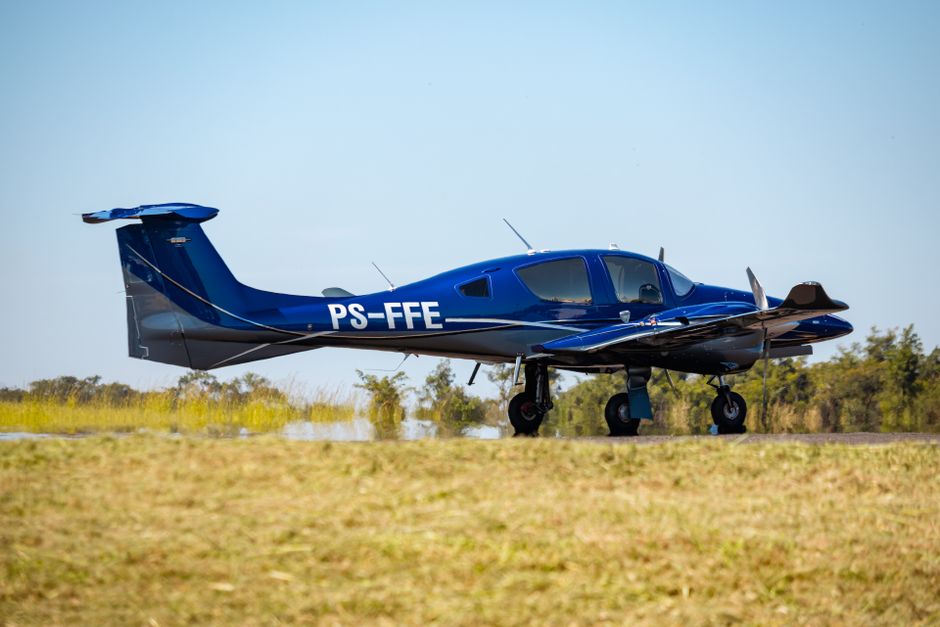
The DA40 is a long, narrow glider-shaped airplane with a bubble canopy up front, a separate rear door, and 180 horsepower up front in the avgas version. It is light on the controls, lands slowly, and sees like nothing else in the class. The trade is cabin width and payload: the DA40 cabin is snug across the shoulders, and with four adults aboard you are usually leaving fuel behind.
The SR20 is the wider airplane by a comfortable margin, with side-yoke controls, a proper luggage area, 56 usable gallons and a useful load around 1,000 pounds on later airframes. From the 2017 G6 onward Cirrus switched the SR20 from the 200-horsepower Continental IO-360-ES to the 215-horsepower Lycoming IO-390-C3B6, which fixed the older airplane's reputation for being a little soft on a hot day.
Think of it as a diesel estate car versus a petrol crossover. One is cheaper by the mile, the other is roomier and easier to live with when you load it up.
Good to Know: Diamond does not publish a fixed overall airframe life limit for the DA40, while the Cirrus SR20 carries a 12,000-hour airframe life limit. That distinction matters far more to high-utilization training operators than to a private owner flying 100 hours a year.
Edge: SR20 on cabin and payload, DA40 on visibility and landing manners — call the airplane itself a draw and decide on the numbers below.
Fuel: Where the DA40 Makes Its Case
This is the single biggest line item for anyone flying more than casually. The avgas DA40 with the Lycoming IO-360 burns roughly 9 to 10 gallons an hour in normal cruise. The SR20 with the IO-390 sits closer to 10 to 12 gallons an hour for a cruise speed only a few knots faster. That is a small difference per hour and a large one per year.
The DA40 NG is the outlier. Its Austro AE300 turbodiesel burns Jet-A, and owners commonly report 5 to 7 gallons an hour depending on power setting, while still turning in about 154 knots true. At U.S. self-serve prices through 2025 — avgas widely in the $6 to $7 range, Jet-A often a little under that — the NG's fuel bill lands somewhere near half the SR20's for the same trip.
Run it out over a year at 150 hours and $6.50 a gallon: the SR20 spends roughly $10,700 on fuel, the avgas DA40 about $9,300, and the DA40 NG about $5,900. That is a real difference, but hold on to it, because the diesel gives some of it back in the next section.
Edge: DA40 NG, clearly, and the avgas DA40 by a modest margin.
| Spec | Diamond DA40 (Lycoming) | Diamond DA40 NG | Cirrus SR20 |
| Engine | Lycoming IO-360-M1A, 180 hp | Austro AE300 turbodiesel, 168 hp | Lycoming IO-390-C3B6, 215 hp (G6, 2017+); Continental IO-360-ES, 200 hp earlier |
| Fuel | 100LL | Jet-A / diesel | 100LL |
| Published TBO / replacement | Per current Lycoming SI 1009BF; qualifying engines may reach 2,600 hr | 1,800-hour AE300 replacement interval | Earlier Continental and later Lycoming engines vary; verify exact engine and current manufacturer guidance |
| Max cruise | About 142 KTAS for the current DA40 XLT; earlier variants differ | About 154 KTAS | About 155 KTAS |
| Typical cruise burn | 9–10 gph | 5–7 gph | 10–12 gph |
| Usable fuel | Up to 50 gal on the current DA40 XLT; earlier DA40 configurations vary | About 39 gal | 56 gal |
| Max takeoff weight | 2,646 lb | 2,888 lb | 3,150 lb (G6); 3,050 lb earlier |
| Typical useful load | About 880–900 lb | About 900–930 lb | About 1,000 lb |
| Airframe parachute | No | No | Yes (CAPS), 10-year replacement |
| Published airframe life | No fixed overall airframe life limit | No fixed overall airframe life limit | 12,000 hours |
Flying411 keeps DA40 and SR20 listings in one place, so you can compare engine time, avionics and CAPS due dates side by side instead of hunting across three sites.
Engines and Overhaul Reserve
An engine reserve is money you set aside every hour so the overhaul does not arrive as a surprise. It is the second-biggest number in the budget, and it is where the diesel story gets complicated.
The DA40's Lycoming IO-360 and the later SR20's IO-390 are covered by Lycoming's current Service Instruction 1009BF, which assigns overhaul intervals by exact engine model and history. Qualifying factory-new or factory-rebuilt IO-360 and IO-390 engines may now carry recommended TBOs as high as 2,600 hours, so do not assume a blanket 2,000-hour interval when calculating reserves.
The Austro AE300 is different. It is a life-limited engine rather than an overhaulable one, and Austro has raised that limit in steps as fleet experience accumulated; the current published figure is 1,800 hours. Owners report exchange costs well above a Lycoming overhaul, and there are scheduled component changes along the way — gearbox, clutch, high-pressure fuel pump — that the Lycoming simply does not have. Spread that over a shorter interval and the NG's engine reserve typically lands in the $35 to $45 per hour neighbourhood.
Heads Up: Add the fuel and the reserve together and the DA40 NG's advantage over the SR20 shrinks from dramatic to modest — often $10 to $20 an hour rather than $30. The diesel still wins on total cost in most cases, but anyone quoting you the fuel saving alone is telling you half the story.
Edge: Avgas DA40, on the simple strength of a cheap, familiar, widely supported engine.
The Big-Ticket Items Nobody Budgets For
Every airplane has one or two expenses that arrive in a lump. On the SR20 it is CAPS. The parachute assembly and rocket must be replaced on a ten-year cycle, and service centers and owners have generally reported that job landing somewhere between roughly $15,000 and $22,000 installed, depending on model year and shop. We go through the arithmetic in detail in our guide to the Cirrus CAPS repack cost and resale impact.
The important part is that CAPS is a calendar cost, not an hourly one. At 400 hours a year in a school fleet, an $18,000 repack works out to about $4.50 an hour. At 60 hours a year in a private hangar, the same job costs you $30 an hour. That is the sharpest divide in this whole comparison, and it is about you, not the airplane.
The DA40's lumps are different in shape. Composite structure means UV protection matters — an unhangared Diamond in Arizona or Florida ages faster than an aluminum airplane in the same tiedown, and paint work on composite is specialist work. Repairs need a shop that knows composite layup, which is now common but not universal at every field. Parts for Diamond airframes come from Austria and Canada, and owners regularly report longer lead times than on a Cirrus, which has a dense North American service center network. A grounded airplane waiting three weeks for a part has a cost even if no invoice arrives.
Keep in Mind: Annual inspections on both airplanes run broadly similar when nothing is wrong — typically the low-to-mid four figures at a shop that knows the type. What separates them is what the inspection finds, and that depends far more on how the previous owner treated the airplane than on the badge on the tail.
Edge: DA40 for a low-time private owner, SR20 for a high-utilization operator who can spread CAPS across hundreds of hours.
Insurance, Training and Resale
Insurance on both is reasonable by modern standards, because both are fixed-gear four-seaters with good safety records. The AOPA Air Safety Institute has repeatedly placed the DA40 among the lowest fatal accident rates of any light single, which underwriters notice. Cirrus, for its part, requires factory-standardized transition training, and most insurers will not write an SR20 policy without it — expect to budget for a CSIP instructor and a few days of structured training when you buy.
On resale, the SR20 has the larger and more liquid market in the United States by a wide margin, and Cirrus resale values have been notably firm. The DA40 holds value well too, but the buyer pool is smaller and regional, so a Diamond can sit longer before the right buyer walks up. If you might sell in three years, liquidity is worth money.
One more resale wrinkle: an SR20 approaching its ten-year CAPS deadline sells at a discount roughly equal to the cost of the job, and sometimes more. Check the due date before you make an offer. Our breakdown of the SR20 versus the SR22 covers how those same dynamics play out in the bigger airplane.
Edge: SR20, on market depth and resale liquidity.
Flying411 keeps time-since-overhaul, avionics fit and airframe hours visible on every listing, so you can compare two airplanes on the numbers that set your first-year bill.
Which One Should You Buy?
The flight school or leaseback owner. Buy the DA40, and look hard at the NG if you have reliable Jet-A on field. At 400 to 600 hours a year, the fuel saving compounds fast, the 20,000-hour airframe life is genuinely useful, and the two-door layout survives students better than most. The avgas DA40 is the safer bet on parts and engine support; the NG is the better bet on pure cost per hour if your maintenance shop already knows Austro engines.
The private owner flying 80 to 120 hours a year with a family. Buy the SR20. You will spend somewhat more per hour, but the wider cabin, the extra hundred-odd pounds of useful load, the 56 gallons of fuel and the parachute are things you will use or appreciate on every trip. The fuel difference over 100 hours is roughly the cost of one decent family holiday — real money, but not the deciding factor when the airplane is your only one.
The cost-focused owner-pilot who flies alone or with one passenger. Buy the avgas DA40. It is the cheapest of the three to feed, the cheapest to overhaul, it has no ten-year parachute bill waiting, and two people plus bags plus full fuel is exactly the mission it was designed around. If you are also weighing it against the traditional alternative, our Cessna 172 versus Diamond DA40 comparison covers that side of the decision.
Pro Tip: Before you commit to either, price your actual home field. Some airports sell Jet-A at a steep discount to avgas and some sell it at a premium, and a few have no Jet-A self-serve at all. The DA40 NG's entire economic argument lives or dies on that one number.
The Honest Verdict on Cost
Add it all up and the ranking in a Diamond DA40 vs Cirrus SR20 ownership comparison is consistent but narrower than the internet suggests. The DA40 costs less to run per hour in both engine flavours. The SR20 costs more to run and more to keep current, and gives you a bigger, more capable airplane and a stronger resale market in return. Neither one is a mistake. The mistake is buying the cheaper-per-hour airplane and then flying it 60 hours a year, where fixed costs dominate and the hourly saving never shows up on your bank statement.
Look at your logbook from last year, not the one you hope to fill next year. That number tells you which airplane is actually cheaper for you.
Flying411 keeps four-seat trainers from Diamond, Cirrus, Cessna and Piper in one place, so you can compare real airplanes rather than brochure figures.
When you are ready to compare listings, visitFlying411and see what is on the market today.