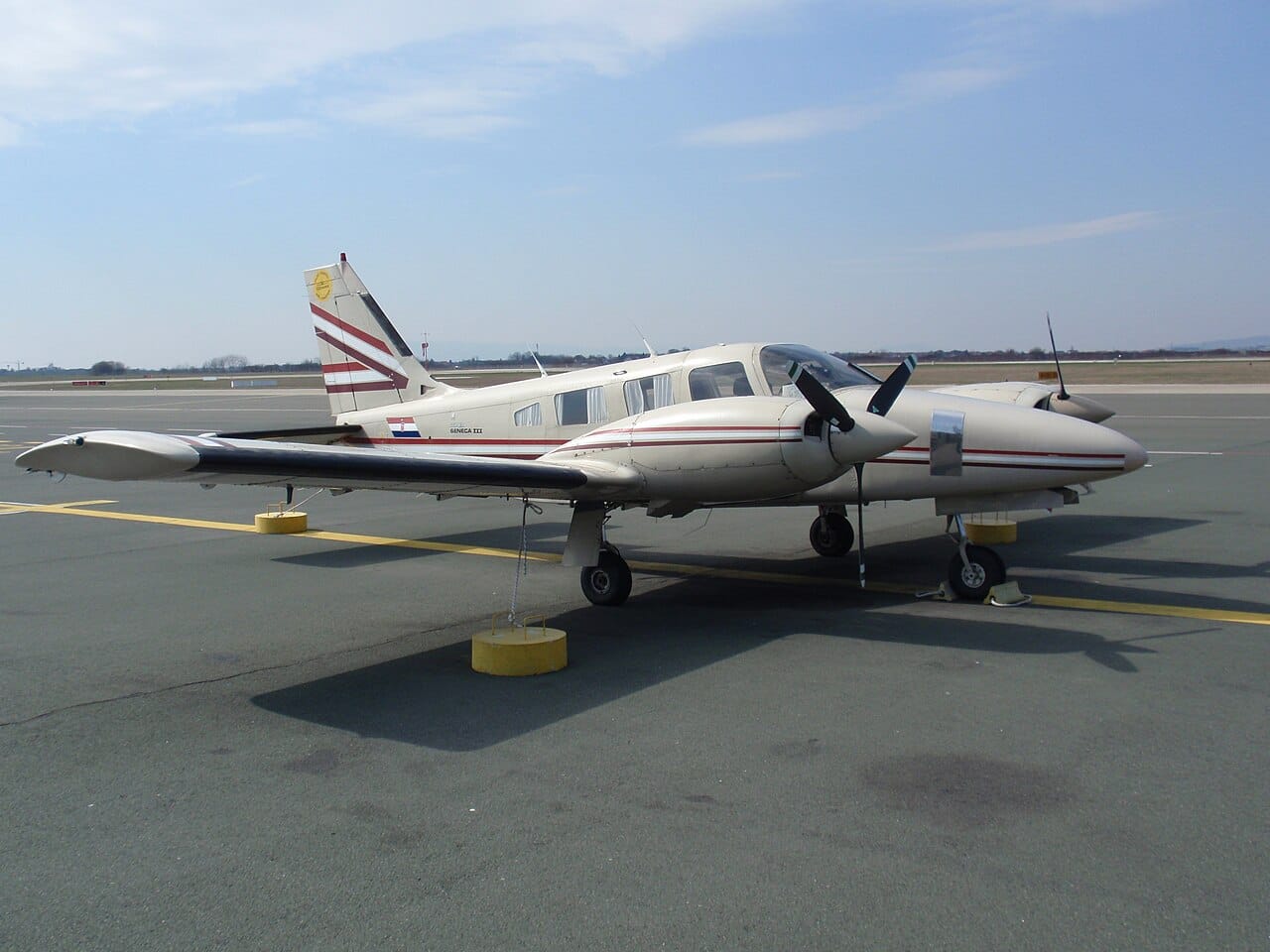
The Seneca III is the better airplane. The Seneca II is usually the cheaper one to get into, and sometimes the cheaper one to own. That tension is the whole argument in Piper Seneca II vs Seneca III, and it only resolves once you stop looking at asking prices and start pricing the engines, turbochargers and exhaust systems hanging on the wings.
Both are six-seat, turbocharged, counter-rotating piston twins built in Vero Beach. Both burn roughly the same fuel and fill the same mission: four adults, bags, and 600 to 800 nautical miles at altitudes where you need oxygen. The differences are real but narrower than the price gap between them suggests, and the money that decides the deal is almost always engine money.
What actually changed between the Seneca II and the Seneca III?
The Seneca III got more takeoff power, more gross weight, and a much better instrument panel. Piper built the Seneca II as the PA-34-200T from 1975 through 1981, then replaced it with the PA-34-220T Seneca III, which ran from 1981 until 1990 before the Seneca IV and V followed in the 1990s.
The headline change is the engine rating. The II carries 200-horsepower Continental TSIO-360 engines. The III carries a later version rated at 220 horsepower for takeoff, limited to five minutes, then 200 horsepower maximum continuous. Maximum takeoff weight went up as well, from about 4,570 pounds on the II to roughly 4,750 pounds on the III. The III also introduced a one-piece windshield and a redesigned panel that put the flight instruments in a conventional T layout directly in front of the pilot, instead of the older split arrangement that scattered engine gauges across the center.
Everything else is family resemblance. Same basic airframe, same counter-rotating propellers, same hydraulic retractable gear, same unpressurized cabin with the club-style rear seating and the double rear door that makes loading people and freight genuinely easy. Neither one is fast for its fuel burn, and neither one pretends to be.
Good to Know: The III's extra 20 horsepower per side is a five-minute takeoff rating, not extra cruise power. In level flight at altitude, a II and a III are pulling the same maximum continuous 200 horsepower each. The III's advantage shows up on a hot day at a short field and in single-engine climb, which is exactly where you want it.
Do the Seneca II and Seneca III use the same engines?
They use the same family but not the same dash numbers, and that matters at overhaul time. The Seneca II uses the Continental TSIO-360-E or -EB on the left side and the LTSIO-360-E or -EB on the right. The Seneca III uses the TSIO-360-KB and LTSIO-360-KB. The "L" prefix means that engine turns the opposite direction, which is why the Seneca has no critical engine — lose either one and the handling penalty is the same.
That counter-rotation is a safety feature you pay for twice. You pay once when you buy, because the right-hand engine is a lower-production part number with a thinner supply of serviceable cores, and you pay again at overhaul when the quote for the right side comes in higher than the left. Propellers follow the same rule: left and right blades and hubs are not interchangeable.
Time between overhauls depends on which dash number is bolted to your firewall. Continental's recommended TBO depends on the exact engine model and serial number. Current guidance lists the TSIO/LTSIO-360-E at 1,400 hours, while EB and KB-series engines are generally 1,800 hours for earlier serial numbers and 2,000 hours for qualifying later serial numbers, with a 12-year calendar recommendation.. Continental also publishes a calendar recommendation — overhaul at the hour limit or at twelve years, whichever comes first. On a twin that flies 80 hours a year, the calendar arrives long before the tach does.
Heads Up: A Seneca advertised as "mid-time engines, 700 hours since major" may still be a full overhaul candidate if those 700 hours were accumulated over eighteen years. Ask for the overhaul date, not just the hours, on both sides.
Flying411 keeps turbocharged piston twins from Piper, Beechcraft and Cessna in one place, so you can compare engine times, overhaul dates and avionics across a dozen listings before you call a single seller.
What does a TSIO-360 overhaul really cost on a Seneca?
Plan on six figures to bring both sides back to zero with the supporting hardware. The engines themselves are the biggest single line, but the turbochargers, exhaust, propellers, mounts and hoses add up faster than first-time twin buyers expect, and skipping them just moves the bill to next year.
The figures below reflect what shops and owners have been quoting in recent years for the TSIO-360 in a Seneca. Treat them as planning ranges, not quotes — cylinder condition, crankshaft and case serviceability, and whether you go field overhaul or factory exchange swing the number by tens of thousands.
| Line item | Per side | Both sides |
| Field overhaul, TSIO-360 / LTSIO-360, installed | $38,000 – $55,000 | $76,000 – $110,000 |
| Factory rebuilt or new exchange engine | $50,000 – $75,000 | $100,000 – $150,000 |
| Turbocharger overhaul or exchange | $2,500 – $5,000 | $5,000 – $10,000 |
| Exhaust system components, slip joints, clamps | $3,000 – $10,000 | $6,000 – $20,000 |
| Propeller overhaul | $3,500 – $6,000 | $7,000 – $12,000 |
| Mounts, hoses, baffles, accessories, labor extras | $3,000 – $8,000 | $6,000 – $16,000 |
| Typical complete engine event | — | $100,000 – $160,000 |
| Reserve per flight hour at 1,400 – 1,800 TBO | — | About $50–$115, depending on engine variant, serial number, and actual overhaul budget |
Divide that total by the hours you will actually fly and the arithmetic gets uncomfortable. At 100 hours a year and a $130,000 engine event every 1,600 hours, you are setting aside about $8,000 annually before you buy a drop of fuel. If you would rather understand what the shop is doing with that money, our walkthrough of how aircraft engine overhauls work covers the teardown, inspection and yellow-tagging process step by step.
How much extra does the turbocharger system add to upkeep?
Budget a few thousand dollars a year on top of a normally aspirated twin, and expect the surprises to come from the exhaust rather than the turbo itself. The turbocharger is a simple device — exhaust gas spins a turbine, the turbine spins a compressor, the compressor stuffs more air into the engine. What wears out is everything around it.
The specific items that cost Seneca owners money are the exhaust risers, slip joints and V-band clamps that live in the hottest part of the cowling. They crack. A cracked riser is not just an expensive part, it is a carbon monoxide and fire path, which is why a careful annual on a turbocharged twin includes pulling and inspecting exhaust components rather than glancing at them through a cowl opening. Add turbo bearing wear from hot shutdowns, wastegate and controller rigging drift, and oil lines that harden with heat cycles.
Neither the Seneca II nor the standard Seneca III came with intercoolers from the factory — those arrived with the Seneca V. Aftermarket intercooler kits have been offered under STC for both the II and the III, and they lower induction temperatures meaningfully. If a listing claims one, check that the STC paperwork and a 337 are actually in the aircraft records before you assign value to it.
Pro Tip: Ask the seller how the previous owner shut down. A turbocharged engine that was taxied in briskly and shut off immediately has been coking its turbo bearing for years. A three-to-five minute cooldown at idle is the difference between a turbo that makes TBO and one that does not.
If you are new to turbocharging in general, our comparison of the Continental IO-550 vs TSIO-550 explains the same trade-offs on a bigger engine: more capability up high, more heat, more parts, more attention.
Is the Seneca III actually faster, and does it carry more?
A little faster, and yes, meaningfully more. Piper's book numbers put maximum cruise for the Seneca II around 190 knots true and the Seneca III in the mid-190s, both at high cruise power in the teens. In practice, on the same day with the same pilot, you are looking at a handful of knots — not enough to redraw a trip.
The gross weight difference is the one you feel. About 180 more pounds of maximum takeoff weight on the III provides useful additional payload flexibility, but the actual increase in people, baggage, or fuel depends on the specific airplane's empty weight and weight-and-balance limits.. Both airplanes carry around 93 gallons usable in standard tanks, with long-range tanks holding about 123 gallons usable. At a combined 20 to 24 gallons per hour in cruise, full long-range tanks are four to five hours of flying plus reserves, which is more airplane endurance than most bladders.
Both are certified to 25,000 feet and neither is pressurized, so realistic operating altitudes are the mid teens on cannulas. Single-engine climb performance is where the III's takeoff rating earns its keep. Published single-engine rate of climb for either airplane is modest — a couple hundred feet per minute at sea level at gross — and the III's numbers are better, not good. That is honest light-twin territory, and it is why currency and training matter more on these airplanes than avionics do.
What should I look for in a Seneca prebuy inspection?
Have the prebuy done by a shop that knows PA-34s specifically, and tell them the exhaust and the logbooks are the priority. A generic prebuy on a turbocharged twin misses the things that later cost $30,000.
The engine and turbo package
Compressions on all twelve cylinders, a borescope on every one, oil analysis history across several samples, and a physical inspection of both exhaust systems with the cowlings off. Check turbo shaft play, wastegate travel and controller condition. Verify that the left and right engines actually match their dash numbers in the logs, and that any cylinder work was documented.
The paperwork
Pull the full airworthiness directive list against the specific serial number and confirm every recurring item is signed off and current. The PA-34 series is covered by its own FAA type certificate data sheet, and the equipment list in it tells you what was legally installed. Missing weight-and-balance amendments after avionics work, and 337s with no matching STC, are common and they are your problem after closing. Our guide to how airframe hours affect aircraft value is worth reading alongside the logs, because on a forty-year-old twin the story in the records moves price more than the tach does.
Airframe and systems
Corrosion in the wing and empennage attach areas, gear rigging and emergency extension function, fuel cell condition and leaks, and the combustion cabin heater. That heater carries its own recurring pressure-decay inspection, and a failed one is an expensive surprise in October. Check the de-ice equipment too if it has boots — reskinning and boot replacement on a twin is a five-figure conversation.
Flying411 keeps Seneca II and Seneca III listings side by side with the equipment details spelled out, so you can see which airframes have known-good de-ice, current engines and honest logbooks before you spend money on a prebuy.
What do Seneca IIs and IIIs sell for, and where does the value break?
A Seneca II generally trades well below a comparable Seneca III, but the spread narrows sharply once engine times are equalized. Broadly, run-out Seneca IIs with tired panels sit at the bottom of the twin market, well-kept IIs with mid-time engines and modern GPS sit in the middle, and clean late Seneca IIIs with low-time engines and glass upgrades reach into Baron territory.
The trap is buying the cheapest airplane on the page. A Seneca II at $50,000 less than a Seneca III, with both engines a hundred hours from TBO and fifteen years since overhaul, is not $50,000 cheaper. It is roughly $80,000 more expensive, and you will spend that money on somebody else's schedule rather than your own. Price the engine event first, subtract it, and then compare airframes. That is the same discipline described in our piece on asking price vs actual sale price, and it is how experienced twin buyers negotiate.
Where the Seneca II wins is on entry cost for a buyer who wants the capability now and can absorb the engines later, or who is buying a II that has already had the engine event done recently and documented properly. Where the III wins is on resale, insurability with some underwriters, and the panel — that redesigned instrument layout is a real quality-of-life difference on a hard IFR night, and it is much cheaper to buy an airplane that already has it than to rebuild a II's panel.
When you are ready to make an offer, our buyer's playbook for negotiating used aircraft prices covers how to turn prebuy findings into dollars without blowing up the deal.
Is a Seneca the right twin at all, or should I look elsewhere?
The Seneca earns its place when you need six seats, a big cargo door and turbocharged terrain-crossing capability on a piston budget. If you never fill the back seats and never cross the Rockies, a fast single will do the same trips on half the maintenance.
Think of the Seneca as the minivan of light twins — roomy, practical, unglamorous, and expensive to keep on the road once the mileage piles up. Against a Beechcraft Baron 58 it gives up speed and polish but costs less to acquire; our Baron 58 vs Cessna 310R comparison shows what that next tier of cabin-class piston twin costs to run. If the goal is multi-engine training or time building rather than family transportation, the lighter airplanes in our DA42 vs Seminole cost comparison are a better match, because neither carries a turbocharger to feed.
Insurance deserves a line of its own. A turbocharged, retractable, six-seat twin is a demanding risk. Low-time multi pilots should expect either high premiums or a training and mentoring requirement before solo coverage, and that requirement is easier to satisfy on a Seneca than on most twins because instructors familiar with the type are common.
Flying411 keeps light twin listings, engine specifications and ownership guides in one place, so you can compare a Seneca against a Baron, a 310 or a Seminole on real numbers rather than impressions.
At a Glance
The Seneca III brings a 220-horsepower five-minute takeoff rating, roughly 180 pounds more gross weight, a one-piece windshield and a far better instrument panel than the 200-horsepower Seneca II, while cruise speed differs by only a few knots. Both run counter-rotating Continental TSIO-360 and LTSIO-360 engines, with recommended TBOs ranging from 1,400 to 2,000 hours depending on model and serial number, plus Continental's 12-year calendar recommendation. A complete two-engine event with turbochargers, exhaust, propellers and accessories realistically runs $100,000 to $160,000, which works out to a reserve of $60 to $100 per flight hour, and the turbo system adds a few thousand dollars a year in exhaust and controller attention that a normally aspirated twin never sees. In Piper Seneca II vs Seneca III terms, the III is the better airplane and the safer resale, but a Seneca II with freshly overhauled, well-documented engines and clean exhaust will beat a cheap III with run-out engines every single time — price the powerplants first, then buy the airframe.
When you are ready to compare listings, visitFlying411 and see what is on the market today.