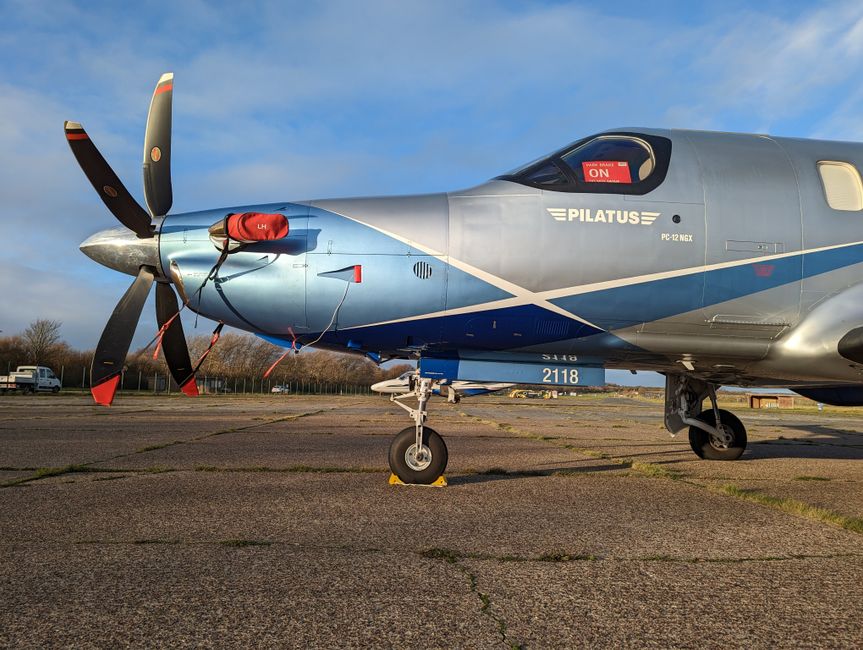
A Daher TBM 900 at high cruise burns roughly 0.17 gallons of Jet A for every nautical mile it covers. A Pilatus PC-12 NG doing the same trip burns about 0.23. That is roughly a third more fuel per mile, but at 200 flight hours a year the hourly fuel-burn figures used in this article work out to about $68,000 for the TBM and $78,000 for the PC-12 at $6 per gallon.That single ratio is where most used Pilatus PC-12 vs Daher TBM comparisons start — and it is also where most of them stop too early.
Because fuel is only one line on the page. Engine reserves, hull insurance, hangar size, recurrent training and the heavy inspections all move in the same direction as airplane size, and the PC-12 is a much bigger airplane. The honest question is not which one burns less. It is which one is cheaper for the flying you actually do, because a PC-12 flown with two people aboard is an expensive way to do a TBM's job, and a TBM asked to haul six adults and their bags simply cannot.
Key Takeaways
The TBM is the cheaper airplane to feed, hangar, insure and inspect — expect it to run meaningfully less per flight hour and less per mile than a PC-12 of similar vintage. The PC-12 is the cheaper airplane per seat and per pound, and it is the only one of the two with a real second life on a Part 135 charter certificate, which is how many owners claw back fixed costs. Both use Pratt & Whitney Canada PT6A engines, but their published overhaul intervals depend on the specific engine configuration and applicable service-bulletin status. The PC-12 NG’s PT6A-67P carries a 3,500-hour basic TBO, while the TBM’s PT6A-66D has a 3,000-hour basic TBO that can increase to 3,500 hours when the applicable Pratt & Whitney Canada requirements are met. Speed goes to the TBM by 40 to 50 knots; cabin volume, payload and unimproved-field ability go to the PC-12 by a wide margin. Pick on mission first, then on money — choosing the wrong size airplane costs more than choosing the wrong brand.
| Item | Pilatus PC-12 (/45 and /47E NG) | Daher TBM 850 | Daher TBM 900 |
| Production years | 1994–present (/45 and /47 to 2007, /47E NG 2008–2019) | 2006–2013 | 2014–2017 |
| Engine | PT6A-67B / -67P, flat rated 1,200 shp | PT6A-66D, 850 shp; TBM 850 limited to 700 shp for takeoff and landing | PT6A-66D, 850 shp |
| Published TBO | 3,500 hr for PT6A-67P | 3,000 hr basic; up to 3,500 hr when applicable P&WC requirements are met | 3,000 hr basic; up to 3,500 hr when applicable P&WC requirements are met |
| Max cruise speed | 270 KTAS (/45), 280 KTAS (NG) | 320 KTAS | 330 KTAS |
| Typical high-cruise fuel burn | ~65 gph | ~56 gph | ~57 gph |
| Fuel cost per nm at $6.00/gal | ~$1.39 | ~$1.08 | ~$1.04 |
| Max takeoff weight | 9,920 lb (/45), 10,450 lb (NG) | 7,394 lb | 7,394 lb |
| Payload with full fuel | ~1,100–1,300 lb | ~750 lb | ~800 lb |
| Seats | Up to 9 passengers plus crew | 6 total, 7th seat optional | 6 total, 7th seat optional |
| Cabin width x height | 5 ft 0 in x 4 ft 9 in | 3 ft 11 in x 4 ft 0 in | 3 ft 11 in x 4 ft 0 in |
| Aft cargo door | Yes, 53 x 52 in | No | No |
| Max operating altitude | FL300 | FL310 | FL310 |
| Wingspan / length | 53 ft 4 in / 47 ft 3 in | 41 ft 7 in / 34 ft 11 in | 42 ft 1 in / 35 ft 2 in |
| Fleet size | More than 2,000 delivered | More than 1,000 TBMs delivered across the 700/850/900 family |
Same Engine Family, Two Completely Different Airplanes
Both of these airplanes hang a PT6A on the nose, and both run that engine well below what it could produce. The PC-12's PT6A-67P is flat rated to 1,200 shaft horsepower from a core capable of roughly 1,845 thermodynamically. The TBM's PT6A-66D is flat rated to 850 shp from a core in the same neighborhood. Think of it like a big V8 loafing along at 2,000 rpm — the engine never works as hard as it can, which is exactly why these two have the service reputations they do.
From there they diverge completely. The PC-12 is a utility airplane with an airliner's cabin cross-section, a 53-by-52-inch aft cargo door, trailing-link gear that tolerates grass and gravel, and a wing designed to get in and out of short fields at ten thousand pounds. The TBM is a fast personal airplane with a cabin about the width of a large sedan, a single airstair door, and an airframe tuned to hold 320 to 330 knots in the high twenties. Pilatus built a truck that happens to be comfortable. Daher built a sports car that happens to carry four people.
Why It Matters: Nearly every cost difference in this comparison traces back to weight and size, not to brand. A 10,450-pound airplane with a 53-foot span costs more to hangar, more to insure, more to re-tire and more to inspect than a 7,394-pound airplane with a 42-foot span. None of that is a quality judgment. It is just mass.
If you want the wider field of turbine singles before you narrow to these two, our roundup of the best single-engine turboprops for the money covers the cheaper entries, and the fastest single-engine turboprops piece puts the TBM's speed in context against the rest of the class.
What Drives the Spread on the Used Market
Asking prices for both models move with the market, so check current listings rather than a number in an article. What does not change is which variables move the price, and on these two airplanes they are not the same variables.
On the PC-12, the panel is the big fork in the road
Early PC-12s and PC-12/45s came with a four-tube Bendix/King EFIS panel that is now thirty years old in the oldest examples. Bringing one of those up to a modern WAAS, ADS-B Out and digital-autopilot standard is a serious six-figure project, and many of the cheapest PC-12s on the market are cheap precisely because nobody has done it. The 2008-and-later PC-12 NG arrived with the Honeywell Primus Apex flight deck and the uprated PT6A-67P, which is why the price step between a /45 and a /47E is so large.
On the TBM, it is the model year and the engine clock
The TBM 850 ran from 2006 to 2013, and from 2008 it was delivered with the Garmin G1000 — a meaningful line in the sand, because the earlier 850s carry the legacy EFIS panel. The TBM 900 of 2014 brought the redesigned cowling, winglets, five-blade prop and a single-lever power control, plus about 10 knots. Engine time matters more on a TBM than on a PC-12 for the simple reason that a mid-six-figure overhaul is a larger share of a smaller airplane's value.
Heads Up: On either type, buy the engine and the records before you buy the paint. Ask whether the engine is enrolled in Pratt & Whitney Canada's Eagle Service Plan or a comparable program, whether the enrollment transfers, and whether it is paid current. An unenrolled engine at 2,800 hours is not a bargain; it is a bill with a date on it.
Flying411 keeps used turbine single listings in one place, so you can compare PC-12 and TBM airframes by engine time, panel and total hours side by side instead of hunting across a dozen tabs.
Fuel and Speed: Per Hour Versus Per Mile
This is the part most buyers get backwards. Per hour, the TBM saves roughly 8 gallons using the planning figures in this article. Its advantage becomes larger on a per-mile basis because it is also covering ground roughly 40 to 50 knots faster.
| 700 nm trip, Jet A at $6.00/gal | PC-12 NG | TBM 900 |
| Cruise speed used | 280 KTAS | 330 KTAS |
| Block time, allowing for climb and descent | ~2 hr 40 min | ~2 hr 15 min |
| Fuel burned, approximate | ~175 gal | ~130 gal |
| Fuel cost | ~$1,050 | ~$780 |
| Fuel cost per seat, cabin full | ~$117 (9 passengers) | ~$156 (5 passengers) |
Read that last row carefully, because it is the whole argument. On a per-airplane basis the TBM wins fuel by about 25 percent. On a per-person basis, with both cabins full, the PC-12 wins — and it does it while carrying bags the TBM cannot physically fit. The PC-12 is cheaper per unit of work; the TBM is cheaper per hour of flying.
Range is close enough that it rarely decides things. Daher quotes roughly 1,730 nm for the TBM 900 at long-range cruise, and the PC-12 NG is in the 1,500 to 1,800 nm band depending on how slowly you are willing to fly it. Both will do a US coast-to-coast trip with one stop. If range is the deciding factor for you, our list of the best single-engine planes for long distance is worth a look before you commit.
Good to Know: The TBM is certified to FL310 and the PC-12 to FL300. That 1,000 feet sounds trivial, but it often puts the TBM on top of weather and in thinner air where its speed advantage is largest. The TBM also holds a higher pressurization differential, so passengers sit at a lower cabin altitude on a long leg — which matters more at the end of four hours than any spec sheet suggests.
Engines, Hot Sections and Honest Reserves
The PC-12 NG’s PT6A-67P carries a 3,500-hour basic TBO, while the TBM’s PT6A-66D carries a 3,000-hour basic TBO that may be extended to 3,500 hours when the applicable Pratt & Whitney Canada service-bulletin requirements are satisfied. Both also have hot-section inspection guidance before overhaul. That parity surprises people who assume the bigger engine must cost proportionally more to maintain. It does cost more, but not 40 percent more, because so much of a PT6 overhaul is labor and common hardware.
Do the arithmetic the way a management company does. Take a mid-six-figure overhaul, add a hot section at roughly mid-life, and spread the total across 3,500 hours. You land at an engine reserve somewhere near $150 to $200 per hour for the PC-12 and roughly $125 to $175 for the TBM. Those are planning ranges, not quotes — actual numbers move with shop rates, parts escalation and how much of the engine needs replacing when it comes apart. Owners enrolled in a per-hour engine program trade that lumpy risk for a fixed rate billed on every hour flown, which is why most turbine singles on the resale market are enrolled.
Keep in Mind: A low-time engine on a high-time airframe is not automatically good news. Ask why. A mid-life hot section that turned into a full overhaul usually shows up in the logs as a story, and the story is what you are buying.
Airframe maintenance
Both manufacturers publish phased inspection programs keyed to hours and calendar time, with heavier events stacking up at multi-year intervals. The practical difference is scale: there is simply more airplane to inspect on a PC-12, more wiring, bigger brakes, bigger tires, more control surfaces. Expect the PC-12's routine inspections to run noticeably higher in both labor hours and parts, and expect the heavy years on either type to be two to three times a routine year.
Parts support is strong on both sides, and both types are well documented — the PC-12 on FAA type certificate data sheet A78EU and the TBM family on A51EU. Where owners report the sharpest pain is avionics. The Honeywell Primus Apex deck in the PC-12 NG is specific to the type, and software and display work is priced accordingly. The G1000 in a post-2008 TBM 850 sits in a far larger support ecosystem, which generally means more shops, more options and more competitive pricing. The same logic applies at a smaller scale in the piston world, as our piece on which avionics upgrades actually increase resale price lays out.
Fixed Costs: Insurance, Hangar and Training
Fixed costs do not care how much you fly, which is why they punish the low-utilization owner hardest. Below is the shape of an annual budget for each, excluding fuel, engine reserve and unscheduled maintenance. Treat these as planning ranges that owners and management companies report, not as quotes.
| Annual fixed cost | PC-12 | TBM 850/900 |
| Hull and liability insurance | $15,000–$30,000 | $11,000–$22,000 |
| Hangar, varies hugely by region | $9,000–$24,000 | $7,000–$15,000 |
| Recurrent simulator training | $6,000–$10,000 | $6,000–$9,000 |
| Databases, subscriptions, weather | $3,000–$6,000 | $3,000–$5,000 |
| Scheduled inspection, routine year | $18,000–$40,000 | $12,000–$28,000 |
Insurance is the line item that has moved most in recent years, and for turbine singles it is driven less by the airplane than by the pilot in it. Underwriters for both types generally want an instrument-rated pilot with turbine or high-performance time, a type-specific initial course, and annual recurrent training in a simulator. A low-time owner-pilot stepping up from a piston single will pay a premium on either airplane, and may be required to fly with a mentor pilot for the first season.
The hangar line is where the PC-12's 53-foot wingspan quietly bites. At a lot of fields, a TBM fits a standard box hangar and a PC-12 needs a corporate bay. In congested metro areas that is not a few hundred dollars a month — it can be double.
Pro Tip: Call your intended home field before you sign anything and ask two questions: do you have a bay that takes a 53-foot span, and what is the waiting list. Owners have bought PC-12s and then paid to base them an hour from home for a year. That is a real cost nobody puts in a spreadsheet.
Flying411 keeps specifications, operating-cost guides and current listings for turbine singles in one place, so you can line up hangar footprint, payload and panel against your own airport before you make an offer.
The Mission Test: Which One Is Cheap For Your Trips
Here is the practical way to decide, and it takes about ten minutes with your own calendar.
List your last twenty trips. For each one, write down the number of people, the total bag weight, the leg length and the runway. Then score them.
- One to four people, bags under 300 pounds, paved runways, legs of 300 to 900 nm. The TBM does all of that faster and for less money. A PC-12 on these trips is paying for capacity it never uses.
- Five to nine people, or bulky cargo, or golf clubs and skis, or a dog crate. Only the PC-12 can do it. The TBM's cabin is 3 feet 11 inches wide with no cargo door; some loads simply do not go in, at any price.
- Grass, gravel, short fields, remote strips. The PC-12 was built for this and is used for it worldwide. The TBM is a paved-runway airplane in practice.
- Full fuel plus four adults and real luggage. With about 750 to 800 pounds of payload at full fuel, the TBM forces a tankering decision on nearly every trip. The PC-12 rarely does.
If your list splits evenly, lean TBM and rent capacity for the three big trips a year. Chartering a larger airplane twice a year is almost always cheaper than owning one twelve months a year. If your list leans heavy, the PC-12's higher hourly cost disappears the moment you compare it to taking two TBM trips or buying extra airline tickets.
Fun Fact: The PC-12's cargo door was sized so a standard cargo pallet and a stretcher could both go through it. That design choice is why the type dominates air-ambulance and small-package freight work, and it is a large part of why the used fleet is so deep.
Resale, Support and the Charter Angle
Both types hold value unusually well for turbine aircraft, and both are supported by factories that are still building current versions — Pilatus with the PC-12 NGX and Daher with the TBM 960. That continuity matters enormously on a twenty-year-old airframe, because it means parts, service bulletins and training all stay alive.
The PC-12 has the deeper fleet, with more than 2,000 delivered since 1994, and a commercial demand floor the TBM does not have. Fractional operators, air-ambulance companies and regional Part 135 charter operators buy used PC-12s continuously. That matters to you in two ways. First, there is always a buyer when you sell. Second, you can put a PC-12 on a charter certificate and recover real money — the airplane is a known quantity to operators, passengers and insurers alike.
The TBM's resale story is different but not weaker. It is an owner-flown airplane and it sells to owner-pilots, who tend to care about panel, paint, interior and engine time in that order. TBMs rarely go on charter certificates in volume, so there is no commercial bid underneath the market. In exchange, the TBM fleet is generally better cared for, because almost every one of them has been somebody's personal airplane rather than a 900-hour-a-year freight tool.
Heads Up: A high-time PC-12 with a commercial history is not disqualifying, but it is a different pre-buy. Look hard at cycles, gear condition, interior wear and whether the airplane spent years landing on unimproved surfaces. Those airframes can be excellent value — if you inspect them like the working aircraft they are.
For a look at how the PC-12 measures up against the newest clean-sheet competitor rather than the TBM, our Beechcraft Denali vs Pilatus PC-12 comparison covers that matchup, and Small Turboprop Planes gives the broader cost picture across the category.
Flying411 keeps listings, specs and ownership guides for the whole turbine-single class in one place, so you can compare a PC-12, a TBM and the alternatives on the same set of numbers.
Conclusion
On a pure cost-per-flight-hour basis, the answer to used Pilatus PC-12 vs Daher TBM ownership is the TBM, and it is not especially close. It burns less fuel, flies faster, insures for less, fits a smaller hangar and costs less to inspect. If you routinely fly yourself and two or three others between paved airports, a TBM 850 or 900 will cost you less every single year you own it, and it will get you there sooner.
On a cost-per-seat, cost-per-pound and cost-per-mission basis, the PC-12 wins — provided you genuinely fill it. Nine seats, a cargo door, a five-foot-wide cabin, grass-strip capability and a charter market that will pay to fly it are things the TBM cannot offer at any price. A PC-12 flown with two people aboard is an expensive airplane. A PC-12 flown full is one of the cheapest ways in aviation to move people and freight at 280 knots.
Decide on the mission list first. Then let the numbers in this article tell you what that mission costs, and budget the engine reserve from day one rather than discovering it at 3,400 hours.
When you are ready to compare listings, visitFlying411and see what is on the market today.
Frequently Asked Questions
Can one pilot legally fly either airplane?
Yes. Both the PC-12 and the TBM are certified for single-pilot operation and neither requires a type rating in the United States, since both are under 12,500 pounds maximum takeoff weight and are not turbojets. What your insurer requires is a different matter — expect a type-specific initial course, annual recurrent training in a simulator, and possibly a mentor-pilot requirement for your first season if you are stepping up from pistons.
Is the TBM 850 a better buy than the TBM 900?
It depends on panel and engine time more than on model year. A 2008-or-later TBM 850 with the Garmin G1000 gives you most of the 900's capability for less money; the 900 adds about 10 knots, winglets, the redesigned cowling and single-lever power control. If the 850 you are looking at predates 2008, factor in the cost of catching the legacy panel up to current standards.
How many hours a year do you need to fly before owning one makes sense?
Fixed costs on either airplane run well into five figures before you turn a propeller, so the per-hour number falls fast with use. Below about 100 hours a year, charter or fractional usually wins on math alone. Between 100 and 200 hours, ownership starts to make sense if you value schedule control. Above 200 hours, ownership is usually clearly cheaper — and that is also the point where putting a PC-12 on a charter certificate starts to pay.
Which one is easier to sell later?
The PC-12, by volume. With more than 2,000 delivered and a steady commercial appetite from air-ambulance, fractional and charter operators, there is almost always a buyer. The TBM sells into a smaller, owner-pilot market, so condition, panel and engine time drive your time on market more than they would on a PC-12.