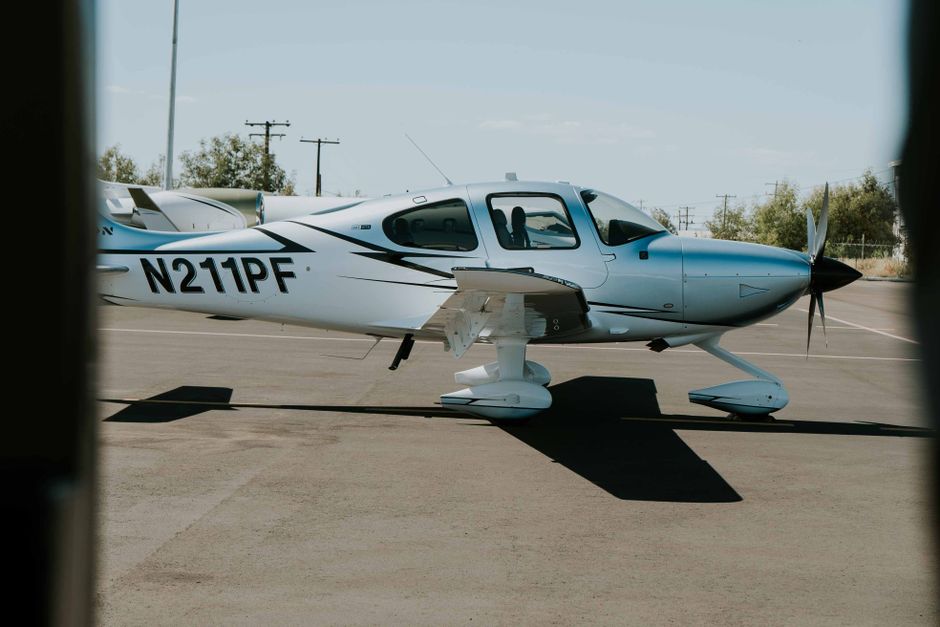
The turbocharged SR22T pays for itself only if your flying regularly involves legs beyond about 500 nautical miles, high terrain, or hot-and-high departures. For a pilot whose typical trip is 200 to 400 miles across flat country, the normally aspirated airplane is cheaper to buy, cheaper to feed, and simpler to maintain — and it arrives maybe ten minutes later.
That is the short answer to Cirrus SR22 vs SR22T, but the useful part is the arithmetic behind it. Below you will find what actually changes mechanically when Cirrus bolts on the turbochargers, how much real trip time the turbo buys at different leg lengths, what the extra hardware costs you every hour and every overhaul, and which missions tip the decision decisively one way.
This is a six-figure decision on purchase price and a four-figure-a-year decision on operating cost, so it is worth more than a glance at the brochure speed.
What Actually Changes When You Add the Turbo
The normally aspirated SR22 runs a Continental IO-550-N rated at 310 horsepower. The SR22T runs a Continental TSIO-550-K rated at 315 horsepower with twin turbochargers. Five horsepower sounds like nothing, and at sea level it nearly is. The difference is what happens as you climb.
A normally aspirated engine loses manifold pressure as the air thins. By 10,000 feet the SR22 is making roughly 75 percent power; by 16,000 it is working hard for very little. Cirrus lists a service ceiling of 17,500 feet for the SR22, and in practice most owners cruise it between 8,000 and 12,000 feet. The turbocharged engine keeps feeding the cylinders sea-level-grade air well into the flight levels, which is why the SR22T carries a maximum operating altitude of 25,000 feet.
Think of it as the difference between a runner at sea level and the same runner at altitude. Both have the same legs; only one is still getting a full breath at 20,000 feet.
To live with that extra pressure, Continental lowered the compression ratio on the TSIO-550-K to 7.5:1, compared with 8.5:1 on the normally aspirated IO-550-N. Lower compression is how you keep detonation at bay under boost, and it is also why the turbo engine is a little thirstier for the same power down low. Continental currently publishes a 2,200-hour or 12-year TBO for both the IO-550-N and TSIO-550-K.
The turbo installation also costs you weight — the turbochargers, wastegate, heavier exhaust and associated plumbing run on the order of 30 to 50 pounds depending on the generation and equipment. On an airplane with a 3,600-pound maximum takeoff weight (G5 and later), that is a passenger's carry-on bag, not a seat. The SR22T comes with a built-in oxygen system as standard equipment, which the non-turbo airplane treats as an option, because an airplane certified to 25,000 feet is useless without it.
Why It Matters: Oxygen is not a nice-to-have on the T. Under 14 CFR Section 91.211, required flight crew must use supplemental oxygen for the portion of a flight above 12,500 feet cabin pressure altitude that exceeds 30 minutes, continuously above 14,000 feet, and each occupant must be provided supplemental oxygen above 15,000 feet. If your personal rules or your passengers' tolerance keep you below 12,500 feet anyway, you have just paid for a capability you will never use.
There Are Really Three Turbocharged Airplanes in the Used Market
Buyers searching used listings run into a naming trap. From 2006 through 2009, Cirrus offered a factory-installed Tornado Alley turbonormalizing system on the standard IO-550-N — those airplanes are badged "SR22 Turbo" or "GTS Turbo," keep the 310-horsepower engine and its 8.5:1 compression, add intercoolers, and are also approved to 25,000 feet. The clean-sheet factory SR22T, with Continental's purpose-built TSIO-550-K, arrived for the 2010 model year and is what Cirrus has sold ever since.
The distinction matters at purchase time and at overhaul time. The turbonormalized airplane overhauls as a standard IO-550 plus a separate turbo system, and owners generally report it runs cool and leans out nicely thanks to the intercoolers. The SR22T is a single factory-supported powerplant with factory parts support, which most shops prefer. Neither is a bad airplane; they are simply not the same airplane, and a listing that says only "turbo" has not told you which one you are looking at.
Flying411 keeps SR22 and SR22T listings from across the market in one place, so you can compare model year, generation and engine type side by side instead of decoding one broker's shorthand at a time.
Speed and Altitude: Where the Turbo Earns Its Keep
Cirrus publishes a maximum cruise of 183 KTAS for the SR22 and 213 KTAS for the SR22T. That 30-knot gap is real, but it is a best-case number measured at the T's best altitude and a high power setting, and nobody flies a 250-mile hop at FL250.
Block speed is the honest measure — wheels up to wheels down, including the climb. A normally aspirated SR22 at 10,000 to 12,000 feet typically blocks somewhere around 165 to 175 knots on a cross-country. An SR22T that climbs into the low or mid flight levels blocks closer to 190 to 200. Run that through a few trip lengths:
| Leg length | SR22 (≈170 kt block) | SR22T (≈195 kt block) | Time saved |
| 300 nm | 1 h 46 m | 1 h 32 m | about 14 minutes |
| 500 nm | 2 h 56 m | 2 h 34 m | about 22 minutes |
| 900 nm | 5 h 18 m | 4 h 37 m | about 41 minutes |
On the short leg, the turbo saves you roughly the time it takes to buy a coffee. On the long leg, it saves enough to turn a trip that ends after dark into one that ends in daylight, or to beat a line of afternoon storms to the destination. That is the real argument: not raw speed, but schedule reliability on long days.
Altitude buys other things that do not show up in the speed column. You can top more weather instead of picking through it. You can hunt for a tailwind at FL230 that simply is not available at 9,000 feet. Over the Rockies, you can cross at an altitude that gives you glide options and terrain clearance rather than threading valleys. And on a 95-degree day out of a 5,000-foot-elevation airport, the turbo still climbs like an airplane while the normally aspirated SR22 is working through a density altitude near 8,000 feet.
Keep in Mind: Headwinds cut both ways. Climbing to FL250 to chase 213 knots true can be a losing trade if the wind up there is 50 knots on the nose and you have burned 20 minutes and several gallons getting there. Turbo owners who do the math every flight get the full value; those who always climb high because they can sometimes do worse than the non-turbo airplane two thousand feet below them.
Range runs the other way. Cirrus publishes maximum range figures of roughly 1,169 nautical miles for the SR22 and 1,021 for the SR22T, both on 92 gallons usable in G5 and later airframes. The turbo is faster but burns more to do it, so the non-turbo airplane actually stretches a tank farther. We go deeper into what those numbers look like with real reserves and real passengers in our guide to how far a Cirrus SR22 can fly.
What It Costs to Buy
On the new-airplane price sheet, the T has consistently carried roughly a six-figure premium over the normally aspirated SR22 of the same generation — call it about $100,000 at 2025 list, before options. Both models are offered in the current G7 airframe, and Cirrus added the G7+ in 2025 with Garmin's Safe Return emergency autoland; verify which capability a specific serial number actually has rather than assuming it from the model year.
Used, the picture is messier, because engine time, avionics generation, CAPS status and damage history move the number more than the turbo does. An eight-year-old SR22T with 1,600 hours on the engine can easily ask less than a same-year SR22 with 300 hours since overhaul and a fresh parachute. Our Cirrus SR22 price guide walks through how the generations stack up, and how engine time affects aircraft value explains why two airplanes with the same year on the tail can be $80,000 apart.
One habit worth building before you shop either model: treat the asking price as an opening position, not a market value. We cover the gap in asking price vs actual sale price and the approach that closes it in our used aircraft negotiation playbook.
Pro Tip: On any SR22 or SR22T, find the CAPS status before you find the price attractive. The parachute system needs a rocket and canopy service at ten-year intervals, and owners report quotes in the $18,000 to $25,000 range as of 2025 depending on service center and what else gets replaced. An airplane nine years and eleven months out from its last repack is carrying a bill, not a bargain — the details are in our write-up on CAPS repack cost and resale impact.
What It Costs to Run
This is where the turbo question is usually decided, because the purchase premium is a one-time hit and the operating gap repeats every year you own the airplane.
Fuel
A normally aspirated SR22 at a typical 65 to 75 percent cruise burns roughly 14 to 17 gallons per hour. An SR22T in the flight levels, leaned conservatively, generally runs 16 to 19 gallons per hour, with owners reporting around 17 to 18 gph lean of peak for cruise speeds near 200 knots. Call the real-world difference 2 to 3 gallons an hour.
At 150 hours a year and 100LL running roughly $6 to $7 a gallon at self-serve pumps through 2025, that is about $1,800 to $3,100 a year in extra fuel. Not ruinous, but it compounds. Fly 300 hours a year and you have doubled it.
There is a fairness point here too: the turbo is burning more per hour but covering more ground per hour. On a per-nautical-mile basis the two airplanes are far closer than the gallons-per-hour figures suggest. If you measure cost by trip rather than by hour, the fuel gap shrinks to pocket change on most flights.
Engine Reserve and Overhaul
Both engines currently carry a published 2,200-hour or 12-year TBO, so the turbo does not shorten the published overhaul interval.. It does make the event more expensive. The TSIO-550-K overhaul includes turbochargers, a wastegate, a more complex exhaust system and more induction plumbing, and shops consistently quote it well above a plain IO-550. Expect the turbo overhaul to land somewhere in the neighborhood of $15,000 to $25,000 above a comparable normally aspirated job once the turbo components are addressed rather than just reused.
Translate that into an hourly reserve and the turbo costs you roughly $8 to $12 more per hour set aside, on top of fuel. Owners who skip the reserve and plan to "deal with it later" are the ones who end up selling a mid-time airplane into a soft market.
Maintenance Items the Non-Turbo Airplane Simply Does Not Have
Turbocharged piston engines run hotter and live under more stress, and the maintenance list reflects it. Exhaust systems on turbocharged Continentals are a recurring inspection focus — slip joints, V-band clamps and the turbine housing all see heat cycling, and a leak in a turbo exhaust is far more serious than a leak in a normally aspirated one. Turbochargers and their oil supply are sensitive to heat, so owners should follow the current Cirrus and Continental operating guidance for power reduction and shutdown rather than relying on a generic fixed ‘cool-down’ period. Wastegate and controller issues show up as cruise-power inconsistencies.
Cirrus Service Centers and Continental publish inspection requirements and service information specific to the turbo system; a shop that works on SRs weekly will know them, and a shop that does not should not be your first choice. Figure, in rough terms, an extra $1,000 to $2,500 a year in turbo-related inspection and repair across an average ownership period, with the understanding that one bad year can swallow several good ones.
Everything else is shared. Insurance is priced primarily on hull value, pilot time and training, not on whether the engine has turbos; a higher-value SR22T will cost somewhat more to insure simply because there is more airplane to replace. CAPS, brakes, tires, TKS fluid, avionics subscriptions and the Cirrus annual inspection are the same on both.
Good to Know: Turbo pilots have a different engine-management workload. Cylinder head temperature discipline, cowl flap-free cooling management on climb-out, and a disciplined leaning technique matter more on the TSIO-550-K than on the IO-550-N. The engine does not punish you immediately for sloppiness; it punishes you at overhaul, with cylinders.
Flying411 keeps maintenance-relevant listing details — engine time, CAPS due dates, avionics generation — in one place, so you can compare the real cost of two airplanes rather than two asking prices.
Mission Fit: Who Should Buy Which
Strip away the specs and the choice comes down to where you live and how you use the airplane.
Buy the normally aspirated SR22 if you are based east of the Rockies or anywhere near sea level, your typical trip is under 500 nautical miles, you fly 75 to 150 hours a year, and your mission is family trips, business day-trips and the occasional long weekend. You will give up almost nothing in practical terms, you will pay less at purchase, less per hour, and less at overhaul, and you will have a simpler airplane with a deeper pool of mechanics who are comfortable with it. For the large majority of SR22 owners, this is the correct answer and the market agrees — the non-turbo airplane remains the volume seller for a reason.
Buy the SR22T if you live in the mountain west, routinely cross high terrain, operate from airports above 4,000 feet elevation in summer, or fly 700-plus-mile legs on a schedule that other people depend on. Also buy it if you fly enough in convective weather that the ability to climb over a building cumulus layer rather than detour around it changes your dispatch rate. The turbo is not a luxury for those missions; it is the airplane working as intended.
Heads Up: "I might fly out west someday" is not a mission. Plenty of owners buy the turbo for a trip they take once every three years and then pay for it 150 hours a year. If the high-altitude flying is occasional, renting or chartering for those trips is almost always cheaper than owning the capability.
If neither airplane quite fits, the comparison does not stop at Cirrus. Buyers weighing a step up often look at the Piper M350 against the SR22T for the pressurized cabin, while those questioning whether they need the SR22's power at all should read SR20 vs SR22. For a composite-single cross-shop, the Cessna TTx against the SR22 covers the other turbocharged option that still trades in the used market.
Key Takeaways
The SR22T buys altitude, not just speed, and altitude is what turns into schedule reliability over terrain and weather — but it charges you roughly a $100,000 premium at purchase, 2 to 3 gallons an hour in extra fuel, $15,000 to $25,000 more at overhaul, and a turbo system that needs an exhaust inspection discipline the normally aspirated airplane never asks for. On trips under about 400 nautical miles, that premium buys you roughly a quarter-hour, which is a poor trade for most owners. On 800-mile legs across the Rockies, or out of a hot airport at 6,000 feet, the same premium buys you a dispatch you would otherwise cancel. Used buyers should also sort out which turbo they are looking at: the 2006-2009 Tornado Alley turbonormalized SR22 and the 2010-and-later factory SR22T fly similarly but overhaul and support differently. Whichever way you lean, let engine time and CAPS status drive the price negotiation, because on a given pair of airplanes those two line items will move the number more than the turbochargers do.
Head-to-Head Scorecard
| Dimension | Cirrus SR22 | Cirrus SR22T |
| Engine | Continental IO-550-N | Continental TSIO-550-K, twin turbochargers |
| Rated power | 310 hp | 315 hp |
| Compression ratio | 8.5:1 | 7.5:1 |
| Published TBO | 2,200 hr or 12 years | 2,200 hr or 12 years |
| Maximum cruise (Cirrus published) | 183 KTAS | 213 KTAS |
| Maximum operating altitude | 17,500 ft (service ceiling) | 25,000 ft |
| Maximum range (Cirrus published) | 1,169 nm | 1,021 nm |
| Usable fuel (G5 and later) | 92 gallons | 92 gallons |
| Typical cruise fuel burn | 14–17 gph | 16–19 gph |
| Built-in oxygen | Optional | Standard |
| Weight cost of turbo hardware | None | Roughly 30–50 lb of useful load |
| Typical new-price premium (2025 list) | Baseline | About $100,000 higher |
| Extra overhaul cost vs baseline | Baseline | Roughly $15,000–$25,000 more |
| Time saved on a 500 nm leg | Baseline (about 2 h 56 m block) | About 22 minutes (about 2 h 34 m block) |
| Maximum takeoff weight (G5 and later) | 3,600 lb | 3,600 lb |
| Best suited to | Legs under 500 nm, low-to-mid altitudes, lowest-cost SR22 ownership | Long legs, high terrain, hot-and-high fields, weather-topping |
Flying411 keeps both Cirrus variants in one searchable marketplace, so you can compare an SR22 and an SR22T on the figures that decide the purchase rather than on the badge on the cowling.
Making the Call on Your Own Mission
Pull up the last two years of trips you actually flew, or expect to fly, and write down the distances and the terrain. If most of those lines are under 500 nautical miles over flat ground, the Cirrus SR22 vs SR22T decision resolves in favor of the normally aspirated airplane, and the money you save belongs in an engine reserve and a CAPS fund instead. If the list is full of long legs, mountain crossings and summer departures from high-elevation fields, the turbo is not an indulgence — it is the version of the airplane that does your job.
Either way, buy the individual airplane rather than the model. A well-maintained, low-time SR22 with clean logs beats a tired SR22T every day of the week, and a pre-purchase inspection at a shop that knows Cirrus airframes is the cheapest money you will spend in the whole transaction.
When you are ready to compare listings, visitFlying411and see what is on the market today.