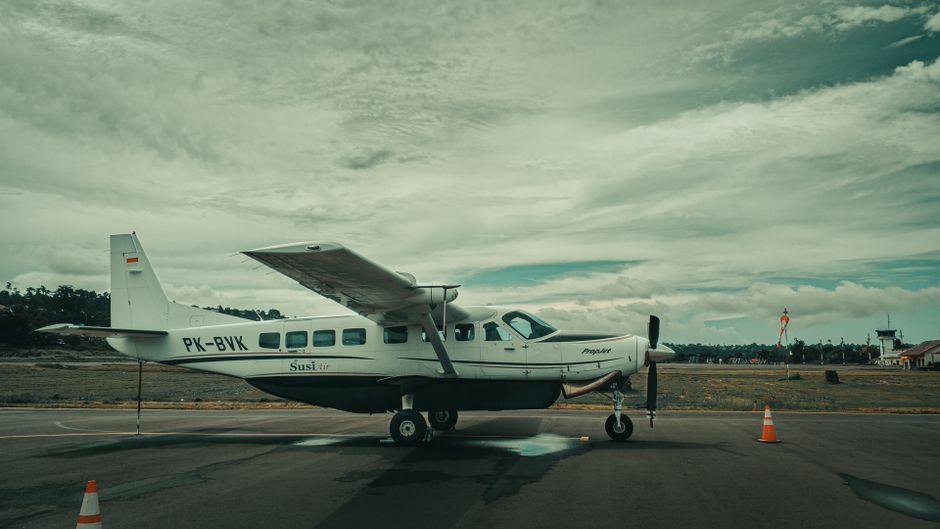
The stretch that turns a 208 into a 208B adds exactly four feet of fuselage — but it also adds 750 pounds of maximum takeoff weight on the very same 675-horsepower engine. That one fact explains most of what separates these two airplanes, and most of what you will argue about with your accountant. In a Cessna 208 Caravan vs 208B Grand Caravan decision, you are not really choosing between two different airplanes. You are choosing between a short-bed and a long-bed version of the same pickup truck, with all the trade-offs that implies: the long bed hauls more, the short bed gets off the ground quicker and costs less to feed.
Both have been in continuous production since the mid-1980s, and Textron Aviation says more than 3,000 Caravans have been delivered worldwide. That long run means the used market has examples from nearly every year, in nearly every configuration, from bush floatplanes to parcel haulers with 25,000 hours on the airframe.
The Short Answer
Buy the 208 Caravan if your flying is weight-limited rather than volume-limited — short strips, hot and high days, skydiving, floats, or a Part 91 owner who wants the lowest hourly cost a PT6 can deliver. Buy the 208B Grand Caravan if you are selling seats or cubic feet: regional passenger runs, parcel feeder contracts, island shuttles, or any mission where you routinely run out of cabin before you run out of useful load. The 208B is the better airplane when cabin volume and payload drive the mission, while the short-body 208 has an advantage over the original 675-hp 208B in short-field and high-density-altitude work. The 867-hp Grand Caravan EX closes much of that performance gap.
Cabin, Seats and What You Can Actually Haul
The 208's cabin runs roughly 12 to 13 feet of usable length; the 208B's runs close to 17. Add the optional belly cargo pod — about 111 cubic feet on either airplane — and the Grand Caravan becomes a genuinely large box with wings. On paper the 208B's maximum takeoff weight of 8,750 pounds (8,807 pounds on the Grand Caravan EX) beats the 208's 8,000 pounds by a wide margin, and useful load follows.
Where the stretch really pays is seats. The 208's type certificate tops out at ten occupants — nine passengers plus the pilot. The 208B is approved for up to fourteen. For an operator charging by the seat, that is a 44 percent revenue increase on an airframe that burns only slightly more fuel.
The catch is that the 208B rarely fills both its seats and its baggage at full fuel. With 332 usable gallons on board — about 2,224 pounds of Jet A, identical on both models — a loaded Grand Caravan is often flying on partial tanks. That is normal, not a flaw. Most 208B operators plan legs of 300 to 500 nautical miles and tanker fuel only when the payload allows.
Why It Matters: Cabin volume, not weight, is usually the binding limit on parcel work. Boxes of e-commerce goods and medical supplies "cube out" long before they "gross out," which is precisely why FedEx built its feeder fleet around the 208B Super Cargomaster rather than the short-body airplane.
Edge: 208B Grand Caravan, decisively, for anything that involves seats or volume.
Fuel Burn and Real Hourly Cost
Both the 208 and the standard 208B use the Pratt & Whitney Canada PT6A-114A, flat-rated to 675 shaft horsepower. The Grand Caravan EX, introduced in 2013, swaps in the PT6A-140 at 867 shaft horsepower. Same fuel tanks, different appetites.
In practice, owners report cruise burns of roughly 50 to 55 gallons per hour on a 208 with the -114A, 55 to 58 on a standard 208B, and about 58 to 65 on an EX worked hard. Call Jet A $6.00 a gallon — FBO retail across the U.S. ranged from under $5 self-serve to well over $8 at big-city ramps through 2025 — and the fuel line alone runs about $320 an hour for the 208, $345 for the 208B, and $380 for the EX.
Fuel is only part of it. A sensible owner adds an engine reserve of roughly $110 to $150 per hour, a propeller and accessory reserve, and an airframe maintenance allowance. Add it up and most Part 91 Caravan owners land somewhere between $650 and $900 per hour in direct operating cost, before crew, hangar, insurance and the annual fixed costs that hit whether you fly or not. The 208 sits at the low end of that band, the EX at the high end — a gap of maybe $75 to $125 an hour. Over 500 hours a year, that is real money, but it is smaller than most buyers expect.
Keep in Mind: Fixed costs are nearly identical between the two. Insurance, hangar and recurrent training do not care about four feet of fuselage. If you fly 150 hours a year, the hourly fuel difference is noise next to the fixed bill — and the 208B's extra capability is close to free.
Flying411 keeps turboprop listings, specifications and ownership guides in one place, so you can compare a 208 and a 208B side by side before you call a broker.
| Figure | 208 Caravan (675) | 208B Grand Caravan | 208B Grand Caravan EX |
| Engine | PT6A-114A, 675 shp | PT6A-114A, 675 shp | PT6A-140, 867 shp |
| Fuselage length | 37 ft 7 in | 41 ft 7 in | 41 ft 7 in |
| Max takeoff weight | 8,000 lb | 8,750 lb | 8,807 lb |
| Max occupants (type certificate) | 10 | 14 | 14 |
| Typical useful load (varies with equipment) | ~3,000–3,300 lb | ~3,600–4,000 lb | ~3,400–3,700 lb |
| Usable fuel | ~332 gal (2,224 lb) | ~332 gal (2,224 lb) | ~332 gal (2,224 lb) |
| Max cruise speed | ~186 kt | ~184 kt | ~185 kt |
| Typical cruise burn | ~50–55 gph | ~55–58 gph | ~58–65 gph |
| Cargo pod volume (optional) | ~111 cu ft | ~111 cu ft | ~111 cu ft |
| Landing gear | Fixed tricycle | Fixed tricycle | Fixed tricycle |
Note that the published cruise speeds are clean-airframe numbers. Owners report the belly pod costs roughly 5 to 10 knots, and most working Caravans plan on 160 to 175 knots true in the real world.
Runway, Climb and Hot-and-High Performance
This is where the short airplane earns its keep. At maximum weight the 208 is 750 pounds lighter on the same engine, and the difference shows in ground roll, initial climb and single-engine... well, there is no second engine, so climb gradient after takeoff matters a great deal on a hot day out of a 2,500-foot strip surrounded by terrain.
A fully loaded 208B on a standard day is a comfortable airplane. A fully loaded 208B at 7,000 feet density altitude is a patient one. The short-body 208 remains popular for mountain strips, gravel bars, jump operations and other missions where lower weight and short-field performance matter more than cabin volume, and skydiving operations — which climb to altitude and descend all day, every day — are almost entirely short-body airplanes.
The Grand Caravan EX narrows the gap considerably. Textron's whole argument for the PT6A-140 was climb performance, and the EX does noticeably better than a -114A Grand Caravan in heat and altitude while carrying the same load. Third-party upgrades exist as well: Blackhawk markets a PT6A-140 conversion for earlier airframes, and Texas Turbine Conversions offers the Supervan 900, which replaces the PT6 with a 900-shaft-horsepower Honeywell TPE331. Both are popular with jump operators and bush fleets for the same reason — time to altitude.
Heads Up: The Caravan's flight-into-known-icing approval has a complicated history. A series of FAA airworthiness directives in the mid-2000s revised the icing limitations and required flight manual changes after a string of accidents. If you are buying for a winter operation, read the current AFM limitations and the icing-related ADs for the serial number in front of you, not a summary from a sales listing.
Edge: 208 Caravan for short, hot and high. Grand Caravan EX closes most of the gap if you need the big cabin anyway.
Maintenance, Engines and the Part 135 Trap
Caravan inspection schedules depend on the aircraft’s approved maintenance or inspection program and its operation. Many commercial operators use phased or continuous inspection programs with recurring hour-based tasks, while Part 91 aircraft may follow a different approved inspection basis. Verify the current Cessna maintenance program and the specific operator’s approved program rather than assuming every Caravan follows the same 200-hour/four-phase cycle. The airframes are famously durable — many cargo feeders pass 20,000 hours — but older high-time examples carry Supplemental Inspection Document requirements and corrosion history that a pre-buy must dig into. Fixed gear means no retract system to rebuild, which is one of the quiet reasons Caravans are cheaper to maintain than most cabin-class twins.
The engine is the big number. Pratt & Whitney Canada publishes a 3,600-hour overhaul interval for the PT6A-114A, subject to the current service bulletin for your serial number and your operating conditions, with a hot section inspection at the midpoint. Full overhauls are six-figure events, which is exactly why a per-hour engine reserve is not optional accounting — it is the difference between an expected expense and a crisis. The same logic applies to resale: a mid-time engine and a run-out engine are two very different airplanes at the closing table, which is the same arithmetic we work through in should you overhaul before selling your plane.
Then there is the regulatory wrinkle most first-time commercial buyers miss. Under 14 CFR Section 135.411, an aircraft type certificated for a passenger seating configuration of ten seats or more, excluding pilot seats, must be maintained under the maintenance-program requirements of Sections 135.415, 135.417, and 135.423 through 135.443. Aircraft type certificated for nine passenger seats or fewer may instead be maintained under Parts 91 and 43 together with the applicable Part 135 requirements, or under an approved aircraft inspection program. The short-body 208 is type certificated for up to nine passengers plus the pilot, while 208B configurations can be approved for ten or more passenger seats, which can put them on the heavier Section 135.411 maintenance-program side of the rule. If you are standing up a small Part 135 operation, talk to your principal maintenance inspector about this before you sign anything, because it can change your maintenance budget more than the fuel burn ever will.
Good to Know: Plenty of 208B operators configure fewer seats for comfort or cargo and still fall on the heavier side of that rule, because the determining factor is what the type certificate allows, not what is bolted to the floor today. Get the answer in writing from the FAA, not from a forum.
Edge: 208 Caravan, for commercial operators who want the lighter regulatory footprint. A draw for Part 91 owners.
Flying411 keeps maintenance, ownership-cost and model-comparison articles in one place, so you can compare what an airframe costs to keep, not just what it costs to buy.
Resale and Market Depth
Caravans hold value unusually well for a working airplane, and the reason is simple: demand from cargo feeders, humanitarian fleets, parachute clubs and island operators never really stops. The 208B is the deeper market by a wide margin — more were built, more operators want them, and a well-kept Grand Caravan tends to find a buyer quickly.
The short-body 208 is scarcer, and scarcity cuts both ways. Clean float-equipped and jump-configured 208s are sought after and can command strong money, but the pool of buyers is narrower. If you need to sell in a hurry, the 208B is easier to move.
One thing both share: condition and equipment beat vintage. Garmin G1000 NXi glass, fresh paint and interior, a mid-time engine, complete logs and no corrosion will outrank a later serial number with a tired engine every time. The same pattern shows up in the piston world, and we cover it in how much small planes cost to buy and own.
Edge: 208B Grand Caravan for liquidity; a draw on percentage value retention.
Which One Should You Buy?
The Part 91 owner-operator or mission flyer. If you are hauling your own people and gear to a lodge, a ranch or a remote strip, the 208 is usually the smarter buy. Lower burn, better short-field manners, fewer seats you will never fill. On floats, the short body is the classic choice and the one most seaplane shops know best.
The commercial seat-seller or parcel hauler. Buy the 208B, and buy it with the cargo pod. The extra four feet of cabin is the whole business case, and the per-hour fuel penalty is small next to the extra revenue. Budget for the heavier Part 135 maintenance program from day one so it is not a surprise in year two.
The hot-and-high or terrain operator who still needs the big cabin. This is the Grand Caravan EX's exact niche. You pay more per hour for the PT6A-140 and you get climb performance that makes high-density-altitude work routine rather than careful. If your airframe budget will not stretch to an EX, a Blackhawk XP140 or Supervan conversion on an older 208B gets you most of the way there — just confirm the supplemental type certificate paperwork and remaining engine time before you count on it.
Pro Tip: On any Caravan pre-buy, ask for the complete engine trend-monitoring data, not just the logbook entries. A PT6 that has been drifting toward its temperature limits tells you the overhaul is closer than the hour meter suggests — and that gap can be worth more than the entire price difference between a 208 and a 208B. The same discipline applies on smaller airplanes, as in our Cessna 172 pre-buy inspection checklist.
Making the Call
The honest summary of Cessna 208 Caravan vs 208B Grand Caravan is that almost nobody regrets buying either one — they regret buying the wrong size for the work. Weigh your three most common missions, write down what each one actually requires in seats, cubic feet and runway, and let that decide. If you find yourself leaving boxes or people behind more than twice a year, you need the 208B. If you find yourself computing takeoff distance with a worried look more than twice a year, you need the 208. If you are still weighing a turboprop single against a pressurized twin, our comparison of the Cessna 425 and 441 Conquest covers that other fork in the road, and what makes one airliner cheaper to operate explains the same cost drivers at a larger scale.
Flying411 keeps Caravan listings, cost guides and buying checklists in one place, so you can compare airframes, engine times and equipment without opening ten tabs.
When you are ready to compare listings, visitFlying411and see what is on the market today.