When pilots step up from a basic trainer into the world of high-performance piston singles, two names tend to land at the top of the shortlist. The Piper M350 vs Cirrus SR22T debate is something worth considering, and for good reason. Both are serious cross-country machines.
Both can climb to 25,000 feet. Both attract owner-pilots who want speed, comfort, and confidence on long trips.
Yet they take wildly different paths to get there. One wraps you in a pressurized cabin and asks you to manage a complex piston system. The other hands you a parachute, a sports-car feel, and a much simpler airframe.
Pick the wrong one for your mission and you'll either feel held back or buried in unnecessary cost.
These two airplanes look like rivals on paper, but they're really answering different questions about what a high-performance single should be.
Key Takeaways
The biggest difference between the Piper M350 and the Cirrus SR22T is cabin pressurization and size. The M350 has a pressurized six-seat cabin and can fly higher in real comfort, while the lighter SR22T is faster off the line, simpler to operate, and comes with a whole-airframe parachute. The M350 fits long-distance, high-altitude business travel. The SR22T fits faster, simpler personal flying.
| Category | Piper M350 | Cirrus SR22T |
| Engine | Lycoming TIO-540-AE2A, 350 hp | Continental TSIO-550-K, 315 hp |
| Max Cruise Speed | Around 213 KTAS | Around 213 KTAS |
| Max Range | Around 1,343 nm | Around 1,000 nm |
| Service Ceiling | 25,000 ft (pressurized) | 25,000 ft (unpressurized) |
| Seats | 6 (1 + 5) | 5 (1 + 4) |
| Landing Gear | Retractable | Fixed |
| Parachute System | No | Yes (CAPS) |
| Approximate New Price | Around $1.2M+ | Around $1.0M to $1.3M |
Looking at high-performance singles like these? Flying411 lists new and used aircraft from major manufacturers, with full specs to help you compare options side by side.
The Two Heavyweights of High-Performance Pistons
Before getting into the matchup, it helps to understand where each airplane comes from. The M350 and the SR22T didn't show up in the same way, and their backgrounds explain a lot about why they fly so differently.
A Quick Look at the Piper M350
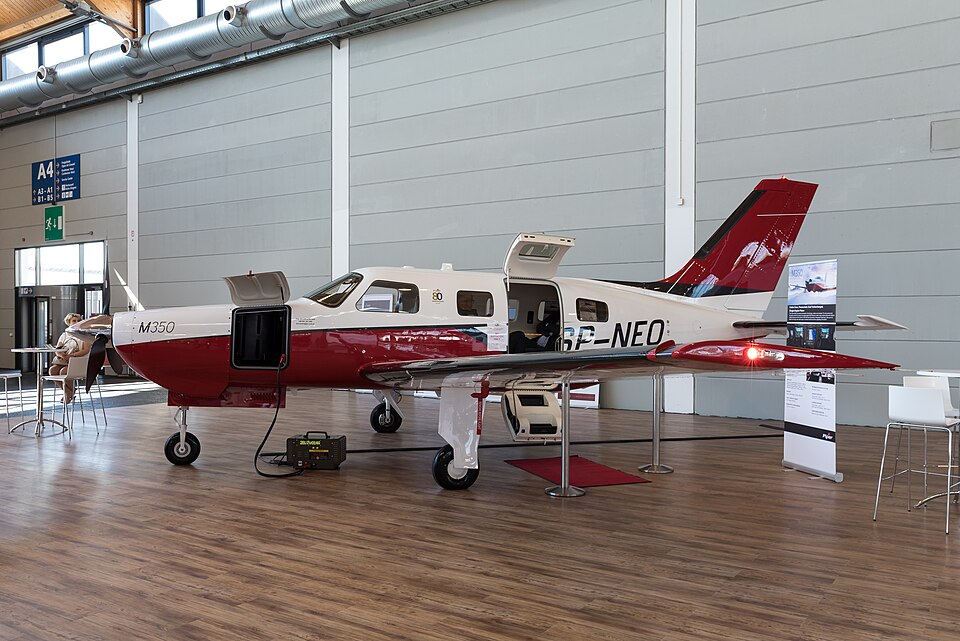
The Piper M350 is the latest version of the long-running PA-46 Malibu Mirage line. Piper introduced the M350 in 2015 as the modern flagship of its piston M-Class series. It carries forward the things that made the Mirage popular for decades. Things like a roomy cabin, retractable gear, and a pressurized cabin that lets you climb high without strapping on an oxygen mask.
Under the cowl sits a turbocharged 350-horsepower Lycoming TIO-540-AE2A driving a three-blade composite Hartzell propeller. The cabin is entered through an airstair door, with club seating for four passengers behind the pilot. It is widely considered one of the only currently produced pressurized piston singles on the market, which gives it a pretty unique pitch in the high-performance segment.
A Quick Look at the Cirrus SR22T
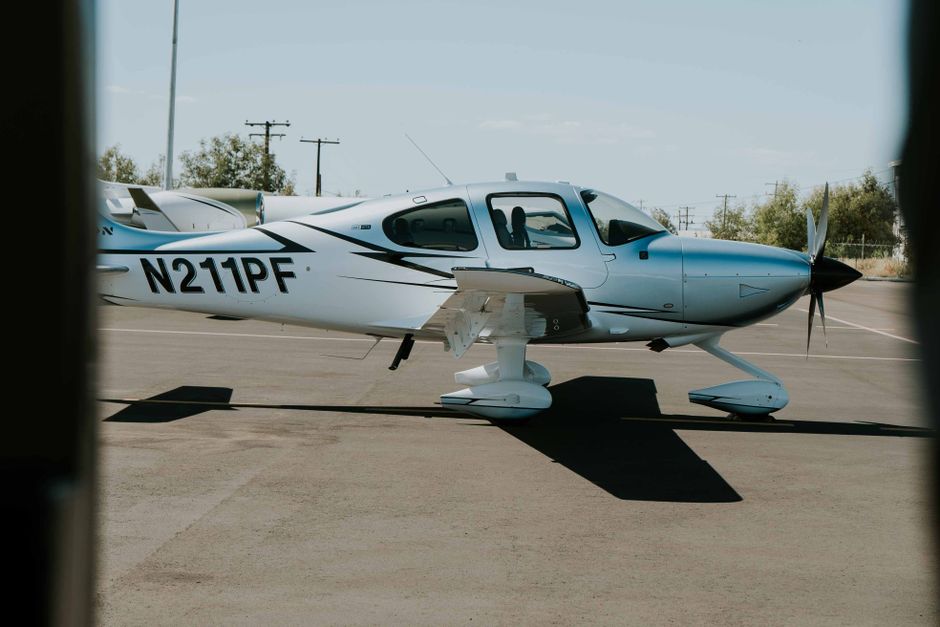
The Cirrus SR22T is the turbocharged version of the SR22, which has long been one of the best-selling high-performance piston singles in the world. Cirrus rolled out the SR22T in 2010, fitting a turbocharged 315-horsepower Continental TSIO-550-K to the same composite airframe. Generations have followed, with the current G7 and G7+ models bringing big touchscreen displays, refreshed interiors, and the new Safe Return emergency autoland feature.
The SR22T sticks with what Cirrus is famous for. A composite airframe, fixed tricycle gear, side-yoke controls, and the Cirrus Airframe Parachute System (CAPS). This whole-aircraft parachute has helped shape Cirrus's reputation around safety and is a key reason many buyers pick the brand. The SR22T trades some interior space and pressurization for lighter weight, simpler systems, and a sportier handling feel.
Fun Fact: The Cirrus SR series has long been considered one of the best-selling high-performance piston singles in the world, with thousands of airframes delivered since the line launched in the early 2000s.
Good to Know: The SR22T is more than a turbocharged SR22 with new stickers. It uses a different engine entirely. The lower-compression Continental was designed to handle a wider range of fuel types, which gives owners some flexibility as the avgas market keeps shifting.
Piper M350 vs Cirrus SR22T at a Glance
Specs alone don't tell the full story, but they give a solid starting point. Here's how the two airplanes compare on the headline numbers.
| Specification | Piper M350 | Cirrus SR22T |
| Engine | Lycoming TIO-540-AE2A | Continental TSIO-550-K |
| Horsepower | 350 hp | 315 hp |
| Max Cruise Speed | About 213 KTAS | About 213 KTAS |
| Typical Cruise Burn | Around 17 to 20 gph | Around 16 to 18 gph |
| Max Range | About 1,343 nm | About 1,000 nm |
| Useful Load | About 1,300 lbs | About 1,250 lbs |
| Fuel Capacity (usable) | 120 gal | 92 gal |
| Service Ceiling | 25,000 ft | 25,000 ft |
| Pressurized | Yes | No |
| Seats | 6 | 5 |
| Landing Gear | Retractable | Fixed |
| Parachute (CAPS) | No | Yes |
| Avionics | Garmin G1000 NXi | Cirrus Perspective Touch+ (Garmin) |
These numbers give a snapshot, but the way each airplane delivers performance is where things get interesting.
Performance and Speed in the Real World
On paper, the top cruise speeds look almost identical. Both airplanes are widely reported to push around 213 knots true airspeed at their best altitudes. In practice, the M350 has to climb high to hit those numbers because that's where its turbocharged engine is happiest.
The SR22T can reach similar speeds in the flight levels too, but most owners cruise lower. Around 175 to 195 knots is more typical when flying at altitudes that don't demand oxygen for everyone on board.
Where the M350 really stretches its legs is range. With 120 gallons of usable fuel and a thirsty but efficient turbocharged Lycoming, it can post a max range close to 1,343 nautical miles. The SR22T tops out closer to 1,000 nm with its 92 gallons. That's still plenty for most missions, but the M350 opens up nonstop city pairs the SR22T can't reach.
A few real-world performance notes worth keeping in mind:
- The SR22T has fixed gear, which means less mechanical complexity but slightly more drag.
- The M350's retractable gear adds maintenance items but cleans up the aircraft for higher speeds and altitudes.
- Climb performance favors the SR22T at lower weights, while the M350 hauls more weight to higher altitudes more comfortably.
- Both airplanes use Garmin autopilots that handle altitude, heading, and approach modes with ease.
Pro Tip: Cruise speed numbers in marketing brochures are usually quoted at max power and ideal altitudes. Real-world cruise depends on weight, weather, and how aggressively you push the engine. Always look at typical owner-reported numbers, not just the spec sheet.
Cabin, Comfort, and Cabin Pressurization
This is where the gap really opens up. The M350 cabin is in a different size class. It measures roughly 12 feet long with club seating for four passengers behind the pilot. The airstair door makes entry easy, and the interior feels closer to a small business turboprop than a typical piston single. Headroom is generous, and the layout is built for long trips with multiple passengers.
The SR22T is no slouch, but it's a smaller airplane. The cabin fits up to four passengers plus the pilot, with a more car-like layout and traditional doors. It's comfortable for two or three adults on long flights, but stuffing in five people with bags becomes a tight squeeze, especially with full fuel.
The real game changer is pressurization. The M350 keeps the cabin at a much lower pressure altitude when flying high. So at 25,000 feet, occupants might feel like they're at around 8,000 feet. That means no oxygen masks, no nasal cannulas, and far less fatigue on long flights. The SR22T can fly that high too, but everyone on board has to use supplemental oxygen above 12,500 feet for any extended period. That's fine for shorter trips, but it gets tiring on multi-hour legs and limits some passengers' willingness to ride along.
Other comfort points to consider:
- The M350 includes amenities like cup holders, USB ports, and reading lights at each seat.
- Both aircraft offer optional air conditioning, though it eats into useful load.
- The SR22T's side-yoke design opens up legroom and makes the cabin feel airy.
- Visibility is excellent in both, with large windows and good sight lines.
Why It Matters: Pressurization is more than a luxury feature. It changes which trips are realistic. Flying for four hours at 23,000 feet with passengers who don't fly often is a much easier sell in the M350 than in any unpressurized airplane.
Safety Systems and Emergency Features
Both aircraft pack serious safety technology, but they take very different approaches.
The Cirrus SR22T is famous for the Cirrus Airframe Parachute System (CAPS). If something goes wrong that the pilot can't recover from, a rocket-deployed parachute can lower the entire airplane to the ground. Cirrus reports hundreds of lives saved through CAPS deployments over the years, and it's a major reason many first-time owners and family members feel comfortable flying behind a single piston engine. CAPS is paired with airbag seatbelts and a strong composite airframe designed to absorb energy in a hard landing.
The Piper M350 takes a different path. It doesn't have a whole-aircraft parachute, but it loads up on systems designed to keep an emergency from happening in the first place. These include:
- Electronic Stability Protection (ESP) that nudges the controls if the airplane drifts toward unsafe attitudes or speeds.
- Coupled Go-Around, which uses the autopilot to handle a missed approach with a single button push.
- Level Mode (LVL), a blue button that returns the airplane to wings-level flight.
- Emergency Descent Mode (EDM) that detects cabin depressurization and automatically descends to a safer altitude.
- Hypoxia recognition that brings the airplane down if the pilot becomes unresponsive at altitude.
The newest Cirrus SR22T G7+ models also include Safe Return emergency autoland, which can fly the aircraft to a runway and land it with no pilot input. That's a major leap forward and matches the spirit of what the M350 has been doing for years, but with the added benefit of a fully automatic landing.
Heads Up: A parachute system and autoland feature don't replace good training and decision-making. They're backups for the worst scenarios. Either airplane still demands a current, well-trained pilot who knows the systems inside and out.
Avionics and Cockpit Technology
Both airplanes use Garmin-based glass cockpits, but the panels look and feel different.
The Piper M350 runs the Garmin G1000 NXi suite with three large displays and the GFC 700 autopilot. This is the same family of avionics found in many high-end piston and turbine airplanes. It's a mature, well-supported platform that pilots transitioning from other Garmin-equipped aircraft can pick up quickly. Synthetic vision, weather datalink, and traffic awareness are all built in.
The Cirrus SR22T uses Cirrus Perspective Touch+ by Garmin, which is based on the Garmin G3000/G1000 family but designed specifically for Cirrus. The G7 generation introduced 35 percent larger touchscreens, a 3D taxi guide, stick shaker stall warning, and a refreshed user interface. It feels more modern in some ways, with deeper touch integration and a cleaner panel layout.
A few avionics highlights to consider:
- Garmin G1000 NXi (M350): Three-screen layout, full integration with autopilot, proven reliability across many aircraft types.
- Cirrus Perspective Touch+ (SR22T): Larger displays, more touch-driven controls, integrated approach features, optional Safe Return autoland on G7+.
- Both systems support synthetic vision, terrain awareness, traffic, weather, and ADS-B In and Out.
The bottom line on avionics is that both are excellent. The choice often comes down to which interface a pilot prefers, and which they're already trained on.
Operating Costs and Ownership Considerations
This is where the M350 and SR22T separate again. The M350 is a more complex airplane, and complexity costs money. Pressurization systems, retractable gear, and a larger turbocharged engine all add to maintenance bills and insurance premiums.
Some general ownership cost factors:
| Cost Area | Piper M350 | Cirrus SR22T |
| Fuel Burn (typical cruise) | About 17 to 20 gph | About 16 to 18 gph |
| Annual Inspection | Higher (more systems) | Lower (simpler airframe) |
| Insurance | Generally higher | Generally lower |
| Hangar Footprint | Larger wingspan | Smaller |
| Engine Overhaul | TIO-540, around 1,800 hr TBO | TSIO-550-K, around 2,000 hr TBO |
| Pressurization Maintenance | Required | Not applicable |
| Gear Inspections | Required (retractable) | Minimal (fixed) |
Insurance is a big factor for many buyers. Pressurized retractable singles often come with higher minimum training requirements and more demanding insurance underwriting, especially for newer owners. The SR22T, while still a high-performance airplane, tends to be easier to insure for a wider range of pilot experience levels.
Keep in Mind: Hourly operating cost numbers can swing widely based on how many hours you fly each year. Spreading fixed costs like insurance, hangar, and annual inspections across more flight hours brings down the per-hour figure, which is why busy owner-operators often see better numbers than weekend pilots.
Shopping for a new flagship or a well-maintained pre-owned option? Flying411's aircraft marketplace connects buyers and sellers across new and used airplanes, including major manufacturers like Piper, Cirrus, Cessna, and Beechcraft.
Key Differences Between the Piper M350 and Cirrus SR22T
This is the heart of the matchup. The cirrus sr22t vs piper m350 comparison really comes down to a handful of clear differences that separate the two airplanes once you get past the surface-level numbers. These eight points cover the most meaningful gaps for owner-pilots.
1. Cabin Pressurization
The M350 has it. The SR22T doesn't. This is the single biggest functional difference between the two airplanes. Pressurization changes what kinds of trips feel comfortable, especially when flying with passengers, and it removes the need for oxygen masks at high altitudes.
2. Cabin Size and Seating
The M350 seats six in a true cabin-class layout with club seating and an airstair door. The SR22T seats five in a more compact, car-like cabin. For families, business groups, or anyone hauling people and gear regularly, the M350's interior is a notable upgrade.
3. Range
The M350's larger fuel capacity gives it roughly 300 to 350 nautical miles more range than the SR22T at typical cruise. That's the difference between making a coast-to-coast trip with one fuel stop versus two for many city pairs.
4. Safety Philosophy
The SR22T leans on the CAPS parachute as a last-resort safety net for the airframe and everyone in it. The M350 leans on layered automation like ESP, LVL, EDM, and hypoxia recognition to keep emergencies from escalating. Both philosophies have strong track records.
5. Landing Gear
The M350 has retractable tricycle gear. The SR22T has fixed gear with wheel pants. Retractable gear cleans up the airplane for higher speeds, but adds maintenance, cost, and another item on every checklist.
6. Engine and Powerplant
The M350 uses a 350 hp Lycoming TIO-540, while the SR22T uses a 315 hp Continental TSIO-550-K. Both are turbocharged piston sixes with proven service histories, but they have different overhaul schedules, maintenance footprints, and fuel flexibility.
7. Avionics Experience
The M350 uses the Garmin G1000 NXi with three displays. The SR22T uses the Cirrus Perspective Touch+ with larger touchscreens. Both are excellent. The SR22T G7+ adds Safe Return autoland, which is a major modern feature for emergency situations.
8. Price and Operating Costs
A new M350 typically lists higher than a new SR22T, and operating costs follow the same pattern. The M350's pressurization, retractable gear, and larger engine all push hourly costs above the SR22T. For pilots who don't need pressurization, the SR22T offers similar speed at a lower total cost of ownership.
Quick Tip: When comparing single engine plane options at this level, run the numbers on your typical mission. A pressurized airplane only earns its higher price if you regularly fly long, high-altitude legs with passengers. If most flights are under three hours at modest altitudes, the simpler airplane often wins on value.
Who Should Choose the Piper M350?
The Piper M350 makes the most sense for a specific kind of mission and a specific kind of owner. It tends to be the right pick if:
- You routinely fly long cross-country trips of 700 nautical miles or more.
- You carry four to five passengers on a regular basis.
- You want to fly above weather in the high teens or low flight levels.
- You don't want to deal with oxygen masks for yourself or your passengers.
- You appreciate cabin-class amenities like an airstair door, club seating, and a pressurized environment.
- You have the training, currency, and budget to handle a more complex airplane.
This airplane fits the owner-operator who treats their plane like a business tool or family transport. Trips that would feel cramped or fatiguing in a smaller airplane become genuinely pleasant in the M350. For pilots eyeing a future move into a turboprop, the M350 is also a natural stepping stone since its airframe and systems share a lot in common with the M500 and M600.
It's worth comparing the M350 against other PA-46 family members and similar heavy-hitters as part of the shopping process. Looking at how a pressurized cabin compares to top piston singles like the Cessna 182 helps clarify how much of a leap the M350 really is over more common high-performance options.
Who Should Choose the Cirrus SR22T?
The Cirrus SR22T is the right answer for a different mission profile. It tends to fit if:
- Most flights are under three to four hours.
- You usually fly with one or two passengers, or occasionally three.
- You want simpler systems with fewer moving parts.
- You value the CAPS parachute as a safety backup.
- You prefer a sportier handling feel and a more modern, touchscreen-driven cockpit.
- You want a lower total cost of ownership than a pressurized airplane.
The SR22T is also one of the easiest high-performance singles to buy and maintain, with a huge owner community, strong support network, and well-known training pathways. New owners benefit from established Cirrus standardized training programs that focus heavily on safety and emergency procedures, including parachute deployment.
For pilots stepping up from a Cessna 172 or similar trainer, looking at the SR22 alongside something like a Cessna 172 gives a clear sense of where the Cirrus fits on the performance ladder. And for those weighing turbocharged versus naturally aspirated, the SR20 versus SR22 comparison is a useful sanity check before committing to the bigger engine.
Ready to find your next airplane? Browse Flying411's listings of single engine planes for sale including new and pre-owned models, and connect with certified aviation professionals to support your purchase from start to finish.
Final Thoughts on the Piper M350 vs Cirrus SR22T
The piper m350 vs cirrus sr22t matchup isn't really about picking a winner. It's matching the airplane to the mission.
The M350 is a pressurized, six-seat cabin-class piston single with the range and altitude to handle serious cross-country flying with passengers.
The SR22T is a faster-feeling, simpler, parachute-equipped four-to-five seat single that nails most personal aviation missions for less money and less complexity. Both are excellent.
Both are popular for good reasons. Pick the one that fits how you actually fly, not how you wish you flew.
Your next airplane should match your real flying life, not your dream one. Visit Flying411 to browse listings, compare specs, and get connected with the right resources to make a confident purchase.
Frequently Asked Questions
Is the Piper M350 a good first high-performance airplane?
The M350 can be a strong choice, but it's a complex airplane with retractable gear and pressurization. Most pilots transitioning into the M350 spend significant time in formal training and may face higher insurance minimums than they would on a simpler airplane.
How does the Cirrus SR22T compare to the standard SR22?
The SR22T uses a turbocharged Continental TSIO-550-K instead of the SR22's naturally aspirated IO-550-N. This adds high-altitude performance and a higher service ceiling, but slightly increases fuel burn and operating costs.
Can the Cirrus SR22T fly above weather like the Piper M350?
The SR22T can climb to 25,000 feet, but everyone on board has to use supplemental oxygen at those altitudes. That works for shorter flights but becomes uncomfortable on long legs, where the M350's pressurized cabin is a clear advantage.
What kind of training is required to fly the Piper M350 or Cirrus SR22T?
Both aircraft require a private pilot license at minimum, plus high-performance and complex endorsements where applicable. Most insurance providers require type-specific training programs, with Cirrus running structured Cirrus Standardized Instructor Programs and Piper offering recommended M-Class transition training.
How does the Cirrus SR22T compare to a Cessna in the same class?
The SR22T is faster, more modern, and has a parachute system, while many comparable Cessna models have a longer track record and simpler systems. Comparing them through resources that look at Cirrus and Cessna head-to-head helps clarify which brand philosophy fits a buyer's priorities better.