Most buyers treat the RV-10 as an RV-14A with two extra seats and a slightly larger bill. The two airplanes share a factory, a rivet gun and an unmistakable family resemblance, but the gap between them in money, build hours and mission is far wider than the spec sheets let on. Choosing between RV-14A vs RV-10 has almost nothing to do with speed — they cruise within a few miles per hour of each other — and almost everything to do with how many seats you genuinely fill and how much airplane you are willing to pay for twice: once to build or buy it, and again every year you own it.
Think of it the way you would think about cars. The RV-14A is a quick two-door sports sedan that happens to be comfortable on a 600-mile trip. The RV-10 is the three-row SUV that does the same trip with the whole family and their bags. Both get you there. Only one of them makes sense if the back seats stay empty.
The Short Answer
If you fly alone or with one other person almost all the time, and you want the option to roll the airplane on a Sunday morning, build or buy the RV-14A — it is cheaper to finish, cheaper to feed, quicker to build, and it is certified by its designer for aerobatics. If you routinely carry three or four people, or you carry two people plus real luggage on long legs, buy the RV-10 and accept that it costs roughly a third to a half more to put on the ramp and noticeably more per hour to fly. The RV-10 is not a bigger RV-14A; it is a four-seat traveling machine that happens to wear the same blue-and-white factory decals, and buying one to fly solo is the most expensive way to own a two-seat airplane.
Mission and Cabin: Who Is Actually in the Airplane
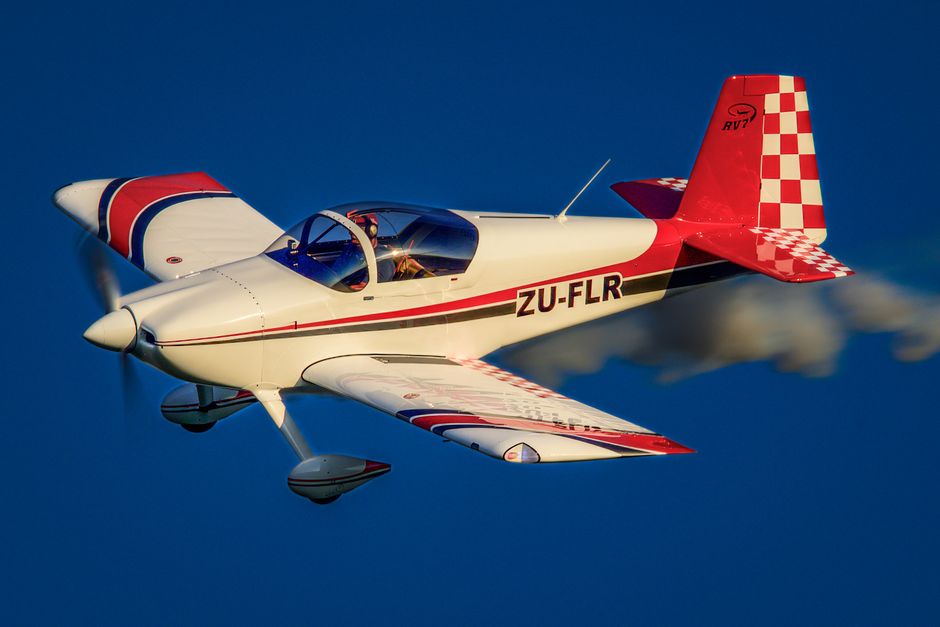
Van's designed the RV-14 and RV-14A as the roomiest side-by-side two-seater in the line, with a cabin roughly 44 inches wide at the shoulders, a 27-foot wingspan and a canopy that opens the whole cockpit to the sky. Van's lists it as aerobatic at a reduced aerobatic gross weight of 1,900 pounds, with design operational limits of +6 and -3 g.That is a real capability, not a footnote — an RV-14A will do loops, rolls and a respectable aileron roll on the way home from a hundred-dollar hamburger.
The RV-10 is a different animal. Four seats, two gull-wing doors, a cabin around 47 inches wide, a 31-foot-9-inch wingspan and a gross weight of 2,700 pounds. Van's does not approve it for aerobatics, and nobody who has flown one would want to. What it does instead is carry four adults, which very few experimental airplanes genuinely do. With a typical empty weight near 1,650 pounds, most RV-10s show a useful load right around 1,000 to 1,050 pounds — four 180-pound people, 60 gallons of fuel and a bit of baggage is a legitimate load for many examples, though you still have to run the numbers for the specific airplane.
The RV-14A's useful load lands near 775 pounds at its 2,050-pound gross. Two people, full fuel and camping gear fits comfortably. Two people, full fuel and a third body does not, because there is no third seat.
Why It Matters: Back seats you never fill are the most expensive empty space in aviation. You pay for them in kit price, engine size, fuel burn, hangar width, insurance hull value and tires. Be ruthlessly honest about how often you will carry four people before you let the RV-10 onto your shortlist.
Edge: RV-10 if you carry people or cargo; RV-14A if you do not.
Performance: Closer Than the Price Gap Suggests
Here is the part that surprises people. Van's publishes a 75-percent cruise of about 193 mph at 8,000 feet for the RV-14/14A on its 210-hp Lycoming IO-390, and about 191 mph at the same power and altitude for the RV-10 on its 260-hp IO-540. Top speeds are about 205 mph and 201 mph respectively. In other words, the four-seater pays for its cabin with a bigger engine and arrives at essentially the same time.
Climb is similar too — Van's quotes roughly 1,500 fpm for the RV-14 and about 1,450 fpm for the RV-10 at gross. Both will outclimb nearly anything you will meet in the pattern at a typical general aviation field. The difference shows up in fuel: at 75 percent, an IO-390 is burning somewhere around 10 to 11 gallons per hour while the IO-540 is drinking 13 to 14. Lean-of-peak operation with a good engine monitor and balanced injectors pulls both down, but the ratio stays roughly the same.
Range comes down to tankage. The RV-14A carries 50 gallons, the RV-10 carries 60. Both work out to roughly four hours of comfortable cruising plus an honest reserve, which at these speeds means legs in the 550 to 650 nautical mile range before the bladders complain anyway.
Fun Fact: The RV-10 is one of the very few kit airplanes that gets built and flown as a primary family cross-country machine rather than a weekend toy. Van's completion tallies have put RV-10s flying well past the thousand mark, while the newer RV-14 family — first flown in 2012 — is still counted in the hundreds.
Edge: Draw on speed and climb. RV-14A wins clearly on fuel burn per mile.
| Specification | Van's RV-14A | Van's RV-10 |
| Seats | 2, side by side | 4, two rows |
| Design engine | Lycoming IO-390, 210 hp | Lycoming IO-540, 260 hp |
| Propeller | Constant-speed (commonly Hartzell) | Constant-speed (commonly Hartzell) |
| Gross weight | 2,050 lb | 2,700 lb |
| Typical empty weight | About 1,275 lb | About 1,650 lb |
| Typical useful load | About 775 lb | About 1,000-1,050 lb |
| Fuel capacity | 50 gal | 60 gal |
| Cruise, 75% at 8,000 ft (Van's) | About 193 mph (168 kt) | About 191 mph (166 kt) |
| Top speed (Van's) | About 205 mph (178 kt) | About 201 mph (175 kt) |
| Rate of climb (Van's) | About 1,500 fpm | About 1,450 fpm |
| Typical fuel burn, 75% | 10-11 gph | 13-14 gph |
| Wingspan | 27 ft 0 in | 31 ft 9 in |
| Cabin width (approx.) | About 44 in | About 47 in |
| Aerobatics | Approved, +6/-3 g at 1,900 lb | Not approved |
| Builder-reported build time | Roughly 1,800-2,000 hr | Roughly 2,000-2,400 hr |
| Engine TBO (Lycoming recommendation) | 2,000 hr | 2,000 hr |
What a Finished One Really Costs
This is the question that sends people to search engines at midnight, and the honest answer is that the kit is the small half of the bill. The airframe kit gets you aluminum, hardware and plans. The engine, propeller, avionics, paint, interior and the hundred small purchases in between get you an airplane.
As of 2025, builders finishing an RV-14A with a new Lycoming IO-390, a constant-speed prop and a modern two-screen glass panel with autopilot commonly report all-in costs somewhere in the $170,000 to $260,000 range. The same builder doing an RV-10 with a new IO-540 and comparable avionics typically lands between $230,000 and $350,000. Top-shelf builds — Thunderbolt engines, triple screens, dual GTNs, show-quality paint, leather interiors, air conditioning — go past those numbers without much effort.
Where the extra RV-10 money goes is fairly predictable: a larger airframe kit, a six-cylinder engine instead of a four, a bigger propeller, more upholstery, more paint, and a door system that eats build hours.
| Line item (2025 builder-reported ranges) | RV-14A | RV-10 |
| Complete airframe kit (all sub-kits) | Roughly $65,000-$85,000 | Roughly $75,000-$100,000 |
| New engine | Roughly $55,000-$70,000 (IO-390) | Roughly $65,000-$85,000 (IO-540) |
| Constant-speed propeller and spinner | $12,000-$20,000 | $14,000-$22,000 |
| Avionics and panel | $25,000-$60,000 | $30,000-$70,000 |
| Paint and interior | $12,000-$30,000 | $15,000-$40,000 |
| Tools, shipping, consumables, the forgotten stuff | $8,000-$20,000 | $10,000-$25,000 |
| Typical all-in finished cost | $170,000-$260,000 | $230,000-$350,000 |
Heads Up: Van's Aircraft filed for Chapter 11 reorganization in December 2023 and emerged in 2024. Kit pricing was restructured in the process and has moved since, so treat every kit figure above as a 2025 snapshot and confirm current numbers with the factory before you budget. The reorganization also means some partially built kits on the used market changed hands mid-build, with gaps in paperwork worth asking about.
Buying a flying example instead of building skips the hours but not the economics. Finished RVs have held value unusually well, and a well-built RV-10 with a good panel is one of the few homebuilts that regularly sells for more than its parts receipts. Asking prices move constantly, so check live listings rather than any number in an article.
Flying411 keeps experimental and certified listings in one place, so you can compare a finished RV-14A against an RV-10 — and against the certified four-seaters they compete with — without hopping between five sites.
Edge: RV-14A, by a wide and consistent margin on cost to finish.
Cost to Fly, Insure and Inspect
Running costs follow the engine. At 100 hours a year and 100LL at typical 2025 self-serve pricing, the RV-10's extra three gallons an hour alone is a four-figure annual difference. Overhaul reserve widens it further: shops quote parallel-valve IO-540 overhauls meaningfully higher than IO-390 overhauls, and both carry Lycoming's recommended 2,000-hour TBO. Set aside roughly $20 to $25 per hour on the RV-14A and $25 to $32 on the RV-10 for engine reserve and you will not be shocked later.
Insurance is the other real gap. Experimental amateur-built airplanes are underwritten on pilot experience far more than on airframe, and a four-seat, 260-hp, $300,000-hull RV-10 flown by a pilot with no retractable, no high-performance and no time in type is a harder risk than an RV-14A on a $220,000 hull. Brokers routinely want a specified number of dual hours in type before they will bind a new RV-10 owner. Budget accordingly and get a quote before you sign anything — the same advice that applies when you are pricing coverage for a simple trainer, as we cover in our guide to Cessna 172 insurance costs.
Inspections are where experimentals shine. An E-AB aircraft needs a condition inspection every 12 calendar months rather than a standard annual inspection. It may be signed off by an appropriately rated A&P, by the holder of the Repairman Experimental Aircraft Builder certificate for that specific aircraft, or, when permitted by the aircraft's operating limitations, by a qualified light-sport repairman under the privileges expanded by MOSAIC.Shop-performed condition inspections commonly run several hundred to a couple thousand dollars depending on how much the owner preps. The experimental airframe itself generally does not carry the same type-certificate-based AD burden as a standard-category aircraft, but applicable ADs can still affect certificated engines, propellers, appliances, or other installed products. Owners should check AD applicability for the specific components installed on the aircraft.
Keep in Mind: The repairman certificate does not transfer with the airplane. If you buy a finished RV, the previous builder's ability to sign off the condition inspection stays with them. Factor an A&P relationship into your ownership plan from day one.
For a closer look at how a four-seat RV stacks up against a certified competitor on running costs, our breakdown of RV-10 vs SR22 ownership costs walks through the annual numbers in detail.
Edge: RV-14A on fuel, insurance and reserves. Draw on inspection cost — both are experimentals and both benefit from the same relaxed rules.
Buying a Finished One: What to Check
Buying someone else's build is a completely different inspection problem from buying a certified airplane. There is no factory build standard to measure against — only the plans, the builder's skill and the quality of the logs. The best RVs are better built than factory airplanes. The worst ones hide problems you cannot see without pulling inspection panels.
Work through these, on both models:
- Builder documentation. Photos, a build log, receipts and the FAA Form 8130-6 package. A thin paper trail is a price negotiation at best and a walk-away at worst.
- Phase I records. Traditional E-AB Phase I requirements call for at least 25 hours with an eligible type-certificated engine/propeller combination and 40 hours with a non-type-certificated or modified combination. Current FAA operating limitations may also permit completion through an approved task-based flight-test plan. Confirm that the aircraft completed the Phase I requirements specified in its operating limitations and was properly released to Phase II.
- Laser-cut parts. Van's shipped certain kits containing laser-cut parts in 2022 and 2023 and later issued guidance on inspecting and replacing them. Any RV-14 or RV-10 built from a kit in that window should have documented compliance with Van's published direction.
- Weight and balance. A heavy RV-10 eats its own useful load. Verify the actual weighing, not a number someone copied from a forum.
- Wiring and panel work. Pull the top skin or panel cover. Neat harnesses, labeled runs and proper strain relief are the single best proxy for overall build quality.
- Engine condition. Compressions, borescope, oil analysis history and whether the engine is a new Lycoming, a Thunderbolt, an overhaul or a used core of unknown parentage.
Much of this is the same discipline we lay out in our walkthrough of buying a Van's RV-6A, and the general cost framing in how much small planes cost is worth reading before you set a budget.
Pro Tip: Hire an A&P who has actually worked on RVs for the pre-buy, not whoever is closest to the airplane. An inspector who knows where RV builders cut corners — fuel tank sealant, rudder bearings, flap actuator hardware, door latch rigging on the RV-10 — finds in two hours what a generalist misses in a day.
Edge: Draw. Both demand the same homework; the RV-10's higher purchase price just raises the stakes.
Which One Should You Buy?
The weekend flyer with a spouse and a hangar. You fly 80 to 120 hours a year, mostly two up, sometimes to a fly-in four states away, and you like the idea of learning aerobatics properly. Buy the RV-14A. It costs less to finish, less to feed, less to insure and it does something the RV-10 cannot do at all. If you want the taildragger version, budget for genuine tailwheel transition training — insurers will ask about it, and so will the airplane.
The family of four who currently rents a 182. Two kids, bags, car seats, a 500-mile trip to grandparents three times a year. Buy the RV-10. Nothing else in the kit world does the job, and the RV-10 does it 25 to 35 knots faster than the Skylane you are renting on about the same fuel. The higher ownership cost buys an airplane you will actually use instead of one you keep apologizing to your family about.
The builder who wants the project as much as the airplane. If this is your first build, the RV-14A is the kinder path: fewer hours, a more forgiving budget, matched-hole construction throughout, and a smaller bill if life interrupts and you have to sell a half-finished project. Builders who have already finished an RV and want more airplane are the natural RV-10 customers.
Good to Know: If you are shopping partly to build flight time toward a commercial certificate or an airline job, neither of these is the obvious economic answer — a simpler, cheaper airframe usually wins that math, which we work through in our guide to the best planes for time building.
Flying411 keeps asking prices, specs and seller details for homebuilt and certified aircraft in one place, so you can compare an RV-14A project against a finished RV-10 side by side before you commit a dollar.
Matching the Airplane to the Flying You Actually Do
The decision in RV-14A vs RV-10 comes down to one honest question: how many seats will be occupied on a typical flight next year? If the answer is two, the RV-14A gives you the same cruise speed, lower fuel burn, a smaller insurance bill, several hundred fewer build hours and aerobatic capability, for something like 60 to 75 percent of the money. If the answer is three or four, the RV-10 is the only Van's airplane that does the job, and the premium is simply the cost of the mission.
Neither one is a compromise airplane. They are two correct answers to two different questions, and the expensive mistake is buying the four-seater for a two-seat life. Price a finished example of each, get an insurance quote with your real logbook times in it, and let those two numbers — not the spec sheet — make the call. If you end up selling a project or a finished airplane down the road, our article on whether to overhaul before selling is worth a read first.
When you are ready to compare listings, visitFlying411and see what is on the market today.