The single-engine turboprop world has been a one-horse race for years. The Pilatus PC-12 has dominated the segment with its Swiss engineering, oversized cabin, and a track record built across thousands of airframes flying every kind of mission you can imagine. Then Textron Aviation showed up with a clean-sheet challenger of its own, and suddenly the conversation got a lot more interesting. The Beechcraft Denali vs Pilatus PC-12 matchup is shaping up to be one of the most-watched comparisons in business aviation today.
Both planes promise jet-like comfort, single-pilot operation, and the ability to land on short or unpaved runways. But under the skin, they take very different paths to get there. One leans on decades of refinement and hard-earned trust. The other arrives with brand-new engine tech, a class-leading cabin, and the latest Garmin avionics out of the box.
Picking between them is less about which is "better" and more about which one fits how you fly. The story behind these two aircraft is a window into how single-engine turboprop design is evolving in real time.
Key Takeaways
The Beechcraft Denali and Pilatus PC-12 are both pressurized single-engine turboprops built for owner-operators, charter fleets, and special missions, but the PC-12 is a proven performer with a long delivery history while the Denali is a brand-new clean-sheet design from Textron Aviation entering service with newer engine and cabin technology.
| Feature | Beechcraft Denali | Pilatus PC-12 NGX / PRO |
| Manufacturer | Textron Aviation (USA) | Pilatus Aircraft (Switzerland) |
| Engine | GE Catalyst (1,300 shp) | Pratt & Whitney PT6E-67XP (1,200 shp) |
| Max Cruise Speed | Around 285 knots | Around 290 knots |
| Range (4 pax) | Around 1,600 nm | Up to about 1,800 nm |
| Max Occupants | Up to 11 (incl. crew) | Up to 10 (incl. crew) |
| Avionics | Garmin G3000 with Autoland | Garmin G3000 PRIME with Autoland (PRO) |
| Status (2026) | Targeting FAA certification | In service, 2,000+ delivered |
| Typical Equipped Price | Around $6.45M (forecast) | Around $6.8M (PRO) |
Flying411 keeps a close eye on the single-engine turboprop market, listing both new and used aircraft, engines, and parts so buyers can shop side by side without leaving the platform.
A Quick Background on Each Aircraft
Before getting into specs and numbers, it helps to understand where each airplane comes from. Their development stories shape almost everything about how they fly today.
The Pilatus PC-12
The PC-12 was first announced by Swiss manufacturer Pilatus Aircraft back in 1989. It received Swiss certification in March 1994 and FAA approval shortly after. The idea was bold for the time: build a single-engine turboprop with a large pressurized cabin that could fly fast, fly far, and still operate from short, unpaved runways.
That gamble paid off. Pilatus delivered its 2,000th PC-12 in May 2023, with operators ranging from corporate flight departments to medevac providers, fractional ownership programs, and government agencies. The aircraft has gone through several major updates: the original PC-12, the PC-12 NG, the PC-12 NGX (introduced in 2020), and now the PC-12 PRO, announced in March 2025.
Fun Fact The PC-12 family has logged well over 11 million flight hours combined, and the underlying PT6 engine family it relies on is widely considered one of the most reliable turboprop engines ever built.
The Beechcraft Denali
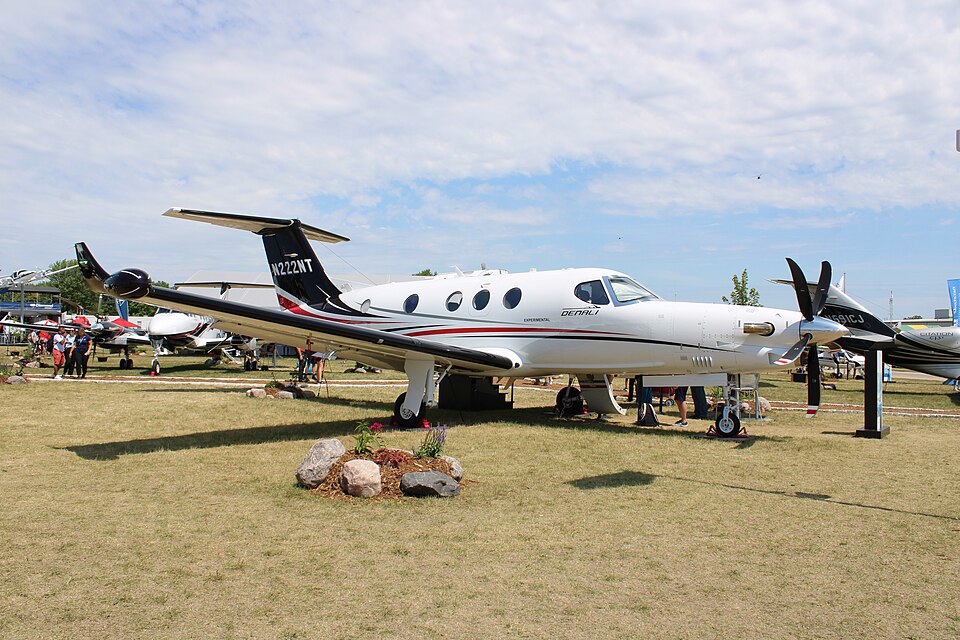
The Denali has had a longer road to the runway. Textron Aviation first announced the aircraft as the Cessna Denali at EAA AirVenture Oshkosh in 2015. The project was rebranded as the Beechcraft Denali in 2021, the same year it took its first flight in November out of Wichita.
The Denali is a clean-sheet design, meaning Textron didn't start with an existing airframe. Everything from the wing to the cabin to the engine is new. It uses the all-new GE Aerospace Catalyst engine, which itself was a clean-sheet design and uses additive manufacturing (3D printing) for many of its parts. The Catalyst is the first centerline turboprop engine certified to the latest FAA standards.
Both the engine and aircraft program saw multiple delays as GE worked through certification on the Catalyst. The engine finally received FAA certification on February 27, 2025. As of the most recent updates, Textron is targeting full Denali type certification in 2026, with the three flight test aircraft having logged thousands of flight hours combined.
Good to Know The Denali is the first new clean-sheet single-engine turboprop in this class to enter the market in years, and it stands as a real test of how brand-new engine tech holds up against the long-trusted PT6.
Performance Specs Side by Side
This is usually where the Beechcraft Denali vs Pilatus PC-12 comparison gets most attention. Both planes target the same mission profile: get six to nine people across long distances at turboprop economy. The numbers are remarkably close, but the differences matter.
Speed and Range
- Beechcraft Denali: Max cruise speed around 285 knots; range of approximately 1,600 nautical miles with four passengers at high-speed cruise.
- Pilatus PC-12 NGX: Max cruise speed around 290 knots; range of up to roughly 1,800 nautical miles in optimum configuration.
The PC-12 has a slight edge in both top speed and range, especially when configured for long-distance cruise. The Denali sacrifices a bit of range for a larger cabin and a different engine philosophy.
Service Ceiling and Cabin Altitude
Both aircraft have a similar service ceiling, but the Denali has a more modern pressurization system. At 31,000 feet of cruise altitude, the Denali is designed to maintain a cabin altitude of about 6,130 feet. That's a noticeable comfort win on longer flights, where higher cabin pressure means more oxygen and less passenger fatigue.
The PC-12 NGX has a certified ceiling of 30,000 feet and a digital pressurization system that has been refined across multiple generations.
Short-Field and Rough-Field Performance
This is one of the PC-12's signature strengths. The aircraft is widely known for operating from short, unpaved runways, which makes it a favorite for remote site access, oil and gas, medevac, and government missions.
The Denali is being marketed with similar capability, including trailing-link landing gear, large tires, and a takeoff distance reportedly around 2,900 feet. The catch is that the PC-12 has years of real-world data behind those numbers. The Denali is just starting to build that record.
Why It Matters Short-field capability isn't a bonus feature in this segment. For many buyers, it's the entire reason they're choosing a turboprop over a light jet, and proven performance in tough conditions is worth real money.
Engine Showdown: GE Catalyst vs Pratt & Whitney PT6E-67XP
The engine choice is one of the biggest philosophical differences between these two aircraft. It also shapes maintenance, fuel burn, pilot workload, and resale value.
The GE Catalyst (Beechcraft Denali)
The Catalyst is built by GE Aerospace and Avio Aero in Italy and the Czech Republic. It generates around 1,300 shaft horsepower and represents a true clean-sheet engine design.
What makes it different:
- Dual-channel FADEC with single-lever power and propeller control, similar to a jet
- Additive-manufactured (3D-printed) components that consolidate hundreds of parts into a few complex pieces
- Time between overhauls (TBO) reportedly around 4,000 hours, which is high for the class
- Reduced fuel burn of about 20% less than older engines in the segment, per manufacturer claims
- Five-blade McCauley composite propeller with electric de-ice and reverse pitch
Heads Up The Catalyst is brand new in the field. While the engine has logged over 8,000 hours of certification testing, the long-term real-world maintenance and reliability data simply doesn't exist yet. Early operators will be the ones writing that history.
The Pratt & Whitney PT6E-67XP (Pilatus PC-12)
The PT6E-67XP is the latest evolution of the legendary PT6 family. It produces about 1,200 shaft horsepower and powers both the PC-12 NGX and the new PC-12 PRO.
What makes it different:
- Dual-channel FADEC is now standard, with single-lever power control similar to the Catalyst
- PT6 family has more than 60 years of service and over 400 million flight hours across all variants
- All-external component layout is designed to make maintenance possible on-wing in many cases
- Five-blade Hartzell composite propeller with quiet mode and reverse pitch
- Single-Engine IFR (SEIFR) approval in the U.S., Canada, Europe, Australia, and New Zealand for commercial operations
The PT6 isn't trusted only because it's old. It's trusted because Pratt & Whitney has had decades to refine it, and operators around the world have a deep service network to support it.
Cabin Comparison: Where Comfort Meets Cargo
Both aircraft pitch themselves as offering "midsize-jet-like" cabins. They are both right, in slightly different ways.
Beechcraft Denali Cabin
The Denali is designed with what Textron calls the largest flat-floor cabin in its segment. Cabin dimensions are roughly:
- Length: 16 feet 9 inches
- Width: 5 feet 3 inches (about 3 inches wider than the PC-12)
- Height: 4 feet 10 inches
It seats up to 11 occupants in a high-density commuter layout, or six in an executive configuration with reclining seats, a forward refreshment center, and an optional aft lavatory. Standard features include large windows, LED lighting, USB and 110V power throughout, and an in-flight accessible baggage compartment.
The cargo door is roughly 4 feet 11 inches tall by 4 feet 5 inches wide, slightly larger than the PC-12's door. That extra opening matters for cargo missions and oversized items.
Pilatus PC-12 Cabin
The PC-12 cabin is one of the longest-running cabin designs in turboprop aviation, and it has been refined steadily over three decades. Approximate cabin dimensions:
- Length: 16 feet 11 inches
- Width: 5 feet 0 inches
- Height: 4 feet 10 inches
The PC-12 NGX seats up to 10 with the copilot seat in use, and offers executive layouts with seats inspired by the larger Pilatus PC-24 jet. The new PC-12 PRO adds a fully restyled cabin (designed in collaboration with BMW Designworks), revised cabinetry, additional storage, and 100 pounds of extra useful load.
Quick Tip If your mission profile includes a lot of cargo or odd-shaped items, look hard at the cargo door dimensions on both aircraft. They're close, but those few inches can be the difference between fitting and not fitting an ATV, a stretcher, or a pallet.
Avionics: Garmin Goes Toe to Toe With Garmin
This used to be one of the clearest distinctions between the two airplanes. The PC-12 NGX used the Honeywell Primus Apex (branded ACE) avionics system, while the Denali was launched with the Garmin G3000 suite. With the introduction of the PC-12 PRO in March 2025, Pilatus made the switch to Garmin too.
Beechcraft Denali Avionics
The Denali features the Garmin G3000 integrated flight deck with:
- Three 14-inch wide-screen LCD displays
- Two touchscreen controllers
- Synthetic Vision Technology (SVT)
- Integrated Garmin Autothrottle (standard)
- Garmin Emergency Autoland (standard)
- Voice command with automatic speech recognition
- Dual-channel FADEC integration with single-lever power
Pilatus PC-12 PRO Avionics
The PC-12 PRO is the first aircraft certified with the new Garmin G3000 PRIME integrated flight deck, which is a generation ahead of the standard G3000 in some respects. Highlights include:
- Three 14-inch primary touchscreen display units with edge-to-edge sunlight-readable glass
- Two 7-inch secondary touchscreen displays
- Pilatus's proprietary cursor control device (CCD)
- Garmin Autoland and Smart Glide
- Electronic Stability Protection (ESP) and Emergency Descent Mode
- PlaneSync connected aircraft management
The PC-12 NGX (still in production) uses the Honeywell ACE/Apex system, which is a capable suite but is being phased out as the PRO takes over.
Pro Tip If avionics commonality matters in your fleet, the Denali and PC-12 PRO are now both in the Garmin family, which makes pilot transitions and training simpler than they used to be. That's a meaningful shift from just a couple of years ago.
Price, Operating Costs, and Resale
Money is where many of these decisions actually get made. The two airplanes are priced in the same neighborhood, but the surrounding economics tell a fuller story.
Acquisition Cost
- Beechcraft Denali: Forecast equipped price of approximately $6.45 million (per 2023 forecasts; subject to change at certification).
- Pilatus PC-12 NGX: Typical equipped price around $6.2 million to $6.8 million, depending on configuration and model year.
- Pilatus PC-12 PRO: Typically equipped price around $6.8 million as of 2025.
Both aircraft are priced as direct competitors. The PC-12 PRO sits at the higher end of the range due to its new avionics and cabin, while the Denali's pricing is competitive with mid-range PC-12 configurations.
Operating Costs
Operating costs depend heavily on annual hours flown, fuel prices, fleet management contracts, and engine programs. Industry estimates put hourly direct operating costs for the PC-12 NGX around the $1,150 to $1,900 per hour range depending on the source and how fixed costs are spread.
The Denali's operating costs are still being calibrated, but the GE Catalyst is marketed as offering meaningful fuel-burn savings compared with older engines in the class. Until enough Denalis are flying in the field, real-world per-hour costs will remain estimates.
Resale Value
This is one of the PC-12's biggest advantages. With over 2,000 airframes delivered and a global service network, PC-12 resale values have historically been strong. Used PC-12 NGs and NGXs hold their value well, and there's an active aftermarket for parts, refurbishment, and conversions.
The Denali, as a brand-new airframe, has no resale track record yet. First-generation aircraft sometimes face airworthiness directives or design tweaks in their early years that can affect early-build values. Buyers should weigh that risk against the benefits of getting in early on a clean-sheet design.
Keep in Mind Test pilots have a saying: "Never fly the 'A' model of anything." That doesn't mean the Denali will have problems, but first-of-type aircraft historically face more early-life refinements than mature airframes. The PC-12 went through its own version of that decades ago.
Looking to compare actual listings? Flying411's marketplace lets you browse new and used aircraft from major manufacturers, including the Pilatus PC-12 lineup, alongside engines and certified parts.
7 Key Differences Between the Beechcraft Denali and Pilatus PC-12
Now for the heart of the comparison. Here are seven specific areas where these two single-engine turboprops actually differ in ways that affect buying decisions and day-to-day flying.
1. Track Record and Trust
The PC-12 has been on the market since 1994 and has crossed 2,000 deliveries. The Denali is just entering certification in 2026 with three flight test aircraft. If you want a known quantity with worldwide support, the PC-12 has the head start. If you want the newest engine and airframe technology in the class, the Denali is the only choice.
2. Engine Philosophy
The PC-12 uses the Pratt & Whitney PT6E-67XP, which is the latest version of one of the most reliable turboprop engine families in history. The Denali uses the GE Catalyst, a clean-sheet design with FADEC, additive manufacturing, and a 4,000-hour TBO. The PT6 is proven. The Catalyst is potentially more efficient and modern, but unproven in long-term commercial service.
3. Cabin Size and Layout
- The Denali's cabin is slightly wider (about 5'3" vs 5'0") with what Textron markets as the largest cross-section in class.
- The PC-12's cabin is slightly longer at 16'11" vs 16'9".
- Both have flat floors and reconfigurable layouts.
- Both offer six-seat executive and high-density commuter configurations.
The Denali leans toward more shoulder room. The PC-12 PRO leans toward refined finish quality, with the new BMW Designworks-developed interior.
4. Pressurization
The Beechcraft Denali is designed for a cabin altitude of about 6,130 feet at 31,000 feet of cruise. That's a meaningful step up in passenger comfort, especially for longer flights. The PC-12 NGX maxes out at a cruise ceiling of 30,000 feet with its own digital pressurization system, which is well-regarded but a slightly older design.
5. Avionics Generation
The Denali uses the Garmin G3000 flight deck. The new PC-12 PRO uses the next-generation Garmin G3000 PRIME, which features faster processors, multi-touch capability, and updated graphics. Both include Garmin Autoland.
For buyers who want the newest cockpit technology, the PC-12 PRO is currently a step ahead in raw avionics generation. Once the Denali reaches certification, expect that gap to narrow as Textron rolls out updates.
6. Range and Speed
- PC-12 NGX: ~290 knot cruise, ~1,800 nm range
- Denali: ~285 knot cruise, ~1,600 nm range
The PC-12 wins on raw range and edges out on top speed, which matters for long-leg missions like coast-to-coast flights or international hops.
7. Special Mission Adaptability
The PC-12 has been adapted into countless special-mission roles: medevac, ISR (intelligence, surveillance, reconnaissance), cargo, fractional ownership shuttles, government surveillance, and more. The U.S. Air Force operates the U-28A Draco, which is a PC-12-based platform.
The Denali is being designed with similar versatility (the cabin is built to convert between passenger and cargo), but the special-mission ecosystem around it will take years to build. STC-approved modifications, training pipelines, and operator experience all need time to develop.
Ready to make a move on either aircraft? Click here to browse Flying411's aircraft listings and connect with verified sellers, A&P mechanics, and avionics specialists in one place.
Who Each Aircraft Is Best For
Different buyers prioritize different things. Here's a rough breakdown of where each airplane shines.
The Pilatus PC-12 Is Best For:
- Owner-operators who want a proven, single-pilot-friendly airplane with strong resale value
- Charter and fractional operators who need a known quantity with a global parts and service network
- Special mission operators in medevac, ISR, surveillance, or remote-site access roles
- Buyers who prioritize range for long single-leg trips
- Operators in regions with mature PC-12 service infrastructure
The Beechcraft Denali Is Best For:
- Buyers who want the newest engine and avionics technology in a single-engine turboprop
- Owner-operators moving up from high-performance pistons or smaller turboprops who want a larger cabin
- Corporate flight departments that already operate Textron aircraft (Citation, King Air) and value support and avionics commonality
- Charter operators willing to be early adopters in exchange for potentially lower fuel burn
- Buyers who prioritize cabin pressurization comfort at high cruise altitudes
Fun Fact Many seasoned PC-12 buyers in the past have been people who first flew the airplane on a charter and decided they wanted one of their own. The same pattern is likely to play out with the Denali once it's in regular service.
Common Questions About Single-Engine Turboprops
Some questions come up in nearly every conversation about this class of aircraft. Here are short answers to a few of the big ones.
Why fly a single-engine turboprop instead of a light jet?
Single-engine turboprops offer lower acquisition and operating costs than light jets, can land on shorter and rougher runways, and burn significantly less fuel per hour. The trade-off is slower cruise speeds and shorter range than most light jets. For missions under about 1,500 to 1,800 nautical miles, a turboprop often makes more sense financially.
Are single-engine turboprops safe?
Modern single-engine turboprops powered by the PT6 family or the GE Catalyst have very strong safety records. The PT6 has the unique distinction of being approved for single-engine IFR (SEIFR) commercial operations in major regions. Both the Denali and the PC-12 PRO offer Garmin Autoland, which can autonomously land the aircraft if the pilot is incapacitated.
How long does it take to train to fly one?
Most pilots transitioning from a high-performance piston or smaller turboprop will need type-specific training, typically through a provider like FlightSafety or Simcom. Initial training generally takes one to three weeks, with recurrent training each year. Garmin avionics commonality (now in both aircraft via the G3000 family) makes transitions easier than they used to be.
Final Thoughts on the Beechcraft Denali vs Pilatus PC-12
The Beechcraft Denali vs Pilatus PC-12 matchup is shaping up to be one of the most interesting in turboprop aviation. The PC-12 is the proven champion with thousands of airframes delivered, a deep service network, and a steadily evolving design that just got a major upgrade with the PC-12 PRO. The Denali brings a clean-sheet airframe, a brand-new GE Catalyst engine, the latest Garmin avionics, and a bigger cabin cross-section to the fight.
Neither is a wrong answer. The PC-12 is the safer bet for buyers who want known quantities and strong resale. The Denali is the play for buyers who want the newest tech and are willing to be early in the cycle.
Both are likely to do well in the years ahead, and competition between them should keep both manufacturers pushing hard on innovation, comfort, and value.
Shopping for your first single-engine turboprop or upgrading your fleet? Flying411 makes it easier to find the right aircraft, the right engine, and the right people to keep it flying. Browse listings, compare specs, and connect with certified pros in one place.
Frequently Asked Questions
Is the Beechcraft Denali certified yet?
As of the most recent updates, the Denali is targeting FAA type certification in 2026. The GE Catalyst engine that powers it received FAA certification in February 2025, clearing one of the major hurdles to full aircraft certification.
How does the Beechcraft Denali fuel burn compare to the PC-12?
GE Aerospace markets the Catalyst engine as offering meaningful fuel-burn improvements over older engines in the class. Real-world numbers will be confirmed once the Denali enters service, but Textron has cited up to 20% better fuel efficiency in some comparisons.
Can the Pilatus PC-12 land on grass or dirt runways?
Yes, the PC-12 is widely known for its rough-field and unpaved runway capability. It is commonly used by operators who fly into remote sites, including ranches, mining areas, and grass strips, with proper inspection and operating procedures.
How does the Beechcraft Denali compare to the Beechcraft King Air?
The Denali is a single-engine turboprop, while the King Air family (including the King Air 260 and King Air 200/350) is twin-engine. The King Air offers redundancy and a larger cabin in some models, but at higher acquisition and operating costs. The Denali is positioned as a more efficient, modern single-engine alternative for missions that don't require a twin.
What's the difference between the PC-12 NGX and the PC-12 PRO?
The PC-12 PRO is the latest generation, introduced in March 2025. The biggest changes from the NGX include the new Garmin G3000 PRIME avionics suite (replacing the Honeywell ACE/Apex system), Garmin Autoland, an additional 100 pounds of useful load, redesigned PC-24-style yokes, and a restyled cabin developed with BMW Designworks.