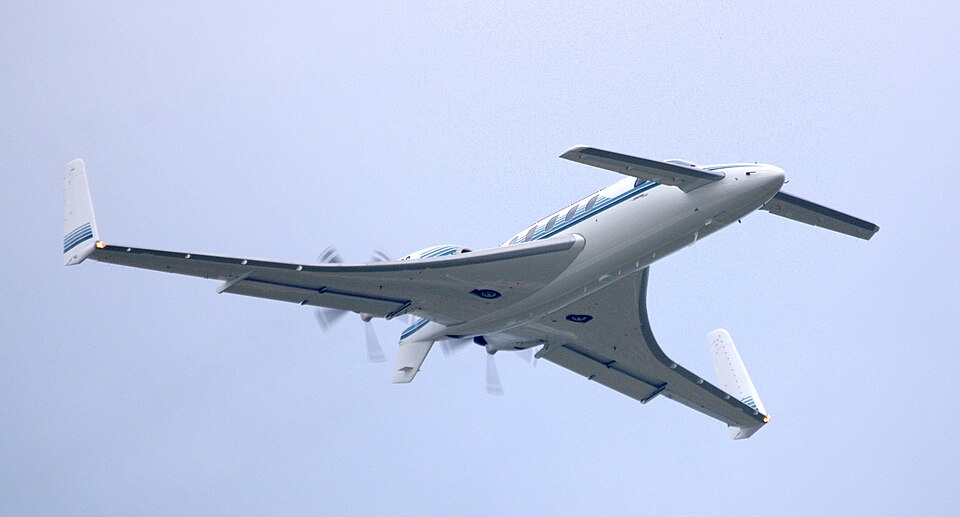
They both look like they escaped from a science fiction movie set. They both feature forward canards, rear-mounted pusher engines, and futuristic silhouettes that turn heads on any ramp. They were both born from the same restless decade of aviation engineering, and they both dared to ask a question most manufacturers were too cautious to voice: what if a turboprop could look and perform, like something from the future?
The Beechcraft Starship and the Piaggio P180 Avanti are two of the most iconic and unconventional business aircraft ever built. But their stories, despite starting in similar places, ended very differently. One became a cautionary tale. The other is still flying and still turning heads today.
The gap between those two outcomes says everything about the difference between bold vision and successful execution.
Key Takeaways
The Beechcraft Starship vs Piaggio Avanti comparison comes down to this: both aircraft share a canard pusher layout and a radical design philosophy, but the Avanti succeeded where the Starship did not. The Avanti delivers faster cruise speeds, a larger cabin, more range, and crucially, it remained in production for decades while the Starship was quietly retired and largely scrapped by its manufacturer. If you want to fly something exotic, the Avanti is the one you can still buy. The Starship lives on mostly in museums and a small group of devoted private owners.
| Feature | Beechcraft Starship | Piaggio P180 Avanti II |
| First Flight | 1986 | 1987 |
| Production Run | 1988-1995 (approx. 53 built) | 1990-present |
| Engines | 2x PT6A-67A (1,200 shp each) | 2x PT6A-66B (850 shp each) |
| Max Cruise Speed | ~335 knots | ~402 knots |
| Range | ~1,750 nm | ~1,400-1,770 nm (EVO) |
| Passengers | 6-8 | Up to 9 |
| Design Origin | USA (Beechcraft / Scaled Composites) | Italy (Piaggio Aero) |
| Still in Production? | No | Yes |
| Defining Feature | First all-composite business aircraft | Fastest certified turboprop |
Flying411 is your marketplace for turboprops, business aircraft, and aviation services — browse listings from top manufacturers and connect with certified aviation professionals all in one place.
The Decade That Produced Two Legends
The 1980s were a strange and ambitious time in business aviation. Fortune 500 companies were spending heavily on executive transport, and manufacturers were pushing the limits of what a turboprop could do. Two programs, starting almost simultaneously on opposite sides of the Atlantic, would produce aircraft so unusual they still draw crowds at airshows today.
At Beechcraft in Wichita, Kansas, engineers began exploring a successor to their successful King Air line in the late 1970s. They wanted something faster, quieter, and more technologically advanced. In Italy, Piaggio Aero was working toward a similar goal with different roots, partnering briefly with Gates Learjet before going it alone to produce an Italian-built speed machine.
Both companies landed on eerily similar solutions: canard foreplane, rear-mounted pusher turboprops, and unconventional aerodynamics that broke from everything the industry considered normal.
Fun Fact: Engineering studies for what would become the Piaggio Avanti began in 1979 — the same year Beechcraft started exploring what would eventually become the Starship. Two continents, two teams, and one shared obsession with reinventing the turboprop.
The fact that two manufacturers independently arrived at such similar configurations is not a coincidence. It reflects genuine aerodynamic logic. Canards and pusher configurations each offer specific advantages that, when combined, create a compelling case for rethinking how a business turboprop should be built.
What Is a Canard? Understanding the Design Both Aircraft Share
Before getting into the specifics of each aircraft, it helps to understand what makes both of these planes look so unusual in the first place: the piaggio canard configuration, and the broader concept of three-surface aerodynamics.
A canard is a small wing placed forward of the main wing, near the nose of the aircraft. In a conventional airplane, the horizontal tail produces downward force to balance the aircraft — which works against the lift generated by the main wing. A canard produces upward lift instead, which means more of the aircraft's lifting surfaces are working in the same direction.
This has real benefits:
- Reduced drag because the horizontal surfaces are lifting rather than pushing down
- Improved stall behavior because the canard reaches its critical angle first, pushing the nose down before the main wing stalls
- Better fuel efficiency because the overall system produces more lift per unit of drag
- Quieter cabin because the pusher engines place the propellers and exhaust behind the passenger area
The Starship used what Beechcraft called a variable-geometry canard — one that could change its sweep angle during flap extension for pitch trim compensation. The Avanti goes further with a true three-surface design, adding a conventional T-tail in addition to the canard and main wing, allowing each surface to be optimized for its specific aerodynamic role.
Good to Know: In a three-surface aircraft like the Piaggio Avanti, the canard produces lift, the main wing produces lift, and the tail provides stability — meaning the main wing can be made smaller and lighter than on a conventional design, reducing drag further.
The plane with wings on nose look that both aircraft share is actually a product of careful aerodynamic engineering, not just style. Those forward surfaces are doing real aerodynamic work.
Beechcraft Starship: The Visionary That Became a Museum Piece
Origins and Design
The Beechcraft Starship story begins in 1979 and takes a turn that no one at the company could have predicted: they hired Burt Rutan.
Rutan's company, Scaled Composites, was contracted in 1982 to refine the design and build an 85% scale proof-of-concept aircraft. The small prototype first flew in 1983 and proved the concept worked. What followed was years of development, certification work, and anticipation. The full-scale prototype made its first flight on February 15, 1986.
The Starship was genuinely unlike anything the industry had produced. It was the first all-composite pressurized business aircraft to receive FAA certification — a milestone in aviation manufacturing. The carbon fiber, Kevlar, and E-glass structure was lighter and stronger than aluminum, and it gave the aircraft a surface finish that was smoother than anything produced by conventional methods.
The design also did away with a conventional rudder. Directional control came from small fins mounted on the wingtips — which Beechcraft called "tipsails" — functioning as both winglets and vertical stabilizers. The result was a fuselage free of the tail noise and propeller-tip vortex interference that conventional aircraft deal with constantly.
Pro Tip: Because the Starship's engines are mounted in pusher configuration with propellers facing rearward, the cabin sits ahead of both the engines and the propeller arc — meaning the propeller noise that plagues conventional turboprops is significantly reduced. Passengers heard a much quieter ride.
The cockpit was equally advanced for its era. The Starship used a Collins Concept 4 avionics package with 14 full-color CRT displays — an early glass cockpit at a time when most business turboprops still relied heavily on analog gauges.
Specifications at a Glance
The Starship 2000A — the production version — was powered by two Pratt & Whitney Canada PT6A-67A turboprop engines, each rated at approximately 1,200 shaft horsepower. The aircraft cruised at around 335 knots and had a service ceiling of 41,000 feet. Maximum takeoff weight was approximately 14,900 pounds, and it could carry six to eight passengers in a pressurized, executive-configured cabin.
Interior dimensions were generous: roughly 21 feet in cabin length, with a height and width of around 5.5 feet each. For a turboprop of that era, it was a substantial cabin with full lavatory, refreshment center, and rear baggage compartment.
Why It Failed
The Starship program is one of aviation's most studied commercial failures, and the reasons are layered.
The aircraft debuted during the late 1980s economic downturn — poor timing for a high-priced, unconventional aircraft asking buyers to take a leap of faith. The composite construction, while technically groundbreaking, added cost and complexity to certification, repairs, and insurance. The FAA required extensive documentation and testing for the first large-scale composite design, which delayed the program and drove up costs.
But the deeper problem was performance. Despite all the engineering innovation, the Starship was not meaningfully faster than the King Air it was meant to replace. Buyers expected a dramatic speed advantage. They did not get one. The aircraft's composite structure, designed to save weight, ended up heavier than projected. The Avanti, as we'll see shortly, achieved much better cruise performance with engines that produced significantly less power per side.
Heads Up: The Starship program ultimately produced only around 53 airframes, with fewer than 30 actually delivered to customers. By 2003, Beechcraft's parent company Raytheon began scrapping aircraft under its control — a decision that shocked the aviation community and left surviving Starships as rare collector's items.
Only a handful of Starships remain airworthy today. Most are in museums. A few are in the hands of devoted private owners who maintain them at considerable expense. Beechcraft sold its entire remaining parts inventory to a private owner at a fraction of retail value, which means those who still fly Starships are working from a finite supply of certified parts.
You can learn more about Beechcraft's twin-engine legacy and how other models in their lineup fared with our comparison of the Beechcraft Duke vs Baron.
Piaggio P180 Avanti: The Italian Speedster That Survived
Origins and Design
Piaggio Aero has roots going back to 1915, with a history that includes military seaplanes, luxury vehicles, and — famously — the Vespa scooter. When the company turned its attention to business aviation in the early 1980s, it brought that Italian sensibility for design and engineering to bear on a turboprop that needed to stand out.
Development of what would become the Piaggio P180 Avanti began around 1979, with formal engineering studies conducted at American universities including the University of Kansas and Ohio State. Piaggio partnered with Gates Learjet in 1983 to develop the fuselage, and Learjet's influence is visible in the steeply raked windshield and the distinctive delta fins under the tail. When Learjet withdrew from the project in 1986 for economic reasons, Piaggio assumed full control.
The first prototype flew in 1987. Italian certification came in March 1990, followed by FAA certification in October of the same year. First customer deliveries began in 1991.
The Avanti's layout is a true three-surface design. The forward canard, main wing, and T-tail all contribute to the aircraft's aerodynamics. The main wing sits further aft than on a conventional design, which means the wing spar passes behind the passenger cabin — freeing up interior space in a way that conventional designs cannot match. The Piaggio aircraft holds its cabin space by moving the structural spar out of the way.
Why It Matters: The wing positioning on the Avanti is not just an aerodynamic choice — it's a cabin design decision. Moving the main wing spar behind the passenger section means no intrusive carry-through structure interrupting the floor or seating area. You get a larger, more usable cabin than the aircraft's size would otherwise suggest.
The pusher engine configuration was chosen specifically to minimize cabin noise. With the propellers positioned behind the cabin, the loudest part of the powerplant is as far from passengers as physically possible. The Avanti's cabin is, by most accounts, significantly quieter than comparable conventional turboprops.
Forty percent of the Avanti's structure is made from composites — including Kevlar, Nomex, and graphite epoxy — with the remaining sixty percent aluminum. The main wing panels were machined from single aluminum billets using computer-controlled mills, with skin tolerances measured in hundredths of an inch.
That precision matters: the Avanti's laminar-flow wing maintains low-drag airflow over a much greater percentage of its chord than conventional turboprop wings, which is a big part of why it goes as fast as it does.
Piaggio P180 Avanti Specifications
The piaggio p180 avanti specifications that stand out most are its speed numbers. The original Avanti used two Pratt & Whitney Canada PT6A-66 engines, flat-rated to 850 shaft horsepower each — significantly less power than the Starship's 1,200-shp-per-side powerplant. Yet the Avanti cruised faster.
The Avanti II, introduced in 2005, upgraded avionics to the Rockwell Collins Pro Line 21 system and refined performance further, reaching maximum cruise speeds of around 402 knots. Range on the Avanti II is approximately 1,410 nautical miles, with the later EVO variant offering an extended range option pushing close to 1,770 nautical miles with an additional fuel tank.
The cabin offers stand-up height — an unusual feature in a turboprop this size — and seats up to nine passengers. Cabin width exceeds six feet, which feels genuinely spacious in flight. The aircraft can operate from shorter runways, making it versatile for accessing airports that jets of comparable performance cannot reach.
The Avanti EVO, announced by Piaggio in 2014, added new Hartzell composite scimitar propellers, winglets, aerodynamic refinements, and an extended range fuel option. EASA certified the EVO in November 2014, and FAA certification followed in mid-2015. The EVO also promised a significant reduction in external noise, addressing one of the aircraft's few operational criticisms.
Fun Fact: The FAI (Fédération Aéronautique Internationale) recognizes the Piaggio P180 Avanti as the fastest propeller-driven aircraft in its class, with a recorded speed that no conventional turboprop can match. That speed comes not from raw horsepower but from aerodynamic efficiency.
Beechcraft Starship vs Piaggio Avanti: Head-to-Head Comparison
Here is where the two aircraft stand when placed directly side by side across the categories that matter most to buyers, operators, and aviation enthusiasts.
Speed
The Avanti wins this category without much contest. The Starship cruised at around 335 knots. The Avanti II cruises at approximately 402 knots — a meaningful difference on any mission of two hours or more. Ironically, the Avanti achieves this with engines that produce considerably less shaft horsepower per side. The efficiency advantage of the three-surface design and laminar-flow wing is the reason.
Pro Tip: The Avanti's speed advantage over the Starship is not just a number on a spec sheet. On a 1,000-nautical-mile trip, the speed difference translates to a meaningful reduction in flight time — getting passengers to their destination in less time while burning less fuel per mile.
Range
Both aircraft offer comparable range on paper, though the specifics vary by variant and loading. The Starship's range was approximately 1,750 nautical miles at normal cruise settings. The standard Avanti II comes in around 1,410 nautical miles, though the EVO's optional extended fuel tank brings that figure up toward 1,770 nautical miles. Advantage: roughly even, with a slight edge to the Starship in base configuration.
Cabin and Passenger Comfort
The Avanti holds a real advantage here. Its three-surface layout moves the wing spar behind the cabin, opening up interior space in ways the Starship cannot match. The Avanti's cabin offers more stand-up height and a wider feel than its overall fuselage size would suggest. Both aircraft are quieter than conventional turboprops, but the Avanti's cabin noise level has been consistently praised.
The Starship's cabin is comfortable and well-appointed, but the carry-through structure and overall layout make it feel more constrained relative to the Avanti.
Design and Construction
The Starship was a genuine pioneer. It was the first all-composite pressurized business aircraft. Its carbon fiber, Kevlar, and E-glass construction was unlike anything the industry had seen at the time. The Avanti uses a mixed aluminum-composite construction — impressive engineering, but not the all-composite landmark the Starship was.
If you are scoring on historical significance and construction innovation, the Starship gets the point. If you are scoring on practical outcomes and maintenance accessibility, the Avanti is easier to own.
Avionics
Both aircraft were advanced for their eras. The Starship's Collins Concept 4 system with 14 CRT displays was leading-edge in the late 1980s. The Avanti II's Rockwell Collins Pro Line 21 suite, introduced in 2005, is a genuinely modern system with digital displays, integrated flight management, and a much cleaner pilot interface. The Avanti wins on modern avionics simply by virtue of still being in production and receiving updates.
Ownership and Supportability
This is the most important practical comparison. The Starship program was cancelled. Beechcraft's parent company sold off parts inventory to a private owner. Finding airworthy parts today requires significant effort and cost, and the pool of mechanics with Starship experience is shrinking.
The Avanti is still in production. Parts are available through normal channels. Piaggio and its authorized service network support the type actively. For anyone who actually wants to fly rather than restore, the Avanti is the only real choice between the two.
Flying411 connects buyers with turboprops, engines, and aviation parts listings — if you are in the market for a Piaggio Avanti or related aircraft, browse current listings and connect with sellers on the platform.
Commercial Success
The Starship was a commercial failure. Roughly 53 airframes were produced, fewer than 30 delivered to customers, and most were eventually scrapped by the manufacturer. The Avanti has sold in the hundreds and remained in continuous production for over three decades, with new variants still entering the market.
Where Are They Now? Surviving Starships and Active Avantis
The fates of the two aircraft today tell the clearest possible story about their respective outcomes.
The Starship is primarily a museum aircraft. Several are on display at institutions including the Kansas Aviation Museum, the Beechcraft Heritage Museum, the Museum of Flight in Seattle (on loan to the Future of Flight at Paine Field), the Pima Air and Space Museum, and others. A very small number remain airworthy in private hands. Their owners are, by all accounts, deeply passionate about the type and committed to keeping them flying against considerable odds.
The Avanti is a different story entirely. Hundreds of Avantis are active worldwide, operated by corporate flight departments, charter operators, and private owners. Special mission variants have been used by government and military operators in Italy and elsewhere. The Avanti EVO continues to be manufactured and sold, keeping the type current and supportable.
For a piaggio aircraft in active service, finding an Avanti on the ramp at a busy FBO is not unusual. Finding a Starship anywhere outside a museum is a notable event.
Keep in Mind: If you're a Beechcraft enthusiast interested in models that did find commercial success, the Debonair and Bonanza represent a very different chapter in the brand's history — one defined by reliability and longevity. Our look at the Beechcraft Debonair vs Bonanza explores two aircraft that stood the test of time in ways the Starship never could.
Why Did One Succeed and the Other Fail?
This question is worth sitting with. Both aircraft were genuinely innovative. Both tackled similar aerodynamic problems. Both looked like nothing else in the sky. Why did the Piaggio survive and the Starship not?
Several factors:
Weight management. The Avanti's mixed aluminum-composite construction was engineered to hit its weight targets. The Starship's all-composite airframe ended up heavier than projected, which directly hurt performance and erased the expected speed advantage over the King Air it was meant to replace.
Speed delivery. Buyers who paid a premium for the Starship expected meaningful speed gains. The aircraft did not deliver them. The Avanti overdelivered — it actually is faster than comparable jets in many conditions, which is a remarkable thing to be able to say about a turboprop.
Production and certification costs. Building an all-composite pressurized aircraft in the late 1980s was enormously expensive. The Avanti's manufacturing approach was more pragmatic and scalable.
Timing and economics. The Starship debuted into a recession. The Avanti launched slightly later and managed to find its footing in a recovering market, then survived the mid-1990s production pause by returning to the market in 2000 with renewed investment.
Market positioning. Piaggio consistently marketed the Avanti on the strength of its actual performance numbers — specifically its speed. That is a clear, defensible value proposition. Beechcraft struggled to articulate what the Starship offered that the King Air did not, beyond novelty.
If you want to explore how Beechcraft's twin-engine platform evolved across its lineup, the Beechcraft Denali vs Pilatus PC-12 comparison shows where the brand is headed with its next-generation turboprop.
Legacy: What These Two Aircraft Mean for Aviation
The Beechcraft Starship vs Piaggio Avanti comparison is ultimately a story about what happens when bold ideas meet the market.
The Starship matters because it pushed boundaries that needed pushing. It proved that an all-composite pressurized business aircraft could be built and certified. It demonstrated canard aerodynamics at scale. It influenced how designers think about non-conventional configurations. Every composite business aircraft that followed — including Cirrus and Pipistrel designs — owes something to the groundwork the Starship laid.
The Avanti matters because it actually worked. It took similar design principles, executed them with greater precision, and delivered a product that buyers could actually use, support, and depend on. It is still the fastest certified turboprop in production. It still turns heads on every ramp it lands on. It still makes economic sense for operators who want jet speed at turboprop fuel costs.
Why It Matters: The Piaggio Avanti demonstrated that unconventional aerodynamics are not just theoretically valid — they are commercially viable. That is a harder thing to prove, and a more lasting contribution to aviation engineering.
Both aircraft represent the best of what happens when engineers are given permission to ignore convention. The difference is that one learned to work within the constraints of the market, and the other ran out of time to do so.
Conclusion
The Beechcraft Starship and the Piaggio Avanti are two sides of the same ambitious coin. Both started from the same canard-pusher idea. Both were built by people who genuinely believed they could reimagine what a business turboprop should be. And in many ways, they were both right.
But the Beechcraft Starship vs Piaggio Avanti story teaches a clear lesson: good ideas have to survive first contact with the real world. The Avanti did. The Starship did not. One lives on in museums and the hearts of devoted owners. The other is still taking off, still cruising faster than any turboprop has a right to, and still making passengers wonder why every turboprop doesn't look like this.
If you're in the market for a turboprop, a business aircraft, or simply want to explore what's available in the world of aviation, Flying411 is your marketplace — browse aircraft listings, connect with sellers, and find the aviation services you need, all in one place.
FAQs
How many Beechcraft Starships are still flying today?
As of the most recent counts, only a small number of Beechcraft Starships remain airworthy — generally estimated in the single digits. Most surviving airframes are on static display in aviation museums across the United States and abroad.
Can you still buy a Piaggio Avanti new from the factory?
Yes. The Piaggio Avanti EVO is the current production variant and remains available through Piaggio Aerospace and its authorized dealers. It is one of the few turboprop aircraft with an active production line offering a canard pusher design.
Why does the Piaggio Avanti have wings near the nose?
The forward surfaces near the nose are canard wings — small lifting surfaces that provide pitch control and produce upward lift. This three-surface design allows the main wing to be smaller and lighter, reducing drag and improving efficiency while also giving the aircraft its distinctive appearance.
Is the Piaggio Avanti faster than a light jet?
In many cruise comparisons, the Avanti operates at speeds that rival entry-level and light jets, with lower fuel burn per hour. It is widely cited as the fastest certified turboprop aircraft, and it regularly outpaces jets in the same market segment in terms of fuel efficiency per nautical mile at cruise altitude.
Why did Beechcraft scrap most of the Starship fleet?
By the early 2000s, Beechcraft's parent company Raytheon determined that maintaining parts support and technical documentation for such a small fleet was not economically sustainable. Most of the aircraft under Raytheon's control were scrapped, though several were donated to aviation museums and educational institutions before the program wound down completely.