The Beechcraft family has a way of creating lifelong loyalties. Pilots who have flown a Bonanza tend to stay in the Beechcraft ecosystem. And nowhere is that loyalty more interesting than in the conversation between two of Beechcraft's most iconic twin-engine piston aircraft: the Duchess and the Baron.
On the surface, these two planes share a manufacturer, a legacy, and a general layout. But they were built for very different missions. The Duchess is a light, approachable entry-level twin — a trainer at heart, designed to ease pilots into the world of multi-engine flying without overwhelming them. The Baron is a serious cross-country machine, a step-up twin with real performance credentials that has remained in production for more than six decades.
Whether you are weighing a multi-engine rating and wondering where to train, shopping the used market for your first twin, or simply curious why these two aircraft keep coming up in the same conversation, the gap between them tells you a lot about how aviation thinks about progression, purpose, and value.
The story of the Beechcraft Duchess vs Baron is really a story about two very different answers to the same question: how much airplane do you actually need?
Key Takeaways
The Beechcraft Duchess and Baron are both twin-engine piston aircraft from Beechcraft, but they serve fundamentally different purposes. The Duchess is a lighter, more economical aircraft designed for training and personal flying, while the Baron is a higher-performance machine built for speed, range, and cross-country utility. Choosing between them comes down to mission, budget, and experience level.
| Feature | Beechcraft Duchess (76) | Beechcraft Baron (58) |
| Engines | 2x Lycoming O-360, 180 hp each | 2x Continental IO-550, 300 hp each |
| Max Cruise Speed | ~165 knots | ~200 knots |
| Gross Weight | 3,900 lbs | 5,400 lbs |
| Seats | 4 | 6 |
| Fuel Burn (cruise) | ~21 GPH combined | ~30-32 GPH combined |
| Primary Role | Training / entry-level ownership | Cross-country / personal transport |
| Production Run | 1978–1983 | 1961–present |
| Typical Used Price | ~$100,000–$150,000 | ~$200,000–$900,000+ |
| Counter-Rotating Engines | Yes | No |
| T-Tail | Yes | No |
Flying411 connects buyers with a wide selection of twin-engine Beechcraft aircraft, making it easy to browse both Duchess and Baron listings in one place.
A Tale of Two Twins: Where Each Plane Comes From
To understand the Duchess vs Baron debate, it helps to know where each aircraft came from and what it was designed to do.
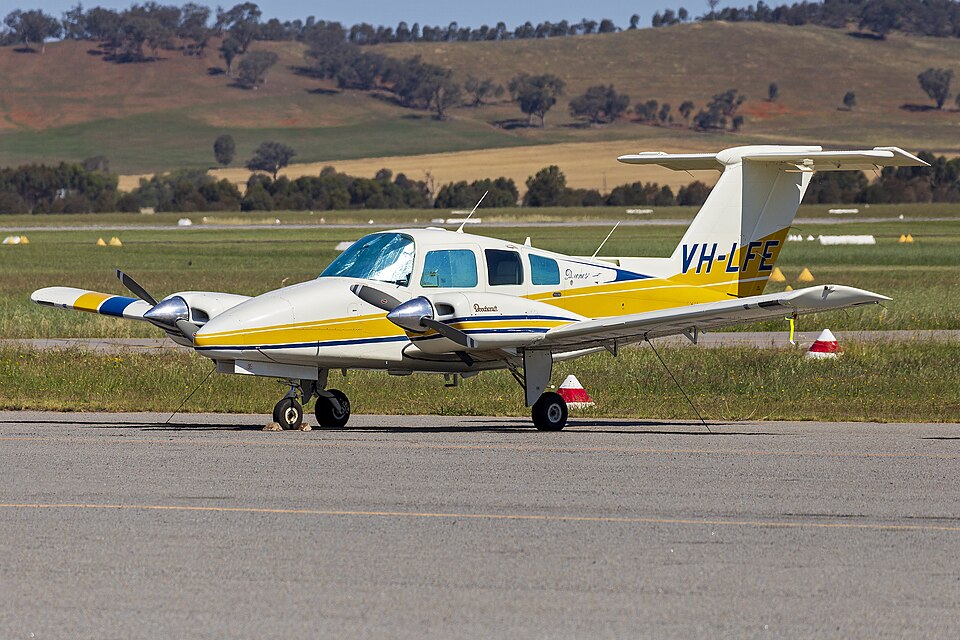
The Beechcraft Baron first flew in 1961 as the Model 55, developed from the Beechcraft Travel Air. It combined the fuselage of the Bonanza, the empennage of the Debonair, and the tail surfaces of the T-34 Mentor trainer. From the start, the Baron was aimed at pilots who wanted real performance from a twin. Over the decades, it evolved through dozens of variants, with the Model 58 Baron — introduced in 1969 — becoming the definitive long-body version. That stretched fuselage added club seating, rear cabin access, and room for six occupants. The Baron 58 remains in production today as the G58, fitted with a Garmin G1000 NXi glass cockpit. It is one of the longest-running production aircraft in general aviation history.
The Duchess arrived much later, in 1978, and with a very different mission. Beechcraft designed the Model 76 as an entry point into twin-engine flying — affordable, simple, and approachable. Engineers pulled from the parts bin liberally: the airframe was adapted from the Sierra, the nose gear came from the A36 Bonanza, and the wing used bonded aluminum honeycomb construction borrowed from the Musketeer line. Counter-rotating Lycoming O-360 engines — one turning each direction — eliminated the "critical engine" concern that complicates training on most light twins. The Duchess was built as much for flight schools as for private owners.
Good to Know: The Beechcraft Duchess production run ended in 1983 after only about five years. Poor timing — the aircraft launched during a general aviation downturn and an energy crisis — was more responsible for its short life than any flaw in the design.
Production of the Duchess wrapped up in 1983 with no significant model changes during its run. The Baron, meanwhile, kept evolving. That gap in longevity alone hints at the difference in market appetite for each aircraft.
Performance: A Clear and Significant Gap
This is where the Duchess and Baron stop looking like relatives and start looking like strangers.
The Duchess cruises comfortably at around 155 to 165 knots depending on power setting and altitude. At max cruise power, you can push it to about 164 knots true airspeed. Pull back to an economy cruise setting and that number drops into the mid-130s. It is a respectable figure for a light twin with 180 horsepower per side, but it is not going to win any races. As one aviation publication put it, the Duchess performs more like a high-performance single than a traditional twin.
The Baron 58 is a different animal entirely. Cruise speeds in the 185 to 202 knot range are typical depending on the variant and power setting. The G58 can reach 202 knots at 75% power. That is roughly 30 to 40 knots faster than the Duchess, which translates to meaningful time savings on any trip longer than an hour.
Climb performance follows the same pattern. The Duchess climbs at a reasonable rate on both engines, but single-engine climb performance — the real test of a twin — is modest. Above 5,000 feet with one engine shut down, expect climb rates of around 100 feet per minute or less in typical conditions. The Baron, with 300 horsepower per side and considerably more thrust-to-weight, handles single-engine scenarios with noticeably more authority.
Fun Fact: The Duchess uses counter-rotating engines, meaning the left engine turns one direction and the right engine turns the other. This clever design eliminates the "critical engine" problem — where losing one engine is far more dangerous than losing the other — that affects most conventional light twins including the Baron.
Fuel burn is one area where the Duchess wins decisively. At recommended cruise power, the Duchess burns around 21 gallons per hour combined. The Baron burns roughly 30 to 32 GPH in similar conditions, and some pilots of older 285-hp IO-520 variants report planning for 25 GPH or more depending on power settings. For an owner watching the fuel bill, the Duchess is genuinely more economical to run per hour.
The service ceiling of the Baron also exceeds the Duchess by a meaningful margin, with the Baron 58P pressurized variant capable of operating at 25,000 feet — a capability the Duchess never had in any production form.
Cabin and Comfort: Size Matters
Both aircraft seat four people comfortably, but the Baron goes further.
The Duchess cabin is actually wider than the Baron's and has better headroom than most twins in its class. It features two entry doors for the cabin — a thoughtful design choice that makes loading and unloading easier for passengers. The panel layout is generally praised for its clarity and ergonomics. The cabin is described by owners as relatively quiet for a twin, which is partly thanks to the T-tail placing the horizontal stabilizer above the propeller slipstream, reducing noise and vibration in back.
But the Duchess is a four-seat airplane. Full stop. You can carry four people, and that is what it was designed around.
The Baron 58 stretches to six seats with club seating in the center row. The long-body fuselage introduced double rear fuselage doors and repositionable club seats, making it genuinely useful for moving small groups with baggage. The aft baggage door and separate over-wing entry to the cockpit give the Baron a passenger-friendly boarding experience that the Duchess cannot match. Visibility is good from all seats, and the raised seating position encourages good posture on longer flights.
Pro Tip: If you regularly fly with four or more adults and their bags, the Baron 58's rear cabin access and six-seat configuration is a meaningful advantage over the Duchess. The Duchess's useful load is also more constrained, so careful weight and balance planning is essential when flying full.
The Baron's cabin does feel more "mission-ready" for real cross-country transport, while the Duchess's cabin feels more like a capable personal airplane or training platform. Neither is cramped by any reasonable standard, but the Baron simply offers more of everything.
The Duchess as a Multi-Engine Trainer
This is the Duchess's home turf, and it excels here.
Flight schools have relied on the Duchess for multi-engine training for decades. The reasons are straightforward. The aircraft handles gently, its systems are not overly complex, and the counter-rotating engines eliminate the critical engine scenario that adds stress to training in conventional light twins. Students can focus on mastering the fundamentals of twin-engine flying without fighting the airplane.
The Duchess is forgiving in the way good trainers are forgiving. It has no serious vices. Handling is stable and predictable, even during single-engine work. The T-tail provides solid stability and keeps the horizontal surfaces out of the propeller wash for cleaner control response. Trim tabs on all three axes make extended single-engine flight more manageable.
Comparing the Duchess to the Baron as a training platform is instructive. The Baron flies heavier and faster, which means everything happens a little quicker. Some instructors argue that training in the Baron builds more capable pilots because it demands sharper scan technique and better anticipation. Others point out that starting on a more forgiving platform builds confidence that translates smoothly to higher-performance aircraft later. How the Beechcraft Skipper compares to similar entry-level trainers offers useful context on how Beechcraft has approached the training market across its lineup.
Why It Matters: The counter-rotating engines on the Duchess are not just a training convenience — they represent a genuine safety feature. In most light twins, losing the left engine (the "critical engine") creates a severe yaw and roll tendency that demands immediate and precise correction. The Duchess sidesteps this entirely, giving students a more symmetrical failure environment.
For pilots building toward a multi-engine rating, the Duchess remains one of the most sensible platforms available, particularly from a cost-per-flight-hour perspective.
The Baron as a Cross-Country Machine
The Baron earns its keep on longer legs, and that is where it shines.
A well-equipped Baron 58 with the IO-550 engines is capable of covering serious distance in comfortable style. Pilots report consistent cruise speeds in the high 180s to low 200s at altitude, with fuel burns that — while higher than the Duchess — are not unreasonable for the performance delivered. Range on standard fuel is around 800 to 1,000 nautical miles with reserves depending on variant and power settings, and extended range configurations push that further.
The Baron's handling is often described as flying on rails. It is heavier than the Duchess and has more inertia, which makes it less susceptible to altitude deviations in turbulence. That stability translates to a more confident instrument flying platform. The Baron is a capable IFR machine, with good redundancy in its systems and plenty of panel space for a full avionics suite.
The G58 variant, with its Garmin G1000 NXi glass cockpit, brings the Baron fully into the modern era. Electronic Stability and Protection, ADS-B In and Out, and high and low IFR charts with night mode come standard. It is a capable platform for pilots who fly regularly into busy airspace or in challenging weather.
Keep in Mind: The Baron's Continental IO-550 engines command a significant overhaul cost. Budget carefully for engine maintenance — it is one of the largest long-term ownership expenses for Baron operators. New engines or recently overhauled engines are a major value driver in the used Baron market.
For a comparison of how the Baron stacks up against other Beechcraft step-up twins, the Baron versus Duke breakdown covers the performance and ownership tradeoffs at the next level up the Beechcraft ladder.
Beechcraft Duchess vs Baron: Head-to-Head on 8 Key Factors
Here is how the two aircraft compare across the factors that matter most to buyers and pilots.
1. Speed and Cruise Performance
The Baron wins this category without debate. Cruise speeds around 185 to 202 knots make it a genuinely fast personal transportation tool. The Duchess is more modest at 155 to 165 knots — quick enough to outrun most singles but clearly outpaced by the Baron on any longer trip.
2. Fuel Efficiency
The Duchess is the clear winner here. Burning roughly 21 gallons per hour combined at cruise, it is among the more economical twins available. The Baron burns approximately 30 to 32 GPH, which is the cost of the extra speed and power. For pilots who fly frequently, this difference adds up quickly.
3. Single-Engine Safety Margins
The Baron's 300-hp engines provide better single-engine climb margins at higher weights and altitudes. The Duchess, lighter but with only 180 hp per side, has modest single-engine climb performance above 5,000 feet. The Duchess's counter-rotating props, however, eliminate the critical engine concern, which is a meaningful safety feature that the Baron does not share.
4. Cabin Size and Passenger Capacity
The Baron holds six with club seating, rear baggage access, and a spacious interior. The Duchess comfortably seats four. The Duchess cabin is notably wider, but the Baron wins on overall utility for moving people and bags.
5. Acquisition Cost
Used Duchess aircraft typically sell in the $100,000 to $150,000 range, making them among the more accessible twin-engine options on the market. Baron 58 prices span a much wider range, from around $200,000 for older models to well over $800,000 or more for late-model G58s with modern avionics and fresh engines. The cost difference is substantial.
Flying411 features both Duchess and Baron listings, making side-by-side comparisons easy for buyers at every budget level.
6. Maintenance Complexity and Cost
The Duchess uses Lycoming O-360 engines with a solid service reputation. Maintenance costs are generally manageable, though Beechcraft parts prices have historically run high. The Baron's Continental engines are reliable but come with steep overhaul costs when the time comes. Overall, the Duchess is a simpler, less expensive airplane to maintain on a per-year basis.
7. Avionics and Upgrade Potential
Older Duchess models can be updated with modern avionics, but the airframe is from the late 1970s and early 1980s, which limits certain upgrade paths. The Baron 58, still in production as the G58, has a broader support ecosystem and the current model comes factory-fitted with Garmin G1000 NXi. Used Barons are also more commonly found with modern glass panel upgrades already installed.
8. Long-Term Value and Support
The Baron benefits from a continuous production history and a large installed fleet. Parts, maintenance shops familiar with the aircraft, and owner communities are easy to find. The Duchess has a loyal following, but with production ending in 1983, parts sourcing can be more challenging. The American Bonanza Society supports Baron owners with training and resources.
Who Should Buy a Duchess?
The Duchess makes a compelling case for a specific type of buyer.
If you are a pilot earning your multi-engine rating and want to train in an aircraft that is forgiving, economical, and genuinely pleasant to fly, the Duchess deserves serious consideration. Flight schools that teach multi-engine training on the Duchess are working with a platform designed for exactly that purpose.
For private buyers, the Duchess appeals most to pilots who want twin-engine redundancy for peace of mind on personal flying without stepping into the operating costs of a heavier, more powerful twin. A well-maintained Duchess is a capable personal airplane for trips under 500 nautical miles with a small family or a couple of colleagues.
The Beechcraft family offers some interesting context here. The Debonair vs Bonanza comparison illustrates a similar dynamic within Beechcraft's single-engine lineup, where a more economical sibling shared heritage with a more capable flagship.
Quick Tip: When buying a used Duchess, pay attention to the main landing gear A-frames — there is a repetitive Airworthiness Directive calling for dye-penetrant inspections every 100 hours. Make sure the logbooks show compliance and note whether any parts have been replaced. Also check the gear actuators for leaks and wear.
Who Should Buy a Baron?
The Baron suits pilots who need real performance from a twin and plan to use that performance regularly.
If you fly long legs frequently, carry four to six passengers, or need a twin that holds its own in busy airspace and varied weather, the Baron delivers. Its speed advantage over the Duchess is not just a number — on a 400-nautical-mile trip, a 35-knot cruise advantage saves a meaningful amount of time every single leg.
The Baron is also the right choice if you are planning to use the aircraft for light charter, air taxi operations, or any commercial role where passenger capacity and reliability matter. Its long production run means strong parts support, and the G58 variant provides a genuinely modern avionics platform out of the box.
Pilots considering stepping up from the Baron toward something more capable should read about how the Beechcraft Denali compares to the Pilatus PC-12, which covers the turboprop territory just above the piston twins.
Heads Up: Insurance costs for the Baron, particularly for lower-time pilots or those without recent multi-engine experience, can be a significant ownership factor. Get an insurance quote before making an offer — it can materially affect the total cost of ownership calculation.
A Note on the Beechcraft Legacy
Beechcraft built both of these aircraft with a consistent commitment to build quality that still shows up in the used market decades later.
The Duchess, despite its short production run, remains well-regarded for its craftsmanship and handling qualities. The Baron, across all its variants, has earned a reputation as one of the best light piston twins ever built — and pilots who fly one tend to say so with genuine enthusiasm. Both aircraft reflect a manufacturer that took pride in getting the details right.
For context on how other Beechcraft twins compare to each other, the Beechcraft Starship versus the Piaggio Avanti illustrates how far Beechcraft pushed the envelope on unconventional twin-engine design later in its history.
The Beechcraft lineage is a study in variety. There are aircraft for first-time twin pilots and aircraft for experienced operators who want serious performance. The Duchess and the Baron sit at two distinct points along that line, with different strengths and different audiences.
Conclusion
The Beechcraft Duchess vs Baron debate does not have a wrong answer — it has a right answer for each individual pilot. The Duchess is the aircraft for those entering the twin-engine world on a measured budget, valuing simplicity, economy, and forgiving handling. The Baron is for pilots who have grown into the twin-engine world and want performance, range, and the kind of cross-country capability that makes a twin worth the operating cost.
Both aircraft carry the Beechcraft name, and that means something. They share a philosophy of quality construction and honest flying characteristics that makes them a pleasure to operate. The choice between them is less about which airplane is better and more about which airplane is better for you.
When you are ready to find your next Beechcraft — Duchess, Baron, or anything in between — Flying411 is the place to start your search. Browse listings, connect with sellers, and find the twin that fits your mission.
Frequently Asked Questions
Is the Beechcraft Duchess a good aircraft for multi-engine training?
Yes, the Duchess is widely regarded as one of the better platforms for multi-engine training. Its counter-rotating engines eliminate the critical engine scenario, its handling is predictable and forgiving, and its lower operating costs make it practical for extended training hours.
How does the Duchess handle single-engine flight compared to the Baron?
Both aircraft can maintain controlled flight on one engine, but the Baron has a more comfortable performance margin at higher weights and altitudes due to its greater power. The Duchess's single-engine climb is modest, especially above 5,000 feet, and pilots should be aware of this limitation when planning flights.
Can you fly a Baron on an instrument flight plan in IMC?
Yes, the Baron 58 is a capable IFR platform with strong redundancy in its systems. Many Barons are equipped with full glass panel avionics, dual navigation radios, and autopilots that make them well-suited to instrument flight in challenging conditions.
What is the main reason the Duchess had such a short production run?
The Duchess launched in 1978 during a general aviation downturn coinciding with rising fuel prices and broader economic pressure. The aircraft's short production life was largely a matter of market timing rather than any design flaw, as the Duchess itself was technically sound and is still praised by pilots today.
Does the Beechcraft Baron still have good parts and maintenance support?
Yes. The Baron has been in production since 1961 and has one of the largest installed fleets in general aviation. Parts availability is good, and many shops around the country have experience working on Baron airframes and engines. Owner groups like the American Bonanza Society also provide strong training and technical support resources.