For most of aviation history, getting off the ground meant burning fuel. A lot of it. But quietly, over the last few years, a new kind of airplane has been rolling onto the ramp. These planes hum instead of roar.
They charge instead of refuel. And a growing handful of small electric planes are no longer science projects. They are flying real circuits, training real pilots, and even carrying passengers over real water.
The strange part is how ordinary some of them look. Park one next to a regular two-seat trainer and you might not notice the difference until the propeller spins up in near silence. That quiet is the whole story.
Key Takeaways
The best small electric planes today are mostly two-seat trainers, with the Pipistrel Velis Electro standing out as the first one to earn a full type certificate. Electric planes are quiet, cheap to run, and clean, but their batteries still limit them to short flights of roughly 30 to 60 minutes. Bigger electric commuter planes and air taxis are coming, though most are still working through testing and certification.
| Aircraft | Type | Seats | Status |
| Pipistrel Velis Electro | Trainer | 2 | Type certified, flying |
| Bye Aerospace eFlyer 2 | Trainer | 2 | In development |
| Diamond eDA40 | Trainer | 2 (later 3) | In testing |
| Bristell B23 Energic | Trainer | 2 | Nearing certification |
| Pipistrel Alpha Electro / Taurus | Trainer / motorglider | 2 | Early electric pioneers |
| Beta ALIA CX300 | Regional / cargo | Up to 5 | In testing |
| Harbour Air eBeaver | Seaplane retrofit | Up to 6 | In certification |
| Eviation Alice | Commuter | 9 | Paused |
| Rolls-Royce Spirit of Innovation | Record-setter | 1 | Speed demonstrator |
Flying411 keeps a close eye on this shift, tracking the planes, parts, and people moving general aviation toward electric power.
What Counts as a Small Electric Plane?
A small electric plane is a light aircraft that uses one or more electric motors instead of a piston or jet engine. The power comes from batteries, not a fuel tank. Most of the ones flying today seat just one or two people, though a few designs aim for five, nine, or more.
The word "small" matters here. Big airliners need a huge amount of stored energy, and batteries are still too heavy to deliver that over long distances. Light planes are the natural starting point because they fly short hops and carry little weight. If you want the bigger picture of how these aircraft fit into the wider light-aircraft world, it helps to know the broader categories of light aircraft first.
Good to Know: Most small electric planes flying today are trainers. That is on purpose. Flight schools fly short, repeated circuits around an airport, which fits a battery's limits perfectly.
How Electric Planes Actually Fly
The idea is simple. A battery pack feeds electricity to a controller, the controller feeds the motor, and the motor spins a propeller. There is no combustion, no fuel burn, and very few moving parts.
This electric propulsion setup brings a few clear upsides:
- Instant power. Electric motors deliver full torque the moment you ask for it, so the climb feels strong and immediate.
- Quiet operation. With no exploding fuel, the cabin and the ground below stay much quieter.
- Fewer parts. No spark plugs, no oil changes, no exhaust. That means less to break and less to maintain.
- No altitude penalty. A piston engine loses power as the air thins. An electric motor does not care about thin air the same way.
The catch is energy storage. A tank of avgas holds far more usable energy per pound than today's best battery. So the trade is almost always the same. You gain quiet, clean, cheap power, and you give up range.
Why Electric Planes Are Suddenly Everywhere
A few things lined up at once. Batteries got better and lighter. Electric motors borrowed from the car world got cheaper and more reliable. And fuel, noise, and emissions kept climbing as concerns for both regulators and neighbors near airports.
Put those together and a light electric trainer starts to make real sense. The numbers behind the pitch are easy to follow:
- Energy cost for an hour of flight is often reported at just a few dollars, compared to far more for an avgas-burning trainer.
- Maintenance drops because there are fewer parts to inspect and replace.
- Noise falls dramatically, which lets schools fly earlier and later without upsetting the neighborhood.
Why It Matters: Flight schools live and die on cost per hour. If an electric trainer can cut fuel and maintenance bills sharply, it changes the math for every student who walks through the door.
That promise is a big reason these planes have moved from press releases to real ramps. It also explains why so many of them are aimed squarely at the electric flight training market rather than at private owners or airlines.
The MOSAIC Rule and What It Changes
In the United States, one rule change matters more than any other right now. The Federal Aviation Administration's MOSAIC rule, short for Modernization of Special Airworthiness Certification, was published in July 2025. Its pilot-privilege changes took effect on October 22, 2025, and the aircraft-certification changes follow on July 24, 2026.
Here is the part that matters for electric flight. The old light-sport rules locked aircraft to a strict weight limit and never really made room for electric motors. MOSAIC throws out the fixed weight cap and replaces it with a performance-based limit tied mostly to stall speed. It also opens the door to new kinds of propulsion, including electric and hybrid systems, and allows up to four seats.
Heads Up: MOSAIC does not let you re-badge an old certified airplane as light-sport. The new performance-based path is mostly for fresh designs that meet the updated consensus standards.
For electric aircraft, this is a real opening. A clean-sheet battery-powered aircraft that could not fit the old box may finally find a clear path to market in the US. That single change is why several electric trainers are now studying the light-sport route as well as the heavier Part 23 route.
9 Best Small Electric Planes Flying and Coming Soon
Here are nine of the best small electric planes worth knowing. Some are flying and certified. Some are deep in testing. One is paused, and one was built purely to break records. Together they show where light electric flight really stands today.
1. Pipistrel Velis Electro
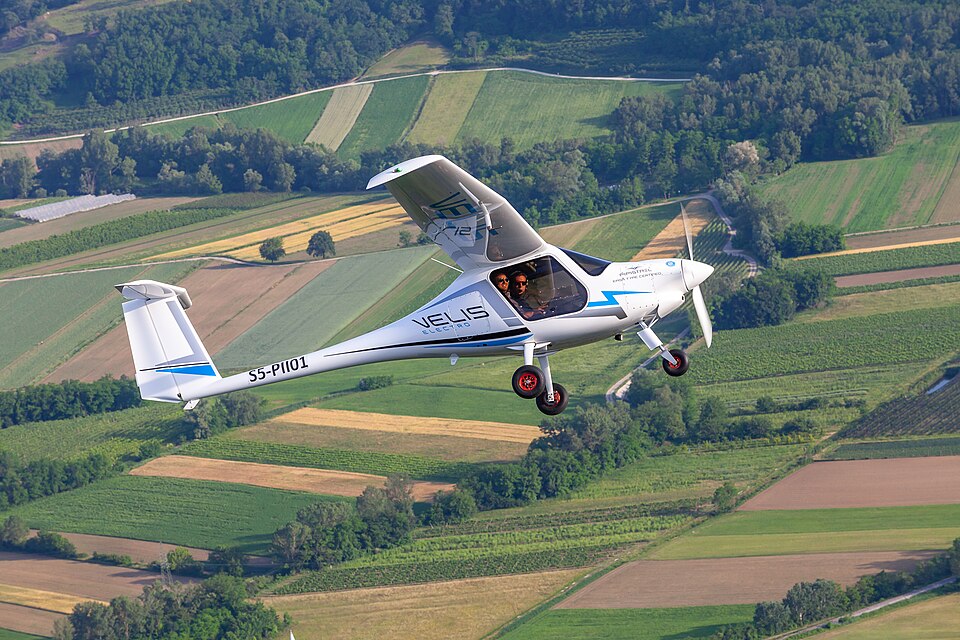
If electric aviation has a poster child, this is it. The Velis Electro, built by Slovenia's Pipistrel (now part of Textron eAviation), holds a special place in history. It was the first electric airplane to earn a full type certificate, granted by Europe's aviation safety agency back in 2020.
It is a two-seat, side-by-side trainer based on a proven piston airframe. Power comes from Pipistrel's own type-certified E-811 motor, rated at 57.6 kW. The plane is famously quiet at around 60 decibels, which is closer to a busy office than a roaring engine.
Key traits worth knowing:
- Endurance of roughly 50 minutes plus a short reserve, which suits pattern work and local training.
- Charging that brings the battery back up in a couple of hours, with faster top-ups possible.
- Energy cost reported at only a few dollars per flight hour.
- Day visual flight rules operation only, so it is built for clear-weather training near the field.
The Velis Electro is approved for pilot training in dozens of countries, and dozens of the planes have been delivered to schools and operators around the world. It will not take you cross-country, but for circuits and first lessons, it set the standard.
Fun Fact: Because it is so quiet, the Velis Electro is said to make flight training possible at airfields close to towns where noisy trainers would normally draw complaints.
2. Bye Aerospace eFlyer 2
Coming out of Denver, Colorado, the eFlyer 2 is one of the most watched electric trainers in the US. It is a sleek two-seat, low-wing design with a bubble canopy, aimed right at the same market as the Cessna 172 and Piper Archer.
The plane uses a Safran ENGINeUS electric motor and high-energy-density battery packs, and the company designs the airframe to be far more aerodynamically efficient than a typical trainer. That efficiency is how it targets a longer endurance than many electric rivals.
What stands out:
- A target of roughly two hours of flight time, plus a reserve, which would be strong for a battery plane.
- A whole-aircraft emergency parachute system, a feature shared with several other modern light planes.
- A claim of much lower maintenance and energy costs compared to a petrol trainer.
Bye Aerospace has been working through FAA certification for years and is closing in on the first flight of its production-conforming prototype, with first deliveries targeted for later this decade. The company reports more than a thousand orders and letters of intent across the eFlyer family. Whole-aircraft recovery systems like the one planned here are part of a wider trend you can read about in coverage of light planes with parachutes.
3. Diamond eDA40
Diamond Aircraft took a different and clever approach. Instead of a clean-sheet design, the eDA40 is an electric version of the company's already certified DA40, a four-seat plane that thousands of pilots already know and trust.
It first flew in 2023 in Austria. Power comes from a Safran ENGINeUS motor, and the battery system supports DC fast charging that can turn the plane around quickly between flights. That fast turnaround is a big deal for busy schools.
Notable points:
- A familiar Garmin glass cockpit, so transitioning students feel right at home.
- A goal of roughly 40 percent lower operating costs than a comparable piston trainer.
- A plan to be among the first electric airplanes certified in its category under both European and US Part 23 rules.
Pro Tip: Watch the charging time as closely as the flight time. A plane that recharges in well under half an hour can fly far more lessons per day than one that needs hours on the plug.
Because it starts from a proven design, the eDA40 fits neatly into a mixed fleet. Schools can use the electric version for circuits and the piston version for longer trips. If you want to understand the family it grew from, the world of single-engine piston designs gives helpful context.
4. Bristell B23 Energic
The Bristell B23 Energic is a joint effort between Czech builder BRM Aero and Swiss electric propulsion firm H55, a company with roots in the Solar Impulse round-the-world solar flight. The result is an all-metal, low-wing two-seater based on the piston B23 trainer.
It carries a battery pack of around 48 kilowatt-hours and aims for roughly an hour of flight time including reserves. The energy cost per hour is reported in the range of a single-digit dollar figure, which is exactly the kind of number that turns heads at flight schools.
There is an interesting rule wrinkle here:
- In Europe, the current version targets about 60 minutes of usable flight.
- In the US, stricter reserve requirements would trim that usable time, so the company plans a bigger battery for its later American launch.
Bristell and H55 are targeting European certification and first deliveries first, with the US market following once the larger battery is ready. It is a good reminder that an electric plane's real-world range depends as much on the rules as on the battery.
Keep in Mind: Endurance numbers and usable flight time are not the same thing. Reserves eat into your real flying minutes, and those reserve rules differ from country to country.
5. Pipistrel Alpha Electro and Taurus Electro
Before the Velis Electro, Pipistrel was already quietly building the future. The Taurus Electro, a two-seat electric motorglider, dates back to around 2007 and is often called the first two-seat electric aircraft. The Alpha Electro followed and served as the direct predecessor to the Velis.
These earlier planes matter because they proved the basics. The Alpha Electro even used swappable battery packs, an idea that lets a school keep flying while one set of batteries charges on the bench.
Why they still deserve a spot:
- They logged real training hours and built years of hard-won electric experience.
- They showed that a light electric trainer could be practical, not just possible.
- They paved the way for the certified planes flying today.
You can think of this pair as the proof of concept that made everything after it credible. Without them, the leap to a type-certified electric trainer would have been far steeper.
6. Beta ALIA CX300
Beta Technologies, based in Vermont, builds the ALIA in two forms. There is a vertical-takeoff version and a more conventional fixed-wing version called the CX300. The CX300 is the one that reads most like a traditional small plane, just with electric power.
It is bigger than the trainers above, with a wingspan around 50 feet and room for up to five people or a load of cargo. It is single-pilot capable and built for night and instrument flying, which sets it apart from the day-only trainers.
Reported highlights:
- A cruise speed up to roughly 150 knots, which is genuinely useful for getting somewhere.
- A demonstrated range in the hundreds of nautical miles on a charge.
- Charging in under an hour, plus low energy and emissions compared to a turbine of similar size.
The CX300 points toward jobs beyond training, like medical logistics and regional passenger hops. It is one of the clearest signs that zero-emission flight is starting to scale up from tiny two-seaters toward more capable machines.
Thinking about adding an electric aircraft, or the parts and avionics to support one, to your operation? Flying411's marketplace lists new and used airframes, engines, and certified components in one place.
7. Harbour Air eBeaver
Now for something that floats. Harbour Air, a seaplane operator in the Pacific Northwest, has been converting a classic de Havilland Beaver to electric power. The result, nicknamed the eBeaver, is widely described as the only fully electric seaplane in the world.
It uses a magniX electric motor and H55 batteries dropped into a proven, decades-old floatplane airframe. The plane first flew back in 2019 and has racked up dozens of flights in Canada since then.
What makes it special:
- It tackles short scenic and commuter water routes, which fit a battery's range nicely.
- It keeps a beloved old airframe flying with clean, quiet power.
- The operator is targeting certification so it can carry paying passengers on short hops.
This electric seaplane is not yet cleared to fly passengers in the US, and certification is the next big hurdle. Still, it shows that electric power and water flying can mix. The broader world of water-capable light aircraft is covered well in this look at small seaplanes.
Fun Fact: Floatplanes are a natural fit for electric power because they often fly short, scenic routes between docks, exactly the kind of trips a battery can handle.
8. Eviation Alice
The Eviation Alice is the dream that hit turbulence. This nine-passenger commuter is one of the most striking clean-sheet electric designs ever built, with a smooth composite body and twin electric motors. It made a single, brief first flight in 2022.
On paper, the Alice aimed at regional routes, carrying nine people a few hundred miles with cargo versions planned. It drew a large order book from airlines and shippers.
Then reality set in:
- The company laid off most of its staff in early 2025 and paused the program.
- The design had already been reworked several times, which added delays.
- As of recently, the project's future remains uncertain.
The Alice earns a spot on this list because it shows both the ambition and the risk in electric aviation. The engineering is real and impressive. The hard part, as so often, is funding and certification. It is a sober reminder that being one of the best designs on paper does not guarantee a finished airplane.
9. Rolls-Royce Spirit of Innovation
Last comes the speed machine. The Spirit of Innovation is a single-seat aircraft built by Rolls-Royce purely to push the limits. In late 2021, it set world records and is widely recognized as one of the fastest all-electric aircraft ever flown, reaching speeds well over 600 kilometers per hour.
It is not a trainer or a commuter. It will never carry passengers. But it answered a key question: can electric power deliver real performance, not just gentle puttering? The answer was a loud and clear yes.
Why it belongs here:
- It proved electric propulsion can hit serious speeds.
- It generated data and confidence for the whole industry.
- It made headlines that pulled new attention and money into electric flight.
Think of it as the showpiece that reminded everyone what electric motors can do when range is not the goal. Among the fastest light aircraft of any kind, an electric one now holds a place in the record books.
How Much Do Small Electric Planes Cost?
This is the question everyone asks, and the honest answer has two parts. There is the price to buy the plane, and there is the cost to fly it. Electric planes flip the usual pattern.
On purchase price, electric trainers tend to land in the same ballpark as a comparable new piston trainer, sometimes a bit more. The battery and motor are not cheap, and these are low-volume, cutting-edge machines.
On running cost, the story changes:
| Cost area | Piston trainer | Electric trainer |
| Fuel / energy | Higher, tied to avgas prices | Much lower, just electricity |
| Maintenance | More moving parts to service | Fewer parts, simpler upkeep |
| Noise impact | Higher | Much lower |
| Range / endurance | Long | Short, often under an hour |
| Battery replacement | Not applicable | A real future expense |
The big asterisk is the battery. Battery packs wear out over many charge cycles and eventually need replacing, which is a cost piston owners never face. So the cheap energy and easy maintenance get partly offset by that long-term battery bill.
Quick Tip: When comparing an electric trainer to a piston one, ask about battery cycle life and replacement cost. That single number can make or break the long-term economics.
If you are weighing the wider money side of light aircraft ownership, it pays to understand what light planes generally cost before zooming in on the electric niche. The basics of buying and owning still apply, even when the fuel tank is a battery.
The Pros and Cons of Going Electric
No airplane is perfect, and electric planes wear their trade-offs on their sleeve. Here is the honest scorecard.
The strong points:
- Low energy cost. Electricity is far cheaper than avgas per hour of flight.
- Quiet and smooth. Less noise and vibration for pilots, passengers, and neighbors.
- Simple maintenance. Fewer moving parts mean fewer things to inspect and fix.
- Clean operation. No combustion means no exhaust during flight.
- Strong, instant power. Great climb and no power loss as the air thins.
The real limits:
- Short range. Most small electric planes fly well under an hour before needing a charge.
- Charging time and access. Fast charging helps, but plugs are still rare at most airfields.
- Battery weight. Heavy packs eat into how much you can carry.
- Battery aging. Packs degrade over time and cost money to replace.
- Weather and rules limits. Many current models are day, clear-weather machines only.
Heads Up: Range anxiety is real in the air, and the stakes are higher than in a car. You cannot pull over at the next exit. That is why current electric planes stick close to home and keep healthy reserves.
For pilots used to the freedom of a full fuel tank, these limits take getting used to. The planes that succeed today are the ones that match the mission to the battery, like training circuits and short scenic hops, rather than fighting against it.
Electric Air Taxis: The Next Wave
You cannot talk about small electric planes without bumping into the air taxi crowd. These are the eVTOL aircraft, short for electric vertical takeoff and landing, that lift off like a helicopter and cruise like a plane. They are a different breed, but they share the same electric heart.
The current leaders are racing through certification:
- Joby Aviation flies a five-seat design and has reached one of the most advanced stages of FAA type certification, with a goal of carrying passengers in the near future.
- Archer Aviation is progressing with its Midnight aircraft and is working through its own certification and testing campaign.
- Beta Technologies is moving forward with both its vertical and fixed-wing ALIA models.
These eVTOL air taxis aim to whisk a few people across a city or between nearby airports, fast and quiet. The FAA published final airworthiness rules for this powered-lift category, which finally gives the whole field a clear target to hit.
Good to Know: Air taxis are not the same as the trainers above. They use many small rotors and complex flight controls, which makes them harder to certify, but they could open up brand-new ways to travel short distances.
Will flying taxis fill the skies tomorrow? Probably not. But the technology is real, the rules are forming, and the first commercial flights are inching closer. The line between a small electric plane and a small electric air taxi is starting to blur.
Who Are Electric Planes For?
Electric planes are not for everyone yet, and that is fine. Right now they shine for a specific set of users.
They make the most sense for:
- Flight schools, which fly short, repeated circuits and care deeply about cost per hour.
- Student pilots, who spend their early lessons near the airport doing takeoffs and landings.
- Short-hop operators, like scenic seaplane tours and quick island or regional connections.
- Eco-minded owners and clubs that want a clean, quiet option in a mixed fleet.
They are a poor fit, for now, for:
- Long cross-country flyers, who need range a battery cannot yet deliver.
- Heavy haulers, since battery weight limits useful load.
- All-weather, all-day missions, which many current models are not built for.
The smart move many operators make is a mixed fleet. Fly the electric plane for circuits and short hops, and keep a piston plane for the longer trips. That way you get the savings where they count without giving up reach. For owners building out a fleet, browsing the range of popular light aircraft alongside the electric options helps balance cost, range, and mission.
Ready to find the right aircraft, engine, or part for your mission, electric or not? Start your search on Flying411 and connect with sellers and certified aviation pros in one place.
Conclusion
The best small electric planes are not flashy jets or far-off concepts. They are quiet two-seat trainers humming around the pattern, a
converted floatplane skimming off the water, and a few bold designs reaching for more. Battery limits keep these aircraft close to home for now, but the savings, the silence, and the clean operation are real and already changing how people learn to fly. The story of small electric planes is still being written, and it is moving faster every year.
Want to stay ahead of where aviation is headed and find your next aircraft while you are at it? Make Flying411 your first stop for listings, parts, services, and the industry insights that keep you flying smart.
Frequently Asked Questions
How long can a small electric plane fly on one charge?
Most small electric planes today fly for about 30 to 60 minutes before needing a charge, plus a safety reserve. That is why they are mainly used for training circuits and short local flights rather than long trips.
Are electric planes safe to fly?
Certified electric planes go through the same rigorous safety testing as other aircraft, including crash and battery-fire checks. The main practical risk is running low on charge, so pilots plan carefully and keep generous reserves.
Can I get a pilot's license in an electric plane?
Yes, you can do much of your early training in a certified electric trainer like the Pipistrel Velis Electro. Many schools pair it with a piston plane for the longer cross-country portions of training that a battery cannot yet cover.
Why don't airlines use electric planes yet?
Large airliners need far more stored energy than today's batteries can provide without becoming impossibly heavy. Electric power works for small, short-range planes first, and bigger commercial use is likely many years away.
How long do aircraft batteries last before they need replacing?
Aircraft battery packs are rated for a set number of charge cycles and gradually lose capacity as they age. Replacement is a real long-term cost, so buyers should always ask about cycle life and the price of a new pack.