At first glance, the Robinson R44 Clipper vs Raven comparison looks like a matchup between two very different machines. It is not. Both share the same airframe, the same two-bladed rotor system, and the same easy handling that made the R44 a favorite among private pilots and small operators. The real story hides in one small set of parts.
The Raven is the standard land helicopter. The Clipper is that same helicopter dressed for the water, with floats bolted on and a bit of extra armor against sea air. Everything else stays remarkably close. Same cabin, same controls, same friendly flying manners.
So the choice between them rarely comes down to power or speed. It comes down to where you plan to fly and what you want under the skids when you get there. A few pounds of floats and a coat of corrosion protection separate the two. Small changes on paper. Big changes the moment you point the nose toward open water.
Key Takeaways
The main difference between the Robinson R44 Clipper and the Raven is simple: the Clipper is a Raven fitted with floats and extra corrosion protection for flying over water, while the Raven is the standard land-based version of the same helicopter. Underneath, they are nearly identical. You pick the Clipper when your route crosses lakes, rivers, or coastline. You pick the Raven when your feet stay over solid ground.
| Question | Quick Answer |
| What is the core difference? | Clipper = Raven + floats + corrosion protection |
| Same airframe and rotor? | Yes, they are built on the same base helicopter |
| Raven I vs Raven II? | Raven I is carbureted, Raven II is fuel-injected and more powerful |
| Float choices? | Fixed floats or pop-out floats (pop-outs on Clipper II only) |
| Best for dry land? | Raven |
| Best for over-water flying? | Clipper |
| Passenger capacity | One pilot plus three passengers |
If you are weighing an R44 purchase, Flying411 makes it easy to compare Raven and Clipper listings side by side so you can see exactly what you are paying for before you commit.
Meet the R44 Family: Where the Raven and Clipper Fit
Before you can compare the two, it helps to know the family tree. Robinson Helicopter Company introduced the R44 in the early 1990s as a four-seat step up from the smaller two-seat R22. Over the years, thousands of R44s have been delivered around the world, and it is widely known as one of the most popular piston helicopters of its kind.
The R44 line has grown into a small group of related models. They all look almost the same from a distance, yet each fills a slightly different role. The Raven and Clipper are two branches of that same tree.
Good to Know: The Clipper is not a separate helicopter with its own design. It is a Raven that leaves the factory (or the shop) with floats and corrosion protection added. Think of it as the "waterfront edition" of the same aircraft.
The Raven, Explained
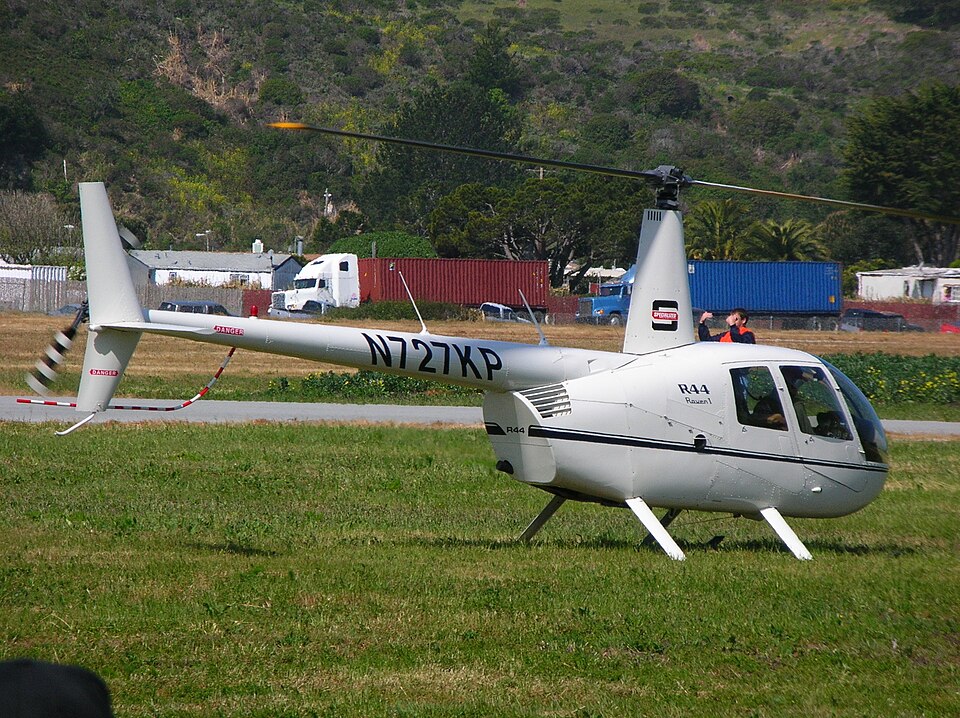
The Raven is the standard R44. It rides on plain metal skids and is built for normal land-based flying. This is the version most people picture when they think of a small private helicopter. It handles training, sightseeing, personal travel, and light utility work with ease.
Because it carries no floats, the Raven is a touch lighter and a touch faster than a float-equipped Clipper. That makes it the natural pick for pilots who spend their time over fields, roads, and towns. Its roomy cabin and clear views make it a comfortable ride for family trips and short hops alike.
The Clipper, Explained
The Clipper takes that same Raven and adds seaworthy floats plus extra sealant to fight off corrosion. The result is a helicopter that feels at home near lakes, rivers, and coastlines. If an engine problem forced a landing over water, the floats give the crew a fighting chance to set down safely instead of sinking.
The Clipper also arrives with a few thoughtful extras, like ground-handling wheels and a pressure gauge to check float pressure before flight. These small touches make life easier for owners who base their aircraft near the shore. For missions built around over-water operations, the Clipper earns its keep.
Raven I vs Raven II: The Engine Question
Here is where many buyers get tripped up. Both the Raven and Clipper come in a "I" and a "II" version. The number does not refer to floats. It refers to the engine under the cowling. This matters just as much as the float question, so it is worth slowing down here.
The R44 Raven II uses a fuel-injected Lycoming engine, while the Raven I uses an older carbureted one. That single change ripples through the whole flying experience.
- Raven I: Powered by a carbureted Lycoming O-540 engine. It offers a lower price and dependable performance, with a carburetor heat assist system that helps guard against carburetor icing.
- Raven II: Powered by a fuel-injected Lycoming IO-540 engine. It produces more power, climbs better with a full load, and handles hot or high-altitude airfields with more confidence. Fuel injection also removes the need for carburetor heat.
Why It Matters: If you fly from high-elevation airports or in hot climates, the Raven II's fuel-injected engine gives you real breathing room. In cool weather near sea level, the Raven I still does the job at a friendlier price.
The Lycoming IO-540 engine in the Raven II is rated at roughly 245 horsepower for takeoff and around 205 horsepower for continuous use. Robinson also raised the maximum gross weight when it launched the Raven II, giving owners a bit more room for people and fuel. The Raven II's service ceiling sits near 14,000 feet, which opens up mountain flying that would strain the Raven I.
Here is a simple side-by-side of the two engine paths:
| Feature | Raven I / Clipper I | Raven II / Clipper II |
| Engine | Lycoming O-540 (carbureted) | Lycoming IO-540 (fuel-injected) |
| Carburetor heat | Needed (with assist system) | Not needed |
| Power | Slightly lower | Around 245 hp for takeoff |
| Hot and high performance | Good | Better |
| Typical price | Lower | Higher |
The takeaway is that "Raven vs Clipper" and "I vs II" are two separate choices. You could own a Raven I, a Raven II, a Clipper I, or a Clipper II. The first word tells you about floats. The number tells you about the engine. Robinson's piston helicopters have earned a strong name for dependable powerplants, and the R44 sits among the reliable piston engines that keep light helicopters flying for decades.
What Makes a Clipper a Clipper
Now let us zoom in on the floats, since that is the heart of the Clipper. Robinson offers two very different float systems, and picking the right one shapes how the helicopter flies and how much it can carry.
Fixed Utility Floats
Fixed utility floats stay inflated all the time. They sit under the skids and are ready for water landings on any flight. Because they are always deployed, they are the right choice for pilots who fly over water often and may want to set down on a remote lake or shoreline.
The trade-off is weight and drag. Fixed floats add roughly 50 pounds to the helicopter's empty weight and trim cruise speed by about 10 knots. That speed loss is the price of always being ready. Fixed floats are offered on both the Clipper I and Clipper II.
Heads Up: Fixed floats need a pressure check before each flight to make sure they are firm and ready. It is a quick step, but skipping it is not an option if you plan to fly over water.
Pop-Out Floats
Pop-out floats take a different approach. They stay folded and tucked into snug covers along the skids, almost invisible from a distance. If an emergency strikes over water, the pilot pulls a lever on the collective. Pressurized helium rushes in, and the floats inflate within a few seconds.
These emergency floats are offered only on the R44 Clipper II. They have six chambers, can be triggered at speeds up to about 80 knots, and carry the same buoyancy as the fixed floats. Because they hide away during normal flight, they barely affect cruise speed. The cost is a little extra weight, about 65 pounds, and a bit more maintenance.
Pop-out floats are meant for emergencies, not for planned water landings. Fixed floats are the ones built for routine over-water touchdowns, though even those come with careful guidance in the flight manual. Here is how the two systems compare:
| Feature | Fixed Utility Floats | Pop-Out Floats |
| Available on | Clipper I and Clipper II | Clipper II only |
| Purpose | Continuous over-water flying | Emergency use |
| State in flight | Always inflated | Folded until deployed |
| Inflation | N/A (already inflated) | Around 2 to 3 seconds |
| Added empty weight | About 50 pounds | About 65 pounds |
| Cruise speed impact | About 10 knots slower | Very small |
| Activation | None needed | Lever on collective, helium tank |
Pro Tip: If you fly over water only a few months of the year, pop-out floats let you keep near-normal speed and useful load the rest of the time. If your daily routes cross water and you may want to land on it, fixed floats make more sense.
Beyond the floats, every Clipper gets extra corrosion proofing. Salt air is hard on aircraft, and that added sealant helps protect the airframe during long careers near the coast. Robinson also includes ground-handling wheels with each Clipper, which makes moving the helicopter around a ramp or hangar far easier.
Robinson R44 Clipper vs Raven: 7 Differences That Matter Most
If you strip away the marketing and line the two up, the differences come down to a short, clear list. Here are the seven that shape a real buying decision.
- Floats. This is the headline difference. The Clipper carries floats. The Raven does not. Everything else flows from this one change.
- Corrosion protection. Clippers leave the factory with extra sealant and corrosion proofing to survive salt air and humid coastal life. The Raven skips this, which is fine for dry inland use.
- Mission focus. The Raven is built for land. The Clipper is built for water crossings, coastal work, and remote lake access. Your typical route decides which one fits.
- Empty weight and useful load. Floats add weight, and every pound of float is a pound you cannot use for passengers, bags, or fuel. The Raven gives you the most useful load of the pair.
- Cruise speed. Fixed floats cost roughly 10 knots of cruise speed because of their drag. The Raven and a pop-out Clipper stay faster in normal flight.
- Ground handling gear. Clippers come with ground-handling wheels and a float pressure gauge as part of the package. The Raven does not include these by default.
- Price and running costs. The Clipper's floats and corrosion package raise the purchase price, and the floats add a few maintenance tasks over the aircraft's life. The Raven is the simpler, lower-cost option to buy and keep.
Keep in Mind: None of these differences change the way the helicopter flies day to day. A Clipper and a Raven feel almost identical in the air. The Clipper simply gives you options the moment water enters the picture.
For buyers who care most about speed and payload for aerial photography work or survey flights over land, the Raven usually wins. For those flying tours or transport near coastlines, the Clipper's safety margin is worth the trade.
Flying411 lists both new and used R44 Ravens and Clippers from trusted sellers, so you can filter by engine type, total hours, and float setup all in one place.
Performance and Specs Side by Side
People often expect a big performance gap between the Raven and Clipper. In truth, the numbers stay close. The main gaps come from floats, not from any deep design change. A Clipper with pop-out floats performs nearly like a Raven, while a Clipper with fixed floats gives up a little speed and load.
Here is a general picture of the R44 platform, using the Raven II as the reference point. Treat these as typical figures, since exact numbers shift with equipment, weight, and conditions.
| Specification | Typical R44 (Raven II) |
| Seats | 1 pilot + 3 passengers |
| Engine | Lycoming IO-540, fuel-injected |
| Takeoff power | Around 245 hp |
| Cruise speed | Around 110 knots |
| Useful load | Roughly 1,000 pounds |
| Fuel burn | About 15 to 16 gallons per hour |
| Service ceiling | Near 14,000 feet |
| Range | Around 300 nautical miles |
Now apply the float penalty. Add fixed floats and you shave off close to 10 knots of cruise and about 50 pounds of useful load. Add pop-out floats and the speed hit nearly vanishes, though you still carry the extra float weight. This is the trade every Clipper buyer weighs.
Fun Fact: The R44 is widely said to be one of the best-selling civilian helicopters ever built, and it has spent years as a top choice among four-seat piston helicopters. Its simple design and worldwide parts network are a big reason it stays popular.
Because the airframe is shared, the two models slot into the same job categories. The R44 is a familiar face among four-seat helicopters used for training, personal travel, and light commercial work. The Clipper simply extends that reach out over the water.
Cost and Ownership Considerations
Money is often the deciding factor, so let us treat it honestly. A Clipper costs more than a comparable Raven because you are paying for the floats, the corrosion package, and the extra hardware. The exact gap depends on the float type, the model year, and the market at the time of purchase.
Used prices for R44s can run into the hundreds of thousands of dollars, and a new one costs more still. Within that range, expect a Clipper to carry a premium over a matching Raven. Raven II and Clipper II models also tend to cost more than the older Raven I and Clipper I versions because of their upgraded engines.
Ownership costs follow a similar pattern. The floats add a handful of inspection and maintenance items:
- Fixed floats need a pressure check before flight to confirm they are properly inflated.
- Pop-out floats call for a preflight helium tank check, periodic leak checks, and a deployment test every few years to make sure they will fire when needed.
None of these tasks are heavy, but they do add time and cost over the life of the aircraft. A plain Raven avoids them entirely. That simplicity is part of the Raven's appeal for buyers who never plan to fly over water.
Quick Tip: Before you buy any R44, get a thorough pre-purchase inspection from a shop that knows Robinson helicopters. On a Clipper, ask them to check the floats, the helium system, and the corrosion proofing with extra care.
If you already own an R44 and are thinking about selling or trading up, it pays to know what your aircraft is worth in today's market. You can check its current value before you list it, so you set a fair price and avoid leaving money on the table. R44s hold their appeal for many roles, from flight schools to business travel, which helps keep resale demand steady.
Which One Should You Choose?
By now the pattern is clear. The right pick depends on your mission, your budget, and where you keep the helicopter. Let us break it down into two simple cases.
Choose a Raven If
- You fly mostly over land, roads, fields, and towns.
- You want the lowest purchase price and the simplest upkeep.
- You care about squeezing out the most speed and useful load.
- You base the aircraft inland, away from salt air.
- Your work is training, sightseeing over land, survey, or personal travel.
Choose a Clipper If
- Your routes cross lakes, rivers, harbors, or open coastline.
- You want the safety margin of floats in case of an over-water problem.
- You base the helicopter near the sea and worry about corrosion.
- You run tours or transport along the water and value that extra peace of mind.
- You are fine trading a little speed and load for water capability.
The engine choice sits on top of both cases. If you fly high, hot, or heavy, lean toward a "II" model with the fuel-injected engine. If you fly in cooler air near sea level and want to save money, a "I" model may serve you well.
Good to Know: Many owners of coastal operations pick a Clipper II with pop-out floats. They get near-Raven speed most of the time, plus the safety of floats that deploy in seconds if the worst happens. It is a popular middle path.
Ready to find your R44? Browse current Raven and Clipper listings on Flying411 and connect with sellers who match your mission and budget.
Conclusion
The Robinson R44 Clipper vs Raven choice is far less about horsepower and far more about geography. The two are the same trusted helicopter at heart. One keeps its feet on dry land, and the other is ready to touch down on water when it counts. Add the Raven I versus Raven II engine question on top, and you have a small menu that covers almost any light-helicopter mission.
Sort out three things and the decision makes itself. Ask where you fly, ask how much you want to spend, and ask how often water sits below your flight path. The R44 will happily carry you over farmland or open sea. The only real question is how many floats you want along for the ride.
Whichever way you lean, Flying411 is the easiest place to compare R44 listings, check values, and land the helicopter that fits the way you fly.
Frequently Asked Questions
Can a Raven be turned into a Clipper later?
In many cases yes, since a Clipper is essentially a float-equipped Raven. Adding an approved float kit and corrosion protection to a compatible Raven II can create a Clipper II setup, though the work must follow Robinson's approved kits and installation rules.
Is the R44 Clipper meant to land on water like a seaplane?
Not routinely. The floats give the helicopter a safe way to touch down on water in an emergency and allow occasional water landings with fixed floats, but the Clipper is not designed to operate off water all day like a dedicated amphibious aircraft.
How many people can an R44 Raven or Clipper carry?
Both seat one pilot plus three passengers, for four people total. Real-world capacity depends on fuel load, baggage, and any float weight, so a heavy day may mean trading passengers for fuel.
Do the floats stay on the Clipper all year?
Fixed floats stay attached and inflated for continuous over-water use, while pop-out floats stow flat on the skids until needed. Some owners remove or swap float setups seasonally to gain speed and payload during dry-weather months.
Is the Raven II worth the extra cost over the Raven I?
If you fly from hot airfields, high elevations, or often carry a full cabin, the fuel-injected Raven II earns its price with better climb and altitude performance. For cool, low-elevation flying on a tighter budget, the Raven I remains a solid value.