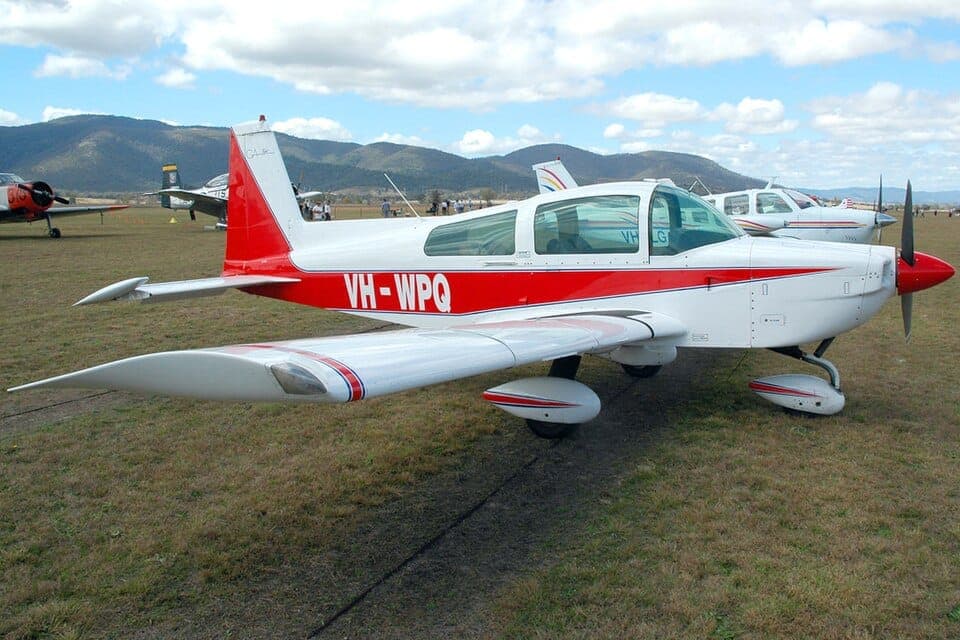
The expensive mistake with this airplane is shopping it like a riveted Cessna. Buyers look at engine time, panel and paint, write the check, and then discover that a soft bonded wing skin or a weeping integral fuel tank is a five-figure problem that no amount of rivets will fix. A Grumman AA-5B Tiger is built more like a laminated countertop than a tin can, and the things that kill its value are different from the things that kill value in a Skyhawk or an Archer.
This guide walks the areas worth real scrutiny on a pre-buy, what a good answer and a bad answer look like in each one, and what the airplane actually costs to run once it is yours.
The Bonded Airframe: Where the Money Hides
The AA-5 family came out of Jim Bede's BD-1 design, and the structure is the part that makes it unusual. The wing is built around a single tubular aluminum spar with bonded aluminum honeycomb skin panels. Most of the fuselage is bonded sheet over a tube frame. There are far fewer rivets than you are used to seeing, which is part of why the Tiger is faster than a Cessna 172 on the same 180 horsepower.
The catch is repairability. A riveted skin can be patched by almost any shop with a drill and a bucking bar. A bonded honeycomb panel usually has to be replaced, using an approved process, by someone who has done it before. That turns a small hangar rash dent into a parts-and-labor conversation.
- Tap-test the wing skins. Run a coin or a light tap hammer across the upper and lower surfaces, especially outboard of the tanks and around the walkway. A good panel rings consistently. A bad one goes dull and dead in a patch — that is disbond or crushed core, and it does not get better.
- Look for skin ripples near the spar and wing root. Gentle, even oil-canning on a thin skin is normal. A line of waviness that runs along the spar, or a skin that has pulled away at a bonded seam edge, is a stop-and-get-help item.
- Inspect the aft fuselage and tailcone from the inside. Pull the inspection panels and look for white powder, bubbled paint under the skin, or staining at the lowest point. Water that gets into bonded structure has nowhere to go and sits against the adhesive line.
- Check the spar tube where it meets the fuselage. Corrosion inside and around the tubular spar at the root deserves a close look, and the Grumman Owners and Pilots Association (formerly the American Yankee Association), the type club for these airplanes, can point you to what to inspect. Clean metal and intact primer is a good answer. Flaking, pitting or a shop that has never looked is a bad one.
- Document every dent and scrape. Photograph them and ask a Grumman-experienced shop what each one costs before you negotiate. On a riveted airplane this is cosmetic. Here it may not be.
Heads Up: Hangar rash on a bonded wing is not the same as hangar rash on a Cherokee. If a line crew clipped a Tiger wingtip with a tug, ask to see the repair paperwork and who signed it, not just the logbook entry.
Wet Wings and Fuel Leaks
The AA-5B carries roughly 51 gallons of usable fuel in integral tanks — the wing structure itself is the tank, sealed at the seams. That is light and simple and gives the airplane genuine four-hour-plus legs. It also means a tired sealant joint shows up as blue stains on the bottom of your wing.
Resealing an integral tank is labor, not parts. Shops have to open the structure, strip old sealant, re-seal and cure. It is a well-understood job on this type, but it is not cheap and it is not a weekend.
- Fill the tanks before the pre-buy and leave the airplane sitting overnight. A seller who has flown in with half tanks has, intentionally or not, hidden the most common defect on the type.
- Look along the lower wing seams and at the wing root in the morning. Dry is a good answer. Fresh blue staining, a fuel smell in the cabin, or a dye-penetrant-looking blue trail downstream of a rib line is a bad one.
- Ask whether the tanks have ever been resealed and when. A documented reseal within the last 10 to 15 years is a plus, not a minus. No record at all on a 1970s airframe means you should budget for it.
- Check the fuel caps and the filler area. Worn cap seals let water in, and on a wet wing the water goes straight into structure. Caps that seat firmly with supple O-rings are what you want.
- Sump everything and look at what comes out. Clear fuel is fine. Water, rust flecks or sealant crumbs in the strainer tell you about the inside of the tank you cannot see.
Flying411 keeps Grumman AA-5B and AG-5B Tiger listings in one place, so you can compare engine time, panel and documented tank work side by side before you book a trip to look at one.
Engine, Prop and Cooling
Every AA-5B runs a 180-horsepower Lycoming O-360-A4K turning a fixed-pitch propeller. That combination is one of the best things about owning the airplane. Lycoming publishes a 2,000-hour recommended TBO for the O-360 series in Service Instruction 1009, the parts network is enormous, and a fixed-pitch prop means no governor, no prop overhaul cycle and one less thing on the annual.
Condition still beats the hour meter. An O-360 that flew 40 hours a year for a decade can be in worse shape internally than one near TBO that flew every week.
- Get a full differential compression check and a borescope of every cylinder. Even compressions in the high 60s to mid 70s over 80, with clean valve faces, is a good answer. One cylinder 20 points below the others, or a burnt-looking exhaust valve, is a bad one.
- Send an oil sample out and ask for the previous ones. A trend across several samples is worth far more than a single reading. A seller who has never done one is telling you something about the rest of the maintenance.
- Check usage history, not just total time. Fewer than about 50 hours a year for several years raises the odds of camshaft and lifter corrosion, which is the classic Lycoming surprise. If the airplane has sat, read our guide on what to inspect after an airplane has sat for a year.
- Confirm Lycoming service document compliance. Ask specifically about the oil pump impeller and crankshaft gear service bulletins and any applicable airworthiness directives, and make sure the logbook entries name the document and the part numbers installed.
- Look at the prop and spinner. Small nicks dressed out are normal. A filed-down leading edge, a repaired spinner crack or any ground strike in the history means a prop and crankshaft inspection discussion.
- Inspect the baffling and engine mount. Tigers run warm in the climb if the baffle seals are hard and curled. Soft, well-fitted seals and intact mount bushings are the good answer.
Why It Matters: A field overhaul on an O-360 commonly lands somewhere around $30,000 to $38,000 installed as of late 2025, and a factory engine is more. On an airframe that may sell for $90,000, the engine is a third of the value. Price it that way in your offer.
Canopy, Landing Gear and Brakes
The sliding canopy is the Tiger's signature and part of why owners love the airplane — visibility is extraordinary and you can slide it back on the ramp on a hot day. It is also a wear item made of plastic, tracks and rollers, and the parts are specific to the type.
The landing gear is equally particular. The nosewheel free-casters, meaning there is no steering linkage at all. You steer on the ground with differential braking and rudder effectiveness from prop wash. It makes the airplane delightfully easy to maneuver in tight spaces and very hard on brakes.
- Slide the canopy its full travel several times. Smooth and even, latching positively, is the good answer. Binding, grinding, or a canopy that needs a shove is worn rollers or a tweaked track.
- Examine the acrylic closely in sunlight. Fine crazing is cosmetic. Any crack radiating from a fastener hole or the edge of the frame is a replacement conversation, and canopy glass for this type is not a stock catalog item at every shop.
- Check the canopy seal and the water stains below it. A leaking canopy drips onto avionics and into bonded floor structure. Streaking down the panel or a musty carpet is a bad answer.
- Measure the brake pads and look at the discs. Expect to replace pads more often than you would on a steerable-nosewheel airplane. Thin pads and grooved, blued discs mean a near-term bill and possibly a pilot who rides the brakes.
- Grab the nose gear and check for play and shimmy damage. It should caster freely with no slop. Looseness, a flat-spotted tire or a bent fork suggests a hard arrival.
- Look at main gear attach areas and the belly behind them. Wrinkles or cracked paint at the attach structure point to an overload landing.
Fun Fact: Owners of Grumman singles routinely taxi with the canopy slid open, which is the closest thing general aviation has to driving a convertible to the runway. Just remember it is a placarded procedure — read the limitations section in the POH for the specific serial number you are buying.
Logbooks, ADs and Who Supports the Type
The Tiger shares Type Certificate Data Sheet A16EA with the AA-5 Traveler, the AA-5A Cheetah and the later AG-5B. There is no published airframe life limit for the type, which is normal in this class — but on a bonded structure, "no life limit" is not the same as "no deadline." Condition and corrosion history decide how much airplane is left, far more than the tach reading.
Support is better than a lot of buyers expect from an airplane that went out of production in 1979. The type certificate is held by True Flight Aerospace in Valdosta, Georgia,the Grumman Owners and Pilots Association (formerly the American Yankee Association) serves as the type club and a specialist parts network exists for Grumman singles. You will still wait on some items.
- Ask for a current AD compliance list and check it against the FAA's database yourself. A signed, dated list that names each AD and the method of compliance is the good answer. A mechanic's blanket "all ADs complied with" line with no detail is the bad one.
- Read the damage history, not just the annuals. On this airframe you specifically want to know who did any bonded repair and under what approval. Our guide to verifying real engine and airframe hours covers how to catch gaps and rebuilt logs.
- Confirm the model and serial number against the TCDS. Travelers and Cheetahs sometimes get advertised loosely as Tigers. Only the 180-horsepower AA-5B and AG-5B are Tigers.
- Check the weight and balance for accuracy. Every avionics change should have an amended form. A Tiger with a realistic empty weight around 1,300 to 1,400 pounds gives you better than 1,000 pounds of useful load; a stack of undocumented installs usually means the real number is worse than the paperwork says.
- Verify the ADS-B Out installation and the rest of the panel. A certified GPS navigator and a modern transponder are worth real money. An old panel is not a dealbreaker, but budget for it rather than assuming you will "get to it later."
Flying411 keeps panel upgrades, engine times and asking prices on four-seat singles in one place, so you can see what a glass-panel Tiger actually costs against a steam-gauge one.
What It Really Costs to Own
The Tiger's reputation is that it is cheap to run for the speed it delivers, and that holds up. You get roughly 139 knots true at 75 percent power on about 10.8 gallons an hour, with a fixed-pitch prop and fixed gear and no turbocharger. The honest comparison is not against a 172 — it is against airplanes that are 15 knots faster and have far more moving parts.
Here is a realistic budget for a privately owned AA-5B flown 100 hours a year, using late-2025 costs. Your hangar rate and insurance will move these numbers more than anything else.
| Cost item | Typical figure (2025) | Per hour at 100 hr/yr |
| Fuel, 10.8 gph at about $6.50/gal | $6,200 per year | $70 |
| Oil and consumables | $400 per year | $4 |
| Engine reserve (overhaul $30k–$38k ÷ 2,000 hr) | $1,500–$1,900 per year | $15–$19 |
| Propeller reserve (fixed pitch) | $200 per year | $2 |
| Annual inspection, no major squawks | $2,000–$3,500 | $20–$35 |
| Unscheduled maintenance reserve | $1,500–$2,500 | $15–$25 |
| Insurance, hull and liability | $1,300–$2,600 | $13–$26 |
| Hangar or tiedown | $2,400–$7,200 | $24–$72 |
| Registration, subscriptions, misc. | $600–$900 | $6–$9 |
| All-in | roughly $17,000–$26,000 per year | about $170–$260 |
If you only count the money you spend to fly the next hour — fuel, oil and reserves — the Tiger lands near $85 to $90 an hour. The fixed costs are what separate a cheap Tiger from an expensive one, and hangar rent is the biggest single lever you control.
On acquisition, as of late 2025 the 1970s AA-5B market generally runs from the high $60,000s for a run-out airframe with an old panel up into the low $130,000s for a low-time, well-equipped example. The later AG-5B models built in the 1990s and 2000s ask meaningfully more. Treat any listing price as a starting point and let the pre-buy findings do the negotiating.
Good to Know: The Tiger holds value well partly because nobody is building more of them. Roughly 1,300 AA-5Bs left the factory between 1975 and 1979, plus a few hundred AG-5Bs later. Scarcity cuts both ways — it supports resale and it lengthens parts lead times. For how usage history plays into price, see our piece on how airframe hours affect aircraft value.
The Checklist at a Glance
| Item to check | What good looks like | Red flag |
| Bonded wing skins (tap test) | Consistent ring across the panel | Dull, dead patches — disbond or crushed core |
| Spar tube at wing root | Clean metal, intact primer, documented look | Pitting, white powder, never inspected |
| Integral fuel tanks | Dry after an overnight sit on full tanks | Blue stains at seams, fuel smell in cabin |
| Tailcone and lower fuselage | Dry interior, no staining at low points | Standing water evidence, bubbled paint |
| Lycoming O-360 compressions | Even readings, clean valves on borescope | One jug far off, burnt valve, no oil analysis |
| Engine usage history | Flown regularly, 75+ hours a year | Long idle periods with no pickling |
| Canopy and track | Slides smoothly, latches positively, dry seal | Binding, cracks from fastener holes, water stains |
| Brakes and discs | Thick pads, smooth discs | Thin pads, blued or grooved discs |
| Free-castering nose gear | Casters freely, no slop, straight fork | Shimmy damage, flat-spotted tire, bent parts |
| AD compliance list | Itemized, dated, signed, matches FAA records | "All ADs complied" with no detail |
| Weight and balance | Amended after every install, useful load over 1,000 lb | Original 1970s form with a modern panel installed |
Before You Sign
Walk away from a Tiger with confirmed disbond or corrosion in the bonded wing structure unless you have a written quote from a shop that has actually done the repair and the price still works. This is the one defect that separates this airframe from a Cherokee or a Skyhawk, and optimism is expensive. A weeping tank, by contrast, is a known job with a known price — use it to negotiate rather than to run.
Get the pre-buy done by a mechanic who has worked on Grumman singles specifically, not just your usual shop. The tap test, the spar inspection and the bonded seam areas are learned skills, and a general A&P can miss all three while finding nothing wrong. The type club is the fastest route to a name in your region. If the seller will not release the airplane for an independent inspection at a neutral shop, that answer is the inspection result.
Done right, a sound Grumman AA-5B Tiger is one of the best speed-per-dollar propositions in certified general aviation — faster than a Skyhawk on the same fuel, simpler than a retractable, and supported by an unusually engaged owner community. See how it stacks up against the obvious alternatives in our comparisons of the Tiger versus the Cessna 172, the Tiger versus the Archer II, the Tiger versus the Cessna 177B Cardinal, and the RV-14A versus the Tiger on cost to own.
Flying411 keeps Tiger, Cheetah and comparable four-seat single listings in one place, so you can compare asking prices against engine time and avionics instead of guessing.
When you are ready to compare listings, visitFlying411 and see what is on the market today.