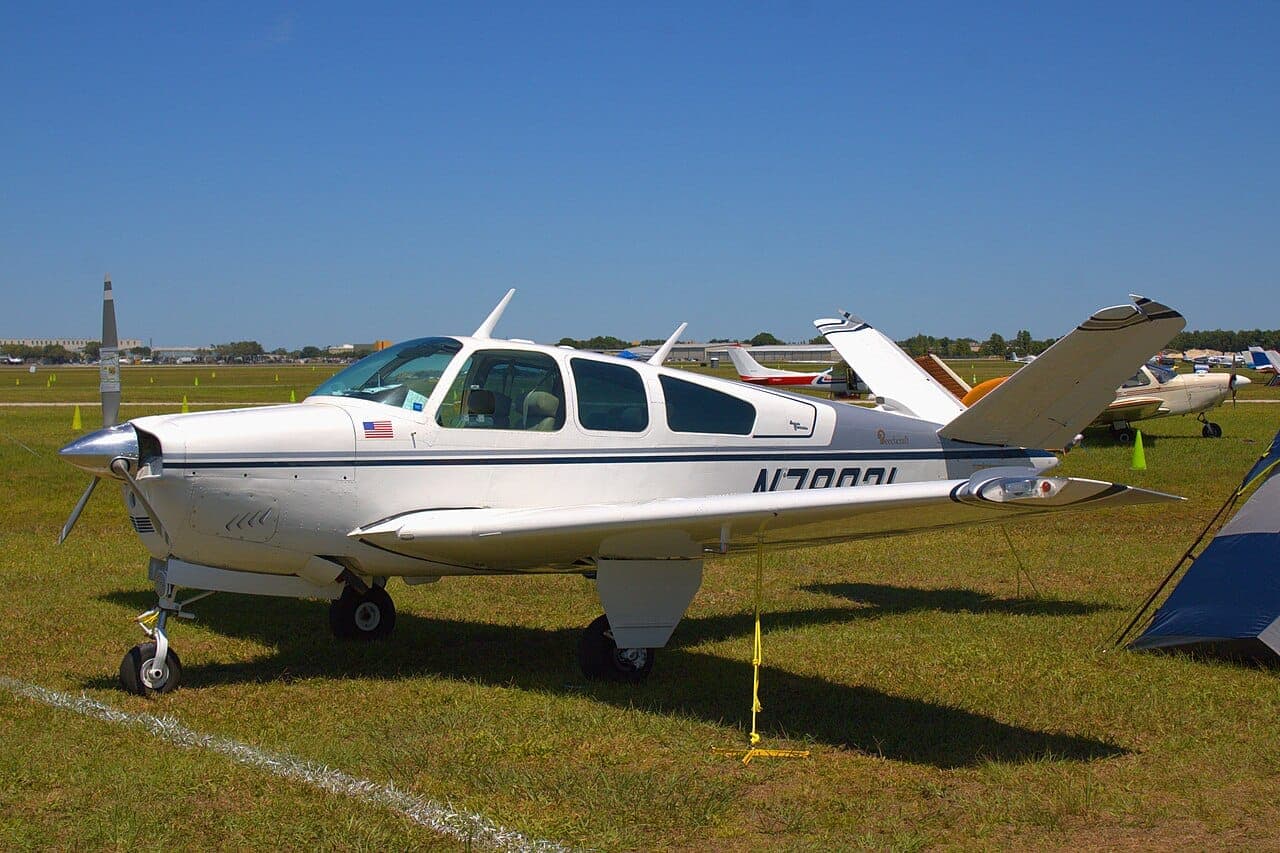
Is the V-tail Bonanza really a doctor killer, and should that stop you from buying one? No — but its safety history deserves a serious look. The airplane earned its reputation partly through in-flight structural failures and loss-of-control accidents, including cases involving high-speed flight beyond normal operating limits. The FAA responded with structural modifications, ruddervator balancing requirements, and recurring inspections that substantially addressed the known tail concerns. Those requirements remain important today, along with pilot training, instrument proficiency, and careful aircraft maintenance. A properly maintained V-tail is a capable high-performance airplane, but buyers should verify its structural condition rather than assume every old concern disappeared.
What follows is what to actually check when you are standing in front of one with a logbook in your hand, and what the numbers say now rather than in 1979.
Where the Nickname Came From, and What It Gets Wrong
The Model 35 went on sale in 1947 at just under $8,000 — real money then — and it was faster than almost anything else a private owner could buy. Beech built roughly 10,400 V-tails between 1947 and 1982, ending with the V35B. The people who could afford a new one tended to be doctors, lawyers and business owners: successful, busy, and often flying far fewer hours per year than the airplane deserved. The nickname "forked-tail doctor killer" was aimed as much at the pilot as the airframe.
That matters for a buyer because it separates two different concerns. One involved known structural vulnerabilities in the V-tail, which led to FAA-mandated modifications and inspections. The other involved pilot loss of control, particularly during challenging weather or high-speed flight. The structural modifications improved safety, but continued inspections and correct ruddervator maintenance remain essential. Pilot proficiency is just as important, especially in a fast, retractable-gear airplane.
- Check the model year and designation first. Good: you know whether you are looking at a short-body 35 through G35, a mid-body H35 through N35, or a long-body S35, V35, V35A or V35B. Bad: the seller calls everything "a Bonanza" and cannot tell you the serial prefix — the differences in gross weight, engine and useful load are large.
- Ask what the airplane was built with. Good: an IO-520-powered V35B at 3,400 lb gross, 285 hp, 1,700-hour TBO on the engine. Bad: an early E-185 or E-225 short-body being marketed on V35B performance numbers.
- Treat the nickname as a pricing artifact, not a defect. Good: you use the reputation to negotiate on an airplane that is mechanically equal to a straight-tail. Bad: you assume the discount exists because the airplane is unsafe, and skip the structural checks below.
Fun Fact: Beech introduced the conventional-tail Debonair in 1960 partly as a lower-priced, plainer-trim alternative — not as a fix for the V-tail. The straight tail became the standard only after the V-tail line ended in 1982. If you want the family history, see our piece on the Debonair versus the Bonanza.
What the Breakup Record Actually Shows
The in-flight airframe failures were real and they were not evenly distributed across the fleet. The NTSB's special study of in-flight airframe failures in the mid-1980s found the V-tail Model 35 failing at a rate several times that of comparable single-engine airplanes, and far above its own straight-tail sibling, the Model 33 — same wing, same engine, same cabin, different tail. Figures cited from that period run as high as roughly 24 times the Model 33's rate, depending on which years and which airframes the analyst counted.
The FAA responded with a special certification review, then with structural testing. The conclusion that mattered to owners: the stabilizer structure, particularly the area forward of the front spar and the carry-through, did not hold the margin it needed in certain load cases. Nearly all of the actual accidents started the same way — a loss of control in cloud, a spiral dive, speed well past redline, and then a pull. The tail failed first because it was the weakest link in that sequence. The V35B's redline is 196 KIAS and maneuvering speed sits in the mid-130s KIAS at gross weight; a graveyard spiral blows past both in seconds.
So the honest framing is this: the V-tail did not fall apart in cruise. It fell apart at the end of an accident sequence that would have badly damaged many airplanes and killed the occupants of most of them. The cuff raised the margin so that the sequence has a better chance of ending with a bent airplane instead of a broken one.
- Read the airplane's own damage history, not just the fleet's. Good: no record of an overspeed, upset, or severe turbulence encounter. Bad: a logbook entry referencing a "hard landing" or "turbulence inspection" with no detail on what was examined or by whom.
- Look for a 337 on any empennage repair. Good: FAA Form 337 on file with the registry, signed, with a clear description. Bad: evidence of sheet-metal work on the stabilizers with nothing in the records.
- Ask about the autopilot. Good: a functioning, recently bench-checked autopilot with a working altitude hold, which is the single best defense against the exact scenario that broke these tails. Bad: a placarded-inoperative S-Tec or Brittain that the seller describes as "an easy fix."
Flying411 keeps V-tail and straight-tail Bonanza listings in one place, so you can compare what a cuffed V35B asks against an F33A of the same vintage and engine time.
AD 94-20-04: The Cuff, and How to Verify It
This is one of the most important airworthiness checks when buying a V-tail Bonanza. The current FAA directive, AD 94-20-04 R2, covers the C35 through V35B models, except aircraft converted to a straight tail under the specified STC. Earlier 35, 35R, A35, and B35 airplanes are addressed separately under AD 2002-21-13. The requirements include applicable stabilizer reinforcement modifications, ruddervator balancing and control-system checks. AD 94-20-04 R2 also requires recurring inspections of the aft fuselage bulkheads and surrounding skin at intervals not exceeding 100 flight hours. Verify the exact aircraft's AD compliance records and required inspection intervals before purchasing.
Three decades on, essentially every airworthy V-tail has the cuff. That is exactly why an airplane without a clean compliance entry should stop you cold — it almost certainly means the airplane has been sitting, or the records are incomplete, and both are expensive.
- Find the compliance entry by AD number. Good: a dated logbook entry naming AD 94-20-04, the Beech kit number installed, the signing A&P/IA and certificate number. Bad: a line reading "complied with tail AD" with no kit number and no method of compliance.
- Then go look at the airplane. Good: you can see and feel the cuff along the leading edge of both stabilizers, with uniform rivet lines and no filler hiding the joint. Bad: paperwork says installed, the leading edge says otherwise — which happens, and is a reason to walk.
- Check the current AD status list against the serial number. Good: a shop-generated AD search dated within the last year, with recurring items tracked by date or hours. Bad: a hand-typed list the owner made himself five annuals ago.
- Confirm the inspection items that ride along with the AD. Good: the ruddervator attach fittings and carry-through inspections are documented at the required intervals. Bad: the cuff went on in 1995 and nothing structural has been looked at since.
Heads Up: A V-tail with no documented cuff installation is not a bargaining chip, it is an unairworthy airplane. Do not accept a ferry-and-fix handshake unless your mechanic has already quoted the work and you have confirmed kit availability through Textron's parts channel.
If you are new to how directives differ from the manufacturer's own recommendations, our explainer on service bulletins versus airworthiness directives covers what a Part 91 owner is actually obligated to do. The same logic a Cessna buyer applies to the 210 wing spar AD applies here: a mandated structural fix on an older airframe is a records question before it is a metal question.
The Other Structural and System Items That Follow a V-Tail
The cuff gets all the attention, but it is not the only thing unique to this tail. The ruddervators do the work of both elevator and rudder, they are mass-balanced, and the older ones are skinned in magnesium. Each of those facts creates a specific thing to look at.
- Free play at the ruddervators. Good: you grip a trailing edge, move it, and it feels tight, with deflection inside the limit in the Beech maintenance manual. Bad: visible slop or a clunk, which points to worn hinge bearings or attach fittings and is a known precursor to flutter.
- Balance after paint or repair. Good: a logbook entry showing the ruddervators were re-balanced after the last repaint. Bad: a beautiful ten-year-old paint job with no balance entry anywhere — paint adds weight behind the hinge line and that is a real flutter risk, not a theoretical one.
- Magnesium ruddervator skin condition. Good: clean, properly protected surfaces with no bubbling, chalky white deposits, cracks or pitting. Bad: corrosion blistering or poorly documented repairs. Magnesium ruddervator skins are found throughout the V-tail Bonanza family, and their condition matters because repairs must preserve the correct control-surface balance. In July 2025, SRS Aviation received FAA parts manufacturer approval for replacement magnesium skins and repair solutions, restoring an important repair option for aircraft that previously faced grounding because suitable parts were unavailable.
- Aft fuselage and stabilizer attach area. Good: your inspector gets inside with a light and a mirror and finds no cracking at the bulkheads or fittings. Bad: the pre-buy report says "tail section appears normal" without describing access.
- Landing gear system. Good: a gear retraction on jacks, correct rigging, good rod ends, and no sign of a repaired gear-up landing. Bad: a gear-up in the history with vague repair records — Bonanzas get landed gear-up often enough that the real question is always how well it was fixed.
- Fuel system and selector. Good: clean tanks, fresh-dated bladders if fitted, and a selector that detents crisply with a legible placard. Bad: staining at the wing root, or a selector you have to hunt for the detent on — fuel mismanagement is still a top cause of Bonanza engine-outs.
- Throw-over yoke or dual controls. Good: you know which one you have and your insurer and your instructor both know too. Bad: you find out at the first training flight that the CFI has no yoke in front of him.
Good to Know: Textron has continued to issue mandatory service bulletins against the 35-series over the years, including structural inspections outside the tail. Ask your shop to run a fresh AD and service-bulletin search against the exact serial number before the pre-buy, not after. The list is long and it does not stop growing just because the airplane stopped being built in 1982.
What Insurance Actually Costs on a V-Tail Today
Here is the part that surprises most buyers: underwriters do not price the V-tail as a death trap. Brokers consistently report that the tail shape is not a rating factor by itself. What drives the quote is retractable-gear time, time in type, instrument rating, recurrent training, hull value and age. A V35B and an F33A with the same hull value and the same pilot generally quote within noise of each other.
As a rough guide for the 2025–2026 market: liability-only coverage on a 35-series Bonanza commonly runs in the high hundreds to low four figures annually, while full hull-and-liability on a $150,000 to $225,000 airplane with an instrument-rated owner who has real retract time tends to land somewhere around 1 to 2 percent of hull value. That is a range, not a quote — your number depends on your logbook more than on the airplane. The broader market hardened sharply between 2019 and 2022 and has eased somewhat since 2023, with more carriers writing again.
- Get a real quote before you make an offer. Good: a bound-able quote in writing with the training requirement spelled out. Bad: a verbal "we can probably do something" from a broker who has not seen your logbook.
- Read the open-pilot warranty. Good: terms you can actually satisfy — commonly something like a minimum total time, a minimum in retracts and a stated number of hours in make and model. Bad: a warranty so tight that no instructor at your field qualifies to fly it with you.
- Price the required training into year one. Good: the quote names a specific course and you have budgeted for it. Bad: you discover after closing that coverage does not attach until you complete a course with a six-month waiting list.
- Ask what happens at renewal. Good: your premium drops meaningfully after the first 100 hours in type. Bad: the carrier is writing you as an accommodation and has already signaled it may not renew.
- If you are over 70, shop early. Good: multiple markets, possibly with a medical or recurrent-training condition attached. Bad: one carrier, take it or leave it, at a number that changes the whole ownership math.
Pro Tip: The American Bonanza Society's Beechcraft Pilot Proficiency Program is the single most recognized training credit in this airframe. Underwriters know it by name. Completing it before you ask for a quote on a first Bonanza can be worth more than any avionics upgrade on the airplane.
If your renewal already jumped and you are trying to work out why, our breakdown of rising aircraft insurance premiums walks through the factors carriers are actually weighting.
Flying411 keeps asking prices, equipment lists and engine times in one place, so you can see how hull value — the number your insurer rates against — moves with avionics and time since overhaul.
Where the Fatal Accidents Still Come From
Strip out the structural failures and the Bonanza's accident profile looks like every other fast, slippery, retractable single: it is an airplane that rewards currency and punishes the absence of it. Think of it the way you would a sports car with a manual gearbox — nothing about it is dangerous in the hands of someone who drives it weekly, and everything about it is unforgiving to the person who takes it out twice a year.
- Loss of control in instrument conditions. Good: you fly 100-plus hours a year, hold a current instrument rating and shoot approaches monthly. Bad: you plan to use the airplane as a weather machine on 40 hours a year.
- Fuel mismanagement. Good: a written tank-switching routine, accurate totalizer, and you know which tank feeds the engine in which phase. Bad: "I just switch when it gets quiet."
- Gear-up landings. Rarely fatal, routinely expensive — figure a prop strike, an engine teardown and months out of service. Good: a gear-warning system you have tested. Bad: a horn you have learned to ignore because it nuisance-sounds on every descent.
- Overspeed in descent. Good: you know the V35B's 196 KIAS redline and plan descents by power reduction, not by pointing the nose down. Bad: you treat redline as a target because the airplane is fast and it feels fine.
Why It Matters: Every item on that list is a pilot decision, which means every one of them is inside your control. The structural question was settled by an AD you can verify in ten minutes. The behavioral question is settled over the first 100 hours of ownership, and it is the one your insurer is really pricing.
The Checklist at a Glance
| What to check | What good looks like | Red flag |
| AD 94-20-04 cuff installation | Documented compliance with AD 94-20-04 R2 or AD 2002-21-13, as applicable, including required modifications | Missing or incomplete compliance records, or modifications that do not match the documentation |
| Recurring tail inspections | Ruddervator attach fittings and carry-through inspected on schedule | Nothing structural looked at since the cuff went on in the 1990s |
| Ruddervator free play | Tight, within the Beech maintenance manual limit | Audible clunk or visible slop at the trailing edge |
| Ruddervator balance | Re-balance documented after the most recent repaint or repair | Fresh paint, no balance entry anywhere in the books |
| Magnesium skin corrosion | Smooth, sound paint with no blistering | Chalky white deposits, pitting or bubbling under paint |
| Damage and 337 history | Clean registry search, no overspeed or upset entries | Empennage sheet-metal work with no supporting paperwork |
| Landing gear | Clean retraction on jacks, correct rigging, no gear-up history | Undocumented gear-up repair or sloppy rod ends |
| Fuel system | Crisp selector detents, legible placards, no staining at wing roots | Weeping bladders, worn selector, unreadable placard |
| Autopilot | Working altitude hold, recent bench check | Placarded inoperative with a "simple fix" promise |
| Insurance | Written quote in hand before the offer, training requirement understood | No quote until after closing, or a single reluctant carrier |
| Training plan | Transition course booked, dual yoke or a plan around a throw-over | "I'll just get checked out by a local CFI sometime" |
Before You Sign
Walk away from any V-tail where the AD 94-20-04 entry cannot be matched to the airframe, where the empennage shows repair work that is not in the records, or where the seller resists a pre-buy by a shop you chose. Those three refusals account for most of the bad V-tail purchases we hear about, and none of them are a pricing problem — they are a knowledge problem, and you are the one who ends up owning it.
Get a professional opinion when the airplane is otherwise good but the records have gaps. A Beech-experienced IA who has opened a 35-series tail before will find in an afternoon what a general shop might miss across two annuals, and a type club technical adviser can often tell you from the serial number alone what to look at first. If your mechanic has never worked a Bonanza, that is not a reason to cancel — it is a reason to add one who has. Our guide to verifying logbooks and maintenance history covers how to reconstruct a record set that is thin, and if you are still deciding between tails, the F33A versus V35B comparison lays out where the money actually goes. Buyers weighing the same questions on a different airframe may also find the Piper Comanche 250 safety review useful, since it faces an almost identical reputation problem.
The fair verdict on the V-tail Bonanza in 2026: a cuffed, well-documented, properly inspected airframe flown by a current instrument pilot is not a doctor killer. It is a 170-knot four-to-five seat single with forty-year-old parts support and a type club that knows it inside out. The discount against a straight-tail is real, and for the buyer willing to do the records work, it is mostly free money.
Flying411 keeps Bonanza listings, specifications and comparable models in one place, so you can compare cuff-complied V35Bs against F33As and A36s before you spend money on a pre-buy.
When you are ready to compare listings, visitFlying411and see what is on the market today.