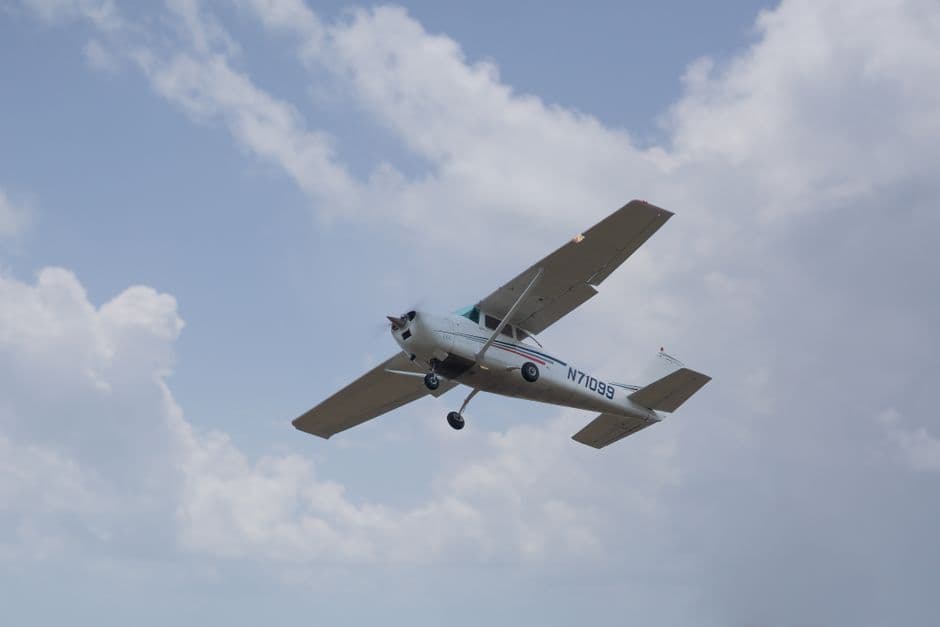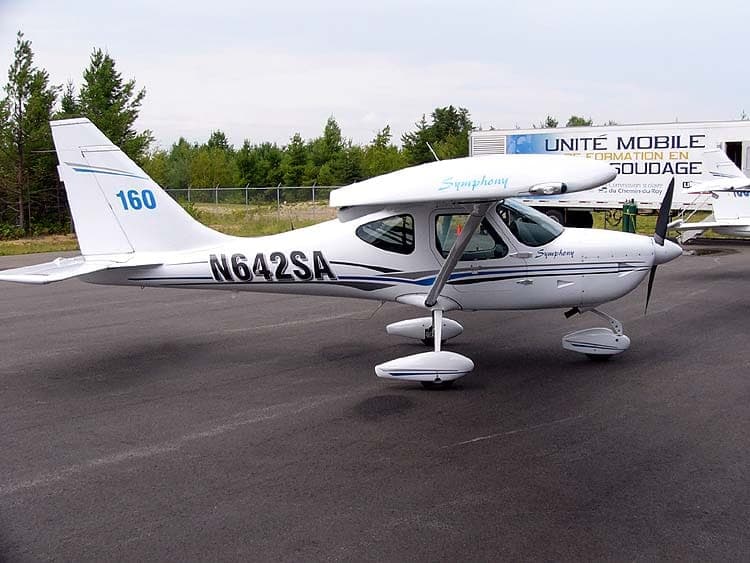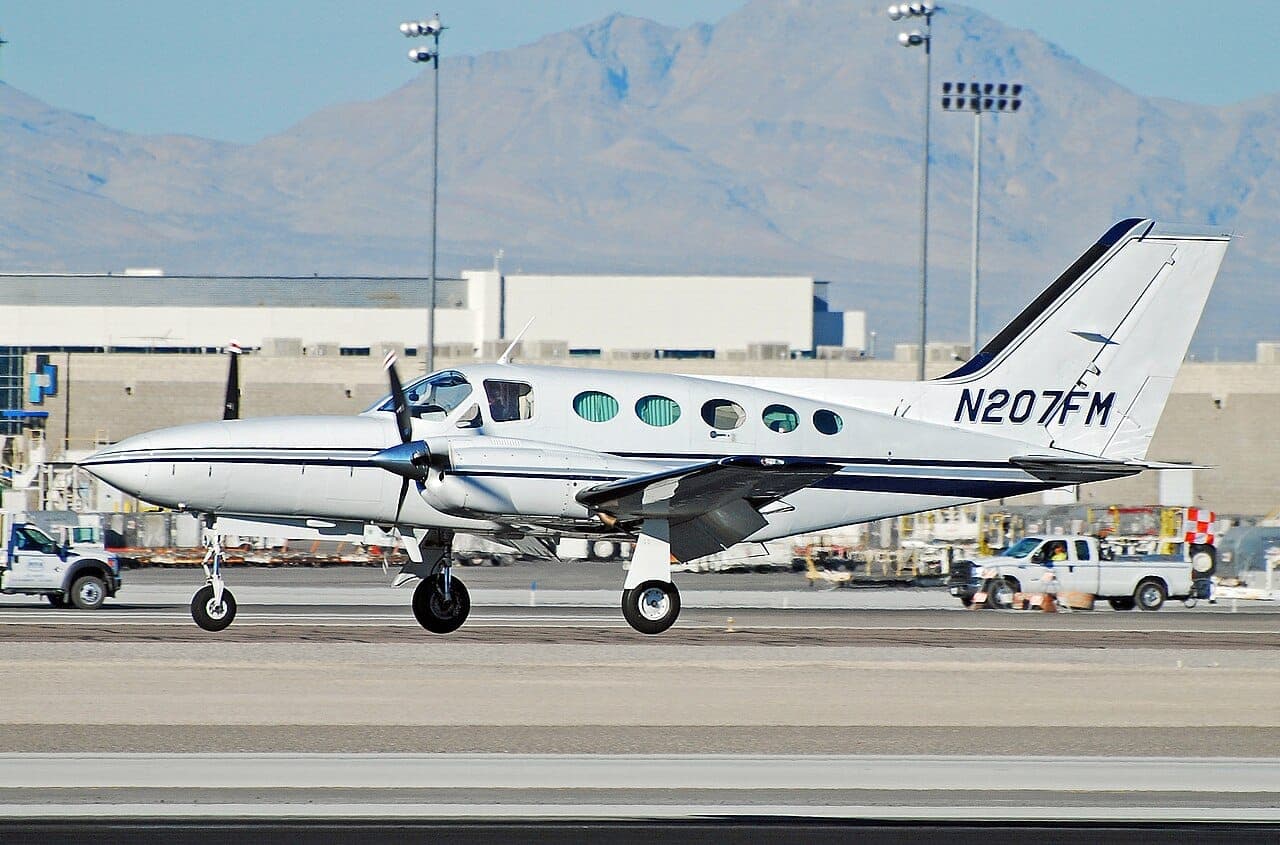
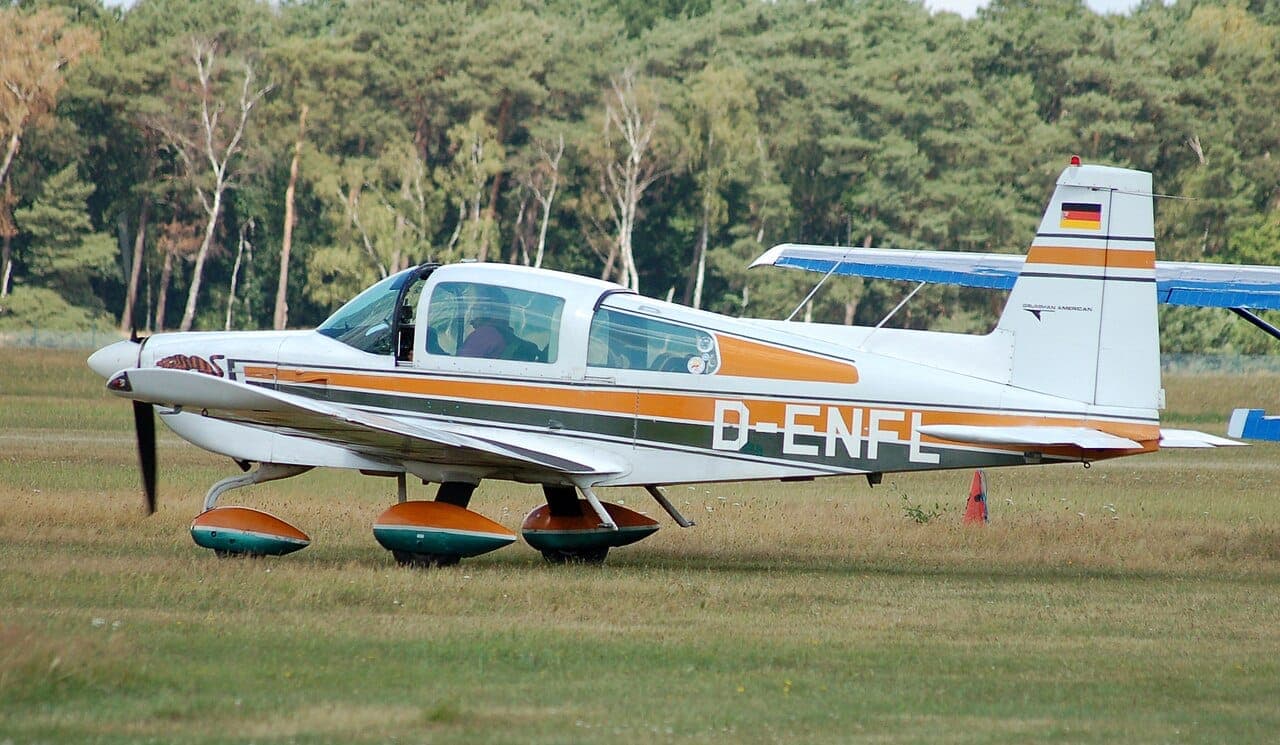
Most pilots assume that two four-seat singles with the same 180-horsepower Lycoming, the same fixed-pitch propeller and roughly the same fuel tanks must fly at roughly the same speed. They do not. The Grumman AA-5B Tiger vs Piper Archer II matchup is the cleanest proof in general aviation that airframe drag, not horsepower, decides how fast you get there — the Tiger is about 15 knots quicker on the same engine and the same gallons per hour.
The second assumption is just as common and just as wrong: that the faster airplane must cost more to own. It usually does not. Where the two part company on money has almost nothing to do with speed and almost everything to do with who makes the parts and how many mechanics have seen the type before.
The Short Answer
If you fly mostly two-up on 200 to 500 nautical mile trips off paved runways and you want to arrive sooner on the same fuel, buy the Tiger — it is the faster, more efficient, more fun airplane, and its running costs are a wash with the Archer's right up until something unusual breaks. If you fly with four people and bags, operate off grass or short strips, want a mechanic at every field in the country to know the airplane cold, and value absolute predictability in parts and resale, buy the Archer II. Think of it as a sports coupe versus a family sedan with the same engine under the hood: the coupe is quicker and more enjoyable, the sedan carries more and is easier to get serviced anywhere.
Which One Is Actually Faster?
Both airplanes run a 180-horsepower Lycoming O-360 with a fixed-pitch prop. The Tiger uses the O-360-A4K, the Archer II the O-360-A4M. Both engines traditionally had a 2,000-hour recommended TBO, but Lycoming's July 2026 guidance allows up to 2,600 hours for eligible factory-new or factory-rebuilt engines. Engines that have undergone an overhaul generally retain the 2,000-hour recommendation, subject to the applicable service instruction.
The difference is the airframe. Grumman's AA-5B uses bonded aluminum honeycomb skins over a tubular main spar, which means very few rivet heads sticking into the airflow, plus a tight sliding canopy instead of a cabin door. Piper's PA-28-181 is a conventionally riveted, semi-tapered wing design built around a cabin you step up into. The manufacturer's figures put the Tiger at roughly 139 knots true at 75 percent power and the Archer II at about 124 knots.
Owners report those numbers hold up reasonably well on well-rigged examples, with the usual caveats: an airplane with old paint, a tired prop or a worn canopy seal gives back a few knots. In practice most Tiger owners plan on 135 to 140 knots and most Archer owners plan on 115 to 122 knots.
Fuel burn is broadly similar, although exact consumption depends on power setting and mixture. The Tiger's higher cruise speed generally lets it cover more distance for each gallon burned. Using 139 knots for the Tiger, 124 knots for the Archer and an illustrative 10 gallons per hour for both, the Tiger saves about 26 minutes and four gallons over a 500 nm cruise. The time savings are the bigger advantage.
Why It Matters: If you regularly fly longer cross-country trips, the Tiger's higher cruise speed adds up. Over a 600 nm round trip, a 15-knot advantage saves roughly half an hour of cruise time, assuming similar conditions.
Edge: Tiger, decisively — same engine, same fuel flow, more speed.
What It Costs to Buy and What It Costs to Keep
Acquisition prices for the two overlap heavily. Both are 1970s and 1980s fixed-gear 180-horsepower singles, and in both cases the avionics panel, engine time and corrosion history move the price far more than the badge on the tail. A Tiger with a 300-hour engine and a modern GPS navigator will outprice a run-out Archer every time, and the reverse is equally true. Check current listings rather than trusting a rule of thumb.
Running costs are where buyers expect a gap and mostly do not find one. The fixed costs — hangar, insurance, annual inspection, database subscriptions — are close enough to be identical. The variable costs track the same Lycoming. A field overhaul of an O-360 ran roughly $30,000 to $40,000 installed as of 2025 depending on shop, accessories and cylinder choices, which works out to somewhere near $17 an hour in engine reserve on a 2,000-hour TBO for either airplane.
Where the two differ is the long tail of unscheduled maintenance:
- Brakes. The Tiger's nosewheel is free-castering — there is no steering linkage. You steer on the ground with differential braking, and Tiger owners consistently report going through brake linings faster than their Piper-flying friends. Budget for it; it is a predictable annoyance, not a surprise.
- Exhaust and mufflers. Both types crack mufflers with age. PA-28 exhaust components are cheap and everywhere.
- Structure. The Archer's riveted skin can be patched by any sheet-metal shop. The Tiger's bonded honeycomb cannot be approached the same way, and a shop that has never seen one will quote accordingly.
Heads Up: On any AA-5B, have the prebuy inspector look hard at the bonded joints, the wing-to-fuselage area and the spar tube for corrosion or skin bubbling, especially on airplanes that lived near salt water. A sound bonded airframe lasts indefinitely; a corroded one can be uneconomic to repair.
Edge: Draw on the numbers you can forecast, Archer on the ones you cannot.
| Specification | Grumman AA-5B Tiger | Piper PA-28-181 Archer II |
| Production years | 1975–1979 (AA-5B); AG-5B 1990–1993 and 2001–2006 | 1976–1988 (line continues as Archer III/LX) |
| Engine | Lycoming O-360-A4K, 180 hp | Lycoming O-360-A4M, 180 hp |
| Propeller | Fixed pitch | Fixed pitch |
| Recommended TBO | 2,000 hours; up to 2,600 for eligible factory-new/rebuilt engines | 2,000 hours; up to 2,600 for eligible factory-new/rebuilt engines |
| Maximum takeoff weight | 2,400 lb | 2,550 lb |
| Typical equipped empty weight | About 1,300–1,400 lb | About 1,400–1,500 lb |
| Usable fuel | About 51 US gallons | 48 US gallons |
| Full-fuel payload (typical example) | Roughly 730 lb | Roughly 810 lb |
| Cruise, 75% power | About 139 KTAS | About 124 KTAS |
| Fuel burn, 75% power | About 10 gph | About 10 gph |
| Rate of climb, sea level | About 850 fpm | About 735 fpm |
| Stall speed, full flaps | About 53 kt | About 49 kt |
| Baggage capacity | 120 lb | 200 lb |
| Cabin access | Sliding canopy, both sides | Single door, right side over wing |
| Nosewheel | Free castering, differential braking | Steerable, linked to rudder pedals |
Flying411 keeps Grumman Tiger and Piper Archer listings in one place, so you can compare engine time, avionics and asking price side by side instead of flipping between tabs.
Parts, Support and the Mechanic Problem
This is the dimension that decides the argument for a lot of buyers, and it is not close.
Piper built the PA-28 family in enormous numbers — more than 32,000 airframes across all variants — and the Archer is still in production today as the Archer LX. Factory parts are supported, the aftermarket is deep, and virtually every maintenance shop in the country has had a Cherokee-family airplane on jacks within the last month. If you are flying cross-country and something breaks in a strange town, the odds are good that the local shop has the part on a shelf or can get it overnight.
The Tiger's story is more complicated. Grumman American built around 1,300 AA-5Bs between 1975 and 1979. American General revived the design as the AG-5B from 1990 to 1993, and Tiger Aircraft built a small number more from 2001 to 2006 before closing. The type certificate has since been held by True Flight in Valdosta, Georgia, which supports the fleet with parts. The American Yankee Association, the type club for the AA-1 and AA-5 series, is an unusually good resource and maintains lists of shops that know the airframe. That combination works — Tigers have not become orphans — but it is a narrower supply chain than Piper's, and a part that takes a Cherokee owner two days can take a Tiger owner two weeks.
Good to Know: The Archer II is not automatically exempt from Piper wing spar inspections. FAA AD 2020-26-16 includes certain fixed-gear PA-28-181 aircraft, along with several other PA-28 and PA-32 models. Applicability depends on the aircraft's serial number, service history and maintenance records. Have your prebuy inspector verify the applicable wing spar requirements before purchasing. If you are also shopping retractables, the same issue comes up in our look at the Arrow IV versus the Arrow III.
Edge: Archer II, clearly.
Cabin, Load and How You Actually Use It
The Tiger's sliding canopy is the single most-loved feature on the airplane and one of the reasons owners keep them for decades. You get in from either side without climbing over a wing, you can taxi with the canopy cracked open on a hot day, and the visibility in the pattern is closer to a bubble-canopy warbird than a typical spam can. Rear-seat passengers do not have to negotiate the front seats to board.
The Archer answers with carrying capacity. It is rated 150 pounds heavier at gross, its baggage compartment takes 200 pounds against the Tiger's 120, and a typical equipped Archer leaves you around 80 pounds more payload with full tanks. For four adults and weekend luggage, that margin is the difference between going and leaving fuel behind. The Archer also has the lower stall speed, bigger flaps and better manners on grass and short, unimproved strips, where the Tiger's low-slung gear, smaller tires and castering nosewheel all argue for staying on pavement.
Keep in Mind: A greenhouse canopy is wonderful in October and punishing in July. Tiger owners in the Southwest and the Gulf states routinely fit a canopy cover and plan departures early. The Archer's small windows are the opposite trade — cooler cabin, less to look at.
Range is competitive for both airplanes. Published figures give the AA-5B Tiger about 554 nautical miles at 75 percent power with 51 usable gallons and a 45-minute reserve, while the Archer II lists about 520 nautical miles at 75 percent best-power cruise with its 48 usable gallons and a reserve. Both can achieve different ranges at more economical power settings, so compare the actual POH performance charts rather than assuming the Tiger always has a large range advantage.
Edge: Archer for load and rough-field work, Tiger for comfort, visibility and legs.
Insurance, Training and Resale
Both are fixed-gear, fixed-pitch, 180-horsepower singles, which is about the friendliest category an underwriter sees. Brokers report that hull and liability on either airplane generally lands in the same band for an instrument-rated private pilot with a few hundred hours.
The difference shows up at the low-time end. Several insurers want specific make-and-model dual instruction before they will write a Tiger for a newly minted private pilot, because the castering nosewheel, the higher approach speed and the airplane's tendency to float when flown fast catch out pilots trained in Cessnas and Cherokees. None of that is hard to learn — most pilots are comfortable in five to ten hours — but find out what your underwriter wants before you sign a purchase agreement, not after.
Training use cuts the other way. If you are buying to build time toward a commercial certificate, or you plan to put the airplane on leaseback at a flight school, the Archer is the obvious tool. Schools already run them, instructors already know them, and the airplane tolerates student landings better. We go further into that side of the Cherokee's character in our comparison of the Cessna 172 and the Piper Archer.
On resale, the Tiger has a quiet advantage that surprises people: because so few were built and because the owner community is loyal, good examples tend to find buyers quickly and hold value well. The Archer is the more liquid market simply because there are more of both airplanes and buyers, but it is also competing against thousands of near-identical airframes.
Fun Fact: The Tiger's wing has no rivets along the top skin in the critical airflow area — the honeycomb panels are bonded. That construction method, borrowed from Grumman's larger aircraft work, is most of the reason a 180-horsepower airplane makes 139 knots.
Edge: Archer for training and leaseback, Tiger for holding its value per dollar invested. Call it a draw overall.
Flying411 keeps specifications, ownership guides and current four-seat single listings in one place, so you can compare an AA-5B and a PA-28-181 on the figures that matter before you book a prebuy.
Which One Should You Buy?
The two-person traveler. You and one other person, 300 to 600 nm trips, paved runways, maybe an instrument rating in the works. Buy the Tiger. You will arrive 30 to 45 minutes earlier on the same fuel, you will enjoy every minute of the flight more, and the payload penalty never bites because you are rarely near gross. Be honest about your maintenance situation: if the nearest shop that has touched a Grumman is three hours away, that changes the math.
The family hauler on mixed strips. Four people, bags, a grass runway at the lake, kids who need to get in and out without a ladder. Buy the Archer II. The extra 80 pounds of full-fuel payload, the 200-pound baggage compartment and the better short- and soft-field manners are worth more to you than 15 knots. Nationwide parts support closes the argument.
The first-time owner watching every dollar. Either works, and the deciding factor is the individual airplane, not the type. Buy the best-maintained airframe with the cleanest logbooks and the most useful panel you can afford. If two candidates are genuinely equal, take the Archer — the broader support network lowers your risk while you are still learning what ownership costs. Readers weighing the Grumman against the Cessna side of the market will find the same reasoning in our Tiger versus Cessna 172 and Tiger versus Cessna 177B Cardinal comparisons.
Pro Tip: On either airplane, spend prebuy money on a compression check with a borescope, a careful look for corrosion in the wing roots and belly, and a full AD and logbook review. A $1,500 prebuy that finds a $20,000 problem is the best return in aviation.
Matching the Airplane to the Mission
The honest verdict on Grumman AA-5B Tiger vs Piper Archer II is that neither one is cheaper to own in any meaningful way — same engine, same overhaul reserve, same insurance band, same hangar bill. The Tiger simply does more with those identical dollars, turning them into about 15 extra knots and 11 percent better miles per gallon. The Archer turns them into payload, parts availability and the certainty that any shop in the country can fix it.
Pick based on what you will actually do with the airplane twelve months from now, not what you hope to do. Two seats and a map favor the Tiger. Four seats, bags and a grass strip favor the Archer.
Flying411 keeps Tiger and Archer listings, ownership cost guides and model comparisons in one place, so you can compare equipment and engine time without chasing a dozen sites.
When you are ready to compare listings, visitFlying411and see what is on the market today.
Frequently Asked Questions
Is the Grumman Tiger really faster than an Archer with the same engine?
Yes. Both use a 180-horsepower Lycoming O-360 turning a fixed-pitch prop, but the Tiger's bonded honeycomb skins, slim fuselage and sliding canopy produce far less drag than the Archer's riveted airframe. Book figures put the Tiger near 139 knots true at 75 percent power and the Archer near 124 knots, on about the same 10 gallons an hour.
Are parts hard to get for a Grumman AA-5B?
Harder than for a Cherokee, but not prohibitive. The type certificate has been held by True Flight in Valdosta, Georgia, which supplies parts, and the American Yankee Association type club maintains knowledge and shop referrals for the fleet. Expect longer lead times on airframe-specific items than you would see on a PA-28, and factor that into where you base the airplane.
Does the Archer II need the Piper wing spar inspection?
Yes, certain Archer II aircraft are subject to FAA wing spar inspection requirements. AD 2020-26-16 includes the PA-28-181, with applicability determined by serial number and aircraft maintenance history. During the prebuy, verify whether the specific aircraft is affected and whether all required inspections have been completed.
Which one is better for a low-time pilot?
The Archer II, in most cases. It has a lower stall speed, a steerable nosewheel, bigger flaps and a more forgiving landing attitude, and underwriters write it with fewer conditions. The Tiger is entirely manageable for a new private pilot, but plan on five to ten hours of make-and-model dual and expect your insurer to require it.