Continental publishes a 1,700-hour or 12-year TBO, whichever comes first, for the original IO-520-BA and IO-520-BB engines in the F33A Bonanza. That is 300 hours shorter than the 2,000 hours most buyers coming from a Cessna 182 or a Cherokee assume, and it quietly resets every parts budget you build. On a reserve basis alone, that difference is worth several dollars an hour. The rest of the airplane follows the same pattern: nothing on it is cheap, but almost nothing on it is a mystery either. Beechcraft F33A Bonanza parts are well documented, well supported, and priced like the premium airframe they belong to.
A straight-tail F33A that has been flown regularly and inspected by a shop that knows Beech airplanes typically costs $6,000 to $12,000 a year in inspections, parts and labor, excluding the engine reserve. A neglected one, or one that has sat, can hand you a $20,000 to $30,000 first year while you catch up on corrosion, fuel cells, exhaust and landing gear rigging. What pushes you to the top of that range is almost always time on the calendar rather than time on the tach.
Why the F33A Breaks Where It Does
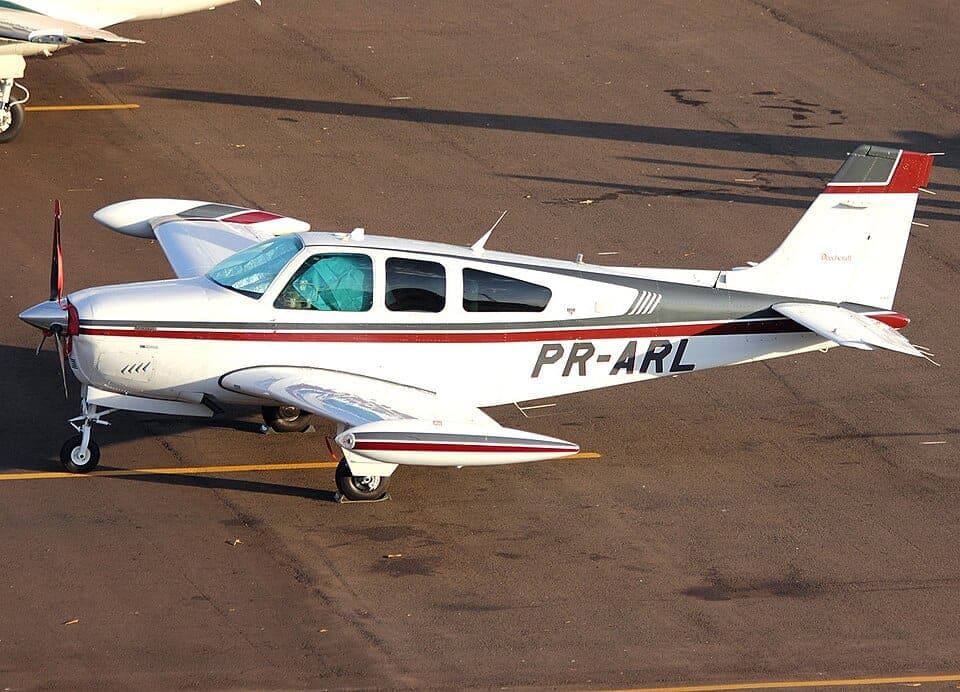
Beech built the Model 33 series under FAA type certificate 3A15, and the F33A ran from 1970 into the mid-1990s as the straight-tail, 285-horsepower member of the family. It is the same wing, the same retractable gear and the same fuselage structure as the V-tail V35B and the stretched A36, which is good news for parts: the supply chain serves the whole Bonanza fleet, not one orphan model.
The design dates to the late 1940s, and three choices from that era drive most of the repair bills. First, the fuel is carried in rubber bladder cells, not wet wing sealant. Second, several control surfaces are skinned in magnesium, which is light and stiff but corrodes aggressively once the paint and primer give up. Third, the landing gear is an electrically driven mechanical system with rods, bellcranks and rod ends that all have to stay in rig. None of that is fragile. All of it is time-sensitive.
Variant differences matter less than people expect. Early F33As left the factory with the IO-520-BA and later ones with the IO-520-BB; parts are largely common. A meaningful number of F33As now fly behind an IO-550-B conversion under supplemental type certificate, which brings 300 horsepower and, depending on the kit, a 2,000-hour TBO. If you are shopping, that conversion changes both your cylinder part numbers and your overhaul quote.
Good to Know: Good to Know: The straight tail sidesteps the V-tail structural airworthiness directives (the AD 94-20-04 series covering ruddervator inspections, modifications and operating limitations), which is one reason F33A prebuys are usually shorter paperwork exercises than V35B prebuys.
Engine Parts: Cylinders, Starter Adapter and Magnetos
The IO-520 is a strong engine with three predictable consumers of money.
Cylinders are the big one. Six of them, and the IO-520 is known for cracking cases and tired jugs if it is run hard and cooled fast, or if it sits. A new factory or PMA cylinder assembly generally runs $1,600 to $2,800, and a shop will add three to six hours of labor to hang it. One cylinder replaced at annual lands around $2,200 to $3,800 installed. A full top overhaul with all six, new or reconditioned, is realistically $12,000 to $22,000. If an engine needs four jugs at 1,200 hours, the honest math usually says keep flying it and plan the overhaul, not top it.
The starter adapter is the Continental part that surprises owners who came from Lycomings. It is a clutch-style drive that wears, slips and eventually will not crank the engine. Overhauled exchange units commonly run $1,000 to $2,200, plus two to four hours to install. Budget $1,200 to $2,800 installed and expect to do it at least once between overhauls.
Magnetos come due on Continental's 500-hour inspection schedule, and most owners simply overhaul or exchange them at that point rather than open and close them twice. Figure $700 to $1,500 per magneto for overhaul or exchange and $1,800 to $3,800 for the pair installed, more if your airplane has pressurized mags or a Bendix dual-drive setup.
Then the overhaul itself. As of 2025 and into 2026, shops quote a field overhaul of an IO-520-BB in the $45,000 to $65,000 range and a Continental factory rebuilt or new engine higher, with installation, hoses, baffles and accessories adding $4,000 to $10,000. Most owners end up writing a check between $55,000 and $90,000 by the time the airplane flies again. Across a 1,700-hour TBO, that is roughly $32 to $53 an hour in reserve, and it is the single number that decides whether an F33A feels affordable.
Pro Tip: Ask the seller for the engine's accessory history, not just the tach time. A 900-hour engine with original magnetos, an original starter adapter and the factory fuel pump is really a 900-hour engine with $5,000 of deferred accessory work sitting on it.
Flying411 keeps Bonanza model guides and cost breakdowns in one place, so you can compare what an engine reserve really does to the hourly number before you make an offer.
Landing Gear: The System That Punishes Neglect
The Bonanza's retractable gear works like a garage door opener: one electric motor, a gearbox, and a run of push-pull rods and bellcranks that have to move together. When it is rigged correctly and lubricated on schedule, it is reliable for decades. When it is not, you get slow retraction, a gear motor that overheats, and in the worst case a gear that does not lock down.
The routine items are the rod ends, bushings, bungee cords and the gear motor itself. A gear motor overhaul or exchange typically runs $1,400 to $3,000, and a full actuator and gearbox overhaul can reach $3,000 to $6,500 with labor. A proper rod-end and bushing refresh, with the gear put back in rig and swung, commonly lands between $1,500 and $5,000 depending on how many parts are worn out.
The number that should actually get your attention is what happens if you ignore all of it. A gear-up landing in an F33A means a propeller strike, a mandatory engine teardown inspection, belly skins, gear doors, antennas and usually the flaps. Repairs in the $25,000 to $60,000 range are common, and that is before you deal with the damage-history note that follows the airframe for the rest of its life.
Heads Up: The American Bonanza Society runs service clinics where trained inspectors put Bonanzas on jacks and go through the gear, the spar carry-through area and the control system. The cost is a few hundred dollars plus your travel. If you are buying an F33A with no clinic history, assume the gear has not been properly rigged in years and budget for it.
Fuel Cells: The Rubber Nobody Thinks About
An F33A does not have sealed wet-wing tanks. It has rubber bladders inside the wing structure, one per side on most airframes, with optional auxiliary cells on some. A bladder is like the liner inside a camping water jug: the jug looks perfect from the outside, but the liner is what actually holds the fuel, and liners get old.
Old bladders go stiff, wrinkle at the bottom, and the wrinkles create low spots where water collects behind the sump drain. That is a fuel-contamination problem, not just a maintenance annoyance. They also seep at the seams, which shows up as a blue stain on the lower wing skin or a persistent fuel smell in the hangar.
Replacement bladders from the specialist manufacturers generally run $1,800 to $4,000 each for the part, and the labor to remove the wing access panels, extract the old cell and work the new one into place is substantial. Shops commonly quote $3,000 to $6,000 per cell installed, so a both-sides job is realistically $6,000 to $12,000. Many owners do one side when it starts weeping and the other a year or two later.
The rest of the fuel system is less dramatic but not free. A fuel selector valve overhaul runs $1,000 to $2,500 installed, and an engine-driven fuel pump exchange is typically $1,500 to $3,000. Fuel injector nozzles should be cleaned at annual; replacing a full set is a few hundred dollars in parts.
Quick Tip: On a prebuy, have the inspector sump each tank after the airplane has sat with full fuel overnight, then rock the wings and sump again. Water that appears on the second sump is a wrinkled-bladder signature.
Magnesium Skins, Corrosion and Sheet Metal
Beech used magnesium skins on Bonanza ailerons and flaps for much of the production run. Magnesium is wonderful material until moisture gets under the finish, and then it does not corrode politely like aluminum. It pits, it bubbles the paint from underneath, and it does not repair well.
This is where F33A ownership can get expensive without warning. New control surfaces ordered through the factory parts channel are premium items. Owners report quotes in the $6,000 to $15,000 range for a new aileron or flap, which is why the used-serviceable market matters so much on this airframe. A sound used surface with a current 8130-3 tag is often $1,500 to $5,000, and for a 40-year-old airplane that is usually the right answer.
Other corrosion-prone areas worth a flashlight: the wing leading edges around the fuel cell bays, the lower aft fuselage, the area under the battery box, and the floor structure beneath the rear seats where water from the door seal collects. Sheet metal repair labor at a shop that knows Beech airplanes runs roughly $100 to $150 an hour in most of the country.
Why It Matters: Buying used serviceable parts is legal and routine, but the paperwork has to be right. Our guides on USM vs OEM aircraft parts, PMA, surplus or owner-produced parts and spotting counterfeit aircraft parts cover what your mechanic needs before a salvage part goes on your airplane.
Exhaust, Electrical and the Small Stuff
The IO-520's exhaust system lives a hard life. Risers crack at the flanges, slip joints wear, and the muffler and heat exchanger that feed your cabin heat are the parts that can turn a crack into a carbon monoxide problem. Individual risers run $700 to $1,800, a muffler or heat exchanger is typically $1,200 to $3,000, and a complete exhaust system overhaul or replacement lands between $4,000 and $9,000. Exhaust is not optional maintenance on this airplane; it is a safety item with a bill attached.
On the electrical and accessory side, the usual suspects are predictable:
- Alternator, overhauled or new: $800 to $2,000 installed
- Voltage regulator: $200 to $600 installed
- Battery (sealed lead-acid, replaced every two to four years): $300 to $650
- Dry vacuum pump, if the airplane still has one: $450 to $1,100 installed, typically every 500 to 800 hours
- Propeller governor overhaul: $900 to $1,800
The propeller deserves its own line. Hartzell and McCauley both publish calendar and hour limits, commonly six years or around 2,400 hours for the two- and three-blade props found on Bonanzas. An overhaul runs $3,500 to $9,000 depending on blade count and whether blades are serviceable; a new three-blade assembly can reach $14,000 to $25,000.
Tires, brakes and glass round it out. Main tires are $150 to $300 each, brake linings $200 to $500 per wheel installed, and a new brake disc $300 to $650. A one-piece windshield is $1,200 to $2,800 for the part, but the install is 20 to 40 hours, so budget $3,500 to $7,000 complete. The arithmetic is the same on most singles, as our Cessna 172 windshield cost breakdown shows: the glass is cheap, the labor is not.
If your F33A still has a vacuum-driven attitude indicator and directional gyro, the modern answer is usually to delete the system entirely rather than keep feeding it. We ran the numbers in Vacuum System to G5 or GI 275, and on a retractable single that flies in weather, the payback is real.
Flying411 keeps maintenance and parts explainers alongside the listings in one place, so you can compare a quoted repair against what the job normally costs before you approve it.
What a Prebuy Should Catch
Every item above is findable before you own it. A proper F33A prebuy, done by a Beech-experienced shop and costing roughly $2,500 to $5,000 including a gear swing on jacks, should produce findings on:
- Compression and borescope results on all six cylinders, plus oil analysis history
- Gear rigging, rod end play, motor amperage draw and emergency extension function
- Fuel cell condition, seepage stains, and water in the sumps after a sit
- Corrosion on magnesium ailerons and flaps, wing leading edges and the aft fuselage
- Exhaust system crack inspection and a carbon monoxide check of the heat exchanger
- Logbook continuity, AD compliance status against type certificate 3A15, and any 337s
- Weight and balance currency, which matters because an F33A's 3,400-pound gross weight leaves roughly 1,100 pounds of useful load before you add avionics and paint
As of November 2026, Flying411 had 5 Beechcraft Bonanza aircraft of all variants listed, asking $100,000 to $750,000 with a median of $380,000, spanning model years 1960 to 1996 and a median total time of 4,400 hours. Those are asking prices on current listings, not appraisals, and the spread tells you what the fleet looks like: a very wide span of condition and equipment behind broadly similar airframes. The maintenance history is what separates them.
Key Takeaways
An F33A that is current on its gear rigging, exhaust, fuel cells and accessories will cost you roughly $6,000 to $12,000 a year in inspections and parts, with the annual inspection itself at $2,500 to $4,500 before squawks. On top of that, set aside $32 to $53 per flight hour for the engine and $6 to $15 per hour for the propeller at 100 hours a year, because the six-year calendar limit arrives before the hour limit. The items that blow up a budget are the ones with a calendar trigger rather than an hour trigger: bladders that aged out, magnesium that corroded while the airplane sat, exhaust that cracked from thermal cycling, and gear that was never properly rigged. Buy an airplane that has been flown 100 hours a year and clinic-inspected, and the parts list above becomes a predictable schedule rather than a series of surprises.
| Part or job | Low (installed) | High (installed) | When it comes due |
| Annual inspection, base labor | $2,500 | $4,500 | Fixed, every 12 months |
| Single cylinder replacement | $2,200 | $3,800 | As found, borescope driven |
| Top overhaul, all six cylinders | $12,000 | $22,000 | Condition based, often mid-TBO |
| Engine overhaul or factory engine | $55,000 | $90,000 | 1,700 hours or 12 years (IO-520-BA/BB) |
| Starter adapter, overhauled exchange | $1,200 | $2,800 | Usually once per TBO |
| Magnetos, pair overhauled | $1,800 | $3,800 | 500-hour inspection cycle |
| Engine-driven fuel pump | $1,500 | $3,000 | On condition / at overhaul |
| Propeller overhaul | $3,500 | $9,000 | About 6 years or 2,400 hours |
| Propeller governor overhaul | $900 | $1,800 | With propeller overhaul |
| Fuel bladder cell, one side | $3,000 | $6,000 | Calendar driven, often 20+ years |
| Fuel selector valve overhaul | $1,000 | $2,500 | On condition |
| Landing gear motor overhaul | $1,400 | $3,000 | On condition |
| Gear rod ends, bushings and re-rig | $1,500 | $5,000 | Every few years, clinic driven |
| Complete exhaust system | $4,000 | $9,000 | Crack driven, inspect annually |
| Muffler or heat exchanger | $1,200 | $3,000 | On condition, CO check annually |
| Magnesium aileron or flap, used serviceable | $1,500 | $5,000 | Corrosion driven |
| Magnesium aileron or flap, new | $6,000 | $15,000 | Corrosion driven |
| Alternator | $800 | $2,000 | On condition |
| Dry vacuum pump | $450 | $1,100 | Roughly 500-800 hours |
| Battery | $300 | $650 | Every 2 to 4 years |
| Brake linings, per wheel | $200 | $500 | Per flight hours and technique |
| Main tire, each | $150 | $300 | Per flight hours and technique |
| Windshield replacement | $3,500 | $7,000 | Crazing driven, once per 20+ years |
Ways to Spend Less
Use the type club. American Bonanza Society membership costs well under $100 a year and gives you access to technical advisors who have seen your exact squawk a hundred times. The trade is time: you have to read, ask and sometimes argue with a shop that wants to do it the expensive way.
Buy used serviceable control surfaces instead of new. A tagged used aileron at $2,500 versus a new one at $10,000 is the single biggest discretionary saving on this airframe. You trade original-condition provenance and the certainty of a factory-fresh part, and you need your mechanic satisfied with the paperwork and the corrosion inspection.
Do owner-assisted annuals. FAR Part 43 Appendix A lets an owner-pilot perform specific preventive maintenance items, and most shops will let you pull and reinstall inspection panels, fairings and interior under supervision. That can trim several hundred to over a thousand dollars of labor off an annual. The trade is a week of your time and a shop willing to work that way.
Fly it more, not less. Most of what breaks on an F33A breaks from sitting: corroded cams, seeping bladders, dried seals, flat-spotted tires. Flying 120 hours a year instead of 40 spreads the fixed costs across more hours and genuinely reduces failures. The trade is obvious, you spend more on fuel.
Delete the vacuum system when you upgrade panels. Pulling the pump, lines and filters removes a recurring 500-to-800-hour part and the gyros it feeds. The trade is a four- to five-figure avionics bill up front, which only makes sense if you were replacing instruments anyway.
Keep every receipt and logbook entry organized. This is not a savings on parts, it is a savings on resale. A documented fuel-cell replacement and a current gear clinic report are worth real money to the next buyer, and they shorten the prebuy that would otherwise find those items for you at the worst moment.
Keep in Mind: Some parts have hard retirement limits rather than condition-based ones, and no amount of good maintenance extends them. Our explainer on life-limited parts covers why, and what documentation a buyer should demand.
Flying411 keeps F33A, V35B and A36 cost breakdowns in one place, so you can compare the real hourly numbers side by side instead of trusting a single seller's spreadsheet.
Owning an F33A With Your Eyes Open
The F33A is not a cheap airplane to maintain, and the people who are happiest with theirs stopped pretending otherwise on day one. What it is, instead, is honest: the failure points are known, the type club publishes on all of them, and the parts supply is shared with thousands of other Bonanzas and Barons still flying. Price Beechcraft F33A Bonanza parts into your budget as a schedule rather than an emergency, and the airplane delivers 165 to 175 knots and a build quality that still embarrasses most of what is parked beside it. If you are weighing it against the stretched six-seater, our F33A vs A36 cost per hour comparison runs the same numbers across both airframes, and Debonair vs Bonanza covers the earlier, lower-powered models that share most of these parts.
When you are ready to compare listings, visitFlying411and see what is on the market today.
Frequently Asked Questions
What is the most expensive thing that commonly fails on an F33A?
Outside the engine, it is a tie between a full set of fuel bladder cells ($6,000 to $12,000 installed for both sides) and corroded magnesium control surfaces, where a new aileron or flap can be quoted at $6,000 to $15,000. Both are calendar-driven rather than hours-driven, which is why a low-time airplane that has sat is often more expensive than a high-time airplane that has flown.
How often do Bonanza fuel bladders need replacing?
There is no mandatory interval. In practice, owners report cells lasting 20 to 30 years or more, with life depending heavily on whether the tanks were kept full, whether the airplane lived outside, and the fuel and additives used. The warning signs are blue stains on the lower wing, a persistent fuel smell, and water that keeps appearing in the sumps after the wings are rocked.
Is the IO-520 really limited to 1,700 hours?
That is Continental's published TBO for the original IO-520-BA and IO-520-BB (1,700 hours or 12 years, whichever comes first; IO-520-BB engines built from serial number 1006000 carry 1,900 hours), and it is a manufacturer recommendation, not a legal limit for a privately operated Part 91 airplane. Many owners run past it on condition, guided by oil analysis, borescope results and compression trends. Airplanes converted to the IO-550-B under STC generally carry a longer published TBO, which is one reason that conversion holds value.
Are F33A parts getting hard to find?
Routine items are not. The Bonanza and Baron fleets share engines, gear components, exhaust and accessories, and the aftermarket and PMA suppliers serve them well. The pinch points are factory-only structural pieces and the magnesium control surfaces, where new parts are expensive and lead times can stretch. That is where the used serviceable market, with proper 8130-3 documentation, does most of the heavy lifting.
Does a prebuy inspection really need to be Bonanza-specific?
Yes. A general shop can check compressions and read logbooks, but the items that cost the most on this airframe, gear rigging, magnesium corrosion, bladder condition and AD status under type certificate 3A15, are the ones a Beech-experienced inspector finds in an afternoon and a generalist misses entirely. Spending $3,000 to avoid a $15,000 surprise is the best-value transaction in Bonanza ownership.