The costliest mistake buyers make with a Cessna 195 is treating the Jacobs radial like a modern flat engine — assuming a mid-time logbook entry means years of flying left, and setting aside nothing for the overhaul. A Jacobs R-755 teardown can swallow a sum close to a third of what the whole airplane cost, and tired radials have a habit of declaring themselves in the first hundred hours after a sale. The other classic error is underestimating the landing gear: insurers have paid out a lot of ground-loop claims on this type, and a wingtip-and-gearbox repair is not a small bill.
None of that makes the Cessna 195 a bad buy. It makes it an airplane you buy with your eyes open. This guide covers why the model still earns hangar space, how the variants differ, what the engine reserve really needs to be, what to inspect before you write a check, and what a year of ownership actually runs.
Why the Cessna 195 Still Makes Sense
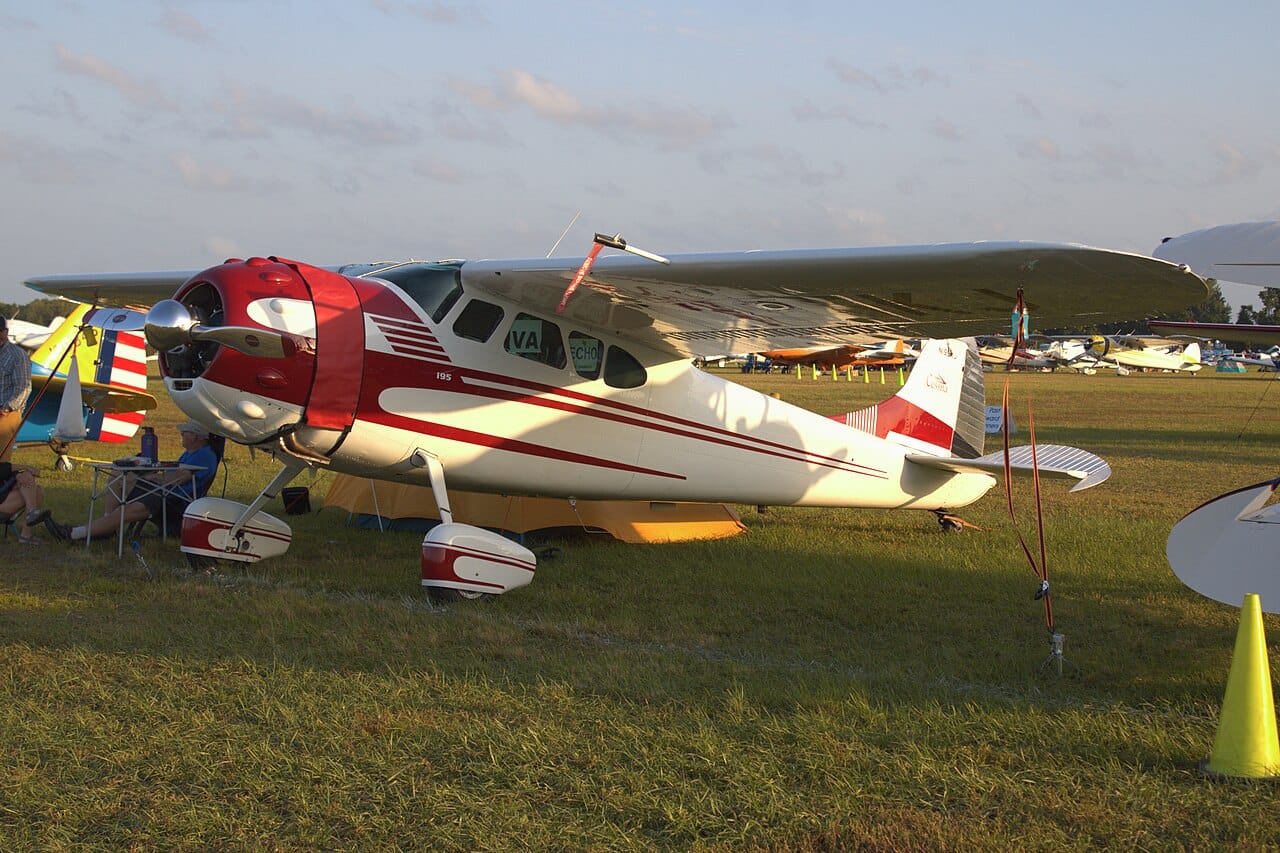
Cessna built the 190 and 195 series from 1947 to 1954, roughly 1,180 airplanes in all, and it remains the last radial-engine airplane the company produced. That alone would make it a collector's item. What keeps it flying is that it is also a genuinely useful machine.
The 195 is an all-metal, five-seat, cantilever-wing airplane — no struts anywhere — with a cabin wide enough that three adults fit across the rear bench without negotiating. Gross weight is 3,350 pounds, and depending on how a particular airframe is equipped, useful load lands somewhere around 1,200 to 1,350 pounds. Fuel capacity is about 80 gallons in two wing tanks. Owners generally flight-plan in the 145 to 160 mph range (roughly 125 to 140 knots) and burn 15 to 17 gallons an hour doing it.
Put plainly: it carries four people and bags four hundred miles, in an airplane that draws a crowd every time you shut down. Compare that to a modern six-seat single and the 195 is slower and thirstier, but the purchase price is a fraction of it, and nothing on the ramp sounds like a Jacobs starting.
Fun Fact: The Jacobs R-755 picked up the nickname "Shaky Jake" from wartime trainee crews. It is a seven-cylinder, 757-cubic-inch radial built by the Jacobs Aircraft Engine Company of Pottstown, Pennsylvania, and it shakes most noticeably at idle — which is exactly when a nervous first-time buyer is listening hardest.
The military bought the type too. Versions designated LC-126 served the U.S. Air Force and Army in liaison and rescue roles, including on skis in Alaska, and a good number were later sold off and civil-registered. If a logbook you are reading starts with a government serial, that is why.
190, 195, 195A and 195B: How the Variants Differ
The airframes are near-identical. The engine up front is what separates them, and it drives almost every ownership decision that follows.
Cessna 190
The 190 uses a Continental W670 of 240 horsepower rather than a Jacobs. It is the rarest of the family — only a couple hundred were built — and parts support for the Continental radial is thinner than for the Jacobs. Buy a 190 because you want a 190, not because it looked cheaper in the ad.
Cessna 195
The original 195 carries the Jacobs R-755-A2 at 300 horsepower. It is the strongest performer of the group and the one most often sought out for floats and backcountry work. More power also means more fuel and, on average, more money at overhaul time.
Cessna 195A
The 195A dropped to the 245-horsepower Jacobs R-755-9. It was the economy option when new, and the trade is real: slightly lower fuel burn and noticeably less climb when you are heavy and the field is high. In mountain country, buyers tend to pass on the A.
Cessna 195B
The final version, built from 1952 into 1954, uses the 275-horsepower Jacobs R-755-B2. It retained the enlarged flap arrangement introduced on the 195A, giving the later airplanes substantially more flap area than the original 190/195 configuration.
Keep in Mind: Engine swaps across the 190/195 series are common. FAA Type Certificate A-790 was written broadly enough that eligible 190, 195, 195A and 195B serial numbers may use any of the engine installations listed on the type certificate without a separate STC or field approval. Check A-790 against the engine actually installed and verify that the installation and records conform to the approved configuration
Flying411 keeps classic taildraggers and modern singles in one place, so you can compare what a 195B is asking against the four-seat alternatives before you commit to a radial.
What a Cessna 195 Costs to Buy
This is a condition-driven market more than a model-driven one. Two 195Bs built four months apart can be separated by a hundred thousand dollars, and the difference is almost always engine time, corrosion history and whether the airplane has been restored or merely maintained.
As a general shape of the market through 2025 and into 2026, flying examples in honest, average condition with mid-time engines trade well into six figures, show-quality restorations with fresh engines and modern panels ask considerably more, and projects — disassembled airplanes, run-out engines, airframes that have been outside for a decade — sell for a fraction of either. The trap sits in the middle. An airplane priced just under the flying-example band is usually priced there for a reason, and the reason is normally something the pre-buy will find.
Run the arithmetic the way a surveyor would. Take the asking price, subtract the full cost of an engine overhaul if the Jacobs is past two-thirds of its recommended life, subtract a propeller overhaul if that is also due, and subtract whatever the avionics need to be legal and useful to you. The number you are left with is what you are actually paying for the airframe. Do that on three airplanes and the genuinely good deal usually becomes obvious.
Heads Up: A "fresh annual" on a radial taildragger that has been sitting means very little. Ask when the airplane last flew a hundred hours in a year. Radials that sit corrode internally, seals dry out, and the first long cross-country after a long nap is where problems surface.
The Jacobs R-755 Overhaul: Budget It Before You Bid
Think of the Jacobs as a wood-burning stove next to the gas furnace of a modern Lycoming or Continental flat engine. It will heat the house beautifully. It also wants attention, it makes a mess, and the people who service it are fewer and further away.
A commonly published overhaul interval for the Jacobs engines installed in the Cessna 195 family is about 1,200 hours, although the exact interval should be verified against the specific engine model, configuration and current overhaul data because modified R-755 installations can differ. That is a manufacturer recommendation, not a Part 91 legal limit, and plenty of owners run past it on condition with good oil analysis and compressions. But calendar time matters at least as much as hours on an engine this age, and the honest planning number for a buyer is this: assume you will pay for an overhaul at some point in your ownership, and decide now whether that is a surprise or a line item.
Overhaul quotes from the shops that specialize in Jacobs work — Radial Engines Ltd. in Guthrie, Oklahoma, is the name most owners mention first — have been running in a broad band that commonly starts in the mid-forty-thousands and climbs past sixty thousand dollars once a crankshaft, a master rod, or a full set of cylinders is involved. Accessories, baffling, hoses, a new exhaust system and the labor to hang and run the engine are usually extra. Owners who have been through it describe a finished, flying-again number closer to the top of that band than the bottom.
Spread across a 1,200-hour planning interval, a $45,000 to $60,000 overhaul works out to roughly $38 to $50 per flight hour in engine reserve.Add the propeller reserve and allowances for accessories and installation work, and a buyer should still budget a substantial powerplant reserve rather than treating a mid-time Jacobs as inexpensive simply because it has hours remaining.
Why It Matters: Buyers who are used to flat-four economics anchor on the wrong number. Our breakdown of what a Cessna 172 overhaul really costs is a useful baseline — then understand that the Jacobs is roughly double it, on a shorter interval, with fewer shops competing for the work.
Two operating habits save Jacobs engines. First, pull the propeller through by hand before every start — nine blades or more — to clear oil that has drained into the lower cylinders overnight. A hydraulic lock on a radial bends connecting rods, and that turns a routine start into an overhaul. Second, lean aggressively on the ground and in cruise. These engines were designed around lower-lead fuel, and 100LL fouls their plugs and sticks their valves if you baby the mixture.
Pro Tip: Ask the seller for oil analysis history, not just compressions. A radial with rising iron and a cam-and-lifter story in the trend data is telling you something the borescope may not show for another fifty hours. If you are weighing a borderline engine, the same logic in our guide on whether to replace or overhaul an aircraft engine applies here, with the caveat that there is no factory reman option waiting for you.
Ground Loops: Where the Reputation Comes From
The 195 is not hard to fly. It is unforgiving of inattention in the last ten seconds of a landing, which is a different thing.
Three features combine. The airplane is heavy for a single, with a lot of mass and a big radial out front. The main gear are Cessna's spring-steel legs, which store energy in a firm arrival and give it back as a bounce. And the tailwheel geometry means that once the tail starts to swing, the airplane wants to keep swinging — steering from behind is like pushing a shopping cart from the back of the basket. Small corrections work. Late, large ones do not.
Cessna offered a crosswind landing gear option that lets the main wheels caster, and some airplanes still carry it. Owners are divided on whether it is a help or a crutch; what is not debatable is that it changes how the airplane behaves on rollout, and you need instruction specific to the configuration in front of you.
Heads Up: Insurers know the accident history. Expect underwriters to ask for meaningful total time, real tailwheel experience, and a block of dual instruction in a 195 before they will bind coverage solo — ten to twenty-five hours in make and model is a common requirement for a pilot new to the type. Budget for that instruction and for the ferry pilot who may need to bring the airplane home.
The practical takeaway for a buyer is that transition training is not optional and not cheap, and that any airplane you look at may well have ground-loop history in its past. That history is not automatically disqualifying. Hidden, badly repaired history is.
Flying411 keeps listings, specs and ownership guidance in one place, so you can compare a 195 against a tricycle-gear six-seater before you commit to the tailwheel learning curve.
What to Inspect Before You Buy
Hire a shop that has worked on 190/195s specifically. A good general A&P who has never seen a Jacobs will miss things, and the type club — the International Cessna 195 Club — is the fastest route to a name in your region.
Airframe and structure
Start at the gearbox, the structure in the lower fuselage where the spring gear legs attach. Wrinkled or oil-canned skin here, mismatched rivets, or filler in the belly almost always means a ground-loop repair. Look for the same signs at the wingtips, the aft fuselage and around the tailwheel attach. Then check the cantilever wing's spar carry-through and attach fittings for corrosion, because there are no struts helping carry that load.
Corrosion
These airplanes are seventy-plus years old. Pull inspection panels and look inside the wings, under the cabin floor, at the belly skins and inside the tailcone. Coastal history, float history and years of outside tie-down are all red flags worth a very thorough look. Float-flown 195s can be excellent airplanes, but they need a harder corrosion inspection than land-only examples.
Engine and firewall forward
Borescope every cylinder. Check for oil residue around the lower cylinders, which may just be normal drain-down or may be a leaking valve. Inspect the engine mount for cracks, the exhaust system for leaks — radial exhausts are expensive and often the long pole in a maintenance event — and the baffling for condition. Verify that the carburetor, magnetos and generator or alternator have current logbook entries, not just a wipe-down.
Paperwork
Confirm the data plate, the engine serial and the airframe records all agree with type certificate A-790. Trace every major alteration to a 337 with an approval basis. Check airworthiness directive compliance on the airframe, the engine and especially the propeller, and get a written AD status list rather than a verbal assurance. If anything about the title or the transfer looks tangled, our guide on transferring aircraft ownership without legal delays is worth reading before you send a deposit.
Good to Know: Missing logbooks hurt a 195 more than they hurt a common production single. With no complete record, you cannot prove corrosion history, damage history or AD compliance, and the next buyer will discount the airplane for the same reason you should.
What It Costs to Own After the Sale
Fixed costs come first, and they do not care how much you fly. Hangar is close to mandatory on an airplane with this much polished or painted aluminum and this much resale sensitivity to corrosion; depending on the field, that is a few hundred to several hundred dollars a month. Insurance on a six-figure hull, for a pilot the underwriter is comfortable with, generally lands in the low-to-mid four figures a year, and runs higher — or gets declined — for a pilot without tailwheel time. For context on how hull value and pilot experience move a premium, our Cessna 172 insurance price guide explains the mechanics; the 195 sits well above those numbers on both hull and risk.
The annual inspection is where radial ownership shows up. A clean annual on a well-sorted 195 with a shop that knows the type is realistically a few thousand dollars. One that finds a cracked exhaust stack, a soft cylinder and a leaking fuel tank is a five-figure event. Setting aside $6,000 to $10,000 a year for inspection plus unscheduled maintenance is not pessimistic on an airplane this age.
Variable costs are easier to pin down. At 16 gallons an hour, fuel alone is in the neighborhood of $100 per hour at common 2026 self-serve 100LL prices. Add oil — radials drink it, and a quart an hour is not unusual — then add the engine, propeller and accessory reserve discussed above. A realistic all-in direct operating cost of $180 to $220 per flight hour, before fixed costs, is the honest planning figure.
Fly a hundred hours a year and the fixed costs spread thin enough to feel reasonable. Fly twenty-five hours a year and every hour carries a share of hangar, insurance and annual that makes the 195 look expensive — which is exactly the arithmetic that pushes some owners toward shared and fractional arrangements instead. A two- or three-owner partnership suits this airplane well, provided everyone meets the same insurance requirement.
Quick Tip: Join the type club before you buy, not after. Members know which airframes are for sale quietly, which shops do good Jacobs work, and which specific serial numbers have a story. On a model with roughly a thousand airframes ever built, that network is worth more than any price guide.
Cessna 190/195 Variant Snapshot
| Variant | Years built | Engine | Horsepower | Approx. useful load | Buyer's note |
| Cessna 190 | 1947–1953 | Continental W670 | 240 hp | ~1,250–1,350 lb | Rarest of the family; thinner parts support than the Jacobs |
| Cessna 195 | 1947–1950 | Jacobs R-755-A2 | 300 hp | ~1,200–1,300 lb | Best climb; favored for floats and high density altitude |
| Cessna 195A | 1950–1952 | Jacobs R-755-9 | 245 hp | ~1,250–1,350 lb | Lowest power; noticeably less climb when heavy |
| Cessna 195B | 1952–1954 | Jacobs R-755-B2 | 275 hp | ~1,200–1,300 lb | 275-hp final production version; retains the enlarged later-series flaps” |
| LC-126 (military) | 1949–1952 | Jacobs R-755 | 300 hp | Varies by conversion | Ex-USAF/Army; verify civil conversion paperwork carefully |
Gross weight for the series is 3,350 pounds; useful load varies with avionics, interior and float provisions, so weigh the specific airplane rather than trusting an old weight-and-balance sheet.
Flying411 keeps classic and modern piston singles in one place, so you can compare useful load, engine time and asking price across the market without chasing six different sites.
Is a 195 the Right Airplane for You?
Buy a Cessna 195 if you want an airplane with real presence that still carries a family and bags, you fly enough hours a year to justify the fixed costs, you are willing to get properly trained in the tailwheel, and you can write the overhaul check without it ending your flying. Pass on one if your budget has no room past the purchase price, because the Jacobs will eventually ask for the rest of it.
The owners who are happiest with this airplane are the ones who treated the pre-buy as the most important money they spent, joined the type club early, and set up an engine reserve from the first month. Done that way, a 195 is one of the few antiques you can genuinely use — and one that holds value better than most things flying with a 1950s build date.
When you are ready to compare listings, visitFlying411and see what is on the market today.